


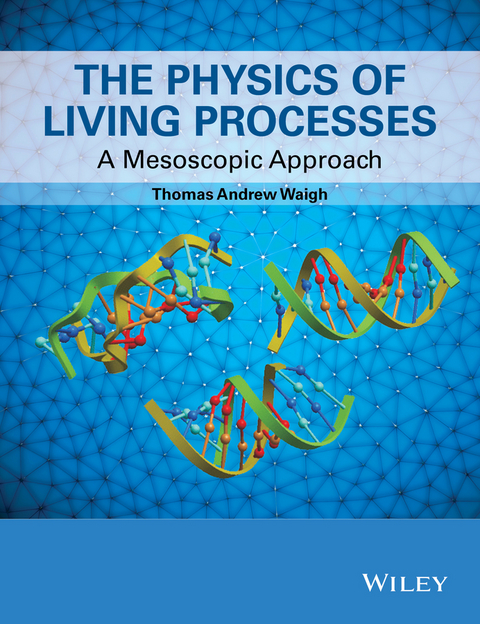
The Physics of Living Processes (eBook)
John Wiley & Sons (Verlag)
978-1-118-69830-3 (ISBN)
This full-colour undergraduate textbook, based on a two semester course, presents the fundamentals of biological physics, introducing essential modern topics that include cells, polymers, polyelectrolytes, membranes, liquid crystals, phase transitions, self-assembly, photonics, fluid mechanics, motility, chemical kinetics, enzyme kinetics, systems biology, nerves, physiology, the senses, and the brain.
The comprehensive coverage, featuring in-depth explanations of recent rapid developments, demonstrates this to be one of the most diverse of modern scientific disciplines.
The Physics of Living Processes: A Mesoscopic Approach is comprised of five principal sections:
• Building Blocks
• Soft Condensed Matter Techniques in Biology
• Experimental Techniques
• Systems Biology
• Spikes, Brains and the Senses
The unique focus is predominantly on the mesoscale - structures on length scales between those of atoms and the macroscopic behaviour of whole organisms. The connections between molecules and their emergent biological phenomena provide a novel integrated perspective on biological physics, making this an important text across a variety of scientific disciplines including biophysics, physics, physical chemistry, chemical engineering and bioengineering.
An extensive set of worked tutorial questions are included, which will equip the reader with a range of new physical tools to approach problems in the life sciences from medicine, pharmaceutical science and agriculture.
Thomas Andrew Waigh
School of Physics and Astronomy, Photon Science Institute, University of Manchester
This full-colour undergraduate textbook, based on a two semester course, presents the fundamentals of biological physics, introducing essential modern topics that include cells, polymers, polyelectrolytes, membranes, liquid crystals, phase transitions, self-assembly, photonics, fluid mechanics, motility, chemical kinetics, enzyme kinetics, systems biology, nerves, physiology, the senses, and the brain. The comprehensive coverage, featuring in-depth explanations of recent rapid developments, demonstrates this to be one of the most diverse of modern scientific disciplines. The Physics of Living Processes: A Mesoscopic Approach is comprised of five principal sections: Building Blocks Soft Condensed Matter Techniques in Biology Experimental Techniques Systems Biology Spikes, Brains and the Senses The unique focus is predominantly on the mesoscale structures on length scales between those of atoms and the macroscopic behaviour of whole organisms. The connections between molecules and their emergent biological phenomena provide a novel integrated perspective on biological physics, making this an important text across a variety of scientific disciplines including biophysics, physics, physical chemistry, chemical engineering and bioengineering. An extensive set of worked tutorial questions are included, which will equip the reader with a range of new physical tools to approach problems in the life sciences from medicine, pharmaceutical science and agriculture.
Thomas Andrew Waigh School of Physics and Astronomy, Photon Science Institute, University of Manchester
| Erscheint lt. Verlag | 8.8.2014 |
|---|---|
| Sprache | englisch |
| Themenwelt | Naturwissenschaften ► Biologie |
| Naturwissenschaften ► Physik / Astronomie ► Angewandte Physik | |
| Technik ► Umwelttechnik / Biotechnologie | |
| Schlagworte | Approach • biological • Biomaterial • Biomaterialien • biomaterials • biomedical engineering • Biomedizinische Technik • Biomedizintechnik • Biophysik • blocks • Cells • comprised • Course • disciplines • Diverse • Essential • explanations • Five • fundamentals • indepth • Medical & Health Physics • Modern • Physics • Physik • Physik in Medizin u. Gesundheitswesen • principal • processes • Scientific • sections • Semester • Topics • two |
| ISBN-10 | 1-118-69830-4 / 1118698304 |
| ISBN-13 | 978-1-118-69830-3 / 9781118698303 |
| Informationen gemäß Produktsicherheitsverordnung (GPSR) | |
| Haben Sie eine Frage zum Produkt? |
 PDF (Adobe DRM)
Kopierschutz: Adobe-DRM
Adobe-DRM ist ein Kopierschutz, der das eBook vor Mißbrauch schützen soll. Dabei wird das eBook bereits beim Download auf Ihre persönliche Adobe-ID autorisiert. Lesen können Sie das eBook dann nur auf den Geräten, welche ebenfalls auf Ihre Adobe-ID registriert sind.
Details zum Adobe-DRM
Dateiformat: PDF (Portable Document Format)
Mit einem festen Seitenlayout eignet sich die PDF besonders für Fachbücher mit Spalten, Tabellen und Abbildungen. Eine PDF kann auf fast allen Geräten angezeigt werden, ist aber für kleine Displays (Smartphone, eReader) nur eingeschränkt geeignet.
Systemvoraussetzungen:
PC/Mac: Mit einem PC oder Mac können Sie dieses eBook lesen. Sie benötigen eine
eReader: Dieses eBook kann mit (fast) allen eBook-Readern gelesen werden. Mit dem amazon-Kindle ist es aber nicht kompatibel.
Smartphone/Tablet: Egal ob Apple oder Android, dieses eBook können Sie lesen. Sie benötigen eine
Geräteliste und zusätzliche Hinweise
Buying eBooks from abroad
For tax law reasons we can sell eBooks just within Germany and Switzerland. Regrettably we cannot fulfill eBook-orders from other countries.


