


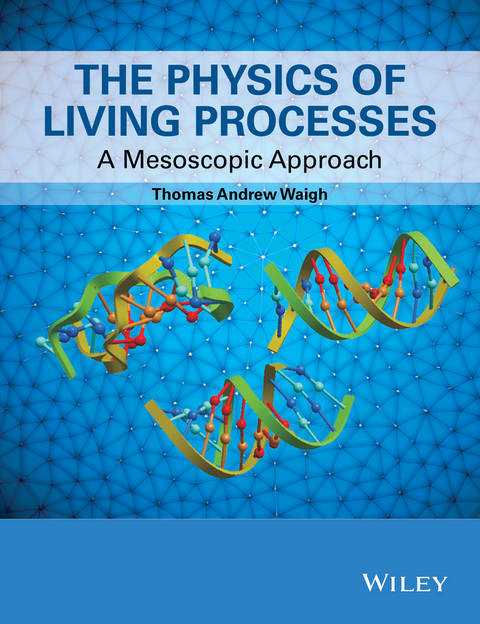
The Physics of Living Processes (eBook)
John Wiley & Sons (Verlag)
978-1-118-69827-3 (ISBN)
This full-colour undergraduate textbook, based on a two semester course, presents the fundamentals of biological physics, introducing essential modern topics that include cells, polymers, polyelectrolytes, membranes, liquid crystals, phase transitions, self-assembly, photonics, fluid mechanics, motility, chemical kinetics, enzyme kinetics, systems biology, nerves, physiology, the senses, and the brain
The comprehensive coverage, featuring in-depth explanations of recent rapid developments, demonstrates this to be one of the most diverse of modern scientific disciplines.
The Physics of Living Processes: A Mesoscopic Approach is comprised of five principal sections:
- Building Blocks
- Soft Condensed Matter Techniques in Biology
- Experimental Techniques
- Systems Biology
- Spikes, Brains and the Senses
The unique focus is predominantly on the mesoscale; structures on length scales between those of atoms and the macroscopic behaviour of whole organisms. The connections between molecules and their emergent biological phenomena provide a novel integrated perspective on biological physics, making this an important text across a variety of scientific disciplines including biophysics, physics, physical chemistry, chemical engineering and bioengineering.
An extensive set of worked tutorial questions are included, which will equip the reader with a range of new physical tools to approach problems in the life sciences from medicine, pharmaceutical science and agriculture.
Thomas Andrew Waigh School of Physics and Astronomy, Photon Science Institute, University of Manchester
Preface
This book is based around a two-semester course on biological physics that has been taught over the past few years at the University of Manchester. Students on the course are predominantly physics undergraduates who have good mathematics and physics foundations, but often lack any advanced biology or chemistry background. Therefore in a bid to make the course self-contained we teach the students the necessary biology, chemistry and physical chemistry as the course goes along. It is therefore hoped that anyone with a reasonably good high/secondary school background in both physics and mathematics can follow the material in this introductory course on the physics of living processes.
The book is divided into five principal sections: building blocks, soft matter, experimental techniques, systems biology and spikes, brains and the senses. The first section describes the basic building blocks used to construct living organisms. The next four sections introduce a series of useful tools for biological physicists to solve problems in the life sciences. This list of tools is not exhaustive, but it is hoped that they will introduce the reader to some of the possibilities.
The subheading of the book: ‘A Mesoscopic Approach’ is there to emphasize the range of length scales considered in the solution of biological problems. Here the mesoscale is taken to include the length scales from molecules to the microscale. Thus, for the most part the underlying quantum mechanical details are ignored, i.e. the approach is coarse grained and on the nano/micrometre scale. The quantised details of the molecules in biological problems are neglected in order to make them tractable, i.e. to provide an approximate solution in real time. Again this is a pragmatic approach due to time constraints and the unwieldy nature of current state-of-the-art ab initio quantum mechanics simulations. Some fascinating biologically relevant processes certainly do depend sensitively on quantum mechanical details for a satisfactory explanation. Photosynthesis and photodetection are classic examples, but for brevity these areas will be predominantly ignored and readers are directed to additional literature for self-study.
In the first three sections of the book the field of molecular biophysics will be introduced. The presentation will focus on the simple underlying concepts and demonstrate them using a series of up-to-date applications. It is hoped that the approach will appeal to physical scientists who are confronted with biological questions for the first time due to the current biotechnological revolution.
The fields of biochemistry and cellular physiology are vast and it is not the aim of the current textbook to encompass the whole area. The first three sections of the book functions on a reductionist, nuts and bolts approach to the subject matter. They aim to explain the constructions and machinery of biological molecules very much as a civil engineer would examine the construction of a building or a mechanical engineer examine the dynamics of a turbine. Little recourse is taken to the specific chemical details of the subject, since these important areas are better treated in other dedicated biochemistry courses. Instead, modern physical ideas are introduced to explain aspects of the phenomena that are confronted. These ideas provide an alternative complementary set of tools to solve biophysical problems. It is thus hoped that the book will equip the reader with these new tools to approach the subject of biological physics.
The reductionist approach to molecular biology has historically been very successful. Organisms, drugs and foods can all be studied in terms of their constituent molecules. However, knowing all the musicians in an orchestra still leaves us none the wiser with respect to the music they are playing as an ensemble. The concerted motion and interaction of many thousands of different types of molecules gives rise to life. The pulsating quivering motion of amoeba cells under a microscope, jet lag in bumble bees when they are moved between continents, the kaleidoscope of colours detected in the ape retina when we view a Van Gogh painting, the searing pain when we burn ourselves, and the miraculous healing processes when we have been cut; all these phenomena and many more require explanation. Often such studies have been labelled physiology and in the modern era predominantly have been studied by medics and vets, who often function in an engineering, the-organism-is-broken-how-do-we-fix-it, -type approach. Pharmacologists also study the effect of drugs on the metabolism of creatures, generally concentrating their interest in the development of new medicines, but again practically this takes a pragmatic engineering approach. What are the large-scale effects of the addition of a single chemical on the millions of biochemical processes upon which it could possibly have an impact? People do the experiments and hope they will discover a well-targeted drug (a magic bullet if you will), which will modify only a single faulty mechanism associated with a particular disease with limited side effects. Necessity (time constraints) requires that they ignore most of the holistic effects required for a complete understanding of a disease.
However, increasingly a quantitative understanding of the phenomena involved in living processes is required, returning physiology to the domain of the physical sciencesa. This would allow us to make a rigorous connection between the structure and dynamics of biological molecules on the nanoscale and their concerted behaviour in living processes over time at larger lengths scales (at the scale of organs and organisms). At first sight this seems an impossible task due to the complexity of the phenomena involved (a huge intractable many-body problem), but a range of new tools are available in the twenty-first century to explore physiology that give us some hope; high-resolution noninvasive experimental probes now exist that will not disrupt or burn the specimens (magnetic resonance imaging, optical coherence tomography, ultrasound, fluorescence microscopy, positron emission tomography, and X-ray tomography, to name just a few); postgenomic technology (the human DNA genome has been sequenced, how do we make sense out of all this information?) holds a vast amount of information relevant to living processes that still needs to be properly mined; network theory provides mathematical tools to describe the geometry and connectivity of interacting components be they neurons, metabolic processes or individual biochemical products; soft condensed-matter physics demonstrates how the tools of conventional physics can be applied to the unusual behaviour of biological soft matter (e.g. statistical mechanics, fluid mechanics, elasticity theory, and novel model biomimetic materials); systems biology explores the robustness and diversity of biochemical processes in terms of the circuit diagrams of individual biochemical reactions; and synthetic biology allows cells to be completely reprogrammed to test the fundamental requirements for life. All these methods offer new approaches to solve physiological problems.
The discussion in this book is extended on from that previously presented in the textbook ‘Applied Biophysics’, also written by the current author, and it incorporates some of the same material. Applied Biophysics considered the application of soft-matter physics in molecular biology. The approach is now extended to the study of living processes with additional emphasis on modern deterministic themes concerning the behaviour of cells, action potentials and networks. These ideas and tools are applied to a series of problems in agriculture, medicine and pharmaceutical science. Many of these areas are currently being revolutionised and it is hoped that the text will provide a flavour of the fields that are being developed with relation to their biological physics and provide a bridge towards the relevant research literature.
The connections between the different themes discussed in the book need to be stressed, since they join together many of the different chapters e.g. signalling from Chapter 23 and motility from Chapter 7. This integration of themes lends strength to quantitative descriptions of physiology in the last two sections of the book and highlights many important facets of a physiological question, e.g. how is insulin metabolised; what are the biochemical circuits? How is the motion of a mouse tracked by an owl; what is the activity of its neural networks? And how do the contractions of the heart give rise to the fluid mechanics of a pulse; what is the electrophysiology of the heart?
Much can be learnt from cells for would-be nanobiotechnologists. For example, currently we can make synthetic nanomotors, but switching them on or off when required is an ongoing challenge. Nature achieves this task with great speed and efficiency using virtuoso performances of ion channels and action potentials inside nerve cells. Physiology thus provides a treasure trove of processes that could be borrowed for synthetic biological designs.
Ethical questions are a concern when considering experiments with live organisms. These questions are worthy of careful thought and their solution requires a consensus amongst a broad community. The ethical consideration of such complex subjects as stem-cell research, cloning, genetic engineering and live animal...
| Erscheint lt. Verlag | 8.8.2014 |
|---|---|
| Sprache | englisch |
| Themenwelt | Naturwissenschaften ► Biologie |
| Naturwissenschaften ► Physik / Astronomie ► Angewandte Physik | |
| Technik ► Umwelttechnik / Biotechnologie | |
| Schlagworte | Approach • biological • Biomaterial • Biomaterialien • biomaterials • biomedical engineering • Biomedizinische Technik • Biomedizintechnik • Biophysik • blocks • Cells • comprised • Course • disciplines • Diverse • Essential • explanations • Five • fundamentals • indepth • Medical & Health Physics • Modern • Physics • Physik • Physik in Medizin u. Gesundheitswesen • principal • processes • Scientific • sections • Semester • Topics • two |
| ISBN-10 | 1-118-69827-4 / 1118698274 |
| ISBN-13 | 978-1-118-69827-3 / 9781118698273 |
| Informationen gemäß Produktsicherheitsverordnung (GPSR) | |
| Haben Sie eine Frage zum Produkt? |
 EPUB (Adobe DRM)
Kopierschutz: Adobe-DRM
Adobe-DRM ist ein Kopierschutz, der das eBook vor Mißbrauch schützen soll. Dabei wird das eBook bereits beim Download auf Ihre persönliche Adobe-ID autorisiert. Lesen können Sie das eBook dann nur auf den Geräten, welche ebenfalls auf Ihre Adobe-ID registriert sind.
Details zum Adobe-DRM
Dateiformat: EPUB (Electronic Publication)
EPUB ist ein offener Standard für eBooks und eignet sich besonders zur Darstellung von Belletristik und Sachbüchern. Der Fließtext wird dynamisch an die Display- und Schriftgröße angepasst. Auch für mobile Lesegeräte ist EPUB daher gut geeignet.
Systemvoraussetzungen:
PC/Mac: Mit einem PC oder Mac können Sie dieses eBook lesen. Sie benötigen eine
eReader: Dieses eBook kann mit (fast) allen eBook-Readern gelesen werden. Mit dem amazon-Kindle ist es aber nicht kompatibel.
Smartphone/Tablet: Egal ob Apple oder Android, dieses eBook können Sie lesen. Sie benötigen eine
Geräteliste und zusätzliche Hinweise
Buying eBooks from abroad
For tax law reasons we can sell eBooks just within Germany and Switzerland. Regrettably we cannot fulfill eBook-orders from other countries.


