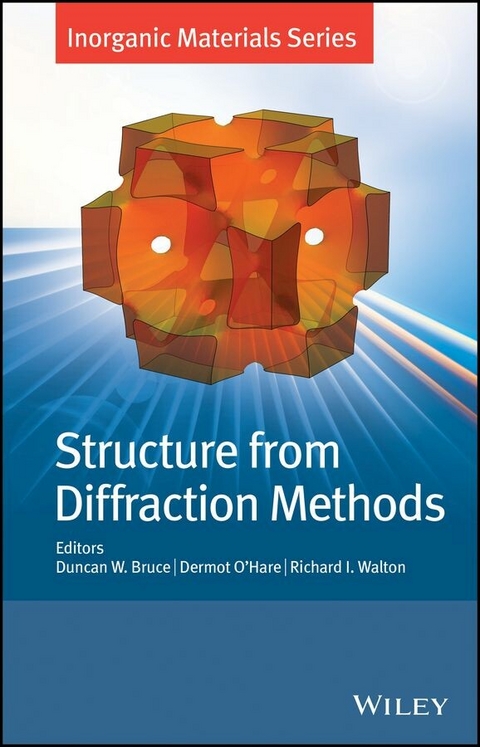
Structure from Diffraction Methods (eBook)
John Wiley & Sons (Verlag)
978-1-118-68249-4 (ISBN)
Inorganic materials show a diverse range of important properties that are desirable for many contemporary, real-world applications. Good examples include recyclable battery cathode materials for energy storage and transport, porous solids for capture and storage of gases and molecular complexes for use in electronic devices. An understanding of the function of these materials is necessary in order to optimise their behaviour for real applications, hence the importance of 'structure-property relationships'.
The chapters presented in this volume deal with recent advances in the characterisation of crystalline materials. They include some familiar diffraction methods, thoroughly updated with modern advances. Also included are techniques that can now probe details of the three-dimensional arrangements of atoms in nanocrystalline solids, allowing aspects of disorder to be studied. Small-angle scattering, a technique that is often overlooked, can probe both ordered and disordered structures of materials at longer length scales than those probed by powder diffraction methods.
Addressing both physical principals and recent advances in their applications, Structure from Diffraction Methods covers:
- Powder Diffraction
- X-Ray and Neutron Single-Crystal Diffraction
- PDF Analysis of Nanoparticles
- Electron Crystallography
- Small-Angle Scattering
Ideal as a complementary reference work to other volumes in the series (Local Structural Characterisation and Multi Length-Scale Characterisation), or as an examination of the specific characterisation techniques in their own right, Structure from Diffraction Methods is a valuable addition to the Inorganic Materials Series.
Duncan Bruce is Professor of Liquid Crystals and Materials Chemistry at the University of York. Prior to this he was Professor of Inorganic Chemistry at the University of Exeter, and co-director of the Sheffield Centre for Molecular Materials. His current research interests include liquid crystals and nanoparticle-doped, nanostructured, mesoporous silicates.
He is immediate Past President of the Royal Society of Chemistry Materials Chemistry Division and Chair of the British Liquid Crystal Society. His work has been recognized by various awards including the RSC Tilden Prize for 2010, the RSC's Sir Edward Frankland Fellowship and Corday-Morgan Medal and Prize.
Dermot O'Hare is Professor in the Chemistry Research Laboratory at the University of Oxford. His interests are wide ranging, and include exploratory synthetic organometallic chemistry, intercalation chemistry, time-resolved, in situ diffraction studies and the synthesis of meso- and microporous solids.
In 2010 he won the RSC Ludwig Mond award for outstanding research in Inorganic chemistry.
Dr Richard Walton is Associate Professor in Inorganic Chemistry at the University of Warwick. He was also formerly based in the Department of Chemistry at the University of Exeter. His research group works in the area of solid-state materials chemistry and has a number of projects focusing upon the synthesis, structural characterization and properties of inorganic materials.
Duncan Bruce is Professor of Liquid Crystals and Materials Chemistry at the University of York. Prior to this he was Professor of Inorganic Chemistry at the University of Exeter, and co-director of the Sheffield Centre for Molecular Materials. His current research interests include liquid crystals and nanoparticle-doped, nanostructured, mesoporous silicates. He is immediate Past President of the Royal Society of Chemistry Materials Chemistry Division and Chair of the British Liquid Crystal Society. His work has been recognized by various awards including the RSC Tilden Prize for 2010, the RSC's Sir Edward Frankland Fellowship and Corday-Morgan Medal and Prize. Dermot O'Hare is Professor in the Chemistry Research Laboratory at the University of Oxford. His interests are wide ranging, and include exploratory synthetic organometallic chemistry, intercalation chemistry, time-resolved, in situ diffraction studies and the synthesis of meso- and microporous solids. In 2010 he won the RSC Ludwig Mond award for outstanding research in Inorganic chemistry. Dr Richard Walton is Associate Professor in Inorganic Chemistry at the University of Warwick. He was also formerly based in the Department of Chemistry at the University of Exeter. His research group works in the area of solid-state materials chemistry and has a number of projects focusing upon the synthesis, structural characterization and properties of inorganic materials.
| Erscheint lt. Verlag | 12.6.2014 |
|---|---|
| Reihe/Serie | Inorganic Materials Series | Inorganic Materials Series |
| Sprache | englisch |
| Themenwelt | Naturwissenschaften ► Chemie |
| Technik ► Maschinenbau | |
| Schlagworte | Anorganische Chemie • Applications • Battery • Capture • Cathode • Chemie • Chemistry • Complexes • Contemporary • desirable • Diverse • Electronic • Energy • Festkörperchemie • Festkörperchemie • gases • Good • important • include • inorganic • Inorganic Chemistry • many • Materials • materials characterization • Materials Science • Materialwissenschaften • Porous • Properties • Range • recyclable • solids • solid state chemistry • Storage • Transport • use • Werkstoffprüfung • Werkstoffprüfung |
| ISBN-10 | 1-118-68249-1 / 1118682491 |
| ISBN-13 | 978-1-118-68249-4 / 9781118682494 |
| Informationen gemäß Produktsicherheitsverordnung (GPSR) | |
| Haben Sie eine Frage zum Produkt? |
 PDF (Adobe DRM)
Kopierschutz: Adobe-DRM
Adobe-DRM ist ein Kopierschutz, der das eBook vor Mißbrauch schützen soll. Dabei wird das eBook bereits beim Download auf Ihre persönliche Adobe-ID autorisiert. Lesen können Sie das eBook dann nur auf den Geräten, welche ebenfalls auf Ihre Adobe-ID registriert sind.
Details zum Adobe-DRM
Dateiformat: PDF (Portable Document Format)
Mit einem festen Seitenlayout eignet sich die PDF besonders für Fachbücher mit Spalten, Tabellen und Abbildungen. Eine PDF kann auf fast allen Geräten angezeigt werden, ist aber für kleine Displays (Smartphone, eReader) nur eingeschränkt geeignet.
Systemvoraussetzungen:
PC/Mac: Mit einem PC oder Mac können Sie dieses eBook lesen. Sie benötigen eine
eReader: Dieses eBook kann mit (fast) allen eBook-Readern gelesen werden. Mit dem amazon-Kindle ist es aber nicht kompatibel.
Smartphone/Tablet: Egal ob Apple oder Android, dieses eBook können Sie lesen. Sie benötigen eine
Geräteliste und zusätzliche Hinweise
Buying eBooks from abroad
For tax law reasons we can sell eBooks just within Germany and Switzerland. Regrettably we cannot fulfill eBook-orders from other countries.
aus dem Bereich