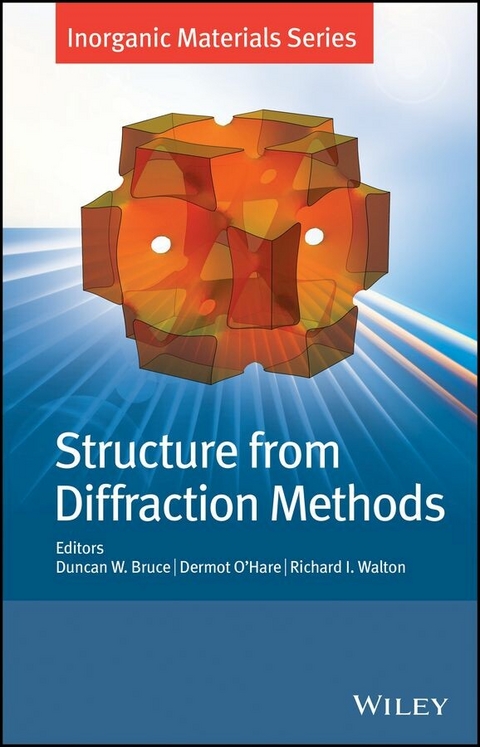
Structure from Diffraction Methods (eBook)
John Wiley & Sons (Verlag)
978-1-118-69571-5 (ISBN)
Inorganic materials show a diverse range of important properties that are desirable for many contemporary, real-world applications. Good examples include recyclable battery cathode materials for energy storage and transport, porous solids for capture and storage of gases and molecular complexes for use in electronic devices. An understanding of the function of these materials is necessary in order to optimise their behaviour for real applications, hence the importance of 'structure–property relationships'.
The chapters presented in this volume deal with recent advances in the characterisation of crystalline materials. They include some familiar diffraction methods, thoroughly updated with modern advances. Also included are techniques that can now probe details of the three-dimensional arrangements of atoms in nanocrystalline solids, allowing aspects of disorder to be studied. Small-angle scattering, a technique that is often overlooked, can probe both ordered and disordered structures of materials at longer length scales than those probed by powder diffraction methods.
Addressing both physical principals and recent advances in their applications, Structure from Diffraction Methods covers:
- Powder Diffraction
- X-Ray and Neutron Single-Crystal Diffraction
- PDF Analysis of Nanoparticles
- Electron Crystallography
- Small-Angle Scattering
Ideal as a complementary reference work to other volumes in the series (Local Structural Characterisation and Multi Length-Scale Characterisation), or as an examination of the specific characterisation techniques in their own right, Structure from Diffraction Methods is a valuable addition to the Inorganic Materials Series.
Duncan Bruce is Professor of Liquid Crystals and Materials Chemistry at the University of York. Prior to this he was Professor of Inorganic Chemistry at the University of Exeter, and co-director of the Sheffield Centre for Molecular Materials. His current research interests include liquid crystals and nanoparticle-doped, nanostructured, mesoporous silicates. He is immediate Past President of the Royal Society of Chemistry Materials Chemistry Division and Chair of the British Liquid Crystal Society. His work has been recognized by various awards including the RSC Tilden Prize for 2010, the RSC's Sir Edward Frankland Fellowship and Corday-Morgan Medal and Prize. Dermot O'Hare is Professor in the Chemistry Research Laboratory at the University of Oxford. His interests are wide ranging, and include exploratory synthetic organometallic chemistry, intercalation chemistry, time-resolved, in situ diffraction studies and the synthesis of meso- and microporous solids. In 2010 he won the RSC Ludwig Mond award for outstanding research in Inorganic chemistry. Dr Richard Walton is Associate Professor in Inorganic Chemistry at the University of Warwick. He was also formerly based in the Department of Chemistry at the University of Exeter. His research group works in the area of solid-state materials chemistry and has a number of projects focusing upon the synthesis, structural characterization and properties of inorganic materials.
Chapter 1
Powder Diffraction
Kenneth D. M. Harris and P. Andrew Williams
School of Chemistry, Cardiff University, Cardiff, UK
1.1 INTRODUCTION
As discussed in Chapter 2, single-crystal X-ray diffraction[1–3] (XRD) is the most widely used and the most powerful technique for determining crystal structures, and this technique led to many monumental scientific discoveries in the 20th century. The wide-ranging scope and the routine application of single-crystal XRD in the modern day have arisen both through advances in instrumentation and through the development of powerful strategies for data analysis, such that crystal structures can now be determined rapidly and straightforwardly in all but the most challenging cases. The central importance of single-crystal XRD in the physical, biological and materials sciences will continue to be further developed and exploited in the years to come. Thus, provided a single crystal of sufficient size and quality is available for the material of interest, successful structure determination by analysis of single-crystal XRD data is nowadays very routine.
However, the requirement to prepare a suitable single crystal specimen for single-crystal XRD experiments represents a major limitation of this technique. As a consequence, the crystal structures of many important crystalline materials remain unknown simply because the material cannot be prepared as a crystal of appropriate size and quality for single-crystal XRD studies. In such cases, however, the material can usually be prepared as a microcrystalline powder, and therefore it is still feasible to record powder XRD data. The question that immediately arises is whether it is feasible to determine the crystal structure of a material from powder XRD data using techniques analogous to those employed with single-crystal XRD data. Furthermore, are there any aspects of structural science that might actually be more readily investigated by powder XRD than single-crystal XRD?
With the aim of addressing these types of question, the present chapter provides an overview of the current state of the art in the application of powder XRD within chemical and materials sciences, focusing in particular on contemporary opportunities for determining crystal structures directly from powder XRD data. Fundamental aspects of the techniques used to carry out crystal structure determination from powder XRD data are described, and several illustrative examples of the application of these techniques in determining the structural properties of materials across a wide range of areas of chemistry are highlighted. In addition, we discuss the wide-ranging utility of powder XRD in other aspects of the characterisation of solid materials, from routine applications in the identification (‘fingerprinting’) of crystalline phases to more advanced applications in which in situ powder XRD studies are exploited to investigate structural transformations associated with phase transitions, solid-state chemical reactions, crystallisation processes and materials synthesis. While the chapter is focused primarily on powder XRD, the complementary opportunities offered by powder neutron diffraction are also discussed.
With the exception of some brief mention of certain specific aspects of experimental techniques for the measurement of powder XRD data, details of the instrumentation used to record powder XRD data lie outside the scope of this chapter, which is focused primarily on the application of powder XRD to determine structural information in chemical contexts rather than on the technical details of experimental techniques. Descriptions of the variety of experimental set-ups that may be used to record powder XRD data and comparisons of their relative merits (e.g. transmission mode versus reflection mode, Debye–Scherrer versus Bragg–Brentano, angle dispersive versus energy dispersive, point detectors versus position-sensitive detectors) may be found in more detailed monographs on instrumentation.[4–7]
1.2 THE SIMILARITIES AND DIFFERENCES BETWEEN SINGLE-CRYSTAL XRD AND POWDER XRD
As discussed above, the form of the sample studied in single-crystal and powder XRD is intrinsically different: a large, individual crystal in the former case and a powder comprising a huge number of small, randomly oriented crystallites in the latter case. However, while the nature of the sample is different, the physical phenomenon underlying both techniques is the same. In each case, X-ray radiation (usually monochromatic radiation) is incident on the sample. As the wavelength of the X-rays is comparable to the periodic repeat distances within the crystalline material (i.e. within the single crystal in the single-crystal XRD experiment and within each crystallite present in the powder sample in the powder XRD experiment), coherent/elastic scattering of the X-rays by the sample gives rise to an ‘XRD pattern’ (Figure 1.1) in which the radiation is scattered with significant intensity only in certain specific directions, while in all other directions the intensity of scattered radiation is zero.
Figure 1.1 Comparison of single-crystal and powder XRD measurements. In powder XRD, the diffraction phenomenon for each individual crystallite in the powder is the same as the diffraction phenomenon in single-crystal XRD. However, the powder comprises a large collection of crystallites with (in principle) a random distribution of crystallite orientations. As a consequence, the three-dimensional diffraction data are effectively compressed into one dimension (intensity versus diffraction angle ) in the powder XRD measurement.
Because the underlying physical phenomenon is the same, single-crystal and powder XRD patterns contain essentially the same information. However, as a result of the different nature of the sample used in each case, the form of the XRD pattern and the way in which it can be measured are different (Figure 1.1). Thus, in the single-crystal XRD pattern, the intense diffraction ‘peaks’ are well separated from each other in three-dimensional (3D) space (‘reciprocal space’) and both the scattering direction and the intensity of each individual intensity maximum can be measured very accurately. In the case of powder XRD, on the other hand, although each individual crystallite in the powder behaves in a similar manner to the single crystal sample in single-crystal XRD, the fact that the powder sample comprises a huge number of randomly oriented crystallites means that only the collective X-ray scattering from the whole sample can be measured. Because of the randomly oriented nature of the crystallites within the powder, the collective X-ray scattering from the whole powder sample comprises a set of coaxial cones of scattered radiation (in contrast to the sharp beams of scattered radiation that arise in single-crystal XRD). The semi-angle of each cone is the diffraction angle, As shown in Figure 1.1, the powder XRD pattern comprises the measured diffracted intensity as a function of a single spatial variable, the diffraction angle Effectively, in making the powder XRD measurement, the 3D information contained in the diffraction data is ‘compressed’ into one dimension, as the diffraction intensity is measured as a function of only one spatial variable.
The peaks in the powder XRD pattern arise at specific values of that satisfy Bragg's law:
where is the wavelength of the X-rays, the indices and are three integers (the Miller indices) that uniquely label each intensity maximum (‘peak’) in the diffraction pattern and is the interplanar spacing of a specific set of lattice planes (also uniquely labelled with the same Miller indices, and ) in the crystal structure (the set of interplanar spacings, for a crystal structure depends on the dimensions of the unit cell – see below).
As a consequence of the fact that the diffraction data are ‘compressed’ into one dimension in the powder XRD measurement, there is usually considerable overlap of peaks in the powder XRD pattern. Such peak overlap serves to obscure information on the position (i.e. the value) and the intensity of each peak in the powder XRD pattern, and the difficulty of obtaining reliable and accurate information on the peak positions and intensities can impede (or, in severe cases, prohibit) the process of carrying out crystal structure determination from powder XRD data. For materials with large unit cells and low symmetry (such as most molecular solids), there is a very high density of peaks in the powder XRD pattern (especially at high values of ) and the problem of peak overlap can be particularly severe (see Figure 1.2). The ‘problem’ of peak overlap presents specific challenges in several aspects of the analysis of powder XRD data, particularly in the context of structure determination. Clearly, the extent of peak overlap may be reduced by recording the data under experimental conditions that give rise to narrow peaks in the powder XRD pattern (i.e. ‘high-resolution’ powder XRD data). As discussed in Section 1.6.4, the widths of peaks in a powder XRD pattern depend both on features of the instrumentation used to record the data and on features of the powder sample, and higher resolution can be achieved (at least in principle) by optimisation of these features. However, while peak overlap may be alleviated by appropriate...
| Erscheint lt. Verlag | 12.6.2014 |
|---|---|
| Reihe/Serie | Inorganic Materials Series |
| Inorganic Materials Series | Inorganic Materials Series |
| Sprache | englisch |
| Themenwelt | Naturwissenschaften ► Chemie |
| Technik ► Maschinenbau | |
| Schlagworte | Anorganische Chemie • Applications • Battery • Capture • Cathode • Chemie • Chemistry • Complexes • Contemporary • desirable • Diverse • Electronic • Energy • Festkörperchemie • Festkörperchemie • gases • Good • important • include • inorganic • Inorganic Chemistry • many • Materials • materials characterization • Materials Science • Materialwissenschaften • Porous • Properties • Range • recyclable • solids • solid state chemistry • Storage • Transport • use • Werkstoffprüfung • Werkstoffprüfung |
| ISBN-10 | 1-118-69571-2 / 1118695712 |
| ISBN-13 | 978-1-118-69571-5 / 9781118695715 |
| Informationen gemäß Produktsicherheitsverordnung (GPSR) | |
| Haben Sie eine Frage zum Produkt? |
 EPUB (Adobe DRM)
Kopierschutz: Adobe-DRM
Adobe-DRM ist ein Kopierschutz, der das eBook vor Mißbrauch schützen soll. Dabei wird das eBook bereits beim Download auf Ihre persönliche Adobe-ID autorisiert. Lesen können Sie das eBook dann nur auf den Geräten, welche ebenfalls auf Ihre Adobe-ID registriert sind.
Details zum Adobe-DRM
Dateiformat: EPUB (Electronic Publication)
EPUB ist ein offener Standard für eBooks und eignet sich besonders zur Darstellung von Belletristik und Sachbüchern. Der Fließtext wird dynamisch an die Display- und Schriftgröße angepasst. Auch für mobile Lesegeräte ist EPUB daher gut geeignet.
Systemvoraussetzungen:
PC/Mac: Mit einem PC oder Mac können Sie dieses eBook lesen. Sie benötigen eine
eReader: Dieses eBook kann mit (fast) allen eBook-Readern gelesen werden. Mit dem amazon-Kindle ist es aber nicht kompatibel.
Smartphone/Tablet: Egal ob Apple oder Android, dieses eBook können Sie lesen. Sie benötigen eine
Geräteliste und zusätzliche Hinweise
Buying eBooks from abroad
For tax law reasons we can sell eBooks just within Germany and Switzerland. Regrettably we cannot fulfill eBook-orders from other countries.
aus dem Bereich