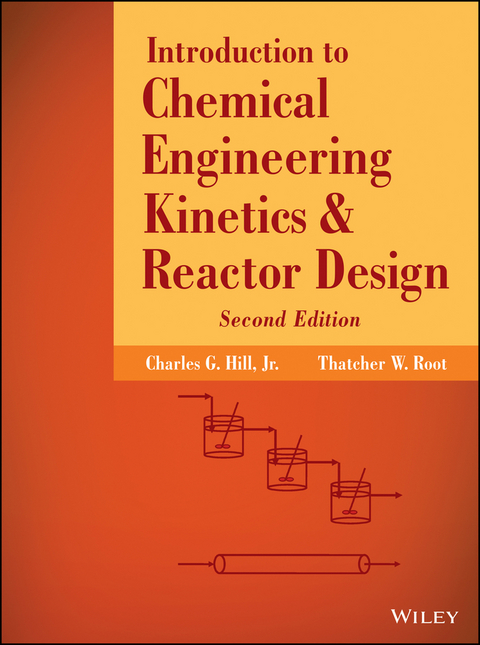
Introduction to Chemical Engineering Kinetics and Reactor Design (eBook)
John Wiley & Sons (Verlag)
978-1-118-79783-9 (ISBN)
The Second Edition features new problems that engage readers in contemporary reactor design
Highly praised by instructors, students, and chemical engineers, Introduction to Chemical Engineering Kinetics & Reactor Design has been extensively revised and updated in this Second Edition. The text continues to offer a solid background in chemical reaction kinetics as well as in material and energy balances, preparing readers with the foundation necessary for success in the design of chemical reactors. Moreover, it reflects not only the basic engineering science, but also the mathematical tools used by today's engineers to solve problems associated with the design of chemical reactors.
Introduction to Chemical Engineering Kinetics & Reactor Design enables readers to progressively build their knowledge and skills by applying the laws of conservation of mass and energy to increasingly more difficult challenges in reactor design. The first one-third of the text emphasizes general principles of chemical reaction kinetics, setting the stage for the subsequent treatment of reactors intended to carry out homogeneous reactions, heterogeneous catalytic reactions, and biochemical transformations. Topics include:
- Thermodynamics of chemical reactions
- Determination of reaction rate expressions
- Elements of heterogeneous catalysis
- Basic concepts in reactor design and ideal reactor models
- Temperature and energy effects in chemical reactors
- Basic and applied aspects of biochemical transformations and bioreactors
About 70% of the problems in this Second Edition are new. These problems, frequently based on articles culled from the research literature, help readers develop a solid understanding of the material. Many of these new problems also offer readers opportunities to use current software applications such as Mathcad and MATLAB®.
By enabling readers to progressively build and apply their knowledge, the Second Edition of Introduction to Chemical Engineering Kinetics & Reactor Design remains a premier text for students in chemical engineering and a valuable resource for practicing engineers.
CHARLES G. HILL, JR., SC.D, is Professor Emeritus at the University of Wisconsin-Madison with over 200 peer-reviewed publications to his credit. In addition to his academic work, he has served as a consultant to government agencies and private corporations. Dr. Hill's research has been highly interdisciplinary, including experience as a Fulbright Senior Scholar collaborating on studies of enzymatic reactions at the Institute for Catalysis and Petrochemistry (Spain).
THATCHER W. ROOT, PHD, is Professor of Chemical Engineering at the University of Wisconsin-Madison. Dr. Root was awarded an NSF Presidential Young Investigator Award and recently received the Benjamin Smith Reynolds Award for Excellence in Teaching Engineers.
The Second Edition features new problems that engage readers in contemporary reactor design Highly praised by instructors, students, and chemical engineers, Introduction to Chemical Engineering Kinetics & Reactor Design has been extensively revised and updated in this Second Edition. The text continues to offer a solid background in chemical reaction kinetics as well as in material and energy balances, preparing readers with the foundation necessary for success in the design of chemical reactors. Moreover, it reflects not only the basic engineering science, but also the mathematical tools used by today s engineers to solve problems associated with the design of chemical reactors. Introduction to Chemical Engineering Kinetics & Reactor Design enables readers to progressively build their knowledge and skills by applying the laws of conservation of mass and energy to increasingly more difficult challenges in reactor design. The first one-third of the text emphasizes general principles of chemical reaction kinetics, setting the stage for the subsequent treatment of reactors intended to carry out homogeneous reactions, heterogeneous catalytic reactions, and biochemical transformations. Topics include: Thermodynamics of chemical reactions Determination of reaction rate expressions Elements of heterogeneous catalysis Basic concepts in reactor design and ideal reactor models Temperature and energy effects in chemical reactors Basic and applied aspects of biochemical transformations and bioreactors About 70% of the problems in this Second Edition are new. These problems, frequently based on articles culled from the research literature, help readers develop a solid understanding of the material. Many of these new problems also offer readers opportunities to use current software applications such as Mathcad and MATLAB . By enabling readers to progressively build and apply their knowledge, the Second Edition of Introduction to Chemical Engineering Kinetics & Reactor Design remains a premier text for students in chemical engineering and a valuable resource for practicing engineers.
CHARLES G. HILL, JR., SC.D, is Professor Emeritus at the University of Wisconsin-Madison with over 200 peer-reviewed publications to his credit. In addition to his academic work, he has served as a consultant to government agencies and private corporations. Dr. Hill's research has been highly interdisciplinary, including experience as a Fulbright Senior Scholar collaborating on studies of enzymatic reactions at the Institute for Catalysis and Petrochemistry (Spain). THATCHER W. ROOT, PHD, is Professor of Chemical Engineering at the University of Wisconsin-Madison. Dr. Root was awarded an NSF Presidential Young Investigator Award and recently received the Benjamin Smith Reynolds Award for Excellence in Teaching Engineers.
| Erscheint lt. Verlag | 24.4.2014 |
|---|---|
| Sprache | englisch |
| Themenwelt | Naturwissenschaften ► Chemie ► Technische Chemie |
| Technik | |
| Schlagworte | Bauingenieur- u. Bauwesen • Charles G. Hill • chemical engineering • chemical kinetics • chemical reactor design • Chemie • chemische Kinetik • Chemische Verfahrenstechnik • Chemistry • Civil Engineering & Construction • Environmental Engineering • heat and mass transfer limitations • Introduction to Chemical Engineering Kinetics and Reactor Design • multiple reactions • residence time effects • temperature and energy effects • Thatcher W. Root • Umwelttechnik |
| ISBN-10 | 1-118-79783-3 / 1118797833 |
| ISBN-13 | 978-1-118-79783-9 / 9781118797839 |
| Informationen gemäß Produktsicherheitsverordnung (GPSR) | |
| Haben Sie eine Frage zum Produkt? |
 EPUB (Adobe DRM)
Kopierschutz: Adobe-DRM
Adobe-DRM ist ein Kopierschutz, der das eBook vor Mißbrauch schützen soll. Dabei wird das eBook bereits beim Download auf Ihre persönliche Adobe-ID autorisiert. Lesen können Sie das eBook dann nur auf den Geräten, welche ebenfalls auf Ihre Adobe-ID registriert sind.
Details zum Adobe-DRM
Dateiformat: EPUB (Electronic Publication)
EPUB ist ein offener Standard für eBooks und eignet sich besonders zur Darstellung von Belletristik und Sachbüchern. Der Fließtext wird dynamisch an die Display- und Schriftgröße angepasst. Auch für mobile Lesegeräte ist EPUB daher gut geeignet.
Systemvoraussetzungen:
PC/Mac: Mit einem PC oder Mac können Sie dieses eBook lesen. Sie benötigen eine
eReader: Dieses eBook kann mit (fast) allen eBook-Readern gelesen werden. Mit dem amazon-Kindle ist es aber nicht kompatibel.
Smartphone/Tablet: Egal ob Apple oder Android, dieses eBook können Sie lesen. Sie benötigen eine
Geräteliste und zusätzliche Hinweise
Buying eBooks from abroad
For tax law reasons we can sell eBooks just within Germany and Switzerland. Regrettably we cannot fulfill eBook-orders from other countries.
aus dem Bereich