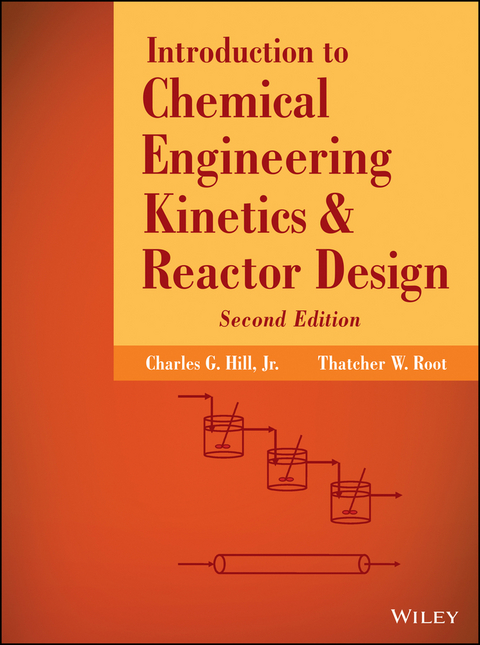
Introduction to Chemical Engineering Kinetics and Reactor Design (eBook)
John Wiley & Sons (Verlag)
978-1-118-79237-7 (ISBN)
The Second Edition features new problems that engage readers in contemporary reactor design
Highly praised by instructors, students, and chemical engineers, Introduction to Chemical Engineering Kinetics & Reactor Design has been extensively revised and updated in this Second Edition. The text continues to offer a solid background in chemical reaction kinetics as well as in material and energy balances, preparing readers with the foundation necessary for success in the design of chemical reactors. Moreover, it reflects not only the basic engineering science, but also the mathematical tools used by today's engineers to solve problems associated with the design of chemical reactors.
Introduction to Chemical Engineering Kinetics & Reactor Design enables readers to progressively build their knowledge and skills by applying the laws of conservation of mass and energy to increasingly more difficult challenges in reactor design. The first one-third of the text emphasizes general principles of chemical reaction kinetics, setting the stage for the subsequent treatment of reactors intended to carry out homogeneous reactions, heterogeneous catalytic reactions, and biochemical transformations. Topics include:
- Thermodynamics of chemical reactions
- Determination of reaction rate expressions
- Elements of heterogeneous catalysis
- Basic concepts in reactor design and ideal reactor models
- Temperature and energy effects in chemical reactors
- Basic and applied aspects of biochemical transformations and bioreactors
About 70% of the problems in this Second Edition are new. These problems, frequently based on articles culled from the research literature, help readers develop a solid understanding of the material. Many of these new problems also offer readers opportunities to use current software applications such as Mathcad and MATLAB®.
By enabling readers to progressively build and apply their knowledge, the Second Edition of Introduction to Chemical Engineering Kinetics & Reactor Design remains a premier text for students in chemical engineering and a valuable resource for practicing engineers.
CHARLES G. HILL, JR., SC.D, is Professor Emeritus at the University of Wisconsin-Madison with over 200 peer-reviewed publications to his credit. In addition to his academic work, he has served as a consultant to government agencies and private corporations. Dr. Hill's research has been highly interdisciplinary, including experience as a Fulbright Senior Scholar collaborating on studies of enzymatic reactions at the Institute for Catalysis and Petrochemistry (Spain).
THATCHER W. ROOT, PHD, is Professor of Chemical Engineering at the University of Wisconsin-Madison. Dr. Root was awarded an NSF Presidential Young Investigator Award and recently received the Benjamin Smith Reynolds Award for Excellence in Teaching Engineers.
The Second Edition features new problems that engage readers in contemporary reactor design Highly praised by instructors, students, and chemical engineers, Introduction to Chemical Engineering Kinetics & Reactor Design has been extensively revised and updated in this Second Edition. The text continues to offer a solid background in chemical reaction kinetics as well as in material and energy balances, preparing readers with the foundation necessary for success in the design of chemical reactors. Moreover, it reflects not only the basic engineering science, but also the mathematical tools used by today s engineers to solve problems associated with the design of chemical reactors. Introduction to Chemical Engineering Kinetics & Reactor Design enables readers to progressively build their knowledge and skills by applying the laws of conservation of mass and energy to increasingly more difficult challenges in reactor design. The first one-third of the text emphasizes general principles of chemical reaction kinetics, setting the stage for the subsequent treatment of reactors intended to carry out homogeneous reactions, heterogeneous catalytic reactions, and biochemical transformations. Topics include: Thermodynamics of chemical reactions Determination of reaction rate expressions Elements of heterogeneous catalysis Basic concepts in reactor design and ideal reactor models Temperature and energy effects in chemical reactors Basic and applied aspects of biochemical transformations and bioreactors About 70% of the problems in this Second Edition are new. These problems, frequently based on articles culled from the research literature, help readers develop a solid understanding of the material. Many of these new problems also offer readers opportunities to use current software applications such as Mathcad and MATLAB . By enabling readers to progressively build and apply their knowledge, the Second Edition of Introduction to Chemical Engineering Kinetics & Reactor Design remains a premier text for students in chemical engineering and a valuable resource for practicing engineers.
CHARLES G. HILL, JR., SC.D, is Professor Emeritus at the University of Wisconsin-Madison with over 200 peer-reviewed publications to his credit. In addition to his academic work, he has served as a consultant to government agencies and private corporations. Dr. Hill's research has been highly interdisciplinary, including experience as a Fulbright Senior Scholar collaborating on studies of enzymatic reactions at the Institute for Catalysis and Petrochemistry (Spain). THATCHER W. ROOT, PHD, is Professor of Chemical Engineering at the University of Wisconsin-Madison. Dr. Root was awarded an NSF Presidential Young Investigator Award and recently received the Benjamin Smith Reynolds Award for Excellence in Teaching Engineers.
Cover 1
Title Page 5
Contents 7
Preface 11
Preface to the First Edition 13
Chapter 1. Stoichiometric Coefficients and Reaction Progress Variables 17
1.0 Introduction 17
1.1 Basic Stoichiometric Concepts 18
1.1.1 Stoichiometric Coefficients 18
1.1.2 Reaction Progress Variables 18
Literature Citation 19
Chapter 2. Thermodynamics of Chemical Reactions 20
2.0 Introduction 20
2.1 Chemical Potentials and Standard States 20
2.2 Energy Effects Associated with Chemical Reactions 21
2.3 Sources of Thermochemical Data 23
2.4 The Equilibrium Constant and its Relation to DeltaG0 23
2.5 Effects of Temperature and Pressure Changes on the Equilibrium Constant 24
2.6 Determination of Equilibrium Compositions 25
2.7 Effects of Reaction Conditions on Equilibrium Yields 27
2.7.1 Effects of Temperature Changes 27
2.7.2 Effects of Total Pressure 27
2.7.3 Effect of Addition of Inert Gases 28
2.7.4 Effect of Addition of Catalysts 28
2.7.5 Effect of Excess Reactants 28
2.8 Heterogeneous Reactions 28
2.9 Equilibrium Treatment of Simultaneous Reactions 28
2.10 Supplementary Reading References 31
Literature Citations 31
Problems 31
Chapter 3. Basic Concepts in Chemical Kinetics: Determination of the Reaction Rate Expression 38
3.0 Introduction 38
3.0.1 Reaction Orders 40
3.0.2 The Reaction Rate Constant 41
3.1 Mathematical Characterization of Simple Reaction Systems 41
3.1.1 Mathematical Characterization of Simple Constant Volume Reaction Systems 41
3.1.2 Mathematical Characterization of Simple Variable Volume Reaction Systems 43
3.2 Experimental Aspects of Kinetic Studies 45
3.2.1 Preliminary Questions to Be Answered in Experimental Kinetics Studies 45
3.2.2 Experimental Techniques and Apparatus 48
3.3 Techniques for the Interpretation of Kinetic Data 50
3.3.1 Differential Methods for the Treatment of Rate Data 51
3.3.2 Integral Methods for the Treatment of Rate Data 55
3.3.3 Techniques for the Analysis of Reaction Rate Data That Are Suitable for Use with Either Integral or Differential Methods 64
3.3.4 Determination of the Activation Energy 67
3.3.5 Precision of Rate Measurements for Simple Irreversible Reactions 68
Literature Citations 69
Problems 70
Chapter 4. Basic Concepts in Chemical Kinetics: Molecular Interpretations of Kinetic Phenomena 88
4.0 Introduction 88
4.1 Reaction Mechanisms 89
4.1.1 The Nature of the Problem 90
4.1.2 Basic Assumptions Involved in the Derivation of a Rate Expression from a Proposed Reaction Mechanism 90
4.1.3 Preliminary Criteria for Testing a Proposed Reaction Mechanism: Stoichiometry and Derivation of a Rate Expression for the Mechanism 91
4.1.4 From Stoichiometry and Rate Expression to Mechanism 94
4.1.5 Additional Methods and Principles Used in Investigations of Reaction Mechanisms 96
4.2 Chain Reactions 99
4.2.1 The Reaction between Hydrogen and Bromine: H2 + Br2 /rightarrow 2HBr 100
4.2.2 Chain Reaction Mechanisms: General Comments 102
4.2.3 Rice-Herzfeld Mechanisms 105
4.2.4 Inhibitors, Initiators, and Induction Periods 107
4.2.5 Branched-Chain Reactions and Explosions 107
4.2.6 Supplementary References 109
4.2.7 Cautionary Note on Reaction Mechanisms 109
4.3 Molecular Theories of Chemical Kinetics 109
4.3.1 Simple Collision Theory 110
4.3.2 Transition State Theory 114
Literature Citations 119
Problems 120
Chapter 5. Chemical Systems Involving Multiple Reactions 133
5.0 Introduction 133
5.1 Reversible Reactions 133
5.1.1 Mathematical Characterization of Simple Reversible Reaction Systems 133
5.1.2 Determination of Reaction Rate Expressions for Reversible Reactions 136
5.1.3 Thermodynamic Consistency of Rate Expressions 139
5.2 Parallel or Competitive Reactions 141
5.2.1 Mathematical Characterization of Parallel Reactions 142
5.2.2 Techniques for Interpretation of Kinetic Data for Parallel Reactions 147
5.3 Series or Consecutive Reactions: Irreversible Series Reactions 149
5.3.1 Mathematical Characterization of Series Reactions 150
5.3.2 Techniques for the Interpretation of Kinetic Data in the Presence of Series Reactions 151
5.4 Complex Reactions 153
5.4.1 General Comments 153
5.4.2 Competitive-Consecutive Second-Order Reactions 153
Literature Citations 158
Problems 158
Chapter 6. Elements of Heterogeneous Catalysis 168
6.0 Introduction 168
6.1 Adsorption Phenomena 169
6.2 Adsorption Isotherms 172
6.2.1 The Langmuir Adsorption Isotherm 173
6.2.2 The BET Isotherm 176
6.3 Reaction Rate Expressions for Heterogeneous Catalytic Reactions 176
6.3.1 Rate Expressions for Heterogeneous Catalytic Reactions Limited by the Rates of Chemical Processes 179
6.3.2 Interpretation of Experimental Data 185
6.4 Physical Characterization of Heterogeneous Catalysts 186
6.4.1 Determination of Catalyst Void Volumes 187
6.4.2 Determination of Pore Size Distributions 188
6.5 Catalyst Preparation, Fabrication, and Activation 190
6.5.1 Catalyst Preparation 191
6.5.2 Catalyst Supports, Promoters, and Inhibitors 192
6.6 Poisoning and Deactivation of Catalysts 193
Literature Citations 194
Problems 195
Chapter 7. Liquid Phase Reactions 205
7.0 Introduction 205
7.1 Electrostatic Effects in Liquid Solution 207
7.2 Pressure Effects on Reactions in Liquid Solution 208
7.3 Homogeneous Catalysis in Liquid Solution 209
7.3.1 Acid-Base Catalysis 209
7.3.2 Catalysis by Enzymes 213
7.4 Correlation Methods for Kinetic Data: Linear Free Energy Relations 218
7.4.1 The Hammett Equation 220
7.4.2 Other Correlations 222
Literature Citations 223
Problems 223
Chapter 8. Basic Concepts in Reactor Design and Ideal Reactor Models 232
8.0 Introduction 232
8.0.1 The Nature of the Reactor Design Problem 232
8.0.2 Reactor Types 233
8.0.3 Fundamental Concepts Used in Chemical Reactor Design 238
8.1 Design Analysis for Batch Reactors 241
8.2 Design of Tubular Reactors 244
8.2.1 The Plug Flow Reactor Model: Basic Assumptions and Design Equations 244
8.2.2 Residence Times in Plug Flow Reactors 249
8.2.3 Series-Parallel Combinations of Tubular Reactors 250
8.3 Continuous Flow Stirred-Tank Reactors 250
8.3.1 Individual Stirred-Tank Reactors 250
8.3.2 Cascades of Stirred-Tank Reactors 257
8.3.3 Recycle Reactors 269
8.4 Reactor Networks Composed of Combinations of Ideal Continuous Flow Stirred-Tank Reactors and Plug Flow Reactors 270
8.5 Summary of Fundamental Design Relations: Comparison of Isothermal Stirred-Tank and Plug Flow Reactors 272
8.6 Semibatch or Semiflow Reactors 272
Literature Citations 275
Problems 275
Chapter 9. Selectivity and Optimization Considerations in the Design of Isothermal Reactors 289
9.0 Introduction 289
9.1 Competitive (Parallel) Reactions 290
9.2 Consecutive (Series) Reactions: A ? B ? C ? D 294
9.3 Competitive Consecutive Reactions 299
9.3.1 Multiple Substitution Reactions 299
9.3.2 Polymerization Reactions 305
9.4 Reactor Design for Autocatalytic Reactions 306
9.4.1 Basic Concepts 306
9.4.2 Reactor Design Considerations 309
Literature Citations 310
Problems 310
Chapter 10. Temperature and Energy Effects in Chemical Reactors 321
10.0 Introduction 321
10.1 The Energy Balance as Applied to Chemical Reactors 321
10.2 The Ideal Well-Stirred Batch Reactor 323
10.3 The Ideal Continuous Flow Stirred-Tank Reactor 327
10.4 Temperature and Energy Considerations in Tubular Reactors 330
10.5 Autothermal Operation of Reactors 333
10.6 Stable Operating Conditions in Stirred Tank Reactors 336
10.7 Selection of Optimum Reactor Temperature Profiles: Thermodynamic and Selectivity Considerations 340
10.7.1 Optimum Temperature Schedules 340
Literature Citations 343
Problems 344
Chapter 11. Deviations from Ideal Flow Conditions 353
11.0 Introduction 353
11.1 Residence Time Distribution Functions, F(t) and dF(t) 353
11.1.1 Experimental Determination of Residence Time Distribution Functions 354
11.1.2 F(t) Curves for Ideal Flow Patterns 356
11.1.3 Models for Nonideal Flow Situations 359
11.2 Conversion Levels in Nonideal Flow Reactors 368
11.2.1 The Segregated Flow Model 370
11.2.2 The Longitudinal Dispersion Model in the Presence of a Chemical Reaction 371
11.2.3 Determination of Conversion Levels Based on the Cascade Model of Stirred-Tank Reactors 373
11.3 General Comments and Rules of Thumb 374
Literature Citations 375
Problems 375
Chapter 12. Reactor Design for Heterogeneous Catalytic Reactions 387
12.0 Introduction 387
12.1 Commercially Significant Types of Heterogeneous Catalytic Reactors 387
12.1.1 Heterogeneous Catalytic Reactors in Which the Motion of the Catalyst Particles Relative to One Another Is Insignificant 387
12.1.2 Heterogeneous Catalytic Reactors in Which There Is Significant Motion of the Catalyst Particles Relative to One Another 390
12.2 Mass Transport Processes within Porous Catalysts 392
12.3 Diffusion and Reaction in Porous Catalysts 396
12.3.1 Effectiveness Factors for Isothermal Catalyst Pellets 397
12.3.2 The Consequences of Intraparticle Temperature Gradients for Catalyst Effectiveness Factors 410
12.3.3 The Influence of Catalyst Poisoning Processes on Catalyst Effectiveness Factors 415
12.3.4 The Influence of Intraparticle Mass Transfer Limitations on Catalyst Selectivity 418
12.4 Mass Transfer Between the Bulk Fluid and External Surfaces of Solid Catalysts 422
12.4.1 External Mass Transfer in Packed Bed Reactors 423
12.4.2 External Mass Transfer in Fluidized-Bed Reactors 424
12.4.3 Implications of External Mass Transfer Processes for Reactor Design Calculations 424
12.5 Heat Transfer Between the Bulk Fluid and External Surfaces of Solid Catalysts 429
12.6 Global Reaction Rates 432
12.7 Design of Fixed Bed Reactors 434
12.7.1 General Considerations 435
12.7.2 Pseudo Homogeneous Models of Packed Bed Reactors 441
12.8 Design of Fluidized Bed Catalytic Reactors 453
Literature Citations 455
Problems 457
Chapter 13. Basic and Applied Aspects of Biochemical Transformations and Bioreactors 467
13.0 Introduction 467
13.1 Growth Cycles of Microorganisms: Batch Operation of Bioreactors 468
13.1.1 Introduction to Growth Cycles 468
13.1.2 Rate Laws and Mathematical Descriptions of Phases of the Growth Cycle 471
13.1.3 Reaction Rates in Bioreactors and the Monod Equation 475
13.1.4 Specific Growth Rates, Yield Coefficients, and Stoichiometric Considerations 478
13.1.5 The Luedeking-Piret Model 485
13.1.6 Mass Transfer Effects on Rates of Reaction in Suspensions of Microorganisms: The Role of Oxygen as a Limiting Substrate in Aerobic Bioreactions 485
13.2 Principles and Special Considerations for Bioreactor Design 488
13.2.1 Batch and Semibatch Operation of Bioreactors 489
13.2.2 Continuous Flow Stirred Tank Bioreactors and Chemostats 496
13.2.3 Relative Productivities of a Chemostat and a Batch Reactor 501
13.2.4 Operation of a Single CSTBR in Conjunction with Cell Separation and Recycle 502
13.2.5 Batteries of CSTBRs: Cascades of Chemostats 504
13.2.6 The Ideal Plug Flow Bioreactor 509
13.2.7 Operation of Bioreactors in a Perfusion Mode 510
13.3 Commercial Scale Applications of Bioreactors in Chemical and Environmental Engineering 511
13.3.1 Bioremediation of Wastewaters: Secondary Treatment with Activated Sludge 512
13.3.2 Culture of Animal Cells 515
13.3.3 Culture of Plant Cells and Tissues 522
13.3.4 Photo-bioreactors 528
13.3.5 Single-Use (Disposable) Bioreactors 529
Literature Citations 532
Problems 533
Author Index 553
Subject Index 561
| Erscheint lt. Verlag | 10.4.2014 |
|---|---|
| Sprache | englisch |
| Themenwelt | Naturwissenschaften ► Chemie ► Technische Chemie |
| Technik ► Umwelttechnik / Biotechnologie | |
| Schlagworte | Bauingenieur- u. Bauwesen • Charles G. Hill • chemical engineering • chemical kinetics • chemical reactor design • Chemie • chemische Kinetik • Chemische Verfahrenstechnik • Chemistry • Civil Engineering & Construction • Environmental Engineering • heat and mass transfer limitations • Introduction to Chemical Engineering Kinetics and Reactor Design • multiple reactions • residence time effects • temperature and energy effects • Thatcher W. Root • Umwelttechnik |
| ISBN-10 | 1-118-79237-8 / 1118792378 |
| ISBN-13 | 978-1-118-79237-7 / 9781118792377 |
| Informationen gemäß Produktsicherheitsverordnung (GPSR) | |
| Haben Sie eine Frage zum Produkt? |
 PDF (Adobe DRM)
Kopierschutz: Adobe-DRM
Adobe-DRM ist ein Kopierschutz, der das eBook vor Mißbrauch schützen soll. Dabei wird das eBook bereits beim Download auf Ihre persönliche Adobe-ID autorisiert. Lesen können Sie das eBook dann nur auf den Geräten, welche ebenfalls auf Ihre Adobe-ID registriert sind.
Details zum Adobe-DRM
Dateiformat: PDF (Portable Document Format)
Mit einem festen Seitenlayout eignet sich die PDF besonders für Fachbücher mit Spalten, Tabellen und Abbildungen. Eine PDF kann auf fast allen Geräten angezeigt werden, ist aber für kleine Displays (Smartphone, eReader) nur eingeschränkt geeignet.
Systemvoraussetzungen:
PC/Mac: Mit einem PC oder Mac können Sie dieses eBook lesen. Sie benötigen eine
eReader: Dieses eBook kann mit (fast) allen eBook-Readern gelesen werden. Mit dem amazon-Kindle ist es aber nicht kompatibel.
Smartphone/Tablet: Egal ob Apple oder Android, dieses eBook können Sie lesen. Sie benötigen eine
Geräteliste und zusätzliche Hinweise
Buying eBooks from abroad
For tax law reasons we can sell eBooks just within Germany and Switzerland. Regrettably we cannot fulfill eBook-orders from other countries.
aus dem Bereich