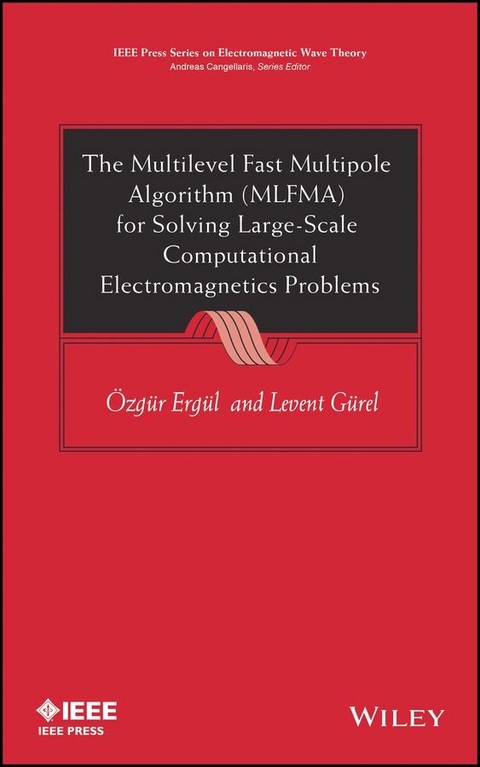
The Multilevel Fast Multipole Algorithm (MLFMA) for Solving Large-Scale Computational Electromagnetics Problems (eBook)
John Wiley & Sons (Verlag)
978-1-118-84490-8 (ISBN)
The Multilevel Fast Multipole Algorithm (MLFMA) for Solving Large-Scale Computational Electromagnetic Problems provides a detailed and instructional overview of implementing MLFMA. The book:
- Presents a comprehensive treatment of the MLFMA algorithm, including basic linear algebra concepts, recent developments on the parallel computation, and a number of application examples
- Covers solutions of electromagnetic problems involving dielectric objects and perfectly-conducting objects
- Discusses applications including scattering from airborne targets, scattering from red blood cells, radiation from antennas and arrays, metamaterials etc.
- Is written by authors who have more than 25 years experience on the development and implementation of MLFMA
The book will be useful for post-graduate students, researchers, and academics, studying in the areas of computational electromagnetics, numerical analysis, and computer science, and who would like to implement and develop rigorous simulation environments based on MLFMA.
Dr Ozgur Ergul, Middle East Technical University, Turkey
Ozgur Ergul received B.Sc., M.S., and PhD degrees from Bilkent University, Turkey, in 2001, 2003 and 2009, respectively, all in electrical and electronic engineering.
Dr Levent Gurel, Bilkent University, Turkey
Levent Gurel received the B.Sc. degree from the Middle East Technical University, Turkey, in 1986, and the M.S. and PhD degrees from the University of Illinois at Urbana-Champaign in 1988 and 1991, respectively, all in electrical engineering.
The Multilevel Fast Multipole Algorithm (MLFMA) for Solving Large-Scale Computational Electromagnetic Problems provides a detailed and instructional overview of implementing MLFMA. The book: Presents a comprehensive treatment of the MLFMA algorithm, including basic linear algebra concepts, recent developments on the parallel computation, and a number of application examples Covers solutions of electromagnetic problems involving dielectric objects and perfectly-conducting objects Discusses applications including scattering from airborne targets, scattering from red blood cells, radiation from antennas and arrays, metamaterials etc. Is written by authors who have more than 25 years experience on the development and implementation of MLFMA The book will be useful for post-graduate students, researchers, and academics, studying in the areas of computational electromagnetics, numerical analysis, and computer science, and who would like to implement and develop rigorous simulation environments based on MLFMA.
Dr Ozgur Ergul, Middle East Technical University, Turkey Ozgur Ergul received B.Sc., M.S., and PhD degrees from Bilkent University, Turkey, in 2001, 2003 and 2009, respectively, all in electrical and electronic engineering. Dr Levent Gurel, Bilkent University, Turkey Levent Gurel received the B.Sc. degree from the Middle East Technical University, Turkey, in 1986, and the M.S. and PhD degrees from the University of Illinois at Urbana-Champaign in 1988 and 1991, respectively, all in electrical engineering.
Cover 1
Title Page 5
Copyright 6
Contents 7
Preface 13
List of Abbreviations 15
Chapter 1 Basics 17
1.1 Introduction 17
1.2 Simulation Environments Based on MLFMA 18
1.3 From Maxwell's Equations to Integro-Differential Operators 19
1.4 Surface Integral Equations 23
1.5 Boundary Conditions 25
1.6 Surface Formulations 26
1.7 Method of Moments and Discretization 28
1.7.1 Linear Functions 31
1.8 Integrals on Triangular Domains 37
1.8.1 Analytical Integrals 38
1.8.2 Gaussian Quadratures 42
1.8.3 Adaptive Integration 42
1.9 Electromagnetic Excitation 45
1.9.1 Plane-Wave Excitation 45
1.9.2 Hertzian Dipole 47
1.9.3 Complex-Source-Point Excitation 47
1.9.4 Delta-Gap Excitation 48
1.9.5 Current-Source Excitation 50
1.10 Multilevel Fast Multipole Algorithm 51
1.11 Low-Frequency Breakdown of MLFMA 55
1.12 Iterative Algorithms 57
1.12.1 Symmetric Lanczos Process 58
1.12.2 Nonsymmetric Lanczos Process 60
1.12.3 Arnoldi Process 61
1.12.4 Golub-Kahan Process 61
1.13 Preconditioning 62
1.14 Parallelization of MLFMA 66
Chapter 2 Solutions of Electromagnetics Problems with Surface Integral Equations 69
2.1 Homogeneous Dielectric Objects 69
2.1.1 Surface Integral Equations 70
2.1.2 Surface Formulations 71
2.1.3 Discretizations of Surface Formulations 74
2.1.4 Direct Calculations of Interactions 76
2.1.5 General Properties of Surface Formulations 83
2.1.6 Decoupling for Perfectly Conducting Surfaces 89
2.1.7 Accuracy with Respect to Contrast 90
2.2 Low-Contrast Breakdown and Its Solution 93
2.2.1 A Combined Tangential Formulation 93
2.2.2 Nonradiating Currents 96
2.2.3 Conventional Formulations in the Limit Case 97
2.2.4 Low-Contrast Breakdown 98
2.2.5 Stabilization by Extraction 98
2.2.6 Double-Stabilized Combined Tangential Formulation 103
2.2.7 Numerical Results for Low Contrasts 104
2.2.8 Breakdown for Extremely Low Contrasts 107
2.2.9 Field-Based-Stabilized Formulations 109
2.2.10 Numerical Results for Extremely Low Contrasts 111
2.3 Perfectly Conducting Objects 121
2.3.1 Comments on the Integral Equations 122
2.3.2 Internal-Resonance Problem 124
2.3.3 Formulations of Open Surfaces 124
2.3.4 Low-Frequency Breakdown 127
2.3.5 Accuracy with the RWG Functions 131
2.3.6 Compatibility of the Integral Equations 138
2.3.7 Convergence to Minimum Achievable Error 140
2.3.8 Alternative Implementations of MFIE 146
2.3.9 Curl-Conforming Basis Functions for MFIE 147
2.3.10 LN-LT Type Basis Functions for MFIE and CFIE 153
2.3.11 Excessive Discretization Error of the Identity Operator 176
2.4 Composite Objects with Multiple Dielectric and Metallic Regions 181
2.4.1 Special Case: Homogeneous Dielectric Object 184
2.4.2 Special Case: Coated Dielectric Object 185
2.4.3 Special Case: Coated Metallic Object 188
2.5 Concluding Remarks 191
Chapter 3 Iterative Solutions of Electromagnetics Problems with MLFMA 193
3.1 Factorization and Diagonalization of the Green's Function 193
3.1.1 Addition Theorem 193
3.1.2 Factorization of the Translation Functions 196
3.1.3 Expansions 199
3.1.4 Diagonalization 200
3.2 Multilevel Fast Multipole Algorithm 202
3.2.1 Recursive Clustering 202
3.2.2 Far-Field Interactions 203
3.2.3 Radiation and Receiving Patterns 204
3.2.4 Near-Field Interactions 206
3.2.5 Sampling 206
3.2.6 Computational Requirements 208
3.2.7 Anterpolation 210
3.3 Lagrange Interpolation and Anterpolation 212
3.3.1 Two-Step Method 214
3.3.2 Virtual Extension of the ?-? Space 215
3.3.3 Sampling at the Poles 217
3.3.4 Interpolation of Translation Operators 221
3.4 MLFMA for Hermitian Matrix-Vector Multiplications 227
3.5 Strategies for Building Less-Accurate MLFMA 229
3.6 Iterative Solutions of Surface Formulations 231
3.6.1 Hybrid Formulations of PEC Objects 232
3.6.2 Iterative Solutions of Normal Equations 242
3.6.3 Iterative Solutions of Dielectric Objects 254
3.6.4 Iterative Solutions of Composite Objects with Multiple Dielectric and Metallic Regions 263
3.7 MLFMA for Low-Frequency Problems 268
3.7.1 Factorization of the Matrix Elements 272
3.7.2 Low-Frequency MLFMA 275
3.7.3 Broadband MLFMA 277
3.7.4 Numerical Results 277
3.8 Concluding Remarks 284
Chapter 4 Parallelization of MLFMA for the Solution of Large-Scale Electromagnetics Problems 285
4.1 On the Parallelization of MLFMA 285
4.2 Parallel Computing Platforms for Numerical Examples 286
4.3 Electromagnetics Problems for Numerical Examples 287
4.4 Simple Parallelizations of MLFMA 287
4.4.1 Near-Field Interactions 287
4.4.2 Far-Field Interactions 289
4.5 The Hybrid Parallelization Strategy 290
4.5.1 Aggregation Stage 291
4.5.2 Translation Stage 293
4.5.3 Disaggregation Stage 294
4.5.4 Communications in Hybrid Parallelizations 294
4.5.5 Numerical Results with the Hybrid Parallelization Strategy 295
4.6 The Hierarchical Parallelization Strategy 299
4.6.1 Hierarchical Partitioning of Tree Structures 299
4.6.2 Aggregation Stage 301
4.6.3 Translation Stage 302
4.6.4 Disaggregation Stage 302
4.6.5 Communications in Hierarchical Parallelizations 303
4.6.6 Irregular Partitioning of Tree Structures 304
4.6.7 Comparisons with Previous Parallelization Strategies 305
4.6.8 Numerical Results with the Hierarchical Parallelization Strategy 307
4.7 Efficiency Considerations for Parallel Implementations of MLFMA 311
4.7.1 Efficient Programming 311
4.7.2 System Software 313
4.7.3 Load Balancing 313
4.7.4 Memory Recycling and Optimizations 318
4.7.5 Parallel Environment 322
4.7.6 Parallel Computers 331
4.8 Accuracy Considerations for Parallel Implementations of MLFMA 333
4.8.1 Mesh Quality 340
4.9 Solutions of Large-Scale Electromagnetics Problems Involving PEC Objects 340
4.9.1 PEC Sphere 342
4.9.2 Other Canonical Problems 354
4.9.3 NASA Almond 358
4.9.4 Flamme 370
4.10 Solutions of Large-Scale Electromagnetics Problems Involving Dielectric Objects 374
4.11 Concluding Remarks 384
Chapter 5 Applications 385
5.1 Case Study: External Resonances of the Flamme 385
5.2 Case Study: Realistic Metamaterials Involving Split-Ring Resonators and Thin Wires 389
5.3 Case Study: Photonic Crystals 393
5.4 Case Study: Scattering from Red Blood Cells 396
5.5 Case Study: Log-Periodic Antennas and Arrays 405
5.5.1 Nonplanar Trapezoidal-Tooth Log-Periodic Antennas 405
5.5.2 Circular Arrays of Log-Periodic Antennas 411
5.5.3 Circular-Sectoral Arrays of Log-Periodic Antennas 419
5.6 Concluding Remarks 426
Appendix 427
A.1 Limit Part of the k Operator 427
A.2 Post Processing 428
A.2.1 Near-Zone Electromagnetic Fields 429
A.2.2 Far-Zone Fields 430
A.3 More Details of the Hierarchical Partitioning Strategy 439
A.3.1 Aggregation/Disaggregation Stages 439
A.3.2 Translation Stage 440
A.4 Mie-Series Solutions 441
A.4.1 Definitions 442
A.4.2 Debye Potentials 442
A.4.3 Electric and Magnetic Fields 443
A.4.4 Incident Fields 443
A.4.5 Perfectly Conducting Sphere 444
A.4.6 Dielectric Sphere 444
A.4.7 Coated Perfectly Conducting Sphere 445
A.4.8 Coated Dielectric Sphere 446
A.4.9 Far-Field Expressions 448
A.5 Electric-Field Volume Integral Equation 449
A.6 Calculation of Some Special Functions 453
A.6.1 Spherical Bessel Functions 453
A.6.2 Legendre Functions 453
A.6.3 Gradient of Multipole-to-Monopole Shift Functions 455
A.6.4 Gaunt Coefficients 455
References 457
Index 469
Supplemental Images 472
| Erscheint lt. Verlag | 9.4.2014 |
|---|---|
| Reihe/Serie | IEEE/OUP Series on Electromagnetic Wave Theory (formerly IEEE only), Series Editor: Donald G. Dudley. | IEEE Press Series on Electromagnetic Wave Theory |
| Sprache | englisch |
| Themenwelt | Naturwissenschaften ► Physik / Astronomie ► Elektrodynamik |
| Technik ► Elektrotechnik / Energietechnik | |
| Schlagworte | Antennas & Propagation • Electrical & Electronics Engineering • Electromagnetic theory • Elektromagnetismus • Elektrotechnik u. Elektronik • Levent Gurel • metamaterials • Mikrowellen- u. Hochfrequenztechnik u. Theorie • Ozgur Ergul • radiation from antennas and arrays • RF / Microwave Theory & Techniques • scattering from airborne targets • scattering from red blood cells • Sende- u. Empfangseinrichtungen • The Multilevel Fast Multipole Algorithm (MLFMA) for Solving Large-scale Computational Electromagnetics Problems |
| ISBN-10 | 1-118-84490-4 / 1118844904 |
| ISBN-13 | 978-1-118-84490-8 / 9781118844908 |
| Informationen gemäß Produktsicherheitsverordnung (GPSR) | |
| Haben Sie eine Frage zum Produkt? |
 PDF (Adobe DRM)
Kopierschutz: Adobe-DRM
Adobe-DRM ist ein Kopierschutz, der das eBook vor Mißbrauch schützen soll. Dabei wird das eBook bereits beim Download auf Ihre persönliche Adobe-ID autorisiert. Lesen können Sie das eBook dann nur auf den Geräten, welche ebenfalls auf Ihre Adobe-ID registriert sind.
Details zum Adobe-DRM
Dateiformat: PDF (Portable Document Format)
Mit einem festen Seitenlayout eignet sich die PDF besonders für Fachbücher mit Spalten, Tabellen und Abbildungen. Eine PDF kann auf fast allen Geräten angezeigt werden, ist aber für kleine Displays (Smartphone, eReader) nur eingeschränkt geeignet.
Systemvoraussetzungen:
PC/Mac: Mit einem PC oder Mac können Sie dieses eBook lesen. Sie benötigen eine
eReader: Dieses eBook kann mit (fast) allen eBook-Readern gelesen werden. Mit dem amazon-Kindle ist es aber nicht kompatibel.
Smartphone/Tablet: Egal ob Apple oder Android, dieses eBook können Sie lesen. Sie benötigen eine
Geräteliste und zusätzliche Hinweise
Buying eBooks from abroad
For tax law reasons we can sell eBooks just within Germany and Switzerland. Regrettably we cannot fulfill eBook-orders from other countries.
aus dem Bereich