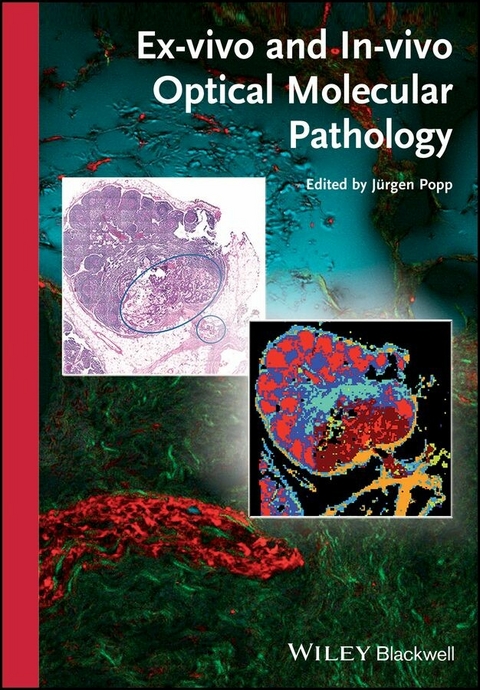
The introductory chapters cover the present status and limitations of currently used methods, followed by an outline of promising novel spectroscopy-based technologies either under development or recently available on the market. The input from both technologists developing these new methods as well as routine clinicians familiar with practical aspects and medical relevance guarantees that this practical work is a valuable asset for a wide audience, including technical personnel and decision makers in treatment centers, experts working in companies developing diagnostic devices, and clinicians specializing in advanced diagnostic methods. Since basic researchers are increasingly adopting novel diagnostic tools developed for human use as well, this will also be of interest for biomedical research institutions with large animal facilities.
Jurgen Popp is Professor at the Friedrich-Schiller-University Jena where he is Director of the Institute of Physical Chemistry. He is also Director of the Institute of Physical High Technology (IPHT) Jena. In the German Main Research Topic 'Biophotonik' (National Network financed by the BMBF) he serves as the speaker.
Jürgen Popp is Professor at the Friedrich-Schiller-University Jena where he is Director of the Institute of Physical Chemistry. He is also Director of the Institute of Physical High Technology (IPHT) Jena. In the German Main Research Topic 'Biophotonik' (National Network financed by the BMBF) he serves as the speaker.
Clinical Pathology (M. Mireskandari, I. Petersen)
Clinical Endoscopy in Gastrointestinal Diseases (M. Goetz, J. Felber, A. Stallmach)
Molecular Pathology via Infrared and Raman Spectral Imaging (M. Diem, A. Mazur, K. Lenau, J. Schubert, B. Bird, M. Miljkovic, C. Krafft, J. Popp)
Coherent Raman for Medical Diagnosis (J.L. Suhalim, E. Potma)
Multimodal Morphochemical Tissue Imaging (R. Cicchi, F.S. Pavone)
Molecular Endospectroscopic Approaches (N. Stone, C. Kallaway, L.M. Almond, J. Wood, J. Hutchings, C. Kendall, H. Barr)
Image Processing - Chemometric Approaches to Analyze Optical Molecular Images (T. Bocklitz, M. Schmitt, J. Popp)
Summary and Conclusions (C. Matthäus, M. Schmitt, J. Popp)
Preface
Spectroscopy, in general, plays an invaluable role in clinical diagnostics. The principle that all of these analytical techniques have in common is the interaction of electromagnetic radiation with the human body or a sample biopsy. All these techniques can be further divided into invasive and noninvasive methods. Long established are colorimetric methods that are based on absorption in the visible region of the spectrum, fluorescence, and optoacoustic techniques. A typical application of fluorescence is, for instance, flow cytometry. Optoacoustic effects are mainly employed for imaging, such as, for instance, the oxygenation level of blood. Examples that utilize light in the near-infrared (NIR) are optical coherence tomography (OCT) and NIR spectroscopy. OCT has become very popular in ophthalmology, dermatology, and cardiology. NIR spectroscopy is used, for instance, to measure blood sugar or to determine the saturation level of hemoglobin.
Visualization techniques commonly used in everyday clinical routines are often based on white light and are essential for the detection and diagnosis of diseases, as well as for the estimation of the risks associated with the disease. Also, for monitoring the development during treatment, these visualization techniques are essential. Endoscopy, for example, can visualize the inside of various organs such as the esophagus, the stomach, or the colon, and is therefore one of the most important techniques in internal medicine. Also very important in pathology are microscopic techniques. Bright-field microscopy is still the most widely used type of microscopy to investigate pathological biopsy samples. It is essential for the evaluation of cancer types, cancer grades, various inflammatory diseases, or changes associated with genetic disorders. There is no doubt that conventional pathology will always be based on these basic visualization techniques. However, by simply looking at structural changes in tissues and cells, there are often diagnostic questions that a pathologist cannot answer with absolute certainty. For instance, it is often very difficult to distinguish between certain cancer types. A better evaluation would often have consequences not only for the diagnosis but also for the treatment of the patient. Another important aspect is the time lag between the inspection of the patient and the preparation of the pathological report. By the application of new technologies, it is possible to have the routinely stained slides of small biopsy samples for microscopic evaluation on the same day of specimen acquisition. In uncomplicated cases, the final diagnosis can be made and the pathology report finalized on the same day. Problems occur if the specimen needs to be evaluated by ancillary methods (immunohistochemistry, molecular analysis) to reach a final and definite diagnosis. These ancillary tests can take a few days to be accomplished. The large resection specimens have to be fixed properly before processing and need to be sectioned cautiously before microscopic evaluations. A time frame of a few days to a week is needed for a complete evaluation of large samples. This unacceptable but legitimate delay contributes sometimes to the discomfort of the patient. Another aspect in pathology is the objectivity of the diagnosis itself. Although nothing can ever replace the trained eye of the pathologist, the evaluation of a pathological sample remains a matter of subjectivity. The same sample given to different pathologists may result in conflicting diagnoses. Interobserver variability is a well-known phenomenon in diagnostic pathology. Although false diagnoses by an experienced pathologist are generally rare, they are not impossible. In general, it would be advantageous if the pathologist could obtain more information about the sample or diseased area he is looking at. There are several imunohistochemical-based protocols, but they are usually limited to the analysis of a single protein. The inspection of multiple biomarkers simultaneously is rare. In addition, it may become expensive and time consuming to investigate a panel of markers. Spectroscopy offers great advantage to actually obtain chemical information about the sample. In other words, qualitative and quantitative biochemical information can be correlated with the pathology. The potential of such a combination is as wide as the field of pathology itself. Knowledge of the chemical composition of the sample would improve the evaluation of the state of the disease: for instance, what grade of malignancy the cancer has reached. It would also be possible to learn more about the origin of a cancer in the case of metastases. A great advantage over histopathology would be a faster pre-evaluation. Spectroscopic screening techniques can be, to a great extent, automated and can be operated by clinical personnel. Therefore, by screening the samples it would be possible to sort the potentially more dangerous cases before evaluation by the pathologist. This could be done on the same day, immediately after the inspection. The time-saving aspect would improve the diagnosis enormously. Additionally, the objective chemical information can be combined with the pathological diagnosis. Another great advantage is that potentially many spectroscopic techniques can be applied in vivo. Therefore, a coupling of spectroscopic fibers with endoscopes is possible. In addition to the visual image, the pathologist obtains valuable information about the chemical composition of the critical area at the same time. The potential to introduce new spectroscopic techniques into the operating theater could have great consequences for improving the decision making of the surgeon.
More recently, molecular spectroscopic techniques that are based on molecular vibrations have been applied to biomedical problems. The concept again is to combine well-established methods from analytical chemistry with optical techniques well established in medicine. The two main vibrational spectroscopy techniques are infrared (IR) spectroscopy, which is based on light absorption within the wavelength range of 2.5–25 μ m, and Raman spectroscopy, which is based on inelastic light scattering in the visible range. The coupling of these techniques to optical instrumentation has led to a tremendous growth within the field of vibrational spectroscopy. For clinical applications, the analytical instrumentation can be combined with either microscopes or endoscopes. The obtained spectral information is in comparison with, for instance, fluorescence very rich and specific. Both IR and Raman microscopy have been successfully employed to study compositional changes associated with various diseases. The two major advantages of both techniques are that they are noninvasive or minimally invasive and can be applied completely label free. Conventional histo- or imunohistochemical pathology and cytology rely on often poorly standardized staining protocols and the trained eye of the pathologist. Conceptually, IR and Raman microscopy can be automated, which would allow faster diagnosis. Because both techniques are noninvasive, the samples can be counterstained after the measurement and compared with standard histopathology. Over the past 10 years, IR and Raman microscopy have been applied to biopsy samples from virtually every organ.
When compared with each other, both techniques have advantages and disadvantages. Absorption measurements in the IR can be obtained relatively fast, which makes it possible to scan whole tissue sections within a reasonable time frame. On the other hand, the penetration depth is relatively small, so that the samples have to be cut into 5–10 μ m thin sections. Also problematic is the high absorption coefficient of water. These facts make IR microscopy very feasible to complement common histopathology and histocytology, but they hinder applications in vivo. Raman measurements can be performed under in vivo conditions, but require longer illumination times.
Other spectroscopic imaging approaches utilize nonlinear optical effects. Under illumination with pulsed laser radiation, molecules show various properties, which are, again, molecule specific and can therefore be used for characterization and identification. Today, most established for biological and medical applications is two-photon excited fluorescence (TPEF) spectroscopy. In TEPF, two photons of relatively long wavelength are used for excitation. Because of the application of the longer wavelength, the method is less invasive and leads to deeper penetration depths. As a consequence, TPEF can be applied in vivo and has been, for instance, used to image neurons. Another two-photon effect is second harmonic generation (SHG), which is ideal for imaging of centrosymmetric molecules such as collagen. Related to vibrational spectroscopy are the nonlinear Raman phenomena of coherent anti-Stokes Raman scattering (CARS) microscopy and stimulated Raman scattering (SRS). CARS microscopy allows rapid imaging of single molecular vibrations over fairly large areas. All these nonlinear imaging techniques can be combined, which is often referred to as multimodal imaging.
This book “Ex Vivo and In Vivo Optical Pathology” aims at introducing all the vibrational spectroscopic and nonlinear techniques in combination with modern pathology and illustrates their enormous potential for clinical applications. In particular, it addresses pathologists and medical doctors, as they are in the key positions to implement any new technical devices associated with the development of new instrumentation. The book should be a motivation to clinicians working in the field of pathology to be open to new technology. As the field of optical pathology is in...
| Erscheint lt. Verlag | 14.3.2014 |
|---|---|
| Sprache | englisch |
| Themenwelt | Naturwissenschaften ► Biologie ► Mikrobiologie / Immunologie |
| Technik | |
| Schlagworte | available • Between • Biowissenschaften • Book • Chemie • Chemistry • Clinical • Clinicians • Collaboration • currently • Diagnostic • Endoscopy • Endoskopie • Generation • introductory chapters • Life Sciences • Limitations • Market • Medical Cell Biology • Medical Science • Medizin • Medizinische Zellbiologie • Methods • Molekularpathologie • New • Outline • Overview • Pathology • present status • result • spectroscopy • spectroscopybased • Spektroskopie • Tools • Unique • Zellbiologie |
| ISBN-10 | 3-527-68191-4 / 3527681914 |
| ISBN-13 | 978-3-527-68191-4 / 9783527681914 |
| Informationen gemäß Produktsicherheitsverordnung (GPSR) | |
| Haben Sie eine Frage zum Produkt? |
 EPUB (Adobe DRM)
Kopierschutz: Adobe-DRM
Adobe-DRM ist ein Kopierschutz, der das eBook vor Mißbrauch schützen soll. Dabei wird das eBook bereits beim Download auf Ihre persönliche Adobe-ID autorisiert. Lesen können Sie das eBook dann nur auf den Geräten, welche ebenfalls auf Ihre Adobe-ID registriert sind.
Details zum Adobe-DRM
Dateiformat: EPUB (Electronic Publication)
EPUB ist ein offener Standard für eBooks und eignet sich besonders zur Darstellung von Belletristik und Sachbüchern. Der Fließtext wird dynamisch an die Display- und Schriftgröße angepasst. Auch für mobile Lesegeräte ist EPUB daher gut geeignet.
Systemvoraussetzungen:
PC/Mac: Mit einem PC oder Mac können Sie dieses eBook lesen. Sie benötigen eine
eReader: Dieses eBook kann mit (fast) allen eBook-Readern gelesen werden. Mit dem amazon-Kindle ist es aber nicht kompatibel.
Smartphone/Tablet: Egal ob Apple oder Android, dieses eBook können Sie lesen. Sie benötigen eine
Geräteliste und zusätzliche Hinweise
Buying eBooks from abroad
For tax law reasons we can sell eBooks just within Germany and Switzerland. Regrettably we cannot fulfill eBook-orders from other countries.
aus dem Bereich