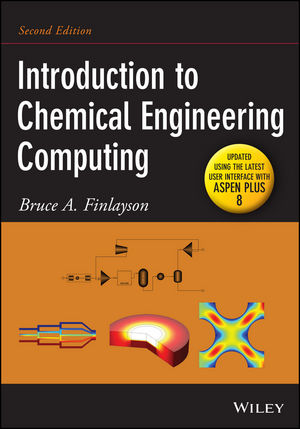
Introduction to Chemical Engineering Computing (eBook)
John Wiley & Sons (Verlag)
978-1-118-88837-7 (ISBN)
Step-by-step instructions enable chemical engineers to master key software programs and solve complex problems
Today, both students and professionals in chemical engineering must solve increasingly complex problems dealing with refineries, fuel cells, microreactors, and pharmaceutical plants, to name a few. With this book as their guide, readers learn to solve these problems using their computers and Excel, MATLAB, Aspen Plus, and COMSOL Multiphysics. Moreover, they learn how to check their solutions and validate their results to make sure they have solved the problems correctly.
Now in its Second Edition, Introduction to Chemical Engineering Computing is based on the author's firsthand teaching experience. As a result, the emphasis is on problem solving. Simple introductions help readers become conversant with each program and then tackle a broad range of problems in chemical engineering, including:
- Equations of state
- Chemical reaction equilibria
- Mass balances with recycle streams
- Thermodynamics and simulation of mass transfer equipment
- Process simulation
- Fluid flow in two and three dimensions
All the chapters contain clear instructions, figures, and examples to guide readers through all the programs and types of chemical engineering problems. Problems at the end of each chapter, ranging from simple to difficult, allow readers to gradually build their skills, whether they solve the problems themselves or in teams. In addition, the book's accompanying website lists the core principles learned from each problem, both from a chemical engineering and a computational perspective.
Covering a broad range of disciplines and problems within chemical engineering, Introduction to Chemical Engineering Computing is recommended for both undergraduate and graduate students as well as practicing engineers who want to know how to choose the right computer software program and tackle almost any chemical engineering problem.
BRUCE A. FINLAYSON, PhD, is Rehnberg Professor Emeritus of Chemical Engineering in the Department of Chemical Engineering of the University of Washington. He is also a former president of the American Institute of Chemical Engineers (AIChE). Among his many accolades and honors, Dr. Finlayson is a recipient of the AIChE's prestigious William H. Walker Award and an elected member of the National Academy of Engineering.
Step-by-step instructions enable chemical engineers to master key software programs and solve complex problems Today, both students and professionals in chemical engineering must solve increasingly complex problems dealing with refineries, fuel cells, microreactors, and pharmaceutical plants, to name a few. With this book as their guide, readers learn to solve these problems using their computers and Excel, MATLAB, Aspen Plus, and COMSOL Multiphysics. Moreover, they learn how to check their solutions and validate their results to make sure they have solved the problems correctly. Now in its Second Edition, Introduction to Chemical Engineering Computing is based on the author s firsthand teaching experience. As a result, the emphasis is on problem solving. Simple introductions help readers become conversant with each program and then tackle a broad range of problems in chemical engineering, including: Equations of state Chemical reaction equilibria Mass balances with recycle streams Thermodynamics and simulation of mass transfer equipment Process simulation Fluid flow in two and three dimensions All the chapters contain clear instructions, figures, and examples to guide readers through all the programs and types of chemical engineering problems. Problems at the end of each chapter, ranging from simple to difficult, allow readers to gradually build their skills, whether they solve the problems themselves or in teams. In addition, the book s accompanying website lists the core principles learned from each problem, both from a chemical engineering and a computational perspective. Covering a broad range of disciplines and problems within chemical engineering, Introduction to Chemical Engineering Computing is recommended for both undergraduate and graduate students as well as practicing engineers who want to know how to choose the right computer software program and tackle almost any chemical engineering problem.
BRUCE A. FINLAYSON, PhD, is Rehnberg Professor Emeritus of Chemical Engineering in the Department of Chemical Engineering of the University of Washington. He is also a former president of the American Institute of Chemical Engineers (AIChE). Among his many accolades and honors, Dr. Finlayson is a recipient of the AIChE's prestigious William H. Walker Award and an elected member of the National Academy of Engineering.
PREFACE
Chemical engineering students and chemical engineers are being asked to solve problems that are increasingly complex, whether the applications are in refineries, fuel cells, microreactors, or pharmaceutical plants. Many years ago, students wrote their own programs, first in the FORTRAN programming language, then in languages such as MATLAB®. However, with the growth in personal computers, software has been written that solves many problems for students, provided they use the programs correctly. Thus, the emphasis shifted from a small group of people who were interested in writing their own programs to a large group of students who will use the programs, but do not write them. In my 42 years of teaching at the University of Washington, I taught those small groups of students how to use numerical analysis to solve complicated problems. Now, I teach all the students how to use the computer wisely. Only a few of the students I teach are interested in the numerical analysis (to my sorrow!), but all the students know they must be able to solve difficult problems, and they need to use the computer to do that.
The goals of this book are to illustrate (a) the problems chemical engineers have to solve, (b) the type of computer programs used to solve them, and (c) how engineers check to be sure they have solved the problems correctly. This is done in the context of how contemporary students learn—minimal reading, just-in-time learning, with lots of computer usage. The programs demonstrated here are Excel®, MATLAB®, Aspen Plus®, and Comsol Multiphysics®.
When writing this book, I assumed that readers are not absolute beginners. Junior and senior chemical engineering students have had experience with spreadsheet programs such as Excel, and they can easily learn on the computer when provided a direction and key ideas or phrases. In fact, many students are more computer-savvy than their instructors. However, a beginner chemical engineering student may not know the application very well and may not have gained a solid understanding of the physical phenomenon behind an engineering problem. Furthermore, they may not have solved very difficult problems. Thus, it is important to give some explanation of why students need to solve certain problems and how to overcome the obstacles when the problems tax the numerical methods. I have drawn on my experience to give insights into the problems in this book.
My teaching philosophy is that the problems engineers are solving today are usually intractable with analytical methods, but they can be solved with the sophisticated software available today. Thus, every engineer will be solving a problem that no one knows the answer to, and it is the engineer’s job to ensure that the problem is posed correctly on paper and in the computer, and it is correctly solved. Engineering students must know how to determine if the computer solved the problem correctly by validating the work done by the computer. If they can do this, they can convince their instructor—or their future boss—that they have a solution that is every bit as reliable as an analytical solution, although without the analytical form and for a problem that cannot be solved analytically. In fact, 98% of the problems in this book are nonlinear and only a few of them have analytical solutions.
HOW TO USE THIS BOOK IN TEACHING
This book grew out of a course I developed at the University of Washington, beginning in 2003. The course is part lecture and part hands-on computer work in a computer laboratory. I usually provide simple problems for the students to solve in the laboratory, when help is available, to help them get over the barrier of using an unfamiliar program. But then, students have to solve a problem that expands their knowledge of chemical engineering and demonstrates they have used the program correctly (and described the checks they made). Since the applications cover much of the chemical engineering field, I joke with the students, saying, “I'm teaching you the entire field in 20 hours.” Although I retired from teaching the course in 2009, the same objectives still apply.
This book can also be used in other courses since each chapter is keyed to a course in the curriculum. Once chemical reaction equilibrium has been discussed in the Thermodynamics class, for example, instructors can hold a laboratory session that teaches computer applications, using the chapter on chemical reaction equilibrium. The material on choice of thermodynamic model (and comparisons) also adds a bit of realism to the Thermodynamics course. Other chapters could be used in other courses. In this way, the students would use the book during their entire education, in course after course: Mass and Energy Balances, Transport of Heat, Mass, and Momentum, Reactor Design, and courses concentrating on projects such as biomedical engineering. The hope is, of course, that students would then be able to concentrate more on the chemical engineering principles and use the computer as a tool.
There are four programs that are featured in this book. It is possible that your school does not use all four. Although the screen images may be different, the ideas and procedures are the same. Certainly the problems can be solved using other programs. In a working environment, engineers use what their company provides. Thus, engineers may use a less powerful program because it is available. The more powerful program may cost more, too. Thus, in several chapters, the same problem is solved using different programs, which lets students see first-hand that the more general purpose programs require significantly more programming to solve complicated problems. In my experience, when given a suite of programs, students will use the one that allows them to solve their problem fastest. The program Comsol Multiphysics comes in many modules. Nearly all the problems in this book can be solved by the basic module, although there are cases where the Chemical Reaction Engineering Module is useful. Connections with MATLAB are made with LiveLinkTM for MATLAB, another module. There are only a couple of problems involving turbulent flow, and those require the CFD module. A complete list of what you get with various combinations is available from Comsol and my list is on the book website (see Appendix D).
Each chapter begins with a list of instructional objectives. In addition, the book website has a list of principles learned from each problem, both from a chemical engineering viewpoint and a computer/computer technique viewpoint. Professors that use the book are encouraged to discuss possible use in other chemical engineering courses so that more advanced problems can be solved in them, too. The indices are available on the book website, too, since students prefer using the Internet rather than turning to the back of the book; more importantly, they can be downloaded and searched for a phrase.
WHAT IS NEW?
One big change from the first edition is the fact that all four programs now have different interfaces than they did in 2005. More importantly, they have greatly enhanced capabilities. I have cut back on some explanations and refer the user to the help menus that come with the programs, since those have improved, too, and they give more information than the book can. But, I provide hints where to look.
The number of problems has approximately doubled. More importantly, the added problems are concentrated in the field of energy: integrated gas-combined cycle, including low temperature air separation, making ethanol from switchgrass, and pressure swing adsorption to make hydrogen to fuel cars. In each case a discussion of the field precedes the definition of the problem so that students can see the applicability. Microfluidics has expanded since 2005, and there are added problems in the field of biomedical applications. This has lead to many more examples and problems involving fluid flow and diffusion in two and three dimensions. An important addition was made in Aspen Plus 7.3: now you have direct access within the program to experimental data on pressure–volume–temperature of pure components and binary vapor–liquid equilibria as summarized by the National Institute of Standards and Technology. This is very important for chemical engineers, since the choice of thermodynamic model must usually be accompanied by a comparison with experimental data, and that is now made very easy—so easy that it would be unprofessional not to do the comparison. Thus, the thermodynamic sections of the book include industrial guidelines, some molecular considerations, and experimental data for comparison. Aspen Plus also has the capability to easily summarize the greenhouse impact of a process. There are talks made by professors about how they used AspenTech products in their courses; contact: University.Program@aspentech.com. One thing that is pointed out by Professor Luyben is that material and energy balances are primarily flow-based, whereas safety problems must be pressure based (and dynamic). The dynamic options are not treated here in detail, but are often covered in a control course. Aspen Plus runs under Microsoft Windows, but the author ran it under Windows by using Parallels Desktop for Mac on an Apple computer. The second edition also has examples running Aspen Plus with a simple user-defined FORTRAN program. The book uses Aspen Plus 8.0.
Some professors like to have more numerical programming in their courses, so a number of problems like that have been added to the end of many chapters. They make a good contrast—solve them using the numerical programming and then solve them using one of the four...
| Erscheint lt. Verlag | 5.3.2014 |
|---|---|
| Sprache | englisch |
| Themenwelt | Mathematik / Informatik ► Mathematik |
| Naturwissenschaften ► Chemie ► Technische Chemie | |
| Technik ► Maschinenbau | |
| Technik ► Umwelttechnik / Biotechnologie | |
| Schlagworte | Book • Chemical • chemical engineering • Chemische Verfahrenstechnik • Complex Problems • Computers • correctly • Dealing • enable • Engineering • Engineering statistics • engineers • Increasingly • Instructions • Key • Maschinenbau • Master • mechanical engineering • Problems • Professionals • Programs • Readers • refineries • Software • Solutions • Statistics • Statistik • Statistik in den Ingenieurwissenschaften • stepbystep • Today |
| ISBN-10 | 1-118-88837-5 / 1118888375 |
| ISBN-13 | 978-1-118-88837-7 / 9781118888377 |
| Informationen gemäß Produktsicherheitsverordnung (GPSR) | |
| Haben Sie eine Frage zum Produkt? |
 EPUB (Adobe DRM)
Kopierschutz: Adobe-DRM
Adobe-DRM ist ein Kopierschutz, der das eBook vor Mißbrauch schützen soll. Dabei wird das eBook bereits beim Download auf Ihre persönliche Adobe-ID autorisiert. Lesen können Sie das eBook dann nur auf den Geräten, welche ebenfalls auf Ihre Adobe-ID registriert sind.
Details zum Adobe-DRM
Dateiformat: EPUB (Electronic Publication)
EPUB ist ein offener Standard für eBooks und eignet sich besonders zur Darstellung von Belletristik und Sachbüchern. Der Fließtext wird dynamisch an die Display- und Schriftgröße angepasst. Auch für mobile Lesegeräte ist EPUB daher gut geeignet.
Systemvoraussetzungen:
PC/Mac: Mit einem PC oder Mac können Sie dieses eBook lesen. Sie benötigen eine
eReader: Dieses eBook kann mit (fast) allen eBook-Readern gelesen werden. Mit dem amazon-Kindle ist es aber nicht kompatibel.
Smartphone/Tablet: Egal ob Apple oder Android, dieses eBook können Sie lesen. Sie benötigen eine
Geräteliste und zusätzliche Hinweise
Buying eBooks from abroad
For tax law reasons we can sell eBooks just within Germany and Switzerland. Regrettably we cannot fulfill eBook-orders from other countries.
aus dem Bereich