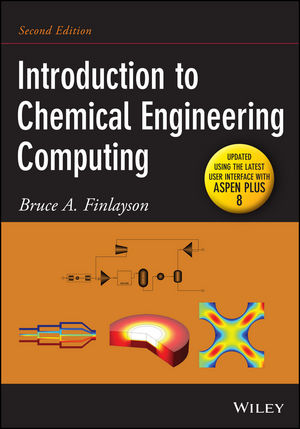
Introduction to Chemical Engineering Computing (eBook)
John Wiley & Sons (Verlag)
978-1-118-88850-6 (ISBN)
Step-by-step instructions enable chemical engineers to master key software programs and solve complex problems
Today, both students and professionals in chemical engineering must solve increasingly complex problems dealing with refineries, fuel cells, microreactors, and pharmaceutical plants, to name a few. With this book as their guide, readers learn to solve these problems using their computers and Excel, MATLAB, Aspen Plus, and COMSOL Multiphysics. Moreover, they learn how to check their solutions and validate their results to make sure they have solved the problems correctly.
Now in its Second Edition, Introduction to Chemical Engineering Computing is based on the author's firsthand teaching experience. As a result, the emphasis is on problem solving. Simple introductions help readers become conversant with each program and then tackle a broad range of problems in chemical engineering, including:
- Equations of state
- Chemical reaction equilibria
- Mass balances with recycle streams
- Thermodynamics and simulation of mass transfer equipment
- Process simulation
- Fluid flow in two and three dimensions
All the chapters contain clear instructions, figures, and examples to guide readers through all the programs and types of chemical engineering problems. Problems at the end of each chapter, ranging from simple to difficult, allow readers to gradually build their skills, whether they solve the problems themselves or in teams. In addition, the book's accompanying website lists the core principles learned from each problem, both from a chemical engineering and a computational perspective.
Covering a broad range of disciplines and problems within chemical engineering, Introduction to Chemical Engineering Computing is recommended for both undergraduate and graduate students as well as practicing engineers who want to know how to choose the right computer software program and tackle almost any chemical engineering problem.
BRUCE A. FINLAYSON, PhD, is Rehnberg Professor Emeritus of Chemical Engineering in the Department of Chemical Engineering of the University of Washington. He is also a former president of the American Institute of Chemical Engineers (AIChE). Among his many accolades and honors, Dr. Finlayson is a recipient of the AIChE's prestigious William H. Walker Award and an elected member of the National Academy of Engineering.
Step-by-step instructions enable chemical engineers to master key software programs and solve complex problems Today, both students and professionals in chemical engineering must solve increasingly complex problems dealing with refineries, fuel cells, microreactors, and pharmaceutical plants, to name a few. With this book as their guide, readers learn to solve these problems using their computers and Excel, MATLAB, Aspen Plus, and COMSOL Multiphysics. Moreover, they learn how to check their solutions and validate their results to make sure they have solved the problems correctly. Now in its Second Edition, Introduction to Chemical Engineering Computing is based on the author s firsthand teaching experience. As a result, the emphasis is on problem solving. Simple introductions help readers become conversant with each program and then tackle a broad range of problems in chemical engineering, including: Equations of state Chemical reaction equilibria Mass balances with recycle streams Thermodynamics and simulation of mass transfer equipment Process simulation Fluid flow in two and three dimensions All the chapters contain clear instructions, figures, and examples to guide readers through all the programs and types of chemical engineering problems. Problems at the end of each chapter, ranging from simple to difficult, allow readers to gradually build their skills, whether they solve the problems themselves or in teams. In addition, the book s accompanying website lists the core principles learned from each problem, both from a chemical engineering and a computational perspective. Covering a broad range of disciplines and problems within chemical engineering, Introduction to Chemical Engineering Computing is recommended for both undergraduate and graduate students as well as practicing engineers who want to know how to choose the right computer software program and tackle almost any chemical engineering problem.
BRUCE A. FINLAYSON, PhD, is Rehnberg Professor Emeritus of Chemical Engineering in the Department of Chemical Engineering of the University of Washington. He is also a former president of the American Institute of Chemical Engineers (AIChE). Among his many accolades and honors, Dr. Finlayson is a recipient of the AIChE's prestigious William H. Walker Award and an elected member of the National Academy of Engineering.
| Erscheint lt. Verlag | 25.3.2014 |
|---|---|
| Sprache | englisch |
| Themenwelt | Mathematik / Informatik ► Mathematik |
| Naturwissenschaften ► Chemie ► Technische Chemie | |
| Technik ► Maschinenbau | |
| Technik ► Umwelttechnik / Biotechnologie | |
| Schlagworte | Book • Chemical • chemical engineering • Chemische Verfahrenstechnik • Complex Problems • Computers • correctly • Dealing • enable • Engineering • Engineering statistics • engineers • Increasingly • Instructions • Key • Maschinenbau • Master • mechanical engineering • Problems • Professionals • Programs • Readers • refineries • Software • Solutions • Statistics • Statistik • Statistik in den Ingenieurwissenschaften • stepbystep • Today |
| ISBN-10 | 1-118-88850-2 / 1118888502 |
| ISBN-13 | 978-1-118-88850-6 / 9781118888506 |
| Informationen gemäß Produktsicherheitsverordnung (GPSR) | |
| Haben Sie eine Frage zum Produkt? |
 PDF (Adobe DRM)
Kopierschutz: Adobe-DRM
Adobe-DRM ist ein Kopierschutz, der das eBook vor Mißbrauch schützen soll. Dabei wird das eBook bereits beim Download auf Ihre persönliche Adobe-ID autorisiert. Lesen können Sie das eBook dann nur auf den Geräten, welche ebenfalls auf Ihre Adobe-ID registriert sind.
Details zum Adobe-DRM
Dateiformat: PDF (Portable Document Format)
Mit einem festen Seitenlayout eignet sich die PDF besonders für Fachbücher mit Spalten, Tabellen und Abbildungen. Eine PDF kann auf fast allen Geräten angezeigt werden, ist aber für kleine Displays (Smartphone, eReader) nur eingeschränkt geeignet.
Systemvoraussetzungen:
PC/Mac: Mit einem PC oder Mac können Sie dieses eBook lesen. Sie benötigen eine
eReader: Dieses eBook kann mit (fast) allen eBook-Readern gelesen werden. Mit dem amazon-Kindle ist es aber nicht kompatibel.
Smartphone/Tablet: Egal ob Apple oder Android, dieses eBook können Sie lesen. Sie benötigen eine
Geräteliste und zusätzliche Hinweise
Buying eBooks from abroad
For tax law reasons we can sell eBooks just within Germany and Switzerland. Regrettably we cannot fulfill eBook-orders from other countries.
aus dem Bereich