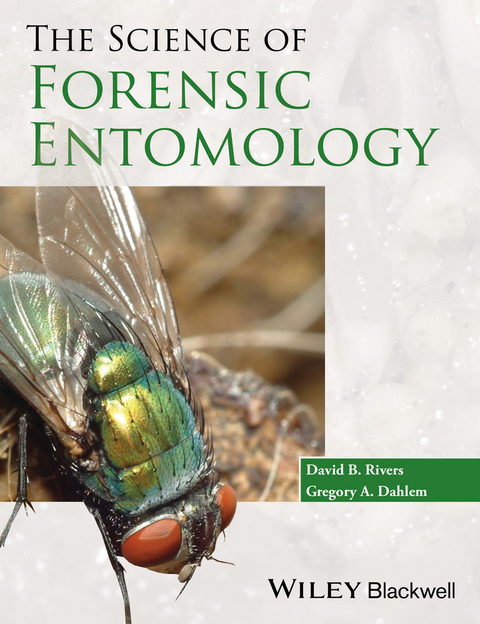
The Science of Forensic Entomology (eBook)
John Wiley & Sons (Verlag)
978-1-118-40303-7 (ISBN)
The Science of Forensic Entomology builds a foundation of biological and entomological knowledge that equips the student to be able to understand and resolve questions concerning the presence of specific insects at a crime scene, in which the answers require deductive reasoning, seasoned observation, reconstruction and experimentation-features required of all disciplines that have hypothesis testing at its core. Each chapter addresses topics that delve into the underlying biological principles and concepts relevant to the insect biology that forms the bases for using insects in matters of legal importance.
The book is more than an introduction to forensic entomology as it offers in depth coverage of non-traditional topics, including the biology of maggot masses, temperature tolerances of necrophagous insects; chemical attraction and communication; reproductive strategies of necrophagous flies; archaeoentomology, and use of insects in modern warfare (terrorism). As such it will enable advanced undergraduate and postgraduate students the opportunity to gain a sound knowledge of the principles, concepts and methodologies necessary to use insects and other arthropods in a wide range of legal matters.
David B Rivers
Loyola University Maryland, Maryland, USA
Gregory Dahlem
Northern Kentucky University, Kentucky, USA
The Science of Forensic Entomology builds a foundation of biological and entomological knowledge that equips the student to be able to understand and resolve questions concerning the presence of specific insects at a crime scene, in which the answers require deductive reasoning, seasoned observation, reconstruction and experimentation features required of all disciplines that have hypothesis testing at its core. Each chapter addresses topics that delve into the underlying biological principles and concepts relevant to the insect biology that forms the bases for using insects in matters of legal importance. The book is more than an introduction to forensic entomology as it offers in depth coverage of non-traditional topics, including the biology of maggot masses, temperature tolerances of necrophagous insects; chemical attraction and communication; reproductive strategies of necrophagous flies; archaeoentomology, and use of insects in modern warfare (terrorism). As such it will enable advanced undergraduate and postgraduate students the opportunity to gain a sound knowledge of the principles, concepts and methodologies necessary to use insects and other arthropods in a wide range of legal matters.
David B Rivers Loyola University Maryland, Maryland, USA Gregory Dahlem Northern Kentucky University, Kentucky, USA
"Overall, I believe that this book has achieved its goal of presenting a thorough introduction to forensic entomology (as well as a number of related topics) to undergraduate and graduate students. The core chapters in particular are informative and include useful lists of references and notes." (Bulletin of the Entomological Society of Canada 2015)
Preface
Welcome to the endlessly fascinating world of insects! For most people, insects are creatures that simply annoy. They buzz around at picnics and the beach, landing unwelcome on food, taking a plunge into cans of soda, or drawing blood from an arm or leg. These ravenous beasts can destroy our food when attacking crops (Figure 1) or if they simply invade a kitchen pantry. Insects can also vector many devastating diseases to humans, pets, and livestock, yielding high mortality rates in several regions of the world (Figure 2). Based on these wonderful experiences, a simple definition of an insect to the lay community probably reads something like “a multilegged ‘worm’ or ‘bug’ that is gross, slimy, and which bites humans at every opportunity.” The necrophagous activity of insects on animal carcasses (carrion), including human corpses, probably does little to alleviate this view.
Fascinating world of insects? Yes indeed! The biology of Insecta is unmatched by any other group of animals, particularly when taking into account the species richness of terrestrial and aquatic environments. Insects are highly adaptable in all life-history characteristics, including morphology, physiology, and behavior; display multiple lifestyles that can change with development; are attuned to seasonal change and respond with highly evolved genetic programs that promote survival; utilize several forms of locomotion, including flight (shared only with birds and bats), aquatic propulsion and jumping (some maggots literally grab their posterior end with their mouth to propel upward); and show amazing efficiency at such tasks as food acquisition, nutrient assimilation, wound healing and fertilization. In the words of the immortal lab rat Brain (of the cartoon Pinky and the Brain2), insects have achieved “world domination.”
This text explores the incredible world of insects from a uniquely applied view: the intersection of insect biology with the judicial system. Each chapter addresses a specific topic of forensic science or forensic entomology, delving into the underlying biological principles and concepts relevant to insect biology that form the bases for using insects to help resolve legal issues.
Science and crime
Obviously all crimes do not involve death. Nor are all legal matters necessarily criminal in nature. Yet homicides, more correctly corpses, attract the undivided attention of many insects, and us. Death is utterly captivating. There is simply no denying it, particularly when foul play is suspected. Despite the fact that death due to homicide, negligence, or accidents represents some of the worst outcomes associated with human interaction, humans are drawn to the macabre. A quick survey of television programming (Table 1) on any given night in the United States confirms the attraction. Why the public interest? A discussion of human nature and psyche is far beyond the scope of this book, but the attraction is real. Jack the Ripper can perhaps be credited as the first figure to capture public attention because of the heinous murders he committed (Figure 3). There was (is) something so intriguing (and frightening) about those grotesque mutilations in the Whitechapel district of London in 1888 that it has led to movies, documentaries, and hundreds of books and articles about the murderous Ripper.
The great fictional detective Sherlock Holmes (Figure 4) may well be responsible for introducing deductive reasoning and scientific methodology to criminal investigation. Certainly arguments can be made for landmark activities of many others before and after Sir Arthur Conan Doyle’s foray into nineteenth-century detective work, yet the mass appeal of Holmes and his faithful sidekick Dr John Watson are undeniable and Conan Doyle’s understanding of the linkage between science and crime were, at the very least, cutting edge for the time. Few police forces incorporated elements of forensic analyses in criminal investigations at the time of Conan Doyle and Holmes.
Today, the use of scientific approaches, analyses and interpretations of crime scenes and physical evidence has become commonplace. Modern investigations rely on forensic science – the application of the scientific method and analyses involving a broad spectrum of disciplines associated with life, physical and social sciences – to resolve questions associated with the legal or judicial system. An in-depth discussion of the role of forensic sciences in criminal and civil matters is presented in Chapter 1. Eleven major subdivisions of forensic science are recognized by the American Academy of Forensic Sciences (http://aafs.org), with over 31 subdisciplines providing some form of expert analysis in legal cases. Forensic entomology is one of the newest subdisciplines to be accepted into the judicial system and as such is also one of the smallest in terms of trained experts.
Figure P.1 Estimates of economic impact (insect damage and cost of control) on an annual basis of several global insect pests. Data derived from Kiplinger Agricultural Letter (July, 2011) and Texas Boll Weevil Eradication Foundation.
Bugs, thugs, and scientists
Several species of insects are attracted to carrion, a term used to describe the carcass of a dead animal at any stage of decay. Depending on the season, geographic location, and a series of other abiotic and biotic influences, the species of insects that arrive on a body and the rate of development are relatively predictable. These features of the life-history strategies of several species of necrophagous insects are the bases for using insects in investigations of suspicious deaths or homicides and fall under the umbrella of medicolegal or medicocriminal entomology. The latter is becoming the accepted name for the branch of forensic entomology where arthropod evidence is used in criminal cases, frequently those associated with violent acts. This subdiscipline is the one most often referred to when mentioning forensic entomology. However, the field is subdivided into three distinct areas: urban entomology, stored product entomology, and medicocriminal entomology. Urban entomology is predominantly focused on insects that interact with humans in residential or commercial settings, including the property associated with these facilities. It is not defined by geographic location (i.e., in municipalities versus rural) as the term “urban” implies. Stored product entomology deals with insect infestation of food and food products and the disputes that result from the presence of insects, their body parts or obvious damage from their activity in foodstuffs. No matter how tolerant you are of insects, few people will tolerate food that has been infested with insects. The thought of insect frass (otherwise known as excrement) in an energy bar or breakfast cereal, or beetle parts floating to the top of a pot of boiling pasta, tends to gross the average person out, and may lead to civil suits against the manufacturer, food distributer, and/or grocer.
Figure P.2 Estimates of human risk worldwide to insect-borne diseases. Insect vectors are given in parentheses. Data from the 1996 World Health Organization report The State of World Health.
Table P.1 Popular crime and forensic investigation based television shows.
| Program | Television network |
| Bones | FOX |
| CSI series | CBS |
| CSI: Crime Scene Investigation |
| CSI: New York |
| CSI: Miami |
| Cold Case | CBS |
| Criminal Minds | CBS |
| Dexter | Showtime |
| Forensic Files | truTV |
| Law & Order: SVU | NBC |
| The Mentalist | CBS |
| Monk | USA |
| NCIS series | CBS |
| NCIS: Naval Crime Investigative Service |
| NCIS: Los Angeles |
| Psyche | USA |
Shows are broadcast in the United States and most appear in syndication in addition to new programming each television season.
Though all three branches of forensic entomology are important and require trained experts to investigate civil or criminal matters involving insects, the focus of this text is on aspects of medicocriminal entomology. Chapter 5 introduces some of the most common insects frequenting corpses, whether indoors or outdoors. Necrophagous flies in the families Calliphoridae and Sarcophagidae are usually among the most important insects to serve as evidence in cases of suspicious deaths or homicides and consequently receive special attention in Chapters 6–9, detailing their reproductive strategies, chemical attraction to carrion, group feeding behavior in maggot masses, and temperature tolerances as adults and juveniles. Other chapters focus on the biology of postmortem decay (Chapter 10), the ecological succession by insects that occur in terrestrial and...
| Erscheint lt. Verlag | 25.11.2013 |
|---|---|
| Sprache | englisch |
| Themenwelt | Studium ► 2. Studienabschnitt (Klinik) ► Rechtsmedizin |
| Naturwissenschaften ► Biologie ► Zoologie | |
| Naturwissenschaften ► Chemie | |
| Recht / Steuern ► Strafrecht ► Kriminologie | |
| Sozialwissenschaften | |
| Schlagworte | Analytische Chemie / Forensik • Biowissenschaften • Chemie • Chemistry • Core • Corpses • Countries • Coverage • Deals • disciplinesfly • Entomologie • Entomology • entomologyurban • every • feed • Forensic • Forensics • Forensic Science • Forensik • international • Judicial • Life Sciences • maggots • newest • recognized • subdisciplines • subfields • Systems • text provides • Three • unpleasant evidence |
| ISBN-10 | 1-118-40303-7 / 1118403037 |
| ISBN-13 | 978-1-118-40303-7 / 9781118403037 |
| Informationen gemäß Produktsicherheitsverordnung (GPSR) | |
| Haben Sie eine Frage zum Produkt? |
 EPUB (Adobe DRM)
Kopierschutz: Adobe-DRM
Adobe-DRM ist ein Kopierschutz, der das eBook vor Mißbrauch schützen soll. Dabei wird das eBook bereits beim Download auf Ihre persönliche Adobe-ID autorisiert. Lesen können Sie das eBook dann nur auf den Geräten, welche ebenfalls auf Ihre Adobe-ID registriert sind.
Details zum Adobe-DRM
Dateiformat: EPUB (Electronic Publication)
EPUB ist ein offener Standard für eBooks und eignet sich besonders zur Darstellung von Belletristik und Sachbüchern. Der Fließtext wird dynamisch an die Display- und Schriftgröße angepasst. Auch für mobile Lesegeräte ist EPUB daher gut geeignet.
Systemvoraussetzungen:
PC/Mac: Mit einem PC oder Mac können Sie dieses eBook lesen. Sie benötigen eine
eReader: Dieses eBook kann mit (fast) allen eBook-Readern gelesen werden. Mit dem amazon-Kindle ist es aber nicht kompatibel.
Smartphone/Tablet: Egal ob Apple oder Android, dieses eBook können Sie lesen. Sie benötigen eine
Geräteliste und zusätzliche Hinweise
Buying eBooks from abroad
For tax law reasons we can sell eBooks just within Germany and Switzerland. Regrettably we cannot fulfill eBook-orders from other countries.
aus dem Bereich