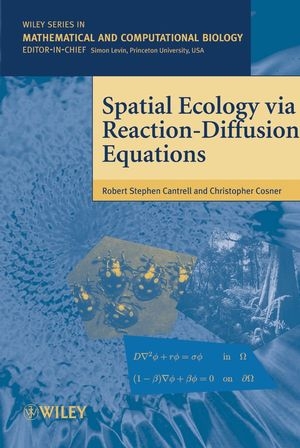
Spatial Ecology via Reaction-Diffusion Equations
John Wiley & Sons Inc (Verlag)
978-0-471-49301-3 (ISBN)
* Rapidly expanding area of research for biologists and applied mathematicians
* Provides a unified and coherent account of methods developed to study spatial ecology via reaction-diffusion models
* Provides the reader with the tools needed to construct and interpret models
* Offers specific applications of both the models and the methods
* Authors have played a dominant role in the field for years
Essential reading for graduate students and researchers working with spatial modelling from mathematics, statistics, ecology, geography and biology.
Robert Stephen Cantrell is the author of Spatial Ecology via Reaction-Diffusion Equations, published by Wiley. Chris Cosner is the author of Spatial Ecology via Reaction-Diffusion Equations, published by Wiley.
Preface.
Series Preface.
1 Introduction.
1.1 Introductory Remarks.
1.2 Nonspatial Models for a Single Species.
1.3 Nonspatial Models For Interacting Species.
1.4 Spatial Models: A General Overview.
1.5 Reaction-Diffusion Models.
1.6 Mathematical Background.
2 Linear Growth Models for a Single Species: Averaging Spatial Effects Via Eigenvalues.
2.1 Eigenvalues, Persistence, and Scaling in Simple Models.
2.2 Variational Formulations of Eigenvalues: Accounting for Heterogeneity.
2.3 Effects of Fragmentation and Advection/Taxis in Simple Linear Models.
2.4 Graphical Analysis in One Space Dimension.
2.5 Eigenvalues and Positivity.
2.6 Connections with Other Topics and Models.
Appendix.
3 Density Dependent Single-Species Models.
3.1 The Importance of Equilibria in Single Species Models.
3.2 Equilibria and Stability: Sub- and Supersolutions.
3.3 Equilibria and Scaling: One Space Dimension.
3.4 Continuation and Bifurcation of Equilibria.
3.5 Applications and Properties of Single Species Models.
3.6 More General Single Species Models.
Appendix.
4 Permanence.
4.1 Introduction.
4.2 Definition of Permanence.
4.3 Techniques for Establishing Permanence.
4.4 Invasibility Implies Coexistence.
4.5 Permanence in Reaction-Diffusion Models for Predation.
4.6 Ecological Permanence and Equilibria.
Appendix.
5 Beyond Permanence: More Persistence Theory.
5.1 Introduction.
5.2 Compressivity.
5.3 Practical Persistence.
5.4 Bounding Transient Orbits.
5.5 Persistence in Nonautonomous Systems.
5.6 Conditional Persistence.
5.7 Extinction Results.
Appendix.
6 Spatial Heterogeneity in Reaction-Diffusion Models.
6.1 Introduction.
6.2 Spatial Heterogeneity within the Habitat Patch.
6.3 Edge Mediated Effects.
6.4 Estimates and Consequences.
Appendix.
7 Nonmonotone Systems.
7.1 Introduction.
7.2 Predator Mediated Coexistence.
7.3 Three Species Competition.
7.4 Three Trophic Level Models.
Appendix.
References.
Index.
| Erscheint lt. Verlag | 1.10.2003 |
|---|---|
| Reihe/Serie | Wiley Series in Mathematical & Computational Biology |
| Verlagsort | New York |
| Sprache | englisch |
| Maße | 176 x 252 mm |
| Gewicht | 907 g |
| Themenwelt | Mathematik / Informatik ► Mathematik ► Analysis |
| Mathematik / Informatik ► Mathematik ► Angewandte Mathematik | |
| Naturwissenschaften ► Biologie ► Ökologie / Naturschutz | |
| ISBN-10 | 0-471-49301-5 / 0471493015 |
| ISBN-13 | 978-0-471-49301-3 / 9780471493013 |
| Zustand | Neuware |
| Informationen gemäß Produktsicherheitsverordnung (GPSR) | |
| Haben Sie eine Frage zum Produkt? |
aus dem Bereich