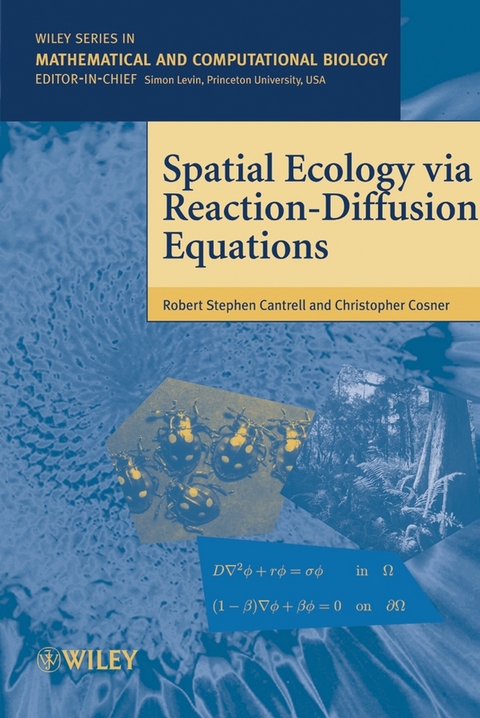
Spatial Ecology via Reaction-Diffusion Equations (eBook)
John Wiley & Sons (Verlag)
978-0-470-87128-7 (ISBN)
* Rapidly expanding area of research for biologists and applied mathematicians
* Provides a unified and coherent account of methods developed to study spatial ecology via reaction-diffusion models
* Provides the reader with the tools needed to construct and interpret models
* Offers specific applications of both the models and the methods
* Authors have played a dominant role in the field for years
Essential reading for graduate students and researchers working with spatial modelling from mathematics, statistics, ecology, geography and biology.
Robert Stephen Cantrell is the author of Spatial Ecology via Reaction-Diffusion Equations, published by Wiley.
Chris Cosner is the author of Spatial Ecology via Reaction-Diffusion Equations, published by Wiley.
Many ecological phenomena may be modelled using apparently random processes involving space (and possibly time). Such phenomena are classified as spatial in their nature and include all aspects of pollution. This book addresses the problem of modelling spatial effects in ecology and population dynamics using reaction-diffusion models. * Rapidly expanding area of research for biologists and applied mathematicians * Provides a unified and coherent account of methods developed to study spatial ecology via reaction-diffusion models * Provides the reader with the tools needed to construct and interpret models * Offers specific applications of both the models and the methods * Authors have played a dominant role in the field for years Essential reading for graduate students and researchers working with spatial modelling from mathematics, statistics, ecology, geography and biology.
Robert Stephen Cantrell is the author of Spatial Ecology via Reaction-Diffusion Equations, published by Wiley. Chris Cosner is the author of Spatial Ecology via Reaction-Diffusion Equations, published by Wiley.
Preface.
Series Preface.
1 Introduction.
1.1 Introductory Remarks.
1.2 Nonspatial Models for a Single Species.
1.3 Nonspatial Models For Interacting Species.
1.4 Spatial Models: A General Overview.
1.5 Reaction-Diffusion Models.
1.6 Mathematical Background.
2 Linear Growth Models for a Single Species: Averaging Spatial Effects Via Eigenvalues.
2.1 Eigenvalues, Persistence, and Scaling in Simple Models.
2.2 Variational Formulations of Eigenvalues: Accounting for Heterogeneity.
2.3 Effects of Fragmentation and Advection/Taxis in Simple Linear Models.
2.4 Graphical Analysis in One Space Dimension.
2.5 Eigenvalues and Positivity.
2.6 Connections with Other Topics and Models.
Appendix.
3 Density Dependent Single-Species Models.
3.1 The Importance of Equilibria in Single Species Models.
3.2 Equilibria and Stability: Sub- and Supersolutions.
3.3 Equilibria and Scaling: One Space Dimension.
3.4 Continuation and Bifurcation of Equilibria.
3.5 Applications and Properties of Single Species Models.
3.6 More General Single Species Models.
Appendix.
4 Permanence.
4.1 Introduction.
4.2 Definition of Permanence.
4.3 Techniques for Establishing Permanence.
4.4 Invasibility Implies Coexistence.
4.5 Permanence in Reaction-Diffusion Models for Predation.
4.6 Ecological Permanence and Equilibria.
Appendix.
5 Beyond Permanence: More Persistence Theory.
5.1 Introduction.
5.2 Compressivity.
5.3 Practical Persistence.
5.4 Bounding Transient Orbits.
5.5 Persistence in Nonautonomous Systems.
5.6 Conditional Persistence.
5.7 Extinction Results.
Appendix.
6 Spatial Heterogeneity in Reaction-Diffusion Models.
6.1 Introduction.
6.2 Spatial Heterogeneity within the Habitat Patch.
6.3 Edge Mediated Effects.
6.4 Estimates and Consequences.
Appendix.
7 Nonmonotone Systems.
7.1 Introduction.
7.2 Predator Mediated Coexistence.
7.3 Three Species Competition.
7.4 Three Trophic Level Models.
Appendix.
References.
Index.
"...particularly attractive and useful for graduate students
and other researchers who are interested in studying applications
of reaction-diffusion theory to spatial ecology." (Mathematical
Reviews, Issue 2007a)
"...I would recommend this book to anyone who wants a well
supported journey into the modern theory of partial differential
equations and dynamic systems..." (The Mathematical
Gazette, March 2005)
| Erscheint lt. Verlag | 9.1.2004 |
|---|---|
| Reihe/Serie | Wiley Series in Mathematical & Computational Biology |
| Wiley Series in Mathematical and Computational Biology | Wiley Series in Mathematical and Computational Biology |
| Sprache | englisch |
| Themenwelt | Mathematik / Informatik ► Mathematik ► Analysis |
| Mathematik / Informatik ► Mathematik ► Angewandte Mathematik | |
| Naturwissenschaften ► Biologie ► Ökologie / Naturschutz | |
| Technik | |
| Schlagworte | Activity • Ãkologie • Applied Mathematics in Science • biological • Biowissenschaften • combination • Common • conservation • Ecological • Effects • Geographie • Geography • Geography Special Topics • habitat fragmentation • Human • involve • Life Sciences • Life Sciences Special Topics • Major • many • Mathematics • Mathematik • Mathematik in den Naturwissenschaften • Modell (Math.) • Models • movements • Multivariate Analyse • multivariate analysis • Ökologie • one approach • Phenomena • Problem • processes • Random • reactiondiffusion • result • space • Spezialthemen Biowissenschaften • Spezialthemen Geographie • Statistics • Statistik • Time |
| ISBN-10 | 0-470-87128-8 / 0470871288 |
| ISBN-13 | 978-0-470-87128-7 / 9780470871287 |
| Informationen gemäß Produktsicherheitsverordnung (GPSR) | |
| Haben Sie eine Frage zum Produkt? |
 PDF (Adobe DRM)
Kopierschutz: Adobe-DRM
Adobe-DRM ist ein Kopierschutz, der das eBook vor Mißbrauch schützen soll. Dabei wird das eBook bereits beim Download auf Ihre persönliche Adobe-ID autorisiert. Lesen können Sie das eBook dann nur auf den Geräten, welche ebenfalls auf Ihre Adobe-ID registriert sind.
Details zum Adobe-DRM
Dateiformat: PDF (Portable Document Format)
Mit einem festen Seitenlayout eignet sich die PDF besonders für Fachbücher mit Spalten, Tabellen und Abbildungen. Eine PDF kann auf fast allen Geräten angezeigt werden, ist aber für kleine Displays (Smartphone, eReader) nur eingeschränkt geeignet.
Systemvoraussetzungen:
PC/Mac: Mit einem PC oder Mac können Sie dieses eBook lesen. Sie benötigen eine
eReader: Dieses eBook kann mit (fast) allen eBook-Readern gelesen werden. Mit dem amazon-Kindle ist es aber nicht kompatibel.
Smartphone/Tablet: Egal ob Apple oder Android, dieses eBook können Sie lesen. Sie benötigen eine
Geräteliste und zusätzliche Hinweise
Buying eBooks from abroad
For tax law reasons we can sell eBooks just within Germany and Switzerland. Regrettably we cannot fulfill eBook-orders from other countries.
aus dem Bereich