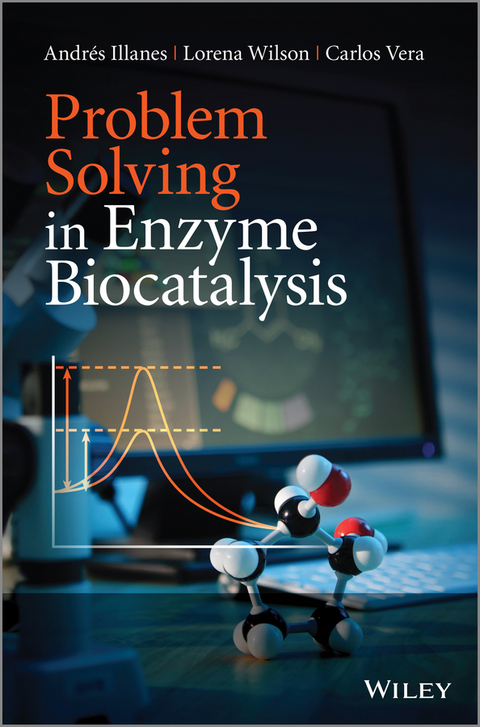
Enzyme biocatalysis is a fast-growing area in process biotechnology that has expanded from the traditional fields of foods, detergents, and leather applications to more sophisticated uses in the pharmaceutical and fine-chemicals sectors and environmental management. Conventional applications of industrial enzymes are expected to grow, with major opportunities in the detergent and animal feed sectors, and new uses in biofuel production and human and animal therapy.
In order to design more efficient enzyme reactors and evaluate performance properly, sound mathematical expressions must be developed which consider enzyme kinetics, material balances, and eventual mass transfer limitations. With a focus on problem solving, each chapter provides abridged coverage of the subject, followed by a number of solved problems illustrating resolution procedures and the main concepts underlying them, plus supplementary questions and answers.
Based on more than 50 years of teaching experience, Problem Solving in Enzyme Biocatalysis is a unique reference for students of chemical and biochemical engineering, as well as biochemists and chemists dealing with bioprocesses.
Contains: Enzyme properties and applications; enzyme kinetics; enzyme reactor design and operation 146 worked problems and solutions in enzyme biocatalysis.
Andrés Illanes is Professor in the School of Biochemical Engineering at Pontificia Universidad Católica de Valparaíso, Chile. He has been researching enzyme biocatalysis since the 1970s, having done research in the main topics related to enzyme technology, and taught many courses at the undergraduate, M.Sc and Ph.D level in the subject both in Chile and abroad. He has authored over 80 ISI journal publications, several book chapters and three books on this topic, the latest with Springer 2008 Enzyme Biocatalysis: Principles and Applications.
Lorena Wilson is Associate Professor at the School of Biochemical Engineering, Pontificia Universidad Católica de Valparaíso. She has worked on enzyme biocatalysis since her time as an undergraduate and done research in aspects related mostly to biocatalyst engineering and enzyme reactor performance. She has more than ten years teaching experience focused mostly on the subject of enzyme biocatalysis. She is a Biochemical Engineer with a PhD from the Universidad Autónoma de Madrid, Spain. Dr Wilson is also author of more than 40 ISI publications in high ranked journals and several book chapters.
Carlos Vera works in the School of Biochemical Engineering at Pontificia Universidad Católica de Valparaíso, Chile.
Enzyme biocatalysis is a fast-growing area in process biotechnology that has expanded from the traditional fields of foods, detergents, and leather applications to more sophisticated uses in the pharmaceutical and fine-chemicals sectors and environmental management. Conventional applications of industrial enzymes are expected to grow, with major opportunities in the detergent and animal feed sectors, and new uses in biofuel production and human and animal therapy. In order to design more efficient enzyme reactors and evaluate performance properly, sound mathematical expressions must be developed which consider enzyme kinetics, material balances, and eventual mass transfer limitations. With a focus on problem solving, each chapter provides abridged coverage of the subject, followed by a number of solved problems illustrating resolution procedures and the main concepts underlying them, plus supplementary questions and answers. Based on more than 50 years of teaching experience, Problem Solving in Enzyme Biocatalysis is a unique reference for students of chemical and biochemical engineering, as well as biochemists and chemists dealing with bioprocesses. Contains: Enzyme properties and applications; enzyme kinetics; enzyme reactor design and operation 146 worked problems and solutions in enzyme biocatalysis.
Andrés Illanes is Professor in the School of Biochemical Engineering at Pontificia Universidad Católica de Valparaíso, Chile. He has been researching enzyme biocatalysis since the 1970s, having done research in the main topics related to enzyme technology, and taught many courses at the undergraduate, M.Sc and Ph.D level in the subject both in Chile and abroad. He has authored over 80 ISI journal publications, several book chapters and three books on this topic, the latest with Springer 2008 Enzyme Biocatalysis: Principles and Applications. Lorena Wilson is Associate Professor at the School of Biochemical Engineering, Pontificia Universidad Católica de Valparaíso. She has worked on enzyme biocatalysis since her time as an undergraduate and done research in aspects related mostly to biocatalyst engineering and enzyme reactor performance. She has more than ten years teaching experience focused mostly on the subject of enzyme biocatalysis. She is a Biochemical Engineer with a PhD from the Universidad Autónoma de Madrid, Spain. Dr Wilson is also author of more than 40 ISI publications in high ranked journals and several book chapters. Carlos Vera works in the School of Biochemical Engineering at Pontificia Universidad Católica de Valparaíso, Chile.
Problem Solving in Enzyme Biocatalysis 1
Contents 7
Preface 11
Nomenclature 13
Epsilon Software Information 23
Acknowledgement 27
1 Facts and Figures in Enzyme Biocatalysis 29
1.1 Introduction 29
1.1.1 Enzyme Properties 29
1.1.2 Enzyme Applications 30
1.2 Enzymes as Process Catalysts 31
1.3 Evolution of Enzyme Biocatalysis: From Hydrolysis to Synthesis 33
1.4 The Enzyme Market: Figures and Outlook 34
References 35
2 Enzyme Kinetics in a Homogeneous System 39
2.1 Introduction 39
2.1.1 Concept and Determination of Enzyme Activity 39
2.1.2 Definition of a Unit of Activity 41
2.1.3 Measurement of Enzyme Activity 41
2.2 Theory of Enzyme Kinetics 42
2.3 Single-Substrate Reactions 45
2.3.1 Kinetics of Enzyme Inhibition 46
2.4 Multiple-Substrate Reactions 47
2.4.1 Reaction Mechanisms 47
2.4.2 Kinetics of Enzyme Reactions with Two Substrates 48
2.5 Multiple-Enzyme Reactions 49
2.6 Determination of Kinetic Parameters 50
2.7 Effects of Operational Variables on Enzyme Kinetics 52
2.7.1 Effects of pH 53
2.7.2 Effects of Temperature 54
Solved Problems 57
Supplementary Problems 100
References 112
3 Enzyme Kinetics in a Heterogeneous System 115
3.1 Introduction 115
3.2 Immobilization of Enzymes 115
3.2.1 Immobilization on Solid Supports (Carrier-Bound Systems) 116
3.2.2 Immobilization by Containment 117
3.2.3 Immobilization in Carrier-Free Systems 117
3.2.4 Parameters of Enzyme Immobilization 118
3.2.5 Optimization of Enzyme Immobilization 119
3.3 Mass-Transfer Limitations in Enzyme Catalysis 120
3.3.1 Partition Effects 121
3.3.2 External Diffusional Restrictions in Impervious Biocatalysts 122
3.3.3 Internal Diffusional Restrictions in Porous Biocatalysts 125
3.4 Determination of Intrinsic Kinetic and Mass-Transfer Parameters 130
3.4.1 EDR 130
3.4.2 IDR 132
Solved Problems 133
Supplementary Problems 155
References 166
4 Enzyme Reactor Design and Operation under Ideal Conditions 169
4.1 Modes of Operation and Reactor Configurations 169
4.2 Definition of Ideal Conditions 170
4.3 Strategy for Reactor Design and Performance Evaluation 171
4.4 Mathematical Models for Enzyme Kinetics, Modes of Operation, and Reactor Configurations under Ideal Conditions 171
4.4.1 Batch Enzyme Reactor 172
4.4.2 Continuous Enzyme Reactors 176
Solved Problems 185
Supplementary Problems 202
References 207
5 Enzyme Reactor Design and Operation under Mass-Transfer Limitations 209
5.1 Sequential Batch and Continuously Operated Reactors with Immobilized Enzymes 210
5.2 Mathematical Models for Enzyme Kinetics, Modes of Operation, and Reactor Configurations under Mass-Transfer Limitations 211
Solved Problems 213
Supplementary Problems 226
6 Enzyme Reactor Design and Operation under Biocatalyst Inactivation 231
6.1 Mechanistically Based Mathematical Models of Enzyme Inactivation 231
6.2 Effect of Catalytic Modulators on Enzyme Inactivation 233
6.3 Mathematical Models for Different Enzyme Kinetics, Modes of Operation, and Reactor Configurations under Biocatalyst Inactivation 234
6.3.1 Nonmodulated Enzyme Inactivation 234
6.3.2 Modulated Enzyme Inactivation 237
6.4 Mathematical Models for Enzyme Kinetics, Modes of Operation, and Reactor Configurations under Simultaneous Mass-Transfer Limitations and Enzyme Inactivation 240
6.5 Strategies for Reactor Operation under Biocatalyst Inactivation 241
Solved Problems 243
Supplementary Problems 261
References 268
7 Optimization of Enzyme Reactor Operation 271
7.1 Strategy for the Optimization of Enzyme Reactor Performance 272
7.1.1 Objective Function 272
7.1.2 Variables for Optimization of Enzyme Reactor Performance 274
7.1.3 Determination of Optimum Temperature 275
7.2 Mathematical Programming for Static Optimization 275
7.3 Dynamic Programming 276
7.4 Statistical Optimization by Surface Response Methodology 277
7.4.1 Assessing the Quality of SRM and its Parameters 279
7.4.2 Process Optimization by SRM 280
Solved Problems 282
Supplementary Problems 300
References 303
Appendix A: Mathematical Methods 305
A.1. Newton’s Method 305
A.2. Curve Fitting by Least Squares 308
A.2.1 Linear Regression 308
A.2.2 Nonlinear Regression 314
A.3. Solving Ordinary Differential Equations 324
A.3.1 Solving First-Order Ordinary Differential Equations by the Separation of Variables 324
A.3.2 Solving First-Order Ordinary Differential Equations Using an Integration Factor 325
A.3.3 Solving Second- and Higher-Order Linear Homogeneous Differential Equations with Constant Coefficients Using their Characteristic Equations 326
A.3.4 Solving Second- and Higher-Order Linear Homogeneous Differential Equations with Variable Coefficients 329
A.4. Numerical Methods for Solving Differential Equations 330
A.4.1 The Euler Method 330
A.4.2 The Fourth-Order Runge–Kutta Method 331
A.4.3 The Finite-Difference Method 331
References 338
Index 339
| Erscheint lt. Verlag | 2.10.2013 |
|---|---|
| Sprache | englisch |
| Themenwelt | Naturwissenschaften ► Biologie ► Biochemie |
| Naturwissenschaften ► Chemie ► Technische Chemie | |
| Technik ► Umwelttechnik / Biotechnologie | |
| Schlagworte | Andres Illanes • biochemical engineering • Bioprocesses • Biotechnologie i. d. Biowissenschaften • Biotechnologie i. d. Chemie • Biotechnology • Biowissenschaften • Carlos Vera • chemical engineering • Chemie • Chemische Verfahrenstechnik • Chemistry • conventional industrial enzymes applications • Enzyme Biocatalysis • Enzyme Biocatalysis Problem Solving • Enzyme kinetics • enzyme reactor design • enzyme reactor efficiency • enzyme reactor operation • enzyme reactor performance • enzymes in biofuel production • industrial enzymes applications • Life Sciences • Lorena Wilson • Problem Solving in Enzyme Biocatalysis • process biotechnology |
| ISBN-13 | 9781118341759 / 9781118341759 |
| Informationen gemäß Produktsicherheitsverordnung (GPSR) | |
| Haben Sie eine Frage zum Produkt? |
 PDF (Adobe DRM)
Kopierschutz: Adobe-DRM
Adobe-DRM ist ein Kopierschutz, der das eBook vor Mißbrauch schützen soll. Dabei wird das eBook bereits beim Download auf Ihre persönliche Adobe-ID autorisiert. Lesen können Sie das eBook dann nur auf den Geräten, welche ebenfalls auf Ihre Adobe-ID registriert sind.
Details zum Adobe-DRM
Dateiformat: PDF (Portable Document Format)
Mit einem festen Seitenlayout eignet sich die PDF besonders für Fachbücher mit Spalten, Tabellen und Abbildungen. Eine PDF kann auf fast allen Geräten angezeigt werden, ist aber für kleine Displays (Smartphone, eReader) nur eingeschränkt geeignet.
Systemvoraussetzungen:
PC/Mac: Mit einem PC oder Mac können Sie dieses eBook lesen. Sie benötigen eine
eReader: Dieses eBook kann mit (fast) allen eBook-Readern gelesen werden. Mit dem amazon-Kindle ist es aber nicht kompatibel.
Smartphone/Tablet: Egal ob Apple oder Android, dieses eBook können Sie lesen. Sie benötigen eine
Geräteliste und zusätzliche Hinweise
Buying eBooks from abroad
For tax law reasons we can sell eBooks just within Germany and Switzerland. Regrettably we cannot fulfill eBook-orders from other countries.
aus dem Bereich