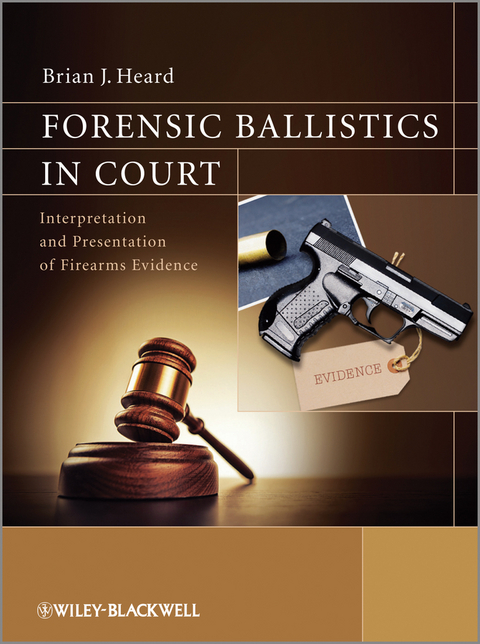
Forensic Ballistics in Court (eBook)
Forensic Ballistics in Court: Interpretation and Presentation of Firearms Evidence is an accessible introduction to firearms and ballistics evidence and how this is analysed and presented as evidence in a court of law.
The book contains little or no coverage of the history and development of weapons, ammunition and forensic technologies but rather approaches the subject in terms of the realities of case work.
Opening with a clear explanation of the correct nomenclature for various weapon types and their parts, illustrations help to clarify the names of the various components of these weapons. Ammunition is also extensively covered, again with annotated illustrations. Basic external and terminal ballistics, wounding capabilities are likewise covered to give an overview of the subject. The book is not intended to provide a detailed examination of all aspects of firearms and ballistics and should the reader need more detail on the subject reference is made to ‘The Handbook of Firearms and Ballistics’ also authored by Brian Heard.
A key aspect of the book covers the theory and philosophy behind striation matches and the associated statistics, how positive matches should be peer reviewed and the importance accreditation has on this subject.
Gunshot residue formation and identification and the various methods used in its analysis are reviewed in depth. This includes a critical examination of the pros and cons of each type of examination and the evidential weight which can be applied to each method. This type of analysis, due to the extremely small particles involved, is very susceptible to contamination, both environmental and cross contamination from police officers or other investigating agencies e.g. during exhibit photography or the taking of fingerprints.
As the main thrust of the book is directed towards the interpretation and assessment of the weight of evidence presented at court this will take up the major portion of the book. There will be considerable reliance on case work that the author has dealt with over the past 40 years to illustrate the various pitfalls of placing too much reliance on the face value of the various types of evidence. The majority of evidence presented at court can be interpreted in various ways and each and every one should be explored before deciding which is the more viable.
Key Differences between the proposed book and the Handbook for Firearms and Ballistics:
- History of firearms, ammunition, propellant and primer will not be included in this book- this is covered in detail in the Handbook.
- Information on internal and external ballistics and headstamps will not be covered as in the Handbook. Instead there will be large sections to assist the lawyer when interpreting such evidence. Some of these areas follow:
- Evidence from crime scene investigations,
- Ricochet analysis,
- The results of stria comparisons submitted by the forensic expert,
- Range of fire estimations,
- A weapons potential for accidental discharge
- Identification of bullet entry/exit holes.
- Missile penetration potential
- The ‘lethality’ of a weapon/ammunition combination
- Determination of when the weapon was last fired
- Examination as to the viability of ammunition
- Determining the age and origin of ammunition
- Whether recovered cartridge cases were from blank or live ammunition
- Determining the age of a weapon (i.e. can it be considered to be an antique)
- Lethality of air, gas and spring guns
- Convertability of toy, replica and blank firing weapons into firearms
The importance of witness and accused statements and their interpretation in relation to the investigation under review will also be examined. This is not covered in the Handbook of Firearms and Ballistics.
Forensic Ballistics in Court: Interpretation and Presentation of Firearms Evidence is an accessible introduction to firearms and ballistics evidence and how this is analysed and presented as evidence in a court of law. The book approaches the subject in terms of the realities of case work, opening with a clear and illustrated explanation of the correct nomenclature for various weapon types and their parts. Ammunition is also extensively covered, again with annotated illustrations. Basic external and terminal ballistics, wounding capabilities are likewise covered to give an overview of the subject. A key aspect of the book covers the theory and philosophy behind striation matches and the associated statistics, how positive matches should be peer reviewed and the importance accreditation has on this subject. Gunshot residue formation and identification and the various methods used in its analysis are reviewed in depth. This includes a critical examination of the pros and cons of each type of examination and the evidential weight which can be applied to each method. Accessible and reader-friendly introduction to firearms and ballistics. Clarifies the limitations of firearms evidence. Extensive use of global case-studies throughout. Focus on the interpretation and assessment of the weight of firearms/ballistics evidence presented at court. Covers the importance of witness and accused statements and their interpretation in relation to the investigation under review. Includes coverage of gunshot residue collection, examination and interpretation and the potential for contamination of GSR samples. Includes numerous real life case studies that the author has dealt with over the past 45 years. Takes an applied approach to the subject.
Brian J. Heard, Formerly of the Ballistics and Firearms Identification Bureau for the Royal Hong Kong Police.
Introduction
An expert may be used in, basically, two different capacities: for consultation or for testimony.
These are derived from five general categories of expertise:
In court, the proffered witness must be assessed as to his/her:
- Expertise. Courts rely heavily on forensic evidence to convict the guilty and to protect the innocent. The presentation of flawed forensic evidence has obvious implications for individual cases, but raises questions about the integrity of the entire criminal justice system. Innocent people may be wrongly convicted and people may lose trust in the justice system. This is not unknown, as a number of recent high profile cases have proved.
- Training. What sets an expert apart from a novice? How does forensic expertise develop over time? Does the speed of expert decision-making influence performance? How does memory for forensic information relate to matching accuracy? Can training time be reduced without compromising performance? What is the best way to provide feedback to examiners about their performance? Do examiners know when to ask for help? How much should examiners rely on instructions from a textbook, compared to practical experience?
- Testimony. What can examiners reasonably claim when testifying in court? What is the most effective way to present forensic evidence to juries? On what basis should judges admit forensic testimony? Should examiners report opinions or statistics?
Judges also have to consider the following factors in determining the manner in which expert testimony should be presented to a jury and in instructing the jury in its evaluation of expert scientific testimony in criminal proceedings:
Many of the reported problems with forensic science evidence have resulted from the failures of trial legal representatives to investigate thoroughly forensic science evidence, the misunderstandings concerning the nature of that evidence, and mis-statements concerning the weight to be attributed to that evidence. Until an elevation in the knowledge base of trial legal representatives is achieved, the adversarial system will continue to falter with respect to the proper presentation of forensic science evidence.
In investigating, assessing and presenting forensic science evidence, the legal representatives should consider the following:
- The extent to which a particular forensic science discipline is founded on reliable scientific methodology that gives it the capacity to analyse accurately the evidence and to report findings.
- The extent to which examiners in a particular forensic science discipline rely on human interpretation.
- The extent to which the examiner using the particular forensic science technique in the case has followed established procedures and standards in examining the evidence.
By keeping these considerations in mind during the investigation and presentation of forensic science evidence, legal representatives will better inform the jury of the relevant contested forensic science issues in the case. The evidence presented that is relevant to these considerations will also provide the underlying basis for instructions to the jury concerning the consideration of the forensic scientist.
Experts frequently testify that they have made a match ‘to the exclusion of all other firearms.’1 This is simply another way of claiming uniqueness. In United States v. Green,2 the court questioned such testimony: ‘O'Shea [the expert] declared that this match could be made “to the exclusion of every other firearm in the world”.... That conclusion, needless to say, is extraordinary, particularly given O'Shea's data and methods.’3
Further, in 2008, a year before the National Academy of Science (NAS) report on forensic science was issued, a different NAS report, one on computerised ballistic imaging, addressed this issue. The report cautioned: ‘Conclusions drawn in firearms identification should not be made to imply the presence of a firm statistical basis when none has been demonstrated.’4 In particular, that report was concerned about testimony cast ‘in bold absolutes’, such as that a match can be made to the exclusion of all other firearms in the world: ‘Such comments cloak an inherently subjective assessment of a match with an extreme probability statement that has no firm grounding and unrealistically implies an error rate of zero.’ Some courts are in accord.5
The court should consider whether additional factors such as those set forth below might be especially important to a jury's ability to fairly assess the reliability of and the weight to be given testimony on particular issues in the case.6
| Erscheint lt. Verlag | 11.3.2013 |
|---|---|
| Sprache | englisch |
| Themenwelt | Studium ► 2. Studienabschnitt (Klinik) ► Rechtsmedizin |
| Naturwissenschaften ► Biologie | |
| Naturwissenschaften ► Chemie | |
| Recht / Steuern ► Strafrecht ► Kriminologie | |
| Sozialwissenschaften | |
| Schlagworte | accessible • Ammunition • Analytische Chemie / Forensik • ballistics • Biowissenschaften • Book • Case Work • Chemie • Chemistry • clear • correct nomenclature • Criminology • Evidence • Explanation • extensively • Firearms • Forensic • Forensics • Forensic Science • Forensik • Illustrated • Interpretation • Introduction • Kriminologie • Law • Life Sciences • presentation • Realities • Rechtswissenschaft • Subject • Terms • various • Weapon |
| ISBN-13 | 9781118505014 / 9781118505014 |
| Informationen gemäß Produktsicherheitsverordnung (GPSR) | |
| Haben Sie eine Frage zum Produkt? |
 EPUB (Adobe DRM)
Kopierschutz: Adobe-DRM
Adobe-DRM ist ein Kopierschutz, der das eBook vor Mißbrauch schützen soll. Dabei wird das eBook bereits beim Download auf Ihre persönliche Adobe-ID autorisiert. Lesen können Sie das eBook dann nur auf den Geräten, welche ebenfalls auf Ihre Adobe-ID registriert sind.
Details zum Adobe-DRM
Dateiformat: EPUB (Electronic Publication)
EPUB ist ein offener Standard für eBooks und eignet sich besonders zur Darstellung von Belletristik und Sachbüchern. Der Fließtext wird dynamisch an die Display- und Schriftgröße angepasst. Auch für mobile Lesegeräte ist EPUB daher gut geeignet.
Systemvoraussetzungen:
PC/Mac: Mit einem PC oder Mac können Sie dieses eBook lesen. Sie benötigen eine
eReader: Dieses eBook kann mit (fast) allen eBook-Readern gelesen werden. Mit dem amazon-Kindle ist es aber nicht kompatibel.
Smartphone/Tablet: Egal ob Apple oder Android, dieses eBook können Sie lesen. Sie benötigen eine
Geräteliste und zusätzliche Hinweise
Buying eBooks from abroad
For tax law reasons we can sell eBooks just within Germany and Switzerland. Regrettably we cannot fulfill eBook-orders from other countries.
aus dem Bereich