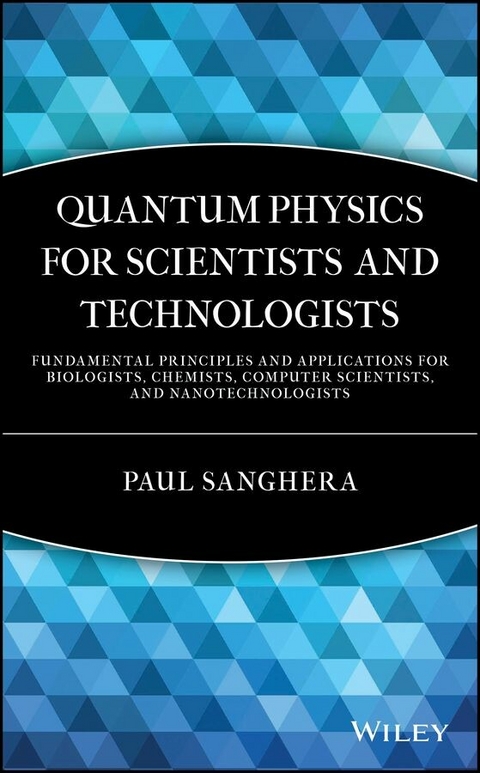
Quantum Physics for Scientists and Technologists (eBook)
John Wiley & Sons (Verlag)
978-0-470-91711-4 (ISBN)
This cohesive book begins with the wavefunction to develop the basic principles of quantum mechanics such as the uncertainty principle and wave-particle duality. Comprehensive coverage of quantum theory is presented, supported by experimental results and explained through applications and examples without the use of abstract and complex mathematical tools or formalisms. From there, the book:
Takes the mystery out of the Schrodinger equation, the fundamental equation of quantum physics, by applying it to atoms
Shows how quantum mechanics explains the periodic table of elements
Introduces the quantum mechanical concept of spin and spin quantum number, along with Pauli's Exclusion Principle regarding the occupation of quantum states
Addresses quantum states of molecules in terms of rotation and vibration of diatomic molecules
Explores the interface between classical statistical mechanics and quantum statistical mechanics
Discusses quantum mechanics as a common thread through different fields of nanoscience and nanotechnology
Each chapter features real-world applications of one or more quantum mechanics principles. 'Study Checkpoints' and problems with solutions are presented throughout to make difficult concepts easy to understand. In addition, pictures, tables, and diagrams with full explanations are used to present data and further explain difficult concepts.
This book is designed as a complete course in quantum mechanics for senior undergraduates and first-year graduate students in non-physics majors. It also applies to courses such as modern physics, physical chemistry and nanotechnology. The material is also accessible to scientists, engineers, and technologists working in the fields of computer science, biology, chemistry, engineering, and nanotechnology.
Quantum Physics for Scientists and Technologists is a self-contained, comprehensive review of this complex branch of science. The book demystifies difficult concepts and views the subject through non-physics fields such as computer science, biology, chemistry, and nanotechnology. It explains key concepts and phenomena in the language of non-physics majors and with simple math, assuming no prior knowledge of the topic. This cohesive book begins with the wavefunction to develop the basic principles of quantum mechanics such as the uncertainty principle and wave-particle duality. Comprehensive coverage of quantum theory is presented, supported by experimental results and explained through applications and examples without the use of abstract and complex mathematical tools or formalisms. From there, the book: Takes the mystery out of the Schrodinger equation, the fundamental equation of quantum physics, by applying it to atoms Shows how quantum mechanics explains the periodic table of elements Introduces the quantum mechanical concept of spin and spin quantum number, along with Pauli's Exclusion Principle regarding the occupation of quantum states Addresses quantum states of molecules in terms of rotation and vibration of diatomic molecules Explores the interface between classical statistical mechanics and quantum statistical mechanics Discusses quantum mechanics as a common thread through different fields of nanoscience and nanotechnology Each chapter features real-world applications of one or more quantum mechanics principles. "e;Study Checkpoints"e; and problems with solutions are presented throughout to make difficult concepts easy to understand. In addition, pictures, tables, and diagrams with full explanations are used to present data and further explain difficult concepts. This book is designed as a complete course in quantum mechanics for senior undergraduates and first-year graduate students in non-physics majors. It also applies to courses such as modern physics, physical chemistry and nanotechnology. The material is also accessible to scientists, engineers, and technologists working in the fields of computer science, biology, chemistry, engineering, and nanotechnology.
PAUL SANGHERA, PHD, is??an educator, scientist, technologist, and entrepreneur. He has worked at world-class laboratories such as CERN in Europe and Nuclear Lab at Cornell, where he participated in designing and conducting experiments to test the quantum theories and models of subatomic particles. Dr. Sanghera is the author of several bestselling books in the fields of science, technology, and project management as well as the author/coauthor of more than 100 research papers on the subatomic particles of matter published in reputed European and American research journals.
"The book presents a rich, self-contained, cohesive, concise, yet
comprehensive picture of quantum
mechanics for senior undergraduate and first-year graduate
students, nonphysicists majors,
and for those professionals at the forefront of biology, chemistry,
engineering, computer science, materials science, nanotechnology,
or related fields." (Zentralblatt MATH, 2011)
| Erscheint lt. Verlag | 28.12.2010 |
|---|---|
| Sprache | englisch |
| Themenwelt | Mathematik / Informatik ► Informatik |
| Naturwissenschaften ► Physik / Astronomie ► Quantenphysik | |
| Technik ► Elektrotechnik / Energietechnik | |
| Schlagworte | Biowissenschaften • Book • Branch • Complex • Computer Science • Concepts • demystifies • difficult • Electrical & Electronics Engineering • Elektrotechnik u. Elektronik • Fields • Introduction • language • Life Sciences • Majors • Math • MEMS • nonphysics • Phenomena • Physics • plainenglish • Quantencomputer • Quantenphysik • quantum • Quantum Computing • Review • Science • scientists • selfcontained • Simple • Subject |
| ISBN-10 | 0-470-91711-3 / 0470917113 |
| ISBN-13 | 978-0-470-91711-4 / 9780470917114 |
| Informationen gemäß Produktsicherheitsverordnung (GPSR) | |
| Haben Sie eine Frage zum Produkt? |
 PDF (Adobe DRM)
Kopierschutz: Adobe-DRM
Adobe-DRM ist ein Kopierschutz, der das eBook vor Mißbrauch schützen soll. Dabei wird das eBook bereits beim Download auf Ihre persönliche Adobe-ID autorisiert. Lesen können Sie das eBook dann nur auf den Geräten, welche ebenfalls auf Ihre Adobe-ID registriert sind.
Details zum Adobe-DRM
Dateiformat: PDF (Portable Document Format)
Mit einem festen Seitenlayout eignet sich die PDF besonders für Fachbücher mit Spalten, Tabellen und Abbildungen. Eine PDF kann auf fast allen Geräten angezeigt werden, ist aber für kleine Displays (Smartphone, eReader) nur eingeschränkt geeignet.
Systemvoraussetzungen:
PC/Mac: Mit einem PC oder Mac können Sie dieses eBook lesen. Sie benötigen eine
eReader: Dieses eBook kann mit (fast) allen eBook-Readern gelesen werden. Mit dem amazon-Kindle ist es aber nicht kompatibel.
Smartphone/Tablet: Egal ob Apple oder Android, dieses eBook können Sie lesen. Sie benötigen eine
Geräteliste und zusätzliche Hinweise
Buying eBooks from abroad
For tax law reasons we can sell eBooks just within Germany and Switzerland. Regrettably we cannot fulfill eBook-orders from other countries.
aus dem Bereich