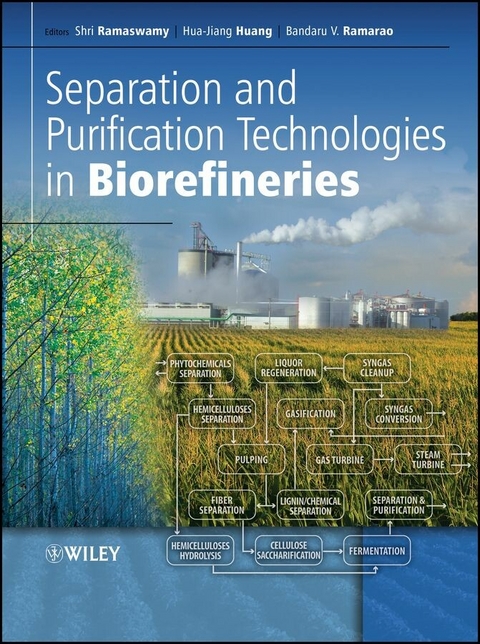
Separation and Purification Technologies in Biorefineries (eBook)
John Wiley & Sons (Verlag)
978-1-118-49348-9 (ISBN)
This book presents a comprehensive overview focused specifically on the present state, future challenges and opportunities for separation and purification methods and technologies in biorefineries.
Topics covered include:
Equilibrium Separations: Distillation, liquid-liquid extraction and supercritical fluid extraction.
Affinity-Based Separations: Adsorption, ion exchange, and simulated moving bed technologies.
Membrane Based Separations: Microfiltration, ultrafiltration and diafiltration, nanofiltration, membrane pervaporation, and membrane distillation.
Solid-liquid Separations: Conventional filtration and solid-liquid extraction.
Hybrid/Integrated Reaction-Separation Systems: Membrane bioreactors, extractive fermentation, reactive distillation and reactive absorption.
For each of these processes, the fundamental principles and design aspects are presented, followed by a detailed discussion and specific examples of applications in biorefineries. Each chapter also considers the market needs, industrial challenges, future opportunities, and economic importance of the separation and purification methods. The book concludes with a series of detailed case studies including cellulosic bioethanol production, extraction of algae oil from microalgae, and production of biopolymers.
Separation and Purification Technologies in Biorefineries is an essential resource for scientists and engineers, as well as researchers and academics working in the broader conventional and emerging bio-based products industry, including biomaterials, biochemicals, biofuels and bioenergy.
Shri Ramaswamy, Department of Bioproducts and Biosystems Engineering, University of Minnesota, USA.
Hua-Jiang Huang, Department of Bioproducts and Biosystems Engineering, University of Minnesota, USA.
Bandaru V. Ramarao, Department of Paper & Bioprocess Engineering, State University of New York College of Environmental Science and Forestry, USA.
Separation and purification processes play a critical role in biorefineries and their optimal selection, design and operation to maximise product yields and improve overall process efficiency. Separations and purifications are necessary for upstream processes as well as in maximising and improving product recovery in downstream processes. These processes account for a significant fraction of the total capital and operating costs and also are highly energy intensive. Consequently, a better understanding of separation and purification processes, current and possible alternative and novel advanced methods is essential for achieving the overall techno-economic feasibility and commercial success of sustainable biorefineries. This book presents a comprehensive overview focused specifically on the present state, future challenges and opportunities for separation and purification methods and technologies in biorefineries. Topics covered include: Equilibrium Separations: Distillation, liquid-liquid extraction and supercritical fluid extraction. Affinity-Based Separations: Adsorption, ion exchange, and simulated moving bed technologies. Membrane Based Separations: Microfiltration, ultrafiltration and diafiltration, nanofiltration, membrane pervaporation, and membrane distillation. Solid-liquid Separations: Conventional filtration and solid-liquid extraction. Hybrid/Integrated Reaction-Separation Systems: Membrane bioreactors, extractive fermentation, reactive distillation and reactive absorption. For each of these processes, the fundamental principles and design aspects are presented, followed by a detailed discussion and specific examples of applications in biorefineries. Each chapter also considers the market needs, industrial challenges, future opportunities, and economic importance of the separation and purification methods. The book concludes with a series of detailed case studies including cellulosic bioethanol production, extraction of algae oil from microalgae, and production of biopolymers. Separation and Purification Technologies in Biorefineries is an essential resource for scientists and engineers, as well as researchers and academics working in the broader conventional and emerging bio-based products industry, including biomaterials, biochemicals, biofuels and bioenergy.
Shri Ramaswamy, Department of Bioproducts and Biosystems Engineering, University of Minnesota, USA. Hua-Jiang Huang, Department of Bioproducts and Biosystems Engineering, University of Minnesota, USA. Bandaru V. Ramarao, Department of Paper & Bioprocess Engineering, State University of New York College of Environmental Science and Forestry, USA.
| Erscheint lt. Verlag | 23.1.2013 |
|---|---|
| Sprache | englisch |
| Themenwelt | Naturwissenschaften ► Chemie ► Technische Chemie |
| Technik ► Elektrotechnik / Energietechnik | |
| Schlagworte | Agriculture • Biorenewable Resources • chemical engineering • Chemie • Chemische Verfahrenstechnik • Chemistry • Grüne Chemie • Grüne Chemie • Landwirtschaft • Nachhaltige u. Grüne Chemie • Nachhaltige u. Grüne Chemie • Nachwachsende Rohstoffe • Separations • Separation science, purification technology, biorefineries, biomass conversion processes, equilibrium based separation processes, distillation, liquid-liquid extraction, supercritical fluid extraction, affinity-based separation technologies, adsorption, ion exchange, simulated moving bed technology, chromatography, membrane separation, microfiltration, ultrafiltration, diafiltration, nanofiltration, membrane pervaporation, membrane distillation, solid-liquid separations, conventional filtration, solid-liqui • Stofftrennverfahren • Sustainable Chemistry & Green Chemistry • Trennverfahren |
| ISBN-10 | 1-118-49348-6 / 1118493486 |
| ISBN-13 | 978-1-118-49348-9 / 9781118493489 |
| Informationen gemäß Produktsicherheitsverordnung (GPSR) | |
| Haben Sie eine Frage zum Produkt? |
 PDF (Adobe DRM)
Kopierschutz: Adobe-DRM
Adobe-DRM ist ein Kopierschutz, der das eBook vor Mißbrauch schützen soll. Dabei wird das eBook bereits beim Download auf Ihre persönliche Adobe-ID autorisiert. Lesen können Sie das eBook dann nur auf den Geräten, welche ebenfalls auf Ihre Adobe-ID registriert sind.
Details zum Adobe-DRM
Dateiformat: PDF (Portable Document Format)
Mit einem festen Seitenlayout eignet sich die PDF besonders für Fachbücher mit Spalten, Tabellen und Abbildungen. Eine PDF kann auf fast allen Geräten angezeigt werden, ist aber für kleine Displays (Smartphone, eReader) nur eingeschränkt geeignet.
Systemvoraussetzungen:
PC/Mac: Mit einem PC oder Mac können Sie dieses eBook lesen. Sie benötigen eine
eReader: Dieses eBook kann mit (fast) allen eBook-Readern gelesen werden. Mit dem amazon-Kindle ist es aber nicht kompatibel.
Smartphone/Tablet: Egal ob Apple oder Android, dieses eBook können Sie lesen. Sie benötigen eine
Geräteliste und zusätzliche Hinweise
Buying eBooks from abroad
For tax law reasons we can sell eBooks just within Germany and Switzerland. Regrettably we cannot fulfill eBook-orders from other countries.
aus dem Bereich