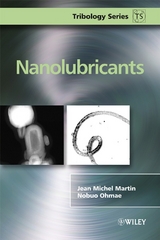
Nanolubricants develops a new concept of lubrication, based on these nanoparticles, and along with the authors' own research it synthesises the information available on the topic of nanolubrication from existing literature and presents it in a concise form.
- Describes the many advantages and potential applications of nanotechnology in the tribological field.
- Offers a full review of the state-of-the-art as well as much original research that is yet unpublished.
- Includes sections on boundary lubrication by colloïdal systems, nanolubricants made of metal dichalcogenides, carbon-based nanolubricants, overbased detergent salts, nanolubricants made of metals and boron-based solid nanolubricants and lubrication additives.
- Authored by highly regarded experts in the field with contributions from leading international academics.
Nanolubricants will appeal to postgraduate students, academics and researchers in mechanical engineering, chemical engineering and materials science. It should also be of interest to practising engineers with petroleum companies and mechanical manufacturers.
Jean Michel Martin is a professor at the Ecole Centrale de Lyon in France where he served for 5 years as director of the materials science department. He has authored 130 journal papers and 4 book chapters.
Nobuo Ohmae is a professor at Kobo University in Japan, where he has served as head of department of mechanical engineering and chaired the International Tribology Conference in 2005. He has authored 135 journal articles and 10 book chapters.
The technology involved in lubrication by nanoparticles is a rapidly developing scientific area and one that has been watched with interest for the past ten years. Nanolubrication offers a solution to many problems associated with traditional lubricants that contain sulphur and phosphorus; and though for some time the production of nanoparticles was restricted by the technologies available, today synthesis methods have been improved to such a level that it is possible to produce large quantities relatively cheaply and efficiently. Nanolubricants develops a new concept of lubrication, based on these nanoparticles, and along with the authors own research it synthesises the information available on the topic of nanolubrication from existing literature and presents it in a concise form. Describes the many advantages and potential applications of nanotechnology in the tribological field. Offers a full review of the state-of-the-art as well as much original research that is yet unpublished. Includes sections on boundary lubrication by collo dal systems, nanolubricants made of metal dichalcogenides, carbon-based nanolubricants, overbased detergent salts, nanolubricants made of metals and boron-based solid nanolubricants and lubrication additives. Authored by highly regarded experts in the field with contributions from leading international academics. Nanolubricants will appeal to postgraduate students, academics and researchers in mechanical engineering, chemical engineering and materials science. It should also be of interest to practising engineers with petroleum companies and mechanical manufacturers.
Jean Michel Martin is a professor at the Ecole Centrale de Lyon in France where he served for 5 years as director of the materials science department. He has authored 130 journal papers and 4 book chapters. Nobuo Ohmae is a professor at Kobo University in Japan, where he has served as head of department of mechanical engineering and chaired the International Tribology Conference in 2005. He has authored 135 journal articles and 10 book chapters.
| Erscheint lt. Verlag | 30.4.2008 |
|---|---|
| Reihe/Serie | Tribology in Practice Series |
| Tribology in Practice Series (PEP) | Tribology in Practice Series (PEP) |
| Sprache | englisch |
| Themenwelt | Naturwissenschaften ► Physik / Astronomie |
| Technik ► Maschinenbau | |
| Schlagworte | associated • available • cheaply • contain • Electrical & Electronics Engineering • Elektrotechnik u. Elektronik • Festkörpermechanik • Festkörpermechanik • Large • lubricants • Lubrication • many problems • Maschinenbau • mechanical engineering • MEMS • Methods • nanolubrication • Nanomaterialien • nanomaterials • nanoparticles • Nanotechnologie • nanotechnology • possible • Production • rapidly • scientific area • solid mechanics • Solution • Sulphur • Technologies • Technology • Time • Traditional |
| ISBN-10 | 0-470-98770-7 / 0470987707 |
| ISBN-13 | 978-0-470-98770-4 / 9780470987704 |
| Informationen gemäß Produktsicherheitsverordnung (GPSR) | |
| Haben Sie eine Frage zum Produkt? |
 PDF (Adobe DRM)
Kopierschutz: Adobe-DRM
Adobe-DRM ist ein Kopierschutz, der das eBook vor Mißbrauch schützen soll. Dabei wird das eBook bereits beim Download auf Ihre persönliche Adobe-ID autorisiert. Lesen können Sie das eBook dann nur auf den Geräten, welche ebenfalls auf Ihre Adobe-ID registriert sind.
Details zum Adobe-DRM
Dateiformat: PDF (Portable Document Format)
Mit einem festen Seitenlayout eignet sich die PDF besonders für Fachbücher mit Spalten, Tabellen und Abbildungen. Eine PDF kann auf fast allen Geräten angezeigt werden, ist aber für kleine Displays (Smartphone, eReader) nur eingeschränkt geeignet.
Systemvoraussetzungen:
PC/Mac: Mit einem PC oder Mac können Sie dieses eBook lesen. Sie benötigen eine
eReader: Dieses eBook kann mit (fast) allen eBook-Readern gelesen werden. Mit dem amazon-Kindle ist es aber nicht kompatibel.
Smartphone/Tablet: Egal ob Apple oder Android, dieses eBook können Sie lesen. Sie benötigen eine
Geräteliste und zusätzliche Hinweise
Buying eBooks from abroad
For tax law reasons we can sell eBooks just within Germany and Switzerland. Regrettably we cannot fulfill eBook-orders from other countries.
aus dem Bereich