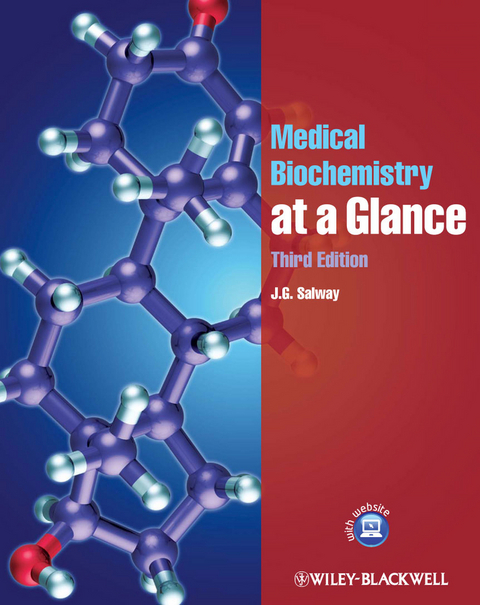
Medical Biochemistry at a Glance (eBook)
John Wiley & Sons (Verlag)
978-1-118-29239-6 (ISBN)
The book is designed as a revision guide for students preparing for examinations and contains topics that have been identified as 'high-yield' facts for the United States Medical Licensing Examination (USMLE), Step 1.
This third edition:
- Has been thoroughly revised and updated and is now in full colour throughout
- Is written by the author of the hugely successful Metabolism at a Glance (ISBN 9781405107167)
- Features updated and improved clinical correlates
- Expands its coverage with a new section on Molecular Biology
- Includes a brand new companion website of self-assessment questions and answers at www.ataglanceseries.com/medicalbiochemistry
J. G. Salway is the author of Medical Biochemistry at a Glance, 3rd Edition, published by Wiley.
Offering a concise, illustrated summary of biochemistry and its relevance to clinical medicine, Medical Biochemistry at a Glance is intended for students of medicine and the biomedical sciences such as nutrition, biochemistry, sports science, medical laboratory sciences, physiotherapy, pharmacy, physiology, pharmacology, genetics and veterinary science. It also provides a succinct review and reference for medical practitioners and biomedical scientists who need to quickly refresh their knowledge of medical biochemistry. The book is designed as a revision guide for students preparing for examinations and contains topics that have been identified as 'high-yield' facts for the United States Medical Licensing Examination (USMLE), Step 1. This third edition: Has been thoroughly revised and updated and is now in full colour throughout Is written by the author of the hugely successful Metabolism at a Glance (ISBN 9781405107167) Features updated and improved clinical correlates Expands its coverage with a new section on Molecular Biology Includes a brand new companion website of self-assessment questions and answers at www.ataglanceseries.com/medicalbiochemistry
J. G. Salway is the author of Medical Biochemistry at a Glance, 3rd Edition, published by Wiley.
Medical Biochemistry at a Glance, Third edition 9
Contents 11
Preface to the third edition 13
Acknowledgements to the third edition 13
Figure key 14
SI/mass unit conversions 15
Part 1: Acids, bases and pH 16
1: Acids, bases and hydrogen ions (protons) 16
2: Understanding pH 18
3: Production and removal of protons into and from the blood 20
4: Metabolic alkalosis and metabolic acidosis 22
5: Respiratory alkalosis and respiratory acidosis 24
Part 2: Structure of amino acids and proteins 26
6: Amino acids and the primary structure of proteins 26
7: Secondary structure of proteins 28
8: Tertiary and quaternary structure and collagen 30
Part 3: Formation of ATP: oxidation and reduction reactions 32
9: Oxidation/reduction reactions, coenzymes and prosthetic groups 32
10: Anaerobic production of ATP by substrate-level phosphorylation, from phosphocreatine and by the adenylate kinase (myokinase) reaction 34
11: Aerobic production of ATP 36
12: Biosynthesis of ATP by oxidative phosphorylation I 38
13: Biosynthesis of ATP by oxidative phosphorylation II 40
14: What happens when protons or electrons leak from the respiratory chain? 42
15: Free radicals, reactive oxygen species and oxidative damage 44
16: Aerobic oxidation of glucose to provide energy as ATP 46
17: Anaerobic oxidation of glucose by glycolysis to form ATP and lactate 48
18: Anaerobic glycolysis in red blood cells, 2,3-BPG(2,3-DPG) and the Bohr effect 50
Part 4: Carbohydrates 52
19: Carbohydrates 52
20: Absorption of carbohydrates and metabolism of galactose 54
21: Fate of glucose in liver: glycogenesis and lipogenesis 56
22: Fructose metabolism 58
23: Glucose homeostasis 60
24: Glucose-stimulated secretion of insulin from ?-cells 62
25: Regulation of glycogen metabolism 64
26: Glycogen breakdown (glycogenolysis) and glycogen storage diseases 66
27: Insulin signal transduction and diabetes mellitus 68
28: Diabetes mellitus 70
29: Alcohol metabolism: hypoglycaemia, hyperlactataemia and steatosis 72
Part 5: Enzymes and regulation of pathways 74
30: Enzymes: nomenclature, kinetics and inhibitors 74
31: Regulation of enzyme activity 76
32: Regulation of glycolysis and Krebs cycle 78
33: Oxidation of fatty acids to produce ATP in muscle and ketone bodies in liver 80
34: Regulation of lipolysis, ?-oxidation, ketogenesis and gluconeogenesis 82
Part 6: Lipids and lipid metabolism 84
35: Structure of lipids 84
36: Phospholipids I: phospholipids and sphingolipids 86
37: Phospholipids II: micelles, liposomes, lipoproteins and membranes 88
38: Metabolism of carbohydrate to cholesterol 90
39: VLDL and LDL metabolism I: “forward” cholesterol transport 92
40: VLDL and LDL metabolism II: endogenous triacylglycerol transport 94
41: HDL metabolism: “reverse” cholesterol transport 96
42 Absorption and disposal of dietary triacylglycerols and cholesterol by chylomicrons 98
43 Steroid hormones: aldosterone, cortisol, androgens and oestrogens 100
Part 7: Metabolism of amino acids and porphyrins 102
44: Urea cycle and overview of amino acid catabolism 102
45: Non-essential and essential amino acids 104
46: Amino acid metabolism: to energy as ATP to glucose and ketone bodies
47: Amino acid disorders: maple syrup urine disease, homocystinuria, cystinuria, alkaptonuria and albinism 108
48: Phenylalanine and tyrosine metabolism in health and disease 110
49: Products of tryptophan and histidine metabolism 112
50: Haem, bilirubin and porphyria 114
Part 8: Vitamins 11
51: Fat-soluble vitamins I: vitamins A and D 116
52: Fat-soluble vitamins II: vitamins E and K 118
53: Water-soluble vitamins I: thiamin, riboflavin, niacin and pantothenate 120
54: Water-soluble vitamins II: pyridoxal phosphate (B6) 122
55: Water-soluble vitamins III: folate and vitamin B12 124
56: Water-soluble vitamins IV: biotin and vitamin C 126
Part 9: Molecular biology 128
57: The cell cycle 128
58: Pyrimidine metabolism 130
59: Purine metabolism 132
60: Structure of DNA 134
61: The “central dogma” of molecular biology 136
62: Organisation of DNA in chromosomes 138
63: Replication of DNA (part 1) 140
64: Replication of DNA (part 2) 142
65: DNA damage and repair 144
66: Transcription of DNA to make messenger RNA (part 1) 146
67: Transcription of DNA to make messenger RNA (part 148
68: Transcription of DNA to make transfer RNA 150
69: Transcription of DNA to make ribosomal RNA 152
70: Translation and protein synthesis 154
71: Comparison of DNA replication, DNA transcription and protein synthesis in eukaryotes and prokaryotes 156
Part 10: Diagnostic clinical biochemistry 158
72: Diagnostic clinical biochemistry (with Dr J. W. Wright FRCP, MRCPath) 158
Index 160
I have taught biochemistry to medical students and to
undergraduates and graduate students, at both Temple University
School of Medicine and at Case Western Reserve University, since
1968, so that I have had a great deal of experience in the field
and have a feel for what works well for medical students.
Medical Biochemistry at a Glance would be an excellent book
for USMLE Step 1. In my experience, medical students (and
pre-medical students) would greatly benefit from reading it in
preparation for the exam.
This compares very well with Lippincott's Biochemistry - this
has the right price and approach to compete with Lippincott for a
less expensive and more accessible alternative to the larger text
books that are out there.
I like the way it combines the metabolic pathways and principles in
such a creative fashion, and the metabolism sections are among the
best I have read and the easiest to understand. Metabolism is a
very complicated subject and, in my experience, most teachers of
the subject would really benefit from your text. (Richard W.
Hanson, Case Western Reserve University School of Medicine)
| Erscheint lt. Verlag | 22.11.2011 |
|---|---|
| Reihe/Serie | At a Glance |
| At a Glance | At a Glance |
| Sprache | englisch |
| Themenwelt | Medizin / Pharmazie ► Medizinische Fachgebiete |
| Studium ► 1. Studienabschnitt (Vorklinik) ► Physiologie | |
| Naturwissenschaften ► Biologie ► Biochemie | |
| Schlagworte | Basic Medical Sciences • biochemistry • biomedical • Book • concise • examinations • glance • Guide • Illustrated • intended • Laboratory • Medical • Medical Science • Medicine • Medizin • Medizinische Grundlagenfächer • Medizinische Grundlagenfächer • Nutrition • Practitioners • Reference • refresh • Review • scientists • students • succinct |
| ISBN-10 | 1-118-29239-1 / 1118292391 |
| ISBN-13 | 978-1-118-29239-6 / 9781118292396 |
| Informationen gemäß Produktsicherheitsverordnung (GPSR) | |
| Haben Sie eine Frage zum Produkt? |
 PDF (Adobe DRM)
Kopierschutz: Adobe-DRM
Adobe-DRM ist ein Kopierschutz, der das eBook vor Mißbrauch schützen soll. Dabei wird das eBook bereits beim Download auf Ihre persönliche Adobe-ID autorisiert. Lesen können Sie das eBook dann nur auf den Geräten, welche ebenfalls auf Ihre Adobe-ID registriert sind.
Details zum Adobe-DRM
Dateiformat: PDF (Portable Document Format)
Mit einem festen Seitenlayout eignet sich die PDF besonders für Fachbücher mit Spalten, Tabellen und Abbildungen. Eine PDF kann auf fast allen Geräten angezeigt werden, ist aber für kleine Displays (Smartphone, eReader) nur eingeschränkt geeignet.
Systemvoraussetzungen:
PC/Mac: Mit einem PC oder Mac können Sie dieses eBook lesen. Sie benötigen eine
eReader: Dieses eBook kann mit (fast) allen eBook-Readern gelesen werden. Mit dem amazon-Kindle ist es aber nicht kompatibel.
Smartphone/Tablet: Egal ob Apple oder Android, dieses eBook können Sie lesen. Sie benötigen eine
Geräteliste und zusätzliche Hinweise
Buying eBooks from abroad
For tax law reasons we can sell eBooks just within Germany and Switzerland. Regrettably we cannot fulfill eBook-orders from other countries.
aus dem Bereich