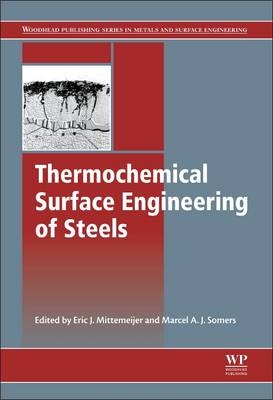
Thermochemical Surface Engineering of Steels
Woodhead Publishing Ltd (Verlag)
978-0-85709-592-3 (ISBN)
- Titel erscheint in neuer Auflage
- Artikel merken
Thermochemical surface engineering significantly improves the properties of steels. Edited by two of the world’s leading authorities, this important book summarises the range of techniques and their applications. It covers nitriding, nitrocarburizing and carburizing. There are also chapters on low temperature techniques as well as boriding, sheradizing, aluminizing, chromizing, thermo-reactive deposition and diffusion.
Eric J. Mittemeijer, Max Planck Institute for Intelligent Systems and Institute for Materials Science, University of Stuttgart, Germany. Marcel A. J. Somers, Technical University of Denmark, Denmark.
About the editors
List of contributors
Woodhead Publishing Series in Metals and Surface Engineering
Introduction
Part One: Fundamentals
1: Thermodynamics and kinetics of gas and gas–solid reactions
Abstract
1.1 Introduction
1.2 Equilibria for gas-exchange reactions
1.3 Equilibria for gas–solid reactions
1.4 Kinetics of gas-exchange reactions
1.5 Kinetics of gas–solid reactions
1.6 Phase stabilities in the Fe-N, Fe-C and Fe-C-N systems
2: Kinetics of thermochemical surface treatments
Abstract
2.1 Introduction
2.2 Development of an interstitial solid solution
2.3 Precipitation of second phase particles in a supersaturated matrix
2.4 Product-layer growth at the surface
2.5 Conclusion
3: Process technologies for thermochemical surface engineering
Abstract
3.1 Introduction
3.2 Different ways of achieving a hardened wear-resistant surface
3.3 Furnaces
3.4 Gaseous carburising
3.5 Gaseous carbonitriding
3.6 Gaseous nitriding and nitrocarburising
3.7 Variants of gaseous nitriding and nitrocarburising
3.8 Gaseous boriding
3.9 Plasma assisted processes: plasma (ion) carburising
3.10 Plasma (ion) nitriding/nitrocarburising
3.11 Implantation processes (nitriding)
3.12 Salt bath processes (nitrocarburising)
3.13 Laser assisted nitriding
3.14 Fluidised bed nitriding
Acknowledgements
Part Two: Improved materials performance
4: Fatigue resistance of carburized and nitrided steels
Abstract
4.1 Introduction
4.2 The concept of local fatigue resistance
4.3 Statistical analysis of fatigue resistance
4.4 Fatigue behavior of carburized microstructures
4.5 Fatigue behavior of nitrided and nitrocarburized microstructures
4.6 Conclusion
5: Tribological behaviour of thermochemically surface engineered steels
Abstract
5.1 Introduction
5.2 Contact types
5.3 Wear mechanisms
5.4 Conclusions
6: Corrosion behaviour of nitrided, nitrocarburised and carburised steels
Abstract
6.1 Introduction
6.2 Corrosion behaviour of nitrided and nitrocarburised unalloyed and low alloyed steels: introduction
6.3 Nitriding processes and corrosion behaviour
6.4 Structure and composition of compound layers and corrosion behaviour
6.5 Post-oxidation and corrosion behaviour
6.6 Passivation of nitride layers
6.7 Corrosion behaviour in molten metals
6.8 Corrosion behaviour of nitrided, nitrocarburised and carburised stainless steels: introduction
6.9 Austenitic-ferritic and austenitic steels: corrosion in chloride-free solutions
6.10 Austenitic-ferritic and austenitic steels: corrosion in chloride-containing solutions
6.11 Ferritic, martensitic and precipitation hardening stainless steels
6.12 Conclusion
Part Three: Nitriding, nitrocarburizing and carburizing
7: Nitriding of binary and ternary iron-based alloys
Abstract
7.1 Introduction
7.2 Strong, intermediate and weak Me–N interaction
7.3 Microstructural development of the compound layer in the presence of alloying elements
7.4 Microstructural development of the diffusion zone in the presence of alloying elements
7.5 Kinetics of diffusion zone growth in the presence of alloying elements
7.6 Conclusion
8: Development of the compound layer during nitriding and nitrocarburising of iron and iron-carbon alloys
Abstract
8.1 Introduction
8.2 Compound layer formation during nitriding in a NH3/H2 gas mixture
8.3 Nitrocarburising in gas
8.4 Compound layer development during salt bath nitrocarburising
8.5 Post-oxidation and phase transformations in the compound layer
8.6 Conclusion
9: Austenitic nitriding and nitrocarburizing of steels
Abstract
9.1 Introduction
9.2 Phase stability regions of nitrogen-containing austenite
9.3 Phase transformation of nitrogen-containing austenite and its consequences for the process
9.4 Phase stability and layer growth during austenitic nitriding and nitrocarburizing
9.5 Properties resulting from austenitic nitriding and nitrocarburizing
9.6 Solution nitriding and its application
10: Classical nitriding of heat treatable steel
Abstract
10.1 Introduction
10.2 Steels suitable for nitriding
10.3 Microstructure and hardness improvement
10.4 Nitriding-induced stress in steel
10.5 Nitriding and improved fatigue life of steel
11: Plasma-assisted nitriding and nitrocarburizing of steel and other ferrous alloys
Abstract
11.1 Introduction
11.2 Glow discharge during plasma nitriding: general features
11.3 Sputtering during plasma nitriding
11.4 Practical aspects of sputtering and redeposition of the cathode material during plasma nitriding
11.5 Plasma nitriding as a low-nitriding potential process
11.6 Role of carbon-bearing gases and oxygen
11.7 Practical aspects of differences in nitriding mechanism of plasma and gas nitriding processes
11.8 Best applications of plasma nitriding and nitrocarburizing
11.9 Methods for reducing plasma nitriding limitations
Acknowledgements
12: ZeroFlow gas nitriding of steels
Abstract
12.1 Introduction
12.2 Improving gas nitriding of steels
12.3 Current gas nitriding processes
12.4 The principles of ZeroFlow gas nitriding
12.5 Thermodynamic aspects of nitriding in atmospheres of NH3 and of two-component NH3 + H2 and NH3 + NH3diss. mixes
12.6 Kinetic aspects of nitriding in atmospheres of NH3 and of two-component NH3 + H2 and NH3 + NH3diss. mixes
12.7 Using the ZeroFlow process under industrial conditions
12.8 Applications of the ZeroFlow method
12.9 Conclusion
13: Carburizing of steels
Abstract
13.1 Introduction
13.2 Gaseous carburizing
13.3 Low pressure carburizing
13.4 Hardening
13.5 Tempering and sub-zero treatment
13.6 Material properties
13.7 Furnace technology
13.8 Conclusion
Part Four: Low temperature carburizing and nitriding
14: Low temperature surface hardening of stainless steel
Abstract
14.1 Introduction
14.2 The origins of low temperature surface engineering of stainless steel
14.3 Fundamental aspects of expanded austenite
15: Gaseous processes for low temperature surface hardening of stainless steel
Abstract
15.1 Introduction
15.2 Surface hardening of austenitic stainless steel
15.3 Residual stress in expanded austenite
15.4 Prediction of nitrogen diffusion profiles in expanded austenite
15.5 Surface hardening of stainless steel types other than austenite
15.6 Conclusion and future trends
16: Plasma-assisted processes for surface hardening of stainless steel
Abstract
16.1 Introduction
16.2 Process principles and equipment
16.3 Microstructure evolution
16.4 Properties of surface hardened steels
16.5 Conclusion and future trends
17: Applications of low-temperature surface hardening of stainless steels
Abstract
17.1 Introduction
17.2 Applications in the nuclear industry
17.3 Applications in tubular fittings and fasteners
17.4 Miscellaneous applications
17.5 Conclusion
Part Five: Dedicated thermochemical surface engineering methods
18: Boriding to improve the mechanical properties and corrosion resistance of steels
Abstract
18.1 Introduction
18.2 Boriding of steels
18.3 Mechanical characterisation of borided steels
18.4 Corrosion resistance of steels exposed to boriding
18.5 Conclusion
19: The thermo-reactive deposition and diffusion process for coating steels to improve wear resistance
Abstract
19.1 Introduction
19.2 Growth behavior of coatings
19.3 High temperature borax bath carbide coating
19.4 High temperature fluidized bed carbide coating
19.5 Low temperature salt bath nitride coating
19.6 Properties of thermo-reactive deposition (TRD) carbide/nitride coated parts
19.7 Applications
19.8 Conclusion
20: Sherardizing: corrosion protection of steels by zinc diffusion coatings
Abstract
20.1 Introduction
20.2 Pretreatment, surface preparation and processing
20.3 Diffusion heat treatment
20.4 Post-treatment, inspection and quality control
20.5 Corrosion behavior and mechanical properties
20.6 Applications
21: Aluminizing of steel to improve high temperature corrosion resistance
Abstract
21.1 Introduction
21.2 Thermodynamics
21.3 Kinetics
21.4 Aluminizing of austenitic stainless steel – experimental examples
21.5 Applications
21.6 Conclusion
Acknowledgements
Index
| Reihe/Serie | Woodhead Publishing Series in Metals and Surface Engineering |
|---|---|
| Verlagsort | Cambridge |
| Sprache | englisch |
| Maße | 152 x 229 mm |
| Gewicht | 1270 g |
| Themenwelt | Naturwissenschaften ► Chemie ► Physikalische Chemie |
| Naturwissenschaften ► Chemie ► Technische Chemie | |
| Technik | |
| ISBN-10 | 0-85709-592-7 / 0857095927 |
| ISBN-13 | 978-0-85709-592-3 / 9780857095923 |
| Zustand | Neuware |
| Informationen gemäß Produktsicherheitsverordnung (GPSR) | |
| Haben Sie eine Frage zum Produkt? |
aus dem Bereich