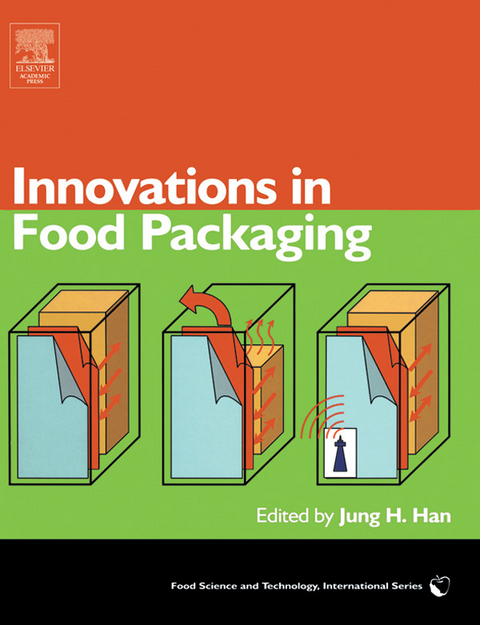
Innovations in Food Packaging (eBook)
503 Seiten
Elsevier Science (Verlag)
978-0-08-045517-4 (ISBN)
This book is organized into five parts. Part I focuses on the fundamental theories covering physical chemistry background and quality preservation of foods. Parts II and III discuss active packaging research and development and modified atmosphere packaging of fresh produce, meats, and ready-to-eat products, respectively. Part IV talks about edible and biodegradable coatings and films, whereas Part V discusses commercialization aspects of packaging technologies. Each part is divided into chapters of subject review and detailed technical information.
This text will benefit those who are interested in innovative technology of food packaging in general, and experienced field packaging specialists and graduate-level food scientists in particular. This book will be useful as a textbook not only for extension programs of food packaging development in food industry, but also for advanced graduate-level food packaging courses.
Covers four major food packaging topics:
* Theories in food packaging
* Active packaging
* Modified atmosphere packaging
* Edible films and coatings
Innovations in Food Packaging addresses selective topics of functions of food packaging to modify the traditional notion of this process. This book is organized into five parts. Part I focuses on the fundamental theories covering physical chemistry background and quality preservation of foods. Parts II and III discuss active packaging research and development and modified atmosphere packaging of fresh produce, meats, and ready-to-eat products, respectively. Part IV talks about edible and biodegradable coatings and films, whereas Part V discusses commercialization aspects of packaging technologies. Each part is divided into chapters of subject review and detailed technical information. This text will benefit those who are interested in innovative technology of food packaging in general, and experienced field packaging specialists and graduate-level food scientists in particular. This book will be useful as a textbook not only for extension programs of food packaging development in food industry, but also for advanced graduate-level food packaging courses.Covers four major food packaging topics: * Theories in food packaging* Active packaging* Modified atmosphere packaging* Edible films and coatings
Cover 1
Innovations in Food Packaging 4
Contents 6
Contributors 13
Preface 15
PART 1 Fundamental theories regarding the physical and chemical background and quality preservation of foods 16
1 New technologies in food packaging: overview 18
Introduction 18
Developments in food processing and packaging 20
Food packaging technologies 21
Extra active functions of packaging systems 21
Modified atmosphere packaging 23
Edible films and coatings 24
New food-processing technologies 24
Future trends in food packaging 25
References 25
2 Mass transfer of gas and solute through packaging materials 27
Introduction 27
General theory 29
Diffusivity 30
Solubility/partitioning 30
Henry’s law and solubility 30
Convective mass transfer 32
Overall mass transfer of gases and solutes 33
Gaseous diffusivity and permeability 33
Solute mass transfer coefficient and overall permeability 34
Summary 35
References 37
3 Quality of packaged foods 39
Introduction 39
Kinetics 40
Rates of deteriorative reactions 40
Zero-order reactions 41
First-order reactions 41
Shelf life 43
Shelf-life prediction 43
Storage conditions 45
Temperature 45
Equilibrium relative humidity 47
Gas atmosphere 47
Light 49
Aseptic packaging 51
Conclusions 55
References 55
4 Surface chemistry of food, packaging and biopolymer materials 60
Introduction 60
Principles of contact angle and surface energy 61
Contact angle 61
Surface energy and spreading coefficient 62
Zisman equation and critical surface tension 63
McGuire’s theory and equation 64
Neumann’s equation 64
Harmonic mean method 65
Germain’s method 65
Techniques for measuring the contact angle 65
Goniometry 66
Tensiometry 67
Applied research 67
Future trends 72
References 72
PART 2 Active packaging research and development 76
5 Introduction to active food packaging technologies 78
Introduction 78
Drivers for choice of active packaging 80
Economic advantage 81
Process engineering limitations 81
Time-dependent processes 81
Secondary effects 82
Environmental impacts 83
Enhanced convenience 83
Forms of active packaging 83
Localized effects 84
Whole package activity 84
Edible coatings 85
History of active packaging 85
Active packaging for processed foods and beverages 86
Oxygen scavenging 86
Carbon dioxide scavenging or release 87
Removal of odors and flavors 87
Active packaging for produce 87
Active packaging for fresh meat 89
Impact on packaging materials and processes 89
Material properties 89
Premature activity 90
Process adaptation 90
Active packaging and the distribution chain 91
Regulatory environment 92
References 92
6 Antimicrobial packaging systems 95
Introduction 95
Food safety 96
Spoilage of food products 96
Food-borne illness 96
Malicious tampering and bioterrorism 97
Antimicrobial packaging 97
Antimicrobial agents 98
Chemical antimicrobial agents 98
Natural antimicrobial agents 100
Probiotics 100
System design 101
Antimicrobial mechanisms 101
Microbiocidal 104
Microbiostatic 105
Functioning modes and volatility 105
Non-volatile migration 106
Volatile migration 107
Non-migration and absorption 107
Shapes and compositions of systems 108
Commercialization 109
Technical factors 109
Compatibility of process conditions and material characteristics 109
Physical properties of packaging materials 111
Controlled release technology 112
Extra advantages 114
Regulatory, marketing and political factors 114
References 116
7 Packaging containing natural antimicrobial or antioxidative agents 123
Introduction 123
Antimicrobial packaging 125
Antioxidative packaging 131
Future potential 133
References 134
8 Oxygen-scavenging packaging 138
Introduction 138
Reviews 139
History 139
Package inserts 139
Oxidation of metals 139
Other oxidation reactions 140
Packaging materials as oxygen scavengers 141
Homogeneous plastic structures 143
Application to food and beverage packaging 147
Future opportunities 150
References 150
9 Intelligent packaging 153
Introduction 153
New packaging systems 153
Intelligent packaging 154
Intelligent packaging applications and technologies 156
Intelligent packaging to provide more convenience 156
Convenience indicators for quality 156
Convenience indicators for storage, distribution, and traceability 156
Improved convenience for preparation and cooking methods 159
Intelligent packaging for improving product quality and product value 160
Freshness and microbial indicators 160
Time–temperature indicators 162
Gas concentration indicators 163
Intelligent packaging to change gas permeability properties 164
Intelligent packaging to provide protection against theft, counterfeiting, and tampering 165
Consumer acceptance and legislative issues 166
Conclusions 167
Recommendations 167
Conclusions 168
Disclaimer 168
References 168
PART 3 Modified atmosphere packaging of fresh produce, meats, and ready-to-eat products 172
10 Introduction to modified atmosphere packaging 174
Introduction 174
Historical developments 174
Principles of MAP 176
MAP techniques 177
Advantages and disadvantages of MAP 178
Effect of MAP on shelf life 179
Meats and poultry 179
Fish and shellfish 180
Bakery products 181
Fruits and vegetables 181
Cheese 182
Other products 183
Effect of MAP on micro-organisms – safety issues 183
Effect of MAP on nutritional quality 184
Combination of MAP with other technologies 184
Refrigeration 184
Freezing 185
Irradiation 185
Hurdle technology 185
Edible coatings 186
Biological control 186
References 186
11 Internal modified atmospheres of coated fresh fruits and vegetables: understanding relative humidity effects 188
Introduction 188
Theoretical approach 190
Fruit-coating model system 190
Permeability dependence on RH 192
Results and discussion 192
RH and coating thickness effects on internal gas pressure of coated fruits 192
RH and maximum respiration rate effects on internal gas pressure of coated fruits 194
Internal CO[sub(2)] vs O[sub(2)] plots as influenced by RH, thickness, maximum respiration rates and film & #946
Possible sources of variation in internal gas composition 196
Conclusions 197
References 198
12 Modified atmosphere packaging of ready-to-eat foods 200
Introduction 200
Ready-to-eat meals 200
Modified atmosphere packaging 201
Classical nitrogen MAP 202
Inhibition of oxidation of food products by MAP 202
Nitrogen : CO[sub(2)] : O[sub(2)] MAP for ready meals 203
Packaging machinery 204
Packaging films and plastics 204
Gas delivery systems 205
Argon MAP 205
Development of argon MAP 205
Exploiting differences between argon and nitrogen for use in MAP 206
Control of oxidation 206
Control of microbial growth 207
Argon MAP for ready meals 207
Modifications of packaging machinery and tools to accommodate argon 208
Gas delivery system 208
Films 208
Example experiments 209
Sample preparations 209
Organoleptic assays 209
Microbial assays 210
Results 210
Relative utility of argon MAP vs Nitrogen MAP in displacing package oxygen 210
Effectiveness of argon MAP in controlling microbial growth in ready meals 211
Ability of argon MAP to preserve organoleptic characteristics of ready meals 212
Practical application of argon MAP in extending the shelf life of ready meals 215
Conclusions 216
References 216
13 Preservative packaging for fresh meats, poultry, and fin fish 219
Introduction 219
Preservation of meat appearance 222
Red meats 222
Poultry 225
Fish 225
Preservation or development of desirable eating qualities 226
Red meats 226
Poultry 227
Fish 228
Delay of microbial spoilage 228
Red meats 228
Poultry 231
Fish 231
Microbiological safety 233
Summary 235
References 235
14 Centralized packaging systems for meats 242
Introduction 242
Traditional meat distribution 243
Centralized packaging systems 243
Individual packages 245
High O[sub(2)] MAP system 245
Cryovac peeling 245
Flavaloc fresh 245
Windjammer case-ready packaging system 246
Master packaging (multiple packages) 246
Applied research 248
Conclusions 249
References 250
PART 4 Edible and biodegradable coatings and films 252
15 Edible films and coatings: a review 254
Introduction 254
Edible films and coatings 254
Biodegradable films and coatings 255
Historical and current uses of edible films and coatings 256
Film composition 257
Film-forming materials 257
Plasticizers 258
Additives 259
Functions and advantages 260
Edibility and biodegradability 260
Physical and mechanical protection 260
Migration, permeation, and barrier functions 262
Convenience and quality preservation 263
Shelf-life extension and safety enhancement 265
Active substance carriers and controlled release 265
Non-edible product applications 265
Other process-aiding functions 267
Scientific parameters 268
Chemistry of film-forming materials 268
Film-forming mechanisms 268
Physical chemistry of films 269
Practical parameters for commercialization 270
Film-production processes 270
Feasibility of commercialized system 272
Consumer-related issues 272
Regulatory issues 273
Conclusions 273
References 274
16 Agro-polymers for edible and biodegradable films: review of agricultural polymeric materials, physical and mechanical characteristics 278
Introduction 278
Agro-polymers 279
Edible films or coatings 279
Biodegradable materials 280
Processing 281
Properties and applications of edible and biodegradable films 282
Organoleptic properties 282
Biodegradability 283
Mechanical properties 283
Water vapor transfer 283
Control of gas exchange 284
Modification of surface conditions and controlled release of additives 285
Applications of agro-polymer based materials 285
Applications of biodegradable plastics 285
Application of edible films 287
Market opportunities 288
Conclusion 289
References 290
17 Edible films and coatings from plant origin proteins 292
Introduction 292
Zein films and coatings 292
Coatings 293
Films 293
Applications 295
Soy protein films 296
Formation of soy protein films 296
Functional properties of soy protein films 296
Applications 299
Wheat gluten films 299
Formation of wheat gluten films 300
Functional properties of wheat gluten-based films 301
Post-production treatments of wheat gluten films 302
Applications 303
Cottonseed protein films 303
Formation of cottonseed films 304
Functional properties of cottonseed flour-based films 305
Applications 306
Other protein films 306
Peanut protein 306
Rice protein 307
Pea protein 308
Pistachio protein 309
Grain sorghum protein 310
Appendix 310
References 310
18 Edible films and coatings from animal-origin proteins 316
Introduction 316
Animal-origin proteins 317
Caseins 319
Whey proteins 321
Collagen and gelatin 321
Myofibrillar proteins 322
Egg white 326
Bioactive protein-based coatings and films 326
References 327
19 Edible films and coatings from starches 333
Introduction 333
Starch fundamentals 334
Film formation 336
Starch solution 336
Film formation 337
Structures in starch films 338
Amorphous structure and glass transition temperature 338
Crystalline structure and degree of crystallinity 340
Water sorption 341
Mechanical properties 343
Oxygen and carbon dioxide barrier 345
Summary and conclusions 347
References 347
20 Edible films and coatings from non-starch polysaccharides 353
Introduction 353
Non-starch polysaccharides used for films and coatings 356
Cellulosic derivatives 356
Chitosan 357
Seaweed extracts 359
Alginate 359
Carrageenan 360
Agar 361
Pectin 361
Microbial polysaccharides 361
Exudate gums 362
Seed gums 362
Applications of edible films and coatings 363
Composition 363
Property modification 364
Edible films as food packaging materials 366
Carbohydrate chemistry 367
Structural analysis of carbohydrates 367
Thermal and physicochemical properties 369
Conclusion 369
References 370
21 Lipid-based edible films and coatings 377
Introduction 377
Materials used in lipid-based films and coatings 378
Preparation 381
Physical properties 384
Influence of film preparation methods on WVP 386
Influence of fatty acids 386
Influence of the concentration of lipids 388
Influence of film thickness 389
Influence of the RH differentials 390
Influence of temperature 390
Applications 391
Fresh and processed food products 392
Minimally processed fruits and vegetables 393
Active packaging 394
Edible packaging 394
Conclusions 395
References 395
22 Emulsion and bi-layer edible films 399
Introduction 399
Composite film formation 400
Properties of bi-layer films 402
Properties of emulsion films 408
Conclusions 413
References 414
23 Plasticizers in edible films and coatings 418
Introduction 418
Definition and purpose of plasticizers 419
Types of plasticizing 419
Internal and external plasticization 419
Polymer molecular weight and plasticization 423
External plasticizer requirements 424
Compatibility 424
Efficiency 424
Permanence 424
Theories of plasticization 425
Gel theory 425
Free volume theory 425
Plasticization models 426
Gordon and Taylor equation 426
Couchman and Karasz equation 427
Couchman and Karasz equation – exact form 427
Other equations 427
Plasticization and T[sub(g)] 428
Advantages and disadvantages of edible films and coatings 429
Properties of edible films and coatings 430
Polysaccharide-based films and coatings 431
Properties 432
Permeability properties 432
Mechanical properties 432
Moisture sorption 434
Protein-based films and coatings 434
Properties 434
Mechanical properties 436
Permeability properties 438
Moisture sorption 440
Challenges and opportunities 440
Food system applications 441
Conclusions 442
References 443
24 Sensory quality of foods associated with edible film and coating systems and shelf-life extension 449
Introduction 449
Sensory quality attributes associated with edible films and coatings 451
Appearance 451
Texture 453
Flavor, odor, taste, and other sensory attributes 454
Edible coatings to improve the quality and extend the shelf life of foods – case studies 455
Whey protein 455
Semperfresh™ 456
Chitosan 457
Lipid–HPMC composite coatings 458
Sensory evaluation of edible films, coatings and coated products 459
Edible films and coatings incorporating functional ingredients 461
Future research 463
Development of new materials 463
Incorporating functional ingredients 463
Sensory studies for determining quality criteria in the measurement of shelf life 464
References 464
PART 5 Commercial aspects of new packaging technologies 470
25 Commercial uses of active food packaging and modified atmosphere packaging systems 472
Introduction 472
Active packaging 473
Oxygen scavenging packaging 474
High gas-permeability package structures 477
High relative humidity control 478
Low relative humidity control 479
Antimicrobials 479
Odor controllers 480
Conclusions on active packaging 480
Modified atmosphere packaging 481
History of CAP and MAP 481
Tectrol 482
Transfresh 482
Cryovac 482
Processed meats 483
Bakery goods 483
Retail red meat 483
Pasta 483
Red meat 484
Poultry 485
Fish 485
Fruits and vegetables 485
Soft bakery goods 486
Prepared foods 487
Further reading 489
26 US Food and Drug Administration approach to regulating intelligent and active packaging components 490
Introduction 490
The food additive petition process 492
Food contact substance notifications 493
Special considerations for antimicrobial food additives 494
Other active or intelligent packaging materials 495
Conclusions 496
27 Packaging for non-thermal food processing 497
Introduction 497
Non-thermal food processing 498
PEF 498
HPP 500
Irradiation 501
Pulsed light 501
Plastic packaging materials 502
Packaging for non-thermal food processing 503
PEF 503
HPP 507
Irradiation 508
Pulsed light 509
Future research 509
References 510
Index 516
A 516
B 517
C 517
D 518
E 518
F 520
G 521
H 521
I 521
K 522
L 522
M 522
N 523
O 524
P 524
Q 526
R 526
S 526
T 527
U 527
V 527
W 528
X 528
Y 528
Z 528
| Erscheint lt. Verlag | 20.7.2005 |
|---|---|
| Sprache | englisch |
| Themenwelt | Sachbuch/Ratgeber |
| Naturwissenschaften ► Biologie ► Mikrobiologie / Immunologie | |
| Technik ► Lebensmitteltechnologie | |
| Technik ► Maschinenbau | |
| ISBN-10 | 0-08-045517-4 / 0080455174 |
| ISBN-13 | 978-0-08-045517-4 / 9780080455174 |
| Informationen gemäß Produktsicherheitsverordnung (GPSR) | |
| Haben Sie eine Frage zum Produkt? |
 EPUB (Adobe DRM)
Kopierschutz: Adobe-DRM
Adobe-DRM ist ein Kopierschutz, der das eBook vor Mißbrauch schützen soll. Dabei wird das eBook bereits beim Download auf Ihre persönliche Adobe-ID autorisiert. Lesen können Sie das eBook dann nur auf den Geräten, welche ebenfalls auf Ihre Adobe-ID registriert sind.
Details zum Adobe-DRM
Dateiformat: EPUB (Electronic Publication)
EPUB ist ein offener Standard für eBooks und eignet sich besonders zur Darstellung von Belletristik und Sachbüchern. Der Fließtext wird dynamisch an die Display- und Schriftgröße angepasst. Auch für mobile Lesegeräte ist EPUB daher gut geeignet.
Systemvoraussetzungen:
PC/Mac: Mit einem PC oder Mac können Sie dieses eBook lesen. Sie benötigen eine
eReader: Dieses eBook kann mit (fast) allen eBook-Readern gelesen werden. Mit dem amazon-Kindle ist es aber nicht kompatibel.
Smartphone/Tablet: Egal ob Apple oder Android, dieses eBook können Sie lesen. Sie benötigen eine
Geräteliste und zusätzliche Hinweise
Buying eBooks from abroad
For tax law reasons we can sell eBooks just within Germany and Switzerland. Regrettably we cannot fulfill eBook-orders from other countries.
aus dem Bereich