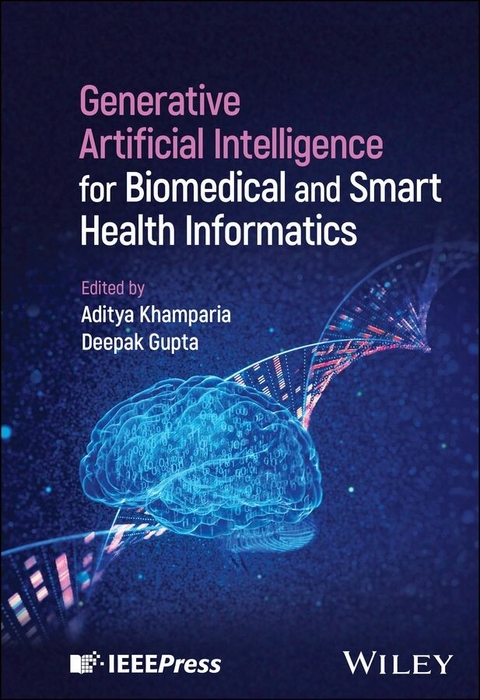
Generative Artificial Intelligence for Biomedical and Smart Health Informatics (eBook)
1080 Seiten
Wiley-IEEE Press (Verlag)
978-1-394-28071-1 (ISBN)
Enables readers to understand the future of medical applications with generative AI and related applications
Generative Artificial Intelligence for Biomedical and Smart Health Informatics delivers a comprehensive overview of the most recent generative AI-driven medical applications based on deep learning and machine learning in which biomedical data is gathered, processed, and analyzed using data augmentation techniques. This book covers many applications of generative models for medical image data, including volumetric medical image segmentation, data augmentation, MRI reconstruction, and modeling of spatiotemporal medical data.
The book explores findings obtained by explainable AI techniques, with coverage of various techniques rarely reported in literature. Throughout, feedback and user experiences from physicians and medical staff, as well as use cases, are included to provide important context.
The book discusses topics including privacy and security challenges in AI-enabled health informatics, biosensor-guided AI interventions in personalized medicine, regulatory frameworks and guidelines for AI-based medical devices, education and training for building responsible AI solutions in healthcare, and challenges and opportunities in integrating generative AI with wearable devices.
Topics covered include:
- Treatment of neurological disorders using intelligent techniques and image-guided and tomography interventions for neuromuscular disorders
- Bio-inspired smart healthcare service frameworks with AI, machine learning, and deep learning, integration of IoT devices, and edge computing in industrial and clinical systems
- Traffic management and optimization in distributed environments, patient data management, disease surveillance and prediction, and telemedicine and remote monitoring
- Education-driven, peer-to-peer, and service-oriented architectures and transparency and accountability in medical decision-making
Generative Artificial Intelligence for Biomedical and Smart Health Informatics is an essential reference for computer science researchers, medical professionals, healthcare informatics, and medical imaging researchers interested in understanding the potential of artificial intelligence and other related technologies in healthcare.
Aditya Khamparia, Assistant Professor, Department of Computer Science at Babasaheb Bhimrao Ambedkar University, India. His research areas include Artificial Intelligence, Intelligent Data Analysis, Machine Learning, Deep Learning, and Soft Computing.
Deepak Gupta, Assistant Professor, Department of Computer Science and Engineering, Maharaja Agrasen Institute of Technology, Delhi, India. His research interests include intelligent data analysis, nature-inspired computing, machine learning, and soft computing.
Enables readers to understand the future of medical applications with generative AI and related applications Generative Artificial Intelligence for Biomedical and Smart Health Informatics delivers a comprehensive overview of the most recent generative AI-driven medical applications based on deep learning and machine learning in which biomedical data is gathered, processed, and analyzed using data augmentation techniques. This book covers many applications of generative models for medical image data, including volumetric medical image segmentation, data augmentation, MRI reconstruction, and modeling of spatiotemporal medical data. The book explores findings obtained by explainable AI techniques, with coverage of various techniques rarely reported in literature. Throughout, feedback and user experiences from physicians and medical staff, as well as use cases, are included to provide important context. The book discusses topics including privacy and security challenges in AI-enabled health informatics, biosensor-guided AI interventions in personalized medicine, regulatory frameworks and guidelines for AI-based medical devices, education and training for building responsible AI solutions in healthcare, and challenges and opportunities in integrating generative AI with wearable devices. Topics covered include: Treatment of neurological disorders using intelligent techniques and image-guided and tomography interventions for neuromuscular disordersBio-inspired smart healthcare service frameworks with AI, machine learning, and deep learning, integration of IoT devices, and edge computing in industrial and clinical systemsTraffic management and optimization in distributed environments, patient data management, disease surveillance and prediction, and telemedicine and remote monitoringEducation-driven, peer-to-peer, and service-oriented architectures and transparency and accountability in medical decision-making Generative Artificial Intelligence for Biomedical and Smart Health Informatics is an essential reference for computer science researchers, medical professionals, healthcare informatics, and medical imaging researchers interested in understanding the potential of artificial intelligence and other related technologies in healthcare.
List of Contributors
Mohammed Abdalla
Faculty of Computers and Artificial Intelligence
Beni-Suef University
Cairo
Egypt
Diksha Aggarwal
CSE, SOET
The NorthCap University
Gurugram
India
Pooja Agarwal
Computer Science
PES
Bangalore
Karnataka
Vanshika Singh Andotra
Manipal University
Jaipur
Komal Arora
School of Computer Science
Lovely Professional University
Phagwara, Punjab
India
Anagha Balakrishnan
Department of Bioinformatics
University of North Bengal
Darjeeling, West Bengal
India
Aaryan Barde
Department of CSE-AIML
LNCT Group of Collage
Bhopal, MP
India
Snehlata Barde
Department of CSECS
PIET Parul University
Vadodara Gujrat
India
Kanaka Durga Prasad Bhamidipaty
Department of Radiology
NRIIMS
Visakhapatnam
India
Veenadhari Bhamidipaty
Department of Computer Science and Engineering
Gandhi Institute of Technology and Management
Visakhapatnam, Andhra Pradesh
India
Durgananda Lahari Bhamidipaty
Department of Biotechnology
Manipal Institute of Technology
Manipal, Karnataka
India
Amit Bhagat
Maulana Azad National Institute of Technology (MANIT)
Bhopal
Suman Bhatia
Department of Artificial Intelligence and Machine Learning
Dr. Akhilesh Das Gupta Institute of Professional Studies (affiliated to Guru Gobind Singh Indraprastha University New Delhi)
New Delhi
Rajesh Botchu
Department of Radiology
NRIIMS
Visakhapatnam
India
and
AHERF
Hyderabad
India
and
Department of Musculoskeletal Radiology
Royal Orthopedic Hospital
Birmingham
UK
Bhuvan Botchu
Solihull School
Solihull
UK
Haewon Byeon
Department of AI and Software
Inje University
Gimhae
Republic of Korea
Poonam Chaudhary
CSE, SOET
The NorthCap University
Gurugram
India
Riddhi Chawla
School of Dentistry
Central Asian University
Tashkent
Uzbekistan
Ganeev Kaur Chhabra
Department of Computer Science & Engineering
BharatiVidyapeeth College of Engineeering
New Delhi
India
Tabsum Chhetri
Department of Bioinformatics
University of North Bengal
Darjeeling, West Bengal
India
Om Dabral
Manipal University
Jaipur
Dharmendra Dangi
Indian Institute of Information Technology (IIITB)
Bhopal
Virrat Devaser
School of Computer Science
Lovely Professional University
Phagwara, Punjab
India
Diwakar Diwakar
BBA University
Lucknow
India
Dheeraj Kumar Dixit
Madhav Institute of Science and Technology (MITS)
Gwalior
Tanay Falor
IIIT
Allahabad
John J. Georrge
Department of Bioinformatics
University of North Bengal
Darjeeling, West Bengal
India
Toshika Goswami
Department of Computer Science & Engineering
BharatiVidyapeeth College of Engineeering
New Delhi
India
Indira Guntoory
Department of Obstetrics & Gynaecology
GIMSR
Visakhapatnam
India
Charu Gupta
Department of Computer Science
Bhagwan Parshuram Institute of Technology
Delhi
India
Anuj Gupta
Department of Electronics and Communication
Chandigarh University
Mohali
India
Rishik Gupta
Department of Information Technology and Computer Science
Manipal University
Jaipur
India
Rishik Gupta
Manipal University
Jaipur
Kusum Gurung
Department of Bioinformatics
University of North Bengal
Darjeeling, West Bengal
India
Ernesto Iadanza
Department of Medical Biotechnologies
University of Siena
Italy
Karthikeyan P. Iyengar
Department of Orthopedics, Southport and Ormskirk Hospital Southport
Mersey and West Lancashire Hospitals NHS Trust
UK
and
AHERF
Hyderabad
India
and
Edge Hill University
Ormskirk
UK
Ati Jain
Institute of Advance Computing
SAGE University
Indore
India
Amiyavardhan Jain
Consultant, Periodontology and Implantology
Noble Dental Care
Indore
India
Akshay Kanwar
Department of Electronics and Communication Engineering
Jawaharlal Nehru Government Engineering college
University Hamirpur
Sundernagar, 175018 Himachal Pradesh
India
Ismail Keshta
Computer Science and Information Systems Department
College of Applied Sciences
AlMaarefa University
Riyadh
Saudi Arabia
Aditya Khamparia
Department of Computer Science
Babasaheb Bhimrao Ambedkar University
Amethi, 226025 Uttar Pradesh
India
Aditya Khamparia
Department of Computer Science
Baba Saheb Bhimrao Ambedkar (Central University)
Lucknow
India
Aditya Khamparia
Department of Computer Science
Babasaheb Bhimrao Ambedkar University (A Central University)
Lucknow
India
Akanksha Kochhar
Department of Computer Science & Engineering
BharatiVidyapeeth College of Engineeering
New Delhi
India
Pramod Kumar
Ganga Institute of Technology and Management
Maharshi Dayanand University
Rohtak, Haryana
India
Vikas Kumar
ERP Department
ERP Functional Riviera Home Furnishing
Panipat
India
Bagesh Kumar
Department of Information Technology and Computer Science
Manipal University
Jaipur
India
Sohan Kumar
Department of Information Technology and Computer Science
Manipal University
Jaipur
India
Sohan Kumar
Manipal University
Jaipur
Ravi Kumar
Department of Computer Science Engineering
Lovely Professional University
Phagwara, 144411 Punjab
India
and
Department of Computer Science Engineering (AIML)
Jawaharlal Nehru Government Engineering college
University Hamirpur
Sundernagar, 175018 Himachal Pradesh
India
Antonio Lavecchia
“Drug Discovery” Laboratory
Department of Pharmacy
University of Naples Federico II
Naples
Italy
Kari Lippert
Department of Systems Engineering
University of South Alabama
Mobile, AL
USA
Niladri Maiti
School of Dentistry
Central Asian University
Tashkent
Uzbekistan
Arish Mallick
Queens University Belfast
UK
Brijendra Pratap Mishra
Department of Biochemistry
Autonomous State Medical College Bahraich
Atal Bihari Vajpayee Medical University
Lucknow, Uttar Pradesh
India
Saurav K. Mishra
Department of Bioinformatics
University of North Bengal
Darjeeling, West Bengal
India
Ayushi Mittal
Department of Computer Science
Indira Gandhi Delhi Technical University for Women
New Delhi
India
Ardra Nair
School of Computer Science
Lovely Professional University
Phagwara, Punjab
India
Aryan Nakhale
Department of Mechatronics
Chandigarh University
Mohali
India
H Naresh Kumar
School of Arts Sciences Humanities & Education
SASTRA Deemed University
Thanjavur
India
Babita Pandey
Department of Computer Science
Baba Saheb Bhimrao Ambedkar (Central University)
Lucknow
India
Devendra Kumar Pandey
School of Biotechnology
Lovely Professional University
Phagwara, Punjab
India
Sagar Dhanraj Pande
School of...
| Erscheint lt. Verlag | 3.1.2025 |
|---|---|
| Sprache | englisch |
| Themenwelt | Medizin / Pharmazie ► Gesundheitsfachberufe |
| Medizin / Pharmazie ► Medizinische Fachgebiete | |
| Schlagworte | biomedical data • data augmentation healthcare • data modeling healthcare • generative AI healthcare • healthcare ai • healthcare architecture • healthcare deep learning • Healthcare Machine Learning • Medical Image Data • mri reconstruction |
| ISBN-10 | 1-394-28071-8 / 1394280718 |
| ISBN-13 | 978-1-394-28071-1 / 9781394280711 |
| Informationen gemäß Produktsicherheitsverordnung (GPSR) | |
| Haben Sie eine Frage zum Produkt? |
 EPUB (Adobe DRM)
Kopierschutz: Adobe-DRM
Adobe-DRM ist ein Kopierschutz, der das eBook vor Mißbrauch schützen soll. Dabei wird das eBook bereits beim Download auf Ihre persönliche Adobe-ID autorisiert. Lesen können Sie das eBook dann nur auf den Geräten, welche ebenfalls auf Ihre Adobe-ID registriert sind.
Details zum Adobe-DRM
Dateiformat: EPUB (Electronic Publication)
EPUB ist ein offener Standard für eBooks und eignet sich besonders zur Darstellung von Belletristik und Sachbüchern. Der Fließtext wird dynamisch an die Display- und Schriftgröße angepasst. Auch für mobile Lesegeräte ist EPUB daher gut geeignet.
Systemvoraussetzungen:
PC/Mac: Mit einem PC oder Mac können Sie dieses eBook lesen. Sie benötigen eine
eReader: Dieses eBook kann mit (fast) allen eBook-Readern gelesen werden. Mit dem amazon-Kindle ist es aber nicht kompatibel.
Smartphone/Tablet: Egal ob Apple oder Android, dieses eBook können Sie lesen. Sie benötigen eine
Geräteliste und zusätzliche Hinweise
Buying eBooks from abroad
For tax law reasons we can sell eBooks just within Germany and Switzerland. Regrettably we cannot fulfill eBook-orders from other countries.
aus dem Bereich