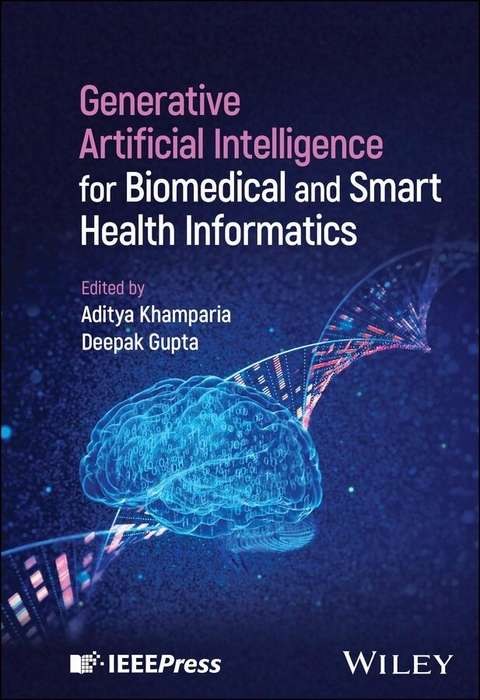
Generative Artificial Intelligence for Biomedical and Smart Health Informatics (eBook)
700 Seiten
Wiley-IEEE Press (Verlag)
978-1-394-28072-8 (ISBN)

Enables readers to understand the future of medical applications with generative AI and related applications
Generative Artificial Intelligence for Biomedical and Smart Health Informatics delivers a comprehensive overview of the most recent generative AI-driven medical applications based on deep learning and machine learning in which biomedical data is gathered, processed, and analyzed using data augmentation techniques. This book covers many applications of generative models for medical image data, including volumetric medical image segmentation, data augmentation, MRI reconstruction, and modeling of spatiotemporal medical data.
The book explores findings obtained by explainable AI techniques, with coverage of various techniques rarely reported in literature. Throughout, feedback and user experiences from physicians and medical staff, as well as use cases, are included to provide important context.
The book discusses topics including privacy and security challenges in AI-enabled health informatics, biosensor-guided AI interventions in personalized medicine, regulatory frameworks and guidelines for AI-based medical devices, education and training for building responsible AI solutions in healthcare, and challenges and opportunities in integrating generative AI with wearable devices.
Topics covered include:
- Treatment of neurological disorders using intelligent techniques and image-guided and tomography interventions for neuromuscular disorders
- Bio-inspired smart healthcare service frameworks with AI, machine learning, and deep learning, integration of IoT devices, and edge computing in industrial and clinical systems
- Traffic management and optimization in distributed environments, patient data management, disease surveillance and prediction, and telemedicine and remote monitoring
- Education-driven, peer-to-peer, and service-oriented architectures and transparency and accountability in medical decision-making
Generative Artificial Intelligence for Biomedical and Smart Health Informatics is an essential reference for computer science researchers, medical professionals, healthcare informatics, and medical imaging researchers interested in understanding the potential of artificial intelligence and other related technologies in healthcare.
Aditya Khamparia, Assistant Professor, Department of Computer Science at Babasaheb Bhimrao Ambedkar University, India. His research areas include Artificial Intelligence, Intelligent Data Analysis, Machine Learning, Deep Learning, and Soft Computing.
Deepak Gupta, Assistant Professor, Department of Computer Science and Engineering, Maharaja Agrasen Institute of Technology, Delhi, India. His research interests include intelligent data analysis, nature-inspired computing, machine learning, and soft computing.
Enables readers to understand the future of medical applications with generative AI and related applications Generative Artificial Intelligence for Biomedical and Smart Health Informatics delivers a comprehensive overview of the most recent generative AI-driven medical applications based on deep learning and machine learning in which biomedical data is gathered, processed, and analyzed using data augmentation techniques. This book covers many applications of generative models for medical image data, including volumetric medical image segmentation, data augmentation, MRI reconstruction, and modeling of spatiotemporal medical data. The book explores findings obtained by explainable AI techniques, with coverage of various techniques rarely reported in literature. Throughout, feedback and user experiences from physicians and medical staff, as well as use cases, are included to provide important context. The book discusses topics including privacy and security challenges in AI-enabled health informatics, biosensor-guided AI interventions in personalized medicine, regulatory frameworks and guidelines for AI-based medical devices, education and training for building responsible AI solutions in healthcare, and challenges and opportunities in integrating generative AI with wearable devices. Topics covered include: Treatment of neurological disorders using intelligent techniques and image-guided and tomography interventions for neuromuscular disordersBio-inspired smart healthcare service frameworks with AI, machine learning, and deep learning, integration of IoT devices, and edge computing in industrial and clinical systemsTraffic management and optimization in distributed environments, patient data management, disease surveillance and prediction, and telemedicine and remote monitoringEducation-driven, peer-to-peer, and service-oriented architectures and transparency and accountability in medical decision-making Generative Artificial Intelligence for Biomedical and Smart Health Informatics is an essential reference for computer science researchers, medical professionals, healthcare informatics, and medical imaging researchers interested in understanding the potential of artificial intelligence and other related technologies in healthcare.
| Erscheint lt. Verlag | 30.12.2024 |
|---|---|
| Sprache | englisch |
| Themenwelt | Medizin / Pharmazie ► Gesundheitsfachberufe |
| Medizin / Pharmazie ► Medizinische Fachgebiete | |
| Schlagworte | biomedical data • data augmentation healthcare • data modeling healthcare • generative AI healthcare • healthcare ai • healthcare architecture • healthcare deep learning • Healthcare Machine Learning • Medical Image Data • mri reconstruction |
| ISBN-10 | 1-394-28072-6 / 1394280726 |
| ISBN-13 | 978-1-394-28072-8 / 9781394280728 |
| Informationen gemäß Produktsicherheitsverordnung (GPSR) | |
| Haben Sie eine Frage zum Produkt? |
 PDF (Adobe DRM)
Kopierschutz: Adobe-DRM
Adobe-DRM ist ein Kopierschutz, der das eBook vor Mißbrauch schützen soll. Dabei wird das eBook bereits beim Download auf Ihre persönliche Adobe-ID autorisiert. Lesen können Sie das eBook dann nur auf den Geräten, welche ebenfalls auf Ihre Adobe-ID registriert sind.
Details zum Adobe-DRM
Dateiformat: PDF (Portable Document Format)
Mit einem festen Seitenlayout eignet sich die PDF besonders für Fachbücher mit Spalten, Tabellen und Abbildungen. Eine PDF kann auf fast allen Geräten angezeigt werden, ist aber für kleine Displays (Smartphone, eReader) nur eingeschränkt geeignet.
Systemvoraussetzungen:
PC/Mac: Mit einem PC oder Mac können Sie dieses eBook lesen. Sie benötigen eine
eReader: Dieses eBook kann mit (fast) allen eBook-Readern gelesen werden. Mit dem amazon-Kindle ist es aber nicht kompatibel.
Smartphone/Tablet: Egal ob Apple oder Android, dieses eBook können Sie lesen. Sie benötigen eine
Geräteliste und zusätzliche Hinweise
Buying eBooks from abroad
For tax law reasons we can sell eBooks just within Germany and Switzerland. Regrettably we cannot fulfill eBook-orders from other countries.
aus dem Bereich