


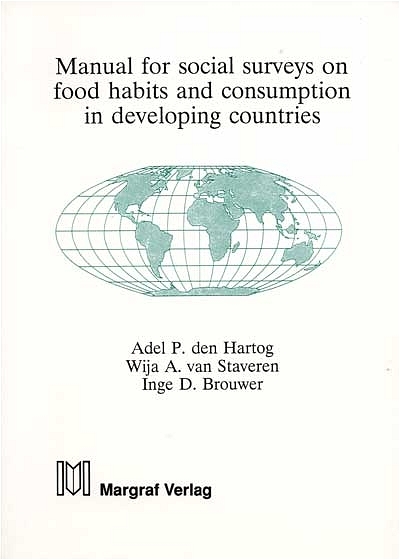
Manual for social surveys on food habits and Consumption in developing countries
- Titel ist leider vergriffen;
keine Neuauflage - Artikel merken
This manual provides practical advice for small-scale surveys on how to collect information on food habits and food consumption, and is primarily intended for field staff of food and nutrition programmes in Third World communities, such as nutritionists, community health staff, home-economics and agricultural extension officers. Many of them may feel the need to collect some information on food habits and food consumption during their work in order to throw light on a nutritional problem in their community and to find ways of solving it. Some may not have the necessary experience in connducting nutrition-oriented social surveys. The aim of the field guide is to outline how to collect information on food habits and food consumption. Such information may be collected for two, but interrelated objectives: for a general reconnaissance of the social context of food and nutrition of a community; and for a more specific problem-oriented approach on food habits and food consumpition. In the instance of the first objective, this can be done by means of a food ethnography which gives a descriptive analysis of the food system and food habits of a population.
In essence, a food ethnography is concerned with the question of how people deal their food. Food ethnography is needed, as in most communities knowledge and insight on the social context of food and nutrition is limited, incomplete or hardly available. When planning a nutrition intervention or nutrition research, it is essential to carry out a food ethnography. There is some evidence that even in long-established food and nutrition programmes much basic information is lacking. In the instance of the second objective, information may be used for anthropometric, clinical or biochemical assessment of the nutritional status of a population, as an indication of who is malnourished and why. Specific information on food habits and food consumption may be needed during planning, inplementation and evaluation of food and nutrition programmes. The user of the guide should bear in mind that a survey only makes sense if one carefully defines its purpose: the goals of the inquiry, why and what one wants to know. So suggestions and questions, questionnaires and worksheets provided by the manuals should be adapted to the specific aims and needs of the user.
One cannot prepare a standard questionnaire on food habits and consumption for every situation. This publication is intended as a guide and not as a set of rules on food habits and food consumption. It may contain questions neither relevanct nor applicable to a specific population and nutritional problems. It is not intended as an introduction on how to carry out sociological and epidemiological studies, which are beyond its scope.
Part 1 Food habits and consumption: introduction to food habits and food consumption patterns - what is food?, social functions of food in society, gastronomic function, means of cultural identity, religious or magic function, food as a means of communication, food as an expression of economic status, a means to exercise influence and power; food habits and ecology - ecology of foods, dairy foods and ecology; dynamics of food habits - change in food habits, acceptance of new foods; orientation from food subsistence farming to cash-crop farming - cash crops and food crops, gender issues and food production, scarcity of fuel for cooking; food habits and urbanization - urbanization, urban influences (migration and rural nutrition, urban markets and food production, spread of urban food habits into rural areas), changing urban food habits, food habits of socio-economic classes (the main urban classes, rural classes, income, household size), street foods and urban agriculture; food distribution in the household and infant feeding - food distribution, food avoidances, fasting and feeding, infant feeding; food shortages and adaptation of food habits - seasonality, adjustment of food habits compelled by necessity, adjustment of food habits as a coping strategy, food shortage of a chronic nature, women and food shortages; nutrition policy and programmes. Part 2 Field studies: some notes on field studies; food ethnography; measurement of food consumption; conversion of amounts of foods into nutrients and evaluation of results; reporting data. Appendices: items of observational data on food ethnography; example of a food ethnography questionnaire; presentation of data on food ethnography; questionnaire on food consumption of an individual; examples of calculation of nutrient intakes. (Part contents)
| Zusatzinfo | Zeichn. |
|---|---|
| Verlagsort | Weikersheim |
| Sprache | deutsch |
| Maße | 240 x 170 mm |
| Einbandart | Paperback |
| Themenwelt | Medizin / Pharmazie ► Gesundheitsfachberufe ► Diätassistenz / Ernährungsberatung |
| Sozialwissenschaften ► Soziologie ► Empirische Sozialforschung | |
| ISBN-10 | 3-8236-1237-9 / 3823612379 |
| ISBN-13 | 978-3-8236-1237-7 / 9783823612377 |
| Zustand | Neuware |
| Informationen gemäß Produktsicherheitsverordnung (GPSR) | |
| Haben Sie eine Frage zum Produkt? |


