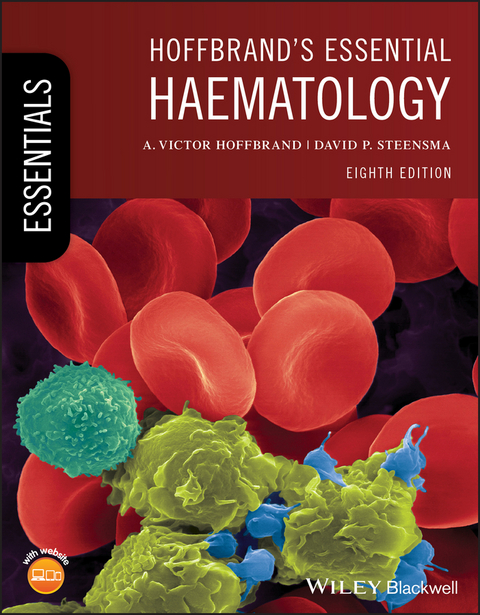
Hoffbrand's Essential Haematology (eBook)
John Wiley & Sons (Verlag)
978-1-119-49595-6 (ISBN)
The new and fully updated edition of the definitive haematology textbook for undergraduate and postgraduate students and trainees
Hoffbrand's Essential Haematology is widely regarded as the most authoritative introduction to the subject available, helping medical students and trainee doctors understand the essential principles of modern clinical and laboratory haematology for nearly four decades. Now in its eighth edition, this market-leading textbook introduces the formation and function of blood cells and the diseases that arise from dysfunction and disruption of these processes.
Beautifully presented with over 300 stunning colour illustrations, the new edition has been thoroughly updated to reflect recent advances in knowledge of the pathogenesis of blood diseases and their diagnosis and treatment. This new text:
- Describes disorders and diseases of the blood such as the various anaemias and white cell disorders, leukaemias, lymphomas and myeloma, as well as bleeding and thrombotic disorders
- Incorporates the latest World Health Organization (WHO) classification of haematological neoplastic diseases
- Reviews contemporary application of multiparameter flow cytometry, DNA sequencing and other technologies in evaluating patients with suspected haematological disease
- Discusses the therapeutic use of chimeric antigen T-cells, mono- and bi-specific monoclonal antibodies, inhibitors of intracellular signalling pathways and direct orally acting anticoagulants
- Includes sections on blood transfusion and the haematological aspects of systemic diseases, pregnancy and the neonate
Hoffbrand's Essential Haematology is a vital resource for all students and trainees, and a valuable reference for practicing specialists wishing to update their knowledge.
Victor Hoffbrand is Emeritus Professor of Haematology, University College London and Honorary Consultant Haematologist, the Royal Free Hospital London, UK.
David Steensma is Associate Professor of Medicine at Harvard Medical School, and Haematologist and Oncologist at Dana-Farber Cancer Institute, Boston, USA.
Victor Hoffbrand is Emeritus Professor of Haematology, University College London and Honorary Consultant Haematologist, the Royal Free Hospital London, UK. David Steensma is Associate Professor of Medicine at Harvard Medical School, and Haematologist and Oncologist at Dana-Farber Cancer Institute, Boston, USA.
Preface to the Eighth Edition vi
Preface to the First Edition vii
How to use your textbook viii
About the companion website x
1 Haemopoiesis 1
2 Erythropoiesis and general aspects of anaemia 11
3 Hypochromic anaemias 27
4 Iron overload 42
5 Megaloblastic anaemias and other macrocytic anaemias 50
6 Haemolytic anaemias 64
7 Genetic disorders of haemoglobin 78
8 The white cells, part 1: granulocytes, monocytes and their benign disorders 96
9 The white cells, part 2: lymphocytes and their benign disorders 111
10 The spleen 126
11 The aetiology and genetics of haematological neoplasia 132
12 Management of haematological malignancy 147
13 Acute myeloid leukaemia 158
14 Chronic myeloid leukaemia 172
15 Myeloproliferative neoplasms 182
16 Myelodysplastic syndromes 196
17 Acute lymphoblastic leukaemia 206
18 The chronic lymphocytic leukaemias 219
19 Hodgkin lymphoma 229
20 Non-Hodgkin lymphomas 238
21 Multiple myeloma and related plasma cell neoplasms 255
22 Aplastic anaemia and bone marrow failure 272
23 Haemopoietic stem cell transplantation 281
24 Platelets, blood coagulation and haemostasis 296
25 Bleeding disorders caused by vascular and platelet abnormalities 312
26 Coagulation disorders 324
27 Thrombosis 1: pathogenesis and diagnosis 338
28 Thrombosis 2: treatment 347
29 Haematological changes in systemic diseases 360
30 Blood transfusion 372
31 Pregnancy and neonatal haematology 386
Appendix 395
Index 401
CHAPTER 1
Haemopoiesis
Key topics
- Site of haemopoiesis
- Haemopoietic stem and progenitor cells
- Bone marrow stroma
- The regulation of haemopoiesis
- Haemopoietic growth factors
- Growth factor receptors and signal transduction
- Adhesion molecules
- The cell cycle
- Transcription factors
- Epigenetics
- Apoptosis
This first chapter is concerned with the general aspects of blood cell formation (haemopoiesis). The processes that regulate haemopoiesis and the early stages of formation of red cells (erythropoiesis), granulocytes and monocytes (myelopoiesis) and platelets (thrombopoiesis) are also discussed.
Site of haemopoiesis
In the first few weeks of gestation, the embryonic yolk sac is a transient site of haemopoiesis called ‘primitive haemopoiesis’. However, ‘definitive haemopoiesis’ derives from a population of stem cells first observed on the aorta-gonads-mesonephros (AGM) region of the developing embryo. These common precursors of endothelial and haemopoietic cells are called haemangioblasts and are believed to seed the liver, spleen and bone marrow.
From 6 weeks until 6–7 months of fetal life, the liver and spleen are the major haemopoietic organs and continue to produce blood cells until about 2 weeks after birth (Table 1.1; see Fig. 7.1b). The placenta also contributes to fetal haemopoiesis. The bone marrow is the most important site from 6–7 months of fetal life. During normal childhood and adult life, the marrow is the only source of new blood cells. The developing cells are situated outside the bone marrow sinuses; mature cells are released into the sinus spaces, the marrow microcirculation and so into the general circulation.
In infancy all the bone marrow is haemopoietic, but during childhood and beyond there is progressive fatty replacement of marrow throughout the long bones, so that in adult life haemopoietic marrow is confined to the central skeleton and proximal ends of the femurs and humeri (Table 1.1). Even in these active haemopoietic areas, approximately 50% of the marrow consists of fat in the middle-aged adult (Fig. 1.1). The remaining fatty marrow is capable of reversion to haemopoiesis and in many diseases there is also expansion of haemopoiesis down the long bones. Moreover, in certain disease states the liver and spleen can resume their fetal haemopoietic role (‘extramedullary haemopoiesis’).
Table 1.1 Dominant sites of haemopoiesis at different stages of development.
| Fetus | 0–2 months (yolk sac) |
| 2–7 months (liver, spleen) |
| 5–9 months (bone marrow) |
| Infants | Bone marrow (practically all bones); dwindling post-parturition contribution from liver/spleen that ceases in the first few months of life |
| Adults | Vertebrae, ribs, sternum, skull, sacrum and pelvis, proximal ends of femur |
Figure 1.1 Normal bone marrow trephine biopsy (posterior iliac crest). Haematoxylin and eosin stain; approximately 50% of the intertrabecular tissue is haemopoietic tissue and 50% is fat.
Haemopoietic stem and progenitor cells
Haemopoiesis starts with a pluripotential stem cell that can self-renew by asymmetrical cell division, but also gives rise to the separate cell lineages. These cells are able to repopulate a bone marrow from which all stem cells have been eliminated by lethal irradiation or chemotherapy. Self-renewal and repopulating ability define the haemopoietic stem cell (HSC). HSCs are rare, perhaps 1 in every 20 million nucleated cells in bone marrow. Newer DNA sequencing techniques suggest that a typical adult has approximately 50 000 HSCs.
HSCs are heterogeneous, with some able to repopulate a bone marrow for more than 16 weeks, called long-term HSCs, while others, although able to produce all haemopoietic cell types, engraft only transiently for a few weeks and are called short–term HSCs. Although the exact cell surface marker phenotype of the HSC is still unknown, on immunological testing these cells are positive for the marker Cluster of Differentiation 34 (CD34+) and negative for CD38− and for cell lineage-defining markers (Lin−). Morphologically, HSCs have the appearance of a small or medium-sized lymphocyte (see Fig. 23.3). The cells reside adjacent to osteoblasts or to endothelial cells of sinusoidal vessels in endosteal or vascular ‘niches’, where they are surrounded by stromal cells, with which they interact in numerous ways. The niches also contain sympathetic nerve endings.
Cell differentiation occurs from the stem cells via committed haemopoietic progenitors, which are restricted in their developmental potential (Fig. 1.2). The existence of the separate progenitor cells can be demonstrated by in vitro culture techniques. Stem cells and very early progenitors are assayed by culture on bone marrow stroma as long-term culture- initiating cells, whereas late progenitors are generally assayed in semi-solid media. As examples, in the erythroid series progenitors can be identified in special cultures as burst-forming units (BFU-E, describing the ‘burst’ with which they form in culture) and colony-forming units (CFU-E; Fig 1.2); the mixed granulocyte/monocyte progenitor is identified as a colony-forming unit-granulocyte/monocyte (CFU-GM) in culture. Megakaryocytes form from the CFU-Meg.
Figure 1.2 Diagrammatic representation of the bone marrow pluripotent stem cells (haemopoietic stem cells, HSC) and the cell lines that arise from them. A megakaryocytic/erythroid progenitor (MkEP) and a mixed lymphoid/myeloid progenitor are formed from the pluripotent stem cells. Each gives rise to more differentiated progenitors. The MkEP divides into erythroid and megakaryocyte progenitors. The mixed lymphoid progenitor gives rise to B and T lymphocytes and to natural killer cells. A granulocyte/monocyte progenitor gives rise to progenitors for monocytes, neutrophils, eosinophils, basophils and mast cells. The erythroid progenitors are also termed BFU-E and CFU-E. BFU-E, burst-forming unit erythroid; CFU-E, colony-forming unit erythroid.
In the haemopoietic hierarchy, the pluripotent stem cell gives rise to a mixed erythroid and megakaryocyte progenitor, which then divides into separate erythroid and megakaryocyte progenitors. The pluripotent stem cell also gives rise to a mixed lymphoid, granulocyte and monocyte progenitor, which divides into a progenitor of granulocytes and monocytes and a mixed lymphoid progenitor, from which B- and T-cell lymphocytes and natural killer (NK) cells develop (Fig. 1.2). The spleen, lymph nodes and thymus are secondary sites of lymphocyte production (see Chapter 9).
The stem cell has the capability for self-renewal (Fig. 1.3), so that marrow cellularity remains constant in a normal, healthy steady state. There is considerable amplification in the system: one stem cell is capable of producing about 106 mature blood cells after 20 cell divisions (Fig. 1.3). In humans HSCs are capable of about 50 cell divisions (the ‘Hayflick limit’), with progressive telomere shortening with each division affecting viability.
Under normal conditions most HSCs are dormant, with at most only a few percent actively in cell cycle on any given day. In humans it has been estimated that any given HSC enters the cell cycle approximately once every 3 months to 3 years. By contrast, progenitor cells are much more numerous and highly proliferative. With ageing, the number of stem cells falls and the relative proportion giving rise to lymphoid rather than myeloid progenitors falls too. Stem cells also accumulate genetic mutations with age, an average of 8 exonic coding mutations by age 60 years (1.3 per decade), and these, either passengers without oncogenic potential or drivers that cause clonal expansion, may be present in neoplasms arising from these stem cells (see Chapter 11).
Figure 1.3 (a) Bone marrow cells are increasingly differentiated and lose the capacity for self-renewal as they mature. (b) A single stem cell gives rise, after multiple cell divisions (shown by vertical lines), to >106 mature cells.
The progenitor and precursor cells are capable of responding to haemopoietic growth factors with increased production of one or other cell line when the need arises. The development of the mature cells (red cells, granulocytes, monocytes, megakaryocytes and lymphocytes) is considered further in other sections of this book.
Bone marrow stroma
The bone marrow forms a suitable environment for stem cell survival, self-renewal and formation of differentiated progenitor cells. It is composed of various types of stromal cells and a microvascular network (Fig. 1.4). The stromal cells include mesenchymal stem cells, adipocytes. fibroblasts, osteoblasts, endothelial cells and macrophages, and they secrete extracellular molecules such as collagen, glycoproteins...
| Erscheint lt. Verlag | 17.10.2019 |
|---|---|
| Reihe/Serie | Essentials |
| Essentials | Essentials |
| Sprache | englisch |
| Themenwelt | Medizinische Fachgebiete ► Innere Medizin ► Hämatologie |
| Schlagworte | Allgemeine u. Innere Medizin • Basic Medical Sciences • General & Internal Medicine • haematological • Hämatologie • Hematology • Medical Science • Medizin • Medizinische Grundlagenfächer • white cells |
| ISBN-10 | 1-119-49595-4 / 1119495954 |
| ISBN-13 | 978-1-119-49595-6 / 9781119495956 |
| Informationen gemäß Produktsicherheitsverordnung (GPSR) | |
| Haben Sie eine Frage zum Produkt? |
 EPUB (Adobe DRM)
Kopierschutz: Adobe-DRM
Adobe-DRM ist ein Kopierschutz, der das eBook vor Mißbrauch schützen soll. Dabei wird das eBook bereits beim Download auf Ihre persönliche Adobe-ID autorisiert. Lesen können Sie das eBook dann nur auf den Geräten, welche ebenfalls auf Ihre Adobe-ID registriert sind.
Details zum Adobe-DRM
Dateiformat: EPUB (Electronic Publication)
EPUB ist ein offener Standard für eBooks und eignet sich besonders zur Darstellung von Belletristik und Sachbüchern. Der Fließtext wird dynamisch an die Display- und Schriftgröße angepasst. Auch für mobile Lesegeräte ist EPUB daher gut geeignet.
Systemvoraussetzungen:
PC/Mac: Mit einem PC oder Mac können Sie dieses eBook lesen. Sie benötigen eine
eReader: Dieses eBook kann mit (fast) allen eBook-Readern gelesen werden. Mit dem amazon-Kindle ist es aber nicht kompatibel.
Smartphone/Tablet: Egal ob Apple oder Android, dieses eBook können Sie lesen. Sie benötigen eine
Geräteliste und zusätzliche Hinweise
Buying eBooks from abroad
For tax law reasons we can sell eBooks just within Germany and Switzerland. Regrettably we cannot fulfill eBook-orders from other countries.
aus dem Bereich