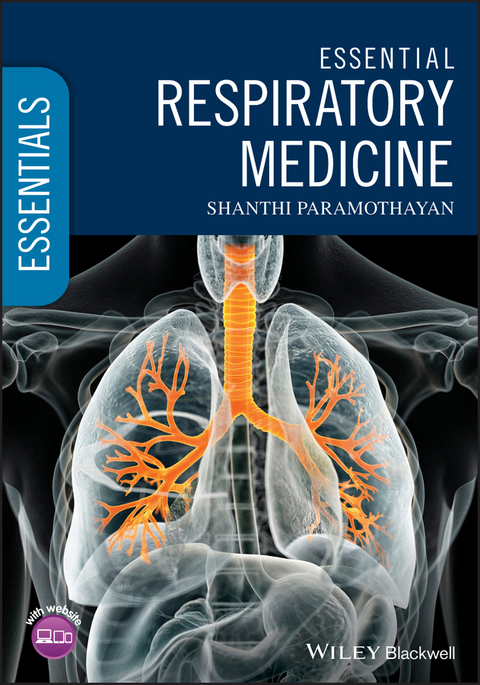
Essential Respiratory Medicine (eBook)
John Wiley & Sons (Verlag)
978-1-118-61831-8 (ISBN)
A succinct yet comprehensive overview of respiratory medicine, written for students and professionals
Essential Respiratory Medicine is an indispensable text offering an understanding of respiratory conditions and their clinical management within evidence-based guidelines. Containing information on taking a medical history, performing examinations and investigations, diagnosis and the management of respiratory conditions, this comprehensive text was put together by a noted expert in the field.
Written in an accessible manner, Essential Respiratory Medicine contains the foundational science associated with respiratory medicine, a wide-variety of practical procedures, helpful diagrams, and self-assessments designed to enhance understanding of the material presented. The text covers a variety of conditions as well as providing suggestions for engaging with patients at different stages of care. This important resource:
- Demonstrates an effective approach to patients presenting with common respiratory symptoms
- Includes a description of all key practical procedures with diagrams
- Discusses acute management of important respiratory emergencies
- Covers both acute and chronic disease
- Contains a companion website containing a range of learning materials, including downloadable management summaries and algorithms, an image bank, videos of patient examination, example respiratory sounds and multiple-choice questions
Essential Respiratory Medicine is an essential resource for anyone on a clinical placement, rotation, or training programme in respiratory medicine.
DR. SHANTHI PARAMOTHAYAN is a Consultant Physician in Respiratory and General Medicine. She is an educationalist with a Masters in Medical Education.
DR. SHANTHI PARAMOTHAYAN is a Consultant Physician in Respiratory and General Medicine. She is an educationalist with a Masters in Medical Education.
About the author ix
Acknowledgements xi
About the companion website xiii
1 Introduction to respiratory medicine 1
2 Embryology, anatomy, and physiology of the lung 5
3 Pharmacology of the lung 29
4 Common respiratory investigations 51
5 Common presentations of respiratory disease 83
6 Obstructive airways disease 105
7 Diffuse parenchymal lung disease 137
8 Respiratory infections 173
9 Lung cancer 205
10 Pleural disease 235
11 Pulmonary embolus, pulmonary hypertension, and vasculitides 267
12 Suppurative lung disease 293
13 Respiratory failure 317
14 Sleep-related disorders 333
15 Occupational, environmental, and recreational lung disease 353
16 Disorders of the mediastinum 369
17 Acute lung injury and acute respiratory distress syndrome 383
Index 395
CHAPTER 2
Embryology, anatomy, and physiology of the lung
Learning objectives
- To gain a basic understanding of the development of the lung
- To be aware of the common developmental lung abnormalities
- To understand the anatomy of the respiratory system which is relevant to clinical practice
- To be aware of the structure and function of the diaphragm
- To understand the muscles of respiration
- To understand how mechanical ventilation occurs
- To gain knowledge of the structure of the bronchial tree and the alveoli
- To gain knowledge of the blood supply, nerve supply, and lymphatics of the respiratory system
- To understand the physiology of the respiratory system which is relevant to clinical practice
- To gain some understanding of the control of breathing
- To gain knowledge of the receptors in the lungs
- To appreciate the function of the central and peripheral chemoreceptors
- To understand how oxygen is transported in the blood from the lungs to tissues
- To understand how carbon dioxide is transported in the blood from tissues to the lungs
- To understand the importance of carbon dioxide in the acid‐base balance of the body
- To understand the causes of physiological shunts
- To understand the causes of ventilation‐perfusion mismatch
- To have some understanding of the defence mechanisms of the lungs
Abbreviations
- ASD
- atrial septal defect
- CA
- carbonic anhydrase
- CO2
- carbon dioxide
- COPD
- chronic obstructive pulmonary disease
- CSF
- cerebrospinal fluid
- FRC
- functional residual capacity
- H+
- hydrogen ion
- H2CO3
- carbonic acid
- HB
- haemoglobin
- HCO3–
- bicarbonate ion
- MCE
- mucociliary escalator
- NANC
- non‐noradrenergic, non‐cholinergic
- NO
- nitric oxide
- O2
- oxygen
- O3
- ozone
- PCD
- primary ciliary dyskinesia
- PCO2
- partial pressure of carbon dioxide
- PO2
- partial pressure of oxygen
- R
- respiratory quotient
- SO2
- sulphur dioxide
- VSD
- ventricular septal defect
Introduction
The respiratory system’s main role is to provide oxygen (O2) that is required for glycolysis, and the removal of the waste product of respiration, carbon dioxide (CO2). This involves two separate processes: (1) mechanical ventilation whereby air is moved into and out of the lungs, and (2) gas exchange across the alveolar‐capillary membrane.
The respiratory system also has an important role in acid‐base balance, the defence against airborne pathogens, and in phonation, which is essential for audible speech. The conversion of angiotensin 1 to angiotensin 11 occurs in the lungs as does the deactivation of bradykinin, serotonin, and various drugs, including propranolol.
The lungs act as a reservoir of 500 ml blood and therefore participate in heat exchange. The lungs filter and lyse microemboli from the veins, preventing them from reaching the systemic circulation.
Development of the respiratory system
The lungs are not required for respiration in utero, but start working as soon as the baby is born and is independent from its mother. The development of the lungs starts in week three of the embryonic period (3–16 weeks), continues through the foetal period (16–38 weeks), beyond birth, and into childhood. During intrauterine life, the lungs are an important source of amniotic fluid, producing around 15 ml kg−1 of body weight, which flows out via the trachea or is swallowed.
Development of the lungs
During the embryonic period, the structures of the respiratory system are formed: the trachea, bronchial tree, blood vessels, nerves, lymphatics, and the structures of the thoracic cage (Figure 2.1). In the latter part of the second trimester and during the third trimester, there is functional development, with lung maturation and the production of surfactant. Five phases of structural lung development are recognised. In the embryonic phase (3–16 weeks), at approximately 28 days after conception, lung development begins with the formation of the sulcus laryngotrachealis in the lower part of the pharynx. At 30 days, a bud, called the true lung primordium, forms from the lower part of the foregut, but remains in communication with it. The oesophagotracheal ridges then fuse to form the oesophagotracheal septum, which divides the oesophagus from the trachea. Failure of the formation of this septum occurs in 1 : 3000 births and results in the formation of a trachea‐oesophageal fistula.
Figure 2.1 Stages of lung development.
The diaphragm develops in the third week after fertilisation, with transverse and longitudinal folding. The septum transversum is the primitive central tendon and forms in the cervical region and migrates downwards, therefore the innervation is from the phrenic nerve that originates from the cervical spinal cord.
Failure of one of the pleuroperitoneal membranes to close results in a congenital diaphragmatic hernia which occurs in 1 : 2000 births. It occurs more commonly on the left side and results in the intestinal contents moving up into the left hemithorax, compromising lung development resulting in lung hypoplasia. Surgical repair carries a high mortality.
Normal lung development depends on the interaction between the epithelium and the mesenchymal tissue which lies beneath it. During the pseudoglandular period of the embryonic phase (5–16 weeks), there is an asymmetrical subdivision of the lung primordium into the two buds which will form the main bronchi. The smaller left main bronchus is directed more acutely away from the trachea while the larger right main bronchus leads more directly from the trachea. The two main bronchi subdivide unequally, giving rise to three lobes on the right and two lobes on the left.
Progressive branching during the embryonic phase results in the formation of the first 16 generations of the conducting airways, composed of the trachea, bronchi, bronchioles, and terminal bronchioles. Differentiation of the epithelium derived from the endoderm, with formation of cilia in the proximal airways, occurs at 13 weeks and is controlled by the mesenchyme beneath it. This ciliated epithelium lines the entire conducting airway system and is important in host defence. In primary ciliary dyskinesia (PCD), the ciliary structure is abnormal, and the consequences are significant, as discussed in Chapter 12. The innervation of the lungs is derived from the ectoderm while the vascular structures, smooth muscle, cartilage, and connective tissue are derived from the mesoderm.
During the canalicular period (16–26 weeks), there is further branching of the bronchial tree, with the terminal bronchioles dividing into the respiratory bronchioles (generations 20–22), which further subdivide into the alveolar ducts (generations 20–22) and finally the alveolar sacs (generation 23). Generations 17–23 are called the respiratory zones and will be responsible for gas exchange. Once the alveolar sacs have been formed, further growth occurs by elongation and widening of the airways.
Type 1 pneumocytes, the main cells of the alveolus, are formed with very thin membranes. There is vascularization, with establishment of the capillary network very close to the type 1 pneumocytes in preparation for the gas exchange. Type 2 pneumocytes, which contain lamellar (or inclusion) bodies, also develop and will eventually synthesise and store surfactant.
At the end of the embryonic period (16 weeks), the pulmonary vessels have developed. The pulmonary circulatory system is smaller than the systemic circulatory system and is formed out of the sixth pharyngeal arch artery and a vessel plexus which originates from the aortic sac. The true sixth aortic arch is only then formed after vessels from the dorsal arch grow into this plexus and there is a connection between the truncus pulmonalis and the dorsal aorta.
During the terminal sac period of foetal development (26–38 weeks), there is further differentiation of the type 1 and type 2 pneumocytes, with progressive thinning of the alveolar walls which will facilitate gas exchange.
At full gestation, there are approximately 20 × 106 alveoli, often called ‘primitive saccules’, which mature during the neonatal period and connect to other alveoli through the pores of Kuhn. The pulmonary arterial network gradually develops a muscle layer during childhood and the capillary network extends and becomes entwined between two alveoli. The lungs continue to develop after birth until the age of 8, with the formation of a total of 300 × 106 mature alveoli.
As the alveoli in the foetus contain fluid and not air, the oxygen tension is low, resulting in pulmonary vasoconstriction and diversion of blood across the ductus arteriosus into the systemic circulation. After the first breath is taken, oxygen enters the alveoli, resulting in an increase in oxygen tension and increased blood flow to the alveoli. Nitric oxide (NO), a potent vasodilator, is secreted by the...
| Erscheint lt. Verlag | 30.10.2018 |
|---|---|
| Reihe/Serie | Essentials |
| Essentials | Essentials |
| Sprache | englisch |
| Themenwelt | Medizinische Fachgebiete ► Innere Medizin ► Pneumologie |
| Schlagworte | Allgemeine u. Innere Medizin • Anatomy Physiology Biochemistry and Pathophysiology of the Respiratory System • Atmung • Basic Respiratory Anatomy • Cell types surfactant breathing in the neonate • Chest wall abnormalities and definitions • Embryology and development of respiratory system • General & Internal Medicine • General Clinical Nursing • Historical Perspective of respiratory medicine • Interaction of Respiratory diseases with other systems cardiovascular system haematology neurology renal • Klinische Krankenpflege • Krankenpflege • <p>Guide to Essential Respiratory Medicine • Medical Science • Medizin • Medizin des Atmungssystems • nursing • Patterns and abnormalities of respiration • Principles of gas exchange ventilation perfusion mismatch</p> • resource to Essential Respiratory Medicine • Respiratory disease worldwide infections tuberculosis lung cancer and COPD • Respiratory Medicine • text Essential Respiratory Medicine • The Respiratory Centre and control of respiration • The Role of the Respiratory System breathing circulation gas exchange • Understanding Essential Respiratory Medicine |
| ISBN-10 | 1-118-61831-9 / 1118618319 |
| ISBN-13 | 978-1-118-61831-8 / 9781118618318 |
| Informationen gemäß Produktsicherheitsverordnung (GPSR) | |
| Haben Sie eine Frage zum Produkt? |
 EPUB (Adobe DRM)
Kopierschutz: Adobe-DRM
Adobe-DRM ist ein Kopierschutz, der das eBook vor Mißbrauch schützen soll. Dabei wird das eBook bereits beim Download auf Ihre persönliche Adobe-ID autorisiert. Lesen können Sie das eBook dann nur auf den Geräten, welche ebenfalls auf Ihre Adobe-ID registriert sind.
Details zum Adobe-DRM
Dateiformat: EPUB (Electronic Publication)
EPUB ist ein offener Standard für eBooks und eignet sich besonders zur Darstellung von Belletristik und Sachbüchern. Der Fließtext wird dynamisch an die Display- und Schriftgröße angepasst. Auch für mobile Lesegeräte ist EPUB daher gut geeignet.
Systemvoraussetzungen:
PC/Mac: Mit einem PC oder Mac können Sie dieses eBook lesen. Sie benötigen eine
eReader: Dieses eBook kann mit (fast) allen eBook-Readern gelesen werden. Mit dem amazon-Kindle ist es aber nicht kompatibel.
Smartphone/Tablet: Egal ob Apple oder Android, dieses eBook können Sie lesen. Sie benötigen eine
Geräteliste und zusätzliche Hinweise
Buying eBooks from abroad
For tax law reasons we can sell eBooks just within Germany and Switzerland. Regrettably we cannot fulfill eBook-orders from other countries.
aus dem Bereich