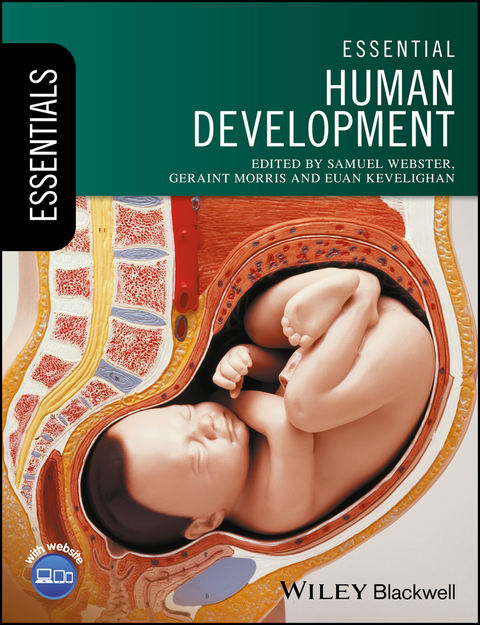
Essential Human Development (eBook)
John Wiley & Sons (Verlag)
978-1-118-52861-7 (ISBN)
As our understanding of the human body broadens, so does the need for a comprehensive text that encompasses all aspects of human development. Essential Human Development is a great course companion that focuses on the human life cycle, ideal for the undergraduate student new to these fields, or for qualified practitioners looking for a reference guide.
Featuring key information points and self-test assessments in each chapter, the book is organised in an accessible manner, beginning with fertilisation and embryology, then moving on to obstetric medicine, neonatal care and child health, with the final section exploring gynaecological medicine.
Ensuring that information is placed in context to aid understanding, Essential Human Development is the perfect support for the modern medical school curriculum, as well as a vital reminder of the core information needed whilst on a women or child health clinical placement.
Dr Samuel Webster, Lecturer in Anatomy, Swansea University, Swansea, UK
Dr Geraint Morris, Consultant in Neonatology, Swansea University, Swansea, UK
Mr Euan Kevelighan, Consultant in Obstetrics & Gynaecology, Singleton Hospital, Swansea, UK
As our understanding of the human body broadens, so does the need for a comprehensive text that encompasses all aspects of human development. Essential Human Development is a great course companion that focuses on the human life cycle, ideal for the undergraduate student new to these fields, or for qualified practitioners looking for a reference guide. Featuring key information points and self-test assessments in each chapter, the book is organised in an accessible manner, beginning with fertilisation and embryology, then moving on to obstetric medicine, neonatal care and child health, with the final section exploring gynaecological medicine. Ensuring that information is placed in context to aid understanding, Essential Human Development is the perfect support for the modern medical school curriculum, as well as a vital reminder of the core information needed whilst on a women or child health clinical placement.
Dr Samuel Webster, Lecturer in Anatomy, Swansea University, Swansea, UK Dr Geraint Morris, Consultant in Neonatology, Swansea University, Swansea, UK Mr Euan Kevelighan, Consultant in Obstetrics & Gynaecology, Singleton Hospital, Swansea, UK
List of contributors ix
Preface xi
How to use your textbook xii
About the companion website xiii
Part 1: Fertilisation 1
1 Principles of development 3
Sam Webster
2 The female reproductive system 12
Sam Webster
3 The male reproductive system 24
Sam Webster
4 Fertilisation 32
Sam Webster
5 Embryology: zygote to blastocyst 38
Sam Webster
6 Embryonic stem cells 43
Sam Webster
Part 2: Pregnancy 49
7 Embryology 51
Sam Webster
8 Physiology of pregnancy 59
Sam Webster
9 Antenatal care 64
Marion Beard
10 Antenatal screening and prenatal diagnosis 71
Alan Treharne and Marsham Moselhi
11 Hypertensive disorders of pregnancy 82
Sharif Ismail
12 Diseases in pregnancy I 89
Alan Treharne and Cerys Scarr
13 Diseases in pregnancy II 94
Alan Treharne, Cerys Scarr and Aleksandra Komarzyniec-Pyzik
14 Multiple pregnancy and other antenatal complications 103
Marion Beard
15 Problems in late pregnancy 109
Deepa Balachandran Nair
16 Fetal growth and tests of fetal wellbeing 117
Maitreyee Deshpande
17 The eye in pregnancy and the newborn 122
Colm McAlinden
Part 3: Birth 137
18 Normal labour 139
Euan Kevelighan
19 Abnormal labour 146
Franz Majoko
20 The puerperium 155
Fran Hodge
21 Obstetric emergencies 162
Benjamin Chisholme and Euan Kevelighan
Part 4: Neonatology 173
22 Newborn resuscitation and newborn examination 175
Nitin Goel and Jamie Evans
23 Newborn feeding, jaundice and maternal diabetes 184
Geraint Morris
24 The preterm infant 189
Nitin Goel
25 Congenital and perinatal infection 196
Ian Morris
Part 5: Childhood and adolescence 205
26 History and examination in childhood 207
Shabeena Webster and Geraint Morris
27 Normal growth and developmental milestones 213
Bethan Williams
28 Developmental delay 241
Bethan Williams
29 Genetics 249
Dana Beasley
30 Neurodevelopmental disorders 256
Surekha Tuohy
31 Puberty 263
Christopher Bidder
32 Non-accidental injury and neglect 271
Catrin Simpson
33 Neurological problems 278
Cathy White
34 Infections and immunodeficiency 292
Pramodh Vallabhaneni
35 Haematology and oncology 299
Pramodh Vallabhaneni
36 Congential and acquired heart disease 307
Geraint Morris
37 Metabolic and endocrine disorders 319
Shabeena Webster
38 Respiratory problems 333
Toni Williams
39 Gastroenterology, nutrition and faltering growth 341
Lakshmipriya Selvarajan
40 Renal and urinary problems 35
Dana Beasley
41 Dermatology 363
Rebecca Balfour
42 Rheumatology and orthopaedics 374
Rebecca Balfour
43 Paediatric surgery 385
Toni Williams
44 Paediatric pharmacology 391
Lakshmipriya Selvarajan
Part 6: Gynaecology 395
45 Problems in early pregnancy 397
Manju Nair
46 Subfertility 409
Gurpreet Singh Kalra
47 Vaginal discharge, pelvic pain and endometriosis 419
Aisling Carroll-Downey and Euan Kevelighan
48 Termination of pregnancy 428
Sophie Walker and Jennifer Davies-Oliveira
49 Contraception 433
Ruth Frazer
50 Obstetric and gynaecological operations 440
Nisha Kadwadkar and Euan Kevelighan
51 The menopause 448
Kinza Younas
Index 455
Chapter 1
Principles of Development
Sam Webster
Case
Jamie is a 4-month-old boy presenting with disparity between limb length, trunk length and cranial circumference. His height is under the fourth percentile, his weight is under the fourth percentile and his head circumference is above the 97th percentile. Motor development milestones are delayed. Jamie's mother and father have typical heights (168 cm and 176 cm respectively).
Learning Outcomes
- You should be able to recognise the stages of cell division in mitosis and meiosis.
- You should be able to describe the basic principles of growth and differentiation.
Chromosomes
As a basis of biology cell theory is a crucial part of understanding development. Complex organisms grow from a single cell. The cell is the fundamental unit of structure in the organism, and new cells are formed from existing cells. All structure, function and organisation relates to the unit of the cell. In development we consider how the cells of the gametes merge to form a cell with a new genetic composition, the division of that cell to form new cells, and how those cells become organised, form shapes and tissues of multiple differentiated cell types.
DNA is stored in chromatin form within the nuclei of cells, and RNA is present in the cytoplasm. When cells divide the chromosomes are duplicated and the daughter cells gain exact copies of the DNA of the parent cell (hopefully, if the replication and error checking mechanisms work correctly).
Somatic cells contain 23 pairs of chromosomes including 22 pairs of autosomes and one pair of sex chromosomes (Figure 1.1). Each chromosome is an organised package of DNA.
Figure 1.1 Human karyotype. (Source: S. Webster and R. de Wreede (2016) Embryology at a Glance, 2nd edn. Reproduced with permission of John Wiley & Sons, Ltd.)
In a homologous pair of chromosomes the same genes are encoded on each chromosome but the genes may occur as slightly different versions. One chromosome has been inherited from the father, and the other from the mother. For example, the gene for head hair pigment colour will occur on both chromosomes of a homologous pair, but one copy may encode for blonde hair and the other for brown. These copies are alleles, and the dominant pigment allele will be represented in the phenotype of the individual. This is a simplified example, and many hair pigments are at play in determining a person's final hair colour, accounting for the wide variation of natural shades that occurs. The mixing up of alleles across homologous chromosomes during cell division is an important part of the genetic diversity advantage given by sexual reproduction over asexual reproduction.
If a cell has two copies of each kind of chromosome (e.g. one copy from the mother and one copy from the mother) it is said to be diploid. If it only had one copy it would be haploid.
We can also describe a cell by the number of copies (n) of each unique double-stranded length of chromosomal DNA. Chromosomal DNA inherited from the mother is different to chromosomal DNA inherited from the father. In a pair of chromosomes the genes are the same but the alleles are different. A haploid cell has only one copy of each kind of chromosome so it is described as 1n. Somatic cells are normally diploid, and during part of the cell cycle only have one DNA strand for each kind of chromosome so are described as 2n. They have two copies of each kind of chromosome (one from the mother and one from the father). When a cell copies its DNA in preparation for cell division it will have four copies of each kind of chromosome and be described as 4n.
If the DNA strand of a chromosome is duplicated its two duplicates are joined together at the centromere forming the familiar X shape of most chromosomes (Figure 1.2). Each of the two duplicates is a sister chromatid.
Figure 1.2 The structure of a chromosome. (Source: S. Webster and R. de Wreede (2016) Embryology at a Glance, 2nd edn. Reproduced with permission of John Wiley & Sons, Ltd.)
Mitosis
Mitosis is the process by which cells divide and increase in number in eukaryotic organisms. The result of mitosis is two daughter cells that contain the same genetic information. Mitosis is the method by which cells repair tissues, it is one way in which growth can occur, and it is how cells lost through normal processes are replaced. Some cells are very good at proliferating by mitosis, such as epidermal keratinocytes, which are lost daily as flakes of skin, and some cells are very poor at mitotic division, such as neurones of the central nervous system, which are expected to survive for the lifetime of the organism (although it is not yet clearly understood how long neurones live, but they are not naturally replaced after brain damage). Mitosis is a major mechanism of growth in the embryo and fetus.
Cell division is a step within the cell cycle (Figure 1.3). The cell cycle describes a series of carefully controlled events in the life of cell that take part in cell division, and cells that do not divide are considered to have left the cell cycle. The stages of the cell cycle are gap 1 (G1), synthesis (S), gap 2 (G2) and mitosis (M). The stages of G1, S and G2 are also known collectively as interphase. A cell's DNA is duplicated during S phase, adding a sister chromatid to the existing chromatid. A cell that no longer divides can be described as existing within a G0 phase.
Figure 1.3 The cell cycle. (Source: S. Webster and R. de Wreede (2016) Embryology at a Glance, 2nd edn. Reproduced with permission of John Wiley & Sons, Ltd.)
When a cell begins mitosis its chromosomes become condensed and form their recognisable X shapes during the first phase of mitosis, called prophase (Figure 1.4). At this stage it is diploid (4n). Centrioles are cylindrical structures that have a number of functions within eukaryotic cells, and during mitosis they arrange and separate DNA. During prophase the centrioles move to opposite ends of the cell.
Figure 1.4 Mitosis. (Source: S. Webster and R. de Wreede (2016) Embryology at a Glance, 2nd edn. Reproduced with permission of John Wiley & Sons, Ltd.)
In the next stage, prometaphase, the nuclear membrane breaks down and disappears releasing the DNA into the cytoplasm. Microtubules link the centromeres of the chromosomes to the centrioles, and during metaphase the chromosomes begin to move, pulled by the microtubules to line up along the middle of the cell.
The centromeres are cut in the telophase step, splitting each chromosome into its separate, genetically identical chromatids. One of each pair of chromatids is pulled to opposite ends of the cell by microtubules and the centrioles.
In telophase the chromatids reach the ends of the cell, begin to lengthen again and are no longer visible under a light microscope. Two new nuclear membranes begin to form around the chromatid DNA to create two nuclei. Cytokinesis follows during which a ring of actin filaments appears around the midline of the cell and shrinks, splitting the cell into two. Mitosis is complete, and the two cells return to the G1 phase. During the G1 phase each cell has a full, diploid complement of DNA but only one copy of each chromosome (2n).
Meiosis
Meiosis is a specialised method of cell division in eukaryotes that produces gamete cells. The primary function of meiosis is to produce cells with a haploid (n) complement of chromosomes. Somatic cells have two homologous copies of each chromosome (diploid) and gametes have one copy of each chromosome (haploid, n). When the male and female gametes combine during fertilisation the resulting cell has a restored, diploid complement of 23 pairs of chromosomes.
Meiosis is similar to mitosis, but differs in a couple of ways. Cell division occurs twice during a full cycle of meiosis, producing four daughter cells from one cell. Alleles of homologous chromosomes are randomly exchanged between those chromosomes during a process known as homologous recombination. Cells produced as a result of meiosis will have all of the genes of the parent cells (hopefully in the same locations within chromosomes as the parent cells if the process occurs accurately) but with a random allocation of the alleles of those genes. This genetic variability is an important advantage of sexual reproduction over asexual reproduction. If, for example, the original diploid cell contained the allele for a blue iris on one chromosome and the allele for a green iris on the homologous chromosome, any cell formed as a result of meiosis could contain either allele. Alleles of the genes on the same chromosome may or may not be carried across with the allele for iris colour, as homologous recombination maintains the order of genes but alleles may be swapped around.
During S phase the cell's DNA is duplicated. The two parts of meiosis are described as meiosis I and meiosis II. Prophase I begins with homologous recombination of DNA across homologous chromosomes before the chromosomes shorten, thicken and become condensed (Figure 1.5). The centrioles move to either end of the cell and microtubules are extended, beginning to form the mitotic spindle. The cell at this stage has a diploid (4n) complement of DNA. Metaphase I follows, with the chromosomes...
| Erscheint lt. Verlag | 5.2.2018 |
|---|---|
| Reihe/Serie | Essentials |
| Essentials | Essentials |
| Sprache | englisch |
| Themenwelt | Medizin / Pharmazie ► Medizinische Fachgebiete ► Gynäkologie / Geburtshilfe |
| Medizin / Pharmazie ► Medizinische Fachgebiete ► Pädiatrie | |
| Studium ► 1. Studienabschnitt (Vorklinik) ► Histologie / Embryologie | |
| Schlagworte | Basic Medical Sciences • Birth • Cell theory • Child Health • Contraception • Embryologie • Embryology • Female Reproductive system • Fertilisation • foetus • Gynaecology • Gynäkologie • Gynäkologie u. Geburtshilfe • Human Development • Infertility • Labor • Labour • Life Cycle • male reproductive system • Medical Science • Medizin • Medizinische Grundlagenfächer • Neonatology • Obstetrics • Obstetrics & Gynecology • Paediatrics • Pregnancy • Reproduction • Sexual Health • women's health |
| ISBN-10 | 1-118-52861-1 / 1118528611 |
| ISBN-13 | 978-1-118-52861-7 / 9781118528617 |
| Informationen gemäß Produktsicherheitsverordnung (GPSR) | |
| Haben Sie eine Frage zum Produkt? |
 EPUB (Adobe DRM)
Kopierschutz: Adobe-DRM
Adobe-DRM ist ein Kopierschutz, der das eBook vor Mißbrauch schützen soll. Dabei wird das eBook bereits beim Download auf Ihre persönliche Adobe-ID autorisiert. Lesen können Sie das eBook dann nur auf den Geräten, welche ebenfalls auf Ihre Adobe-ID registriert sind.
Details zum Adobe-DRM
Dateiformat: EPUB (Electronic Publication)
EPUB ist ein offener Standard für eBooks und eignet sich besonders zur Darstellung von Belletristik und Sachbüchern. Der Fließtext wird dynamisch an die Display- und Schriftgröße angepasst. Auch für mobile Lesegeräte ist EPUB daher gut geeignet.
Systemvoraussetzungen:
PC/Mac: Mit einem PC oder Mac können Sie dieses eBook lesen. Sie benötigen eine
eReader: Dieses eBook kann mit (fast) allen eBook-Readern gelesen werden. Mit dem amazon-Kindle ist es aber nicht kompatibel.
Smartphone/Tablet: Egal ob Apple oder Android, dieses eBook können Sie lesen. Sie benötigen eine
Geräteliste und zusätzliche Hinweise
Buying eBooks from abroad
For tax law reasons we can sell eBooks just within Germany and Switzerland. Regrettably we cannot fulfill eBook-orders from other countries.
aus dem Bereich