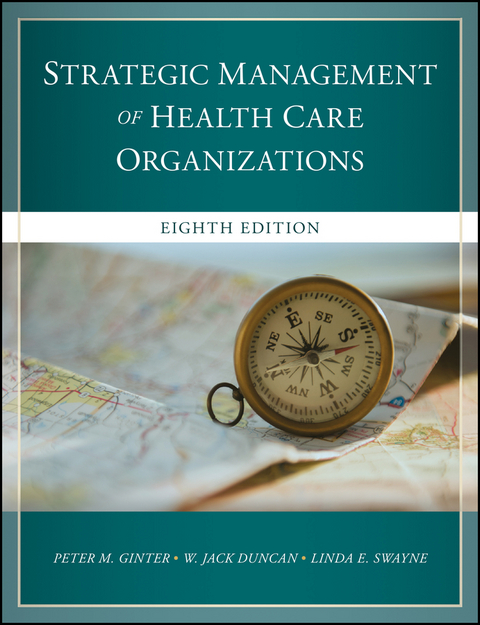
The Strategic Management of Health Care Organizations (eBook)
John Wiley & Sons (Verlag)
978-1-119-34969-3 (ISBN)

A comprehensive guide to effective strategic management of health care organizations.
Strategic Management of Health Care Organizations provides essential guidance for leading health care organizations through strategic management. This structured approach to strategic management examines the processes of strategic thinking, consensus building and documentation of that thinking into a strategic plan, and creating and maintaining strategic momentum - all essential for coping with the rapidly evolving health care industry. Strategic Management of Health Care Organizations fully explains how strategic managers must become strategic thinkers with the ability to evaluate a changing industry, analyze data, question assumptions, and develop new ideas. The book guides readers through the strategic planning process demonstrating how to incorporate strategic thinking and create and document a clear and coherent plan of action. In addition, the all-important processes of creating and maintaining the strategic momentum of the organization are fully described. Finally, the text demonstrates how strategic managers in carrying out the strategic plan, must evaluate its success, learn more about what works, and incorporate new strategic thinking into operations and subsequent planning.
This strategic management approach has become the de facto standard for health care management as leadership and strategic management are more critical than ever in coping with an industry in flux. This book provides heath care management students as well as health care administrators with foundational guidance on strategic management concepts and practices, tailored to the unique needs of the health care industry. Included are a clear discussion of health services external analysis, organizational internal analysis, the development of directional strategies, strategy alternative identification and evaluation, and the development and management of implementation strategies providing an informative and insightful resource for anyone in the field.
This new eighth edition has been fully updated to reflect new insights into strategic thinking, new methods to conceptualize and document critical environmental issues, practical steps for carrying out each of the strategic management processes, industry and management essentials for strategic thinkers , and new case studies for applying the strategic management processes. More specifically, readers of this edition will be able to:
- Create a process for developing a strategic plan for a health care organization.
- Map and analyze external issues, trends, and events in the general environment, the health care system, and the service area.
- Conduct a comprehensive service area competitor analysis.
- Perform an internal analysis and determine the competitive advantages and competitive disadvantages.
- Develop directional strategies.
- Identify strategic alternatives and make rational strategic decisions for a health care organization.
- Develop a comprehensive strategy for a health care organization.
- Create effective value-adding service delivery and support strategies.
- Translate service delivery and support plans into specific action plans.
The health care industry's revolutionary change remains ongoing and organizational success depends on leadership. Strategic management has become the single clearest manifestation of effective leadership of health care organizations and the strategic management framework's strengths are needed now more than ever. The Strategic Management of Health Care Organizations provides comprehensive guidance and up-to-date practices to help leaders keep their organizations on track.
Peter Ginter is the lead author for this project (and the one who I have had the most contact with so far). Peter M. Ginter (Ph.D., University of North Texas; M.B.A., B.S., Auburn University) is a Professor in The Department of Health Care Organization and Policy and Director of the Preparedness and Emergency Response Learning Center. He is also a Senior Scholar in the Lister Hill Center for Health Policy in the School of Public Health at the University of Alabama at Birmingham. Dr. Ginter is active in research in strategic management, leadership, and health care organizations. He is the author or co-author of sixteen books including Strategic Management of Health Care Organizations, 7th edition. (2013), Public Health Leadership and Management (2002) and The Physician Strategist (1996). W. Jack Duncan is Professor of Management Emeritus & University Scholar Emeritus in the Graduate School of Management at the University of Alabama at Birmingham. He also holds appointments as Professor of Health Care Organization & Policy in the School of Public Health and Professor of Health Services Administration in the School of Health Professions. Duncan is a Senior Scholar in the Lister Hill Center for Health Policy. He received his Ph.D. from Louisiana State University in Baton Rouge. Linda Swayne joined the faculty of the Belk College of Business, UNC Charlotte in 1981 and is now Professor of Marketing. She has served as president of the Charlotte Chapter of the American Marketing Association, Southern Marketing Association and Southwestern Federation of Administrative Disciplines. Dr. Swayne has written eleven textbooks.
A comprehensive guide to effective strategic management of health care organizations. Strategic Management of Health Care Organizations provides essential guidance for leading health care organizations through strategic management. This structured approach to strategic management examines the processes of strategic thinking, consensus building and documentation of that thinking into a strategic plan, and creating and maintaining strategic momentum all essential for coping with the rapidly evolving health care industry. Strategic Management of Health Care Organizations fully explains how strategic managers must become strategic thinkers with the ability to evaluate a changing industry, analyze data, question assumptions, and develop new ideas. The book guides readers through the strategic planning process demonstrating how to incorporate strategic thinking and create and document a clear and coherent plan of action. In addition, the all-important processes of creating and maintaining the strategic momentum of the organization are fully described. Finally, the text demonstrates how strategic managers in carrying out the strategic plan, must evaluate its success, learn more about what works, and incorporate new strategic thinking into operations and subsequent planning. This strategic management approach has become the de facto standard for health care management as leadership and strategic management are more critical than ever in coping with an industry in flux. This book provides heath care management students as well as health care administrators with foundational guidance on strategic management concepts and practices, tailored to the unique needs of the health care industry. Included are a clear discussion of health services external analysis, organizational internal analysis, the development of directional strategies, strategy alternative identification and evaluation, and the development and management of implementation strategies providing an informative and insightful resource for anyone in the field. This new eighth edition has been fully updated to reflect new insights into strategic thinking, new methods to conceptualize and document critical environmental issues, practical steps for carrying out each of the strategic management processes, industry and management essentials for strategic thinkers , and new case studies for applying the strategic management processes. More specifically, readers of this edition will be able to: Create a process for developing a strategic plan for a health care organization. Map and analyze external issues, trends, and events in the general environment, the health care system, and the service area. Conduct a comprehensive service area competitor analysis. Perform an internal analysis and determine the competitive advantages and competitive disadvantages. Develop directional strategies. Identify strategic alternatives and make rational strategic decisions for a health care organization. Develop a comprehensive strategy for a health care organization. Create effective value-adding service delivery and support strategies. Translate service delivery and support plans into specific action plans. The health care industry s revolutionary change remains ongoing and organizational success depends on leadership. Strategic management has become the single clearest manifestation of effective leadership of health care organizations and the strategic management framework s strengths are needed now more than ever. The Strategic Management of Health Care Organizations provides comprehensive guidance and up-to-date practices to help leaders keep their organizations on track.
Peter Ginter is the lead author for this project (and the one who I have had the most contact with so far). Peter M. Ginter (Ph.D., University of North Texas; M.B.A., B.S., Auburn University) is a Professor in The Department of Health Care Organization and Policy and Director of the Preparedness and Emergency Response Learning Center. He is also a Senior Scholar in the Lister Hill Center for Health Policy in the School of Public Health at the University of Alabama at Birmingham. Dr. Ginter is active in research in strategic management, leadership, and health care organizations. He is the author or co-author of sixteen books including Strategic Management of Health Care Organizations, 7th edition. (2013), Public Health Leadership and Management (2002) and The Physician Strategist (1996). W. Jack Duncan is Professor of Management Emeritus & University Scholar Emeritus in the Graduate School of Management at the University of Alabama at Birmingham. He also holds appointments as Professor of Health Care Organization & Policy in the School of Public Health and Professor of Health Services Administration in the School of Health Professions. Duncan is a Senior Scholar in the Lister Hill Center for Health Policy. He received his Ph.D. from Louisiana State University in Baton Rouge. Linda Swayne joined the faculty of the Belk College of Business, UNC Charlotte in 1981 and is now Professor of Marketing. She has served as president of the Charlotte Chapter of the American Marketing Association, Southern Marketing Association and Southwestern Federation of Administrative Disciplines. Dr. Swayne has written eleven textbooks.
Strategic Management of Health Care Organizations 3
Contents 7
Cases 9
Preface 15
Features of the Text 16
Retained Features 16
New Features 17
Organization of the Text 18
To the Students: Why This Book About Strategic Management Is Important 20
The Author Team 20
Acknowledgments 21
Chapter 1 The Nature of Strategic Management 23
Why the Nature of Strategic Management Is Important 23
Strategic Management Competency 24
Managing in a Dynamic Industry 25
The Nature of Health Care Change 25
Coping with Change 28
The Foundations of Strategic Management 29
Long-Range Planning to Strategic Planning 29
Strategic Planning to Strategic Management 30
Strategic Management in the Health Care System 32
Strategic Management Versus Health Policy 32
The Dimensions of Strategic Management 34
Combining the Analytical and Emergent Views 35
Strategic Thinking 36
Strategic Planning 39
Strategic Momentum 42
The Benefits of Strategic Management 45
What Strategic Management Is Not 46
A Systems Perspective 46
The Level and Orientation of the Strategy 47
The Importance of Leadership 50
Leadership Roles throughout the Organization 52
Chapter Summary 53
Practical Lessons for Health Care Strategic Thinkers 54
Questions for Class Discussion 55
Notes 55
Chapter 2 External Analysis 59
Why External Analysis Is Important 59
Strategic Management Competency 60
The External Nature of Strategic Management 61
The Goals of External Analysis 61
The Limitations of External Analysis 62
The Process of External Analysis 63
Step 1: Organize the External Analysis Process 64
Step 2: Scan the General Environment, Health Care System, and Service Area 75
Step 3: Monitor and Confirm External Issues 79
Step 4: Forecast External Issues 79
Step 5: Assess External Issues 79
Select the Strategic Thinking Framework 90
Step 6: Complete an Issue Map 92
Strategic Momentum: Validating the Strategic Assumptions 94
Chapter Summary 96
Practical Lessons for Health Care Strategic Thinkers 97
Questions for Class Discussion 98
Notes 98
Chapter 3 Service Area Competitor Analysis 101
Why Service Area Competitor Analysis Is Important 101
Strategic Management Competency 102
Further Focus within External Analysis 102
A Process for Service Area Competitor Analysis 103
An Application of Service Area Competitor Analysis 104
Step 1: Review of External Analysis 107
Step 1: Review of External Analysis – Plastic Surgery in Charlotte, NC 107
Step 2: Conduct Service Area Structural Analysis 108
Step 2: Service Area Structural Analysis – Plastic Surgery 115
Step 3: Conduct Competitor Analysis 118
Step 3: Conduct Competitor Analysis – Plastic Surgery 121
Step 4: Analyze Critical Success Factors 123
Step 4: Analyze Critical Success Factors – Plastic Surgery 124
Step 5: Map Strategic Groups 125
Step 5: Map Strategic Groups – Plastic Surgery 127
Step 6: Assess Likely Competitor Actions or Responses 131
Step 6: Assess Likely Competitor Actions or Responses – Plastic Surgery 132
Step 7: Synthesizing the Analyses 133
Step 7: Synthesizing the Analyses – Plastic Surgery 133
Obstacles to Effective Service Area Competitor Analysis 134
Strategic Momentum: Validating the Strategic Assumptions 137
The Use of External Analysis and Competitor Analysis 138
Chapter Summary 138
Practical Lessons for Health Care Strategic Thinkers 139
Notes 140
Chapter 4 Internal Analysis and Competitive Advantage 143
Why Internal Analysis and Competitive Advantage Are Important 143
Strategic Management Competency 144
The Process for Internal Analysis and the Search for Competitive Advantage 145
Step 1: Review Results of External Analysis and Service Area Competitor Analysis 146
Step 2: Organize the Internal Analysis Process – Using the Value Chain 147
Step 3: Identify Organizational Strengths and Weaknesses 154
Step 3: Identify Organizational Strengths and Weaknesses – Hill-Rom 158
Step 4: Determine Competitive Advantages and Disadvantages 163
Step 4: Determine Competitive Advantages and Disadvantages – Hill-Rom 168
Step 5: Synthesize and Determine the Implications of the Competitive Advantages and Disadvantages 174
Step 5: Synthesize and Determine the Implications of the Competitive Advantages and Disadvantages – Hill-Rom 174
A Final Challenge 176
Strategic Momentum 179
Chapter Summary 180
Practical Lessons for Health Care Strategic Thinkers 180
Questions for Class Discussion 181
Notes 182
Chapter 5 Directional Strategies 185
Why Directional Strategies Are Important 185
Strategic Management Competency 187
Directional Strategies 187
The Process for Establishing Directional Strategies 187
Step 1: Review Results of Situational Analysis 187
Step 2: Develop a Statement of Mission 188
Step 3: Develop a Statement of Vision 200
Step 4: Develop a Statement of Values as Guiding Principles 208
Step 5: Develop Strategic Goals 211
Roles and Responsibilities of Boards of Directors (or Trustees) in Strategic Management 214
Health Care Performance and the Usual Suspects 216
Board Process: Missing Link? 218
Strategic Momentum – Evaluating Directional Strategies 218
Chapter Summary 220
Practical Lessons for Health Care Strategic Thinkers 221
Questions for Class Discussion 222
Notes 222
Chapter 6 Identifying Strategic Alternatives 227
Why Identifying Strategic Alternatives Is Important 227
Strategic Management Competency 228
The Process for Identifying Strategy Alternatives 228
Step 1: Understand the Decision Logic of Strategy Development 230
Step 2: Understand the Role of Directional Strategies 233
Step 3: Understand Adaptive Strategy Alternatives 234
Expansion of Scope Strategies 234
Reduction of Scope Strategies 243
Maintenance of Scope Strategies 246
Step 4: Understand Market Entry/Exit Strategy Alternatives 250
Purchase Strategies 251
Cooperation Strategies 254
Development Strategies 258
Market Exit Strategies 261
Market Entry/Exit Strategy Linkage 262
Step 5: Understand Competitive Strategy Alternatives 264
Strategic Posture 265
Positioning Strategies: Marketwide or Focus 269
Step 6: Understand Combination Strategies 272
Chapter Summary 274
Practical Lessons for Health Care Strategic Thinkers 275
Questions for Class Discussion 276
Notes 277
Chapter 7 Evaluation of Alternatives and Strategic Choice 281
Why Evaluation of Alternatives and Strategic Choice Are Important 281
Strategic Management Competency 282
A Process for the Evaluation of the Alternatives 282
Step 1: Link Strategy with Situational Analysis 284
Step 2: Evaluate and Select Adaptive Strategies 284
Step 3: Evaluate and Select Market Entry/Exit Strategies 311
Step 4: Evaluate and Select Competitive Strategies 318
Step 5: Synthesize and Identify Implications of Strategy Choices – Strategy Map 325
Strategy Map: An Example 325
Strategic Momentum: Adaptive, Market Entry/Exit, and Competitive Strategies 326
Chapter Summary 329
Practical Lessons for Health Care Strategic Thinkers 330
Questions for Class Discussion 331
Notes 332
Chapter 8 Value-Adding Service Delivery Strategies 335
Why Value-Adding Service Delivery Strategies Are Important 335
Strategic Management Competency 336
Implementation Strategies 337
Strategies Based on the Value Chain 337
Decision Logic for the Value-Adding Service Delivery Strategies 339
Process for Developing Service Delivery Strategies 341
Step 1: Identify the Service Delivery Requirements of the Strategy and Service Delivery Value-Adding Potential 341
The Value-Adding Service Delivery Strategies Potential 342
Pre-Service Delivery Strategies 343
Point-of-Service Delivery Strategies 353
After-Service Strategies 361
Step 2: Compare the Strategy Requirements with the Results of the Service Delivery Internal Analysis 368
Step 3: Decide to Maintain or Change Pre-Service Delivery 369
Step 4: Decide to Maintain or Change Point-of-Service 370
Step 5: Decide to Maintain or Change After-Service 371
Step 6: Provide Guidance to Organizational Units 373
Strategic Momentum: Service Delivery Strategies 373
Chapter Summary 376
Practical Lessons for Health Care Strategic Thinkers 377
Questions for Class Discussion 378
Notes 378
Chapter 9 Value-Adding Support Strategies 381
Why Value-Adding Support Strategies Are Important 381
Strategic Management Competency 383
Implementing Support Strategies 383
Decision Logic for the Value-Adding Support Strategies 383
Process for Developing Support Strategies 384
Step 1: Identify the Support Requirements of the Strategy and Support Value-Adding Potential 386
Value-Adding Support Strategies Potential 387
Organizational Culture Strategies 388
Organizational Structure Strategies 391
Strategic Resources Strategies 396
Step 2: Compare the Strategy Requirements with the Results of the Support Activities Internal Analysis 406
Step 3: Decide to Maintain or Change Organizational Culture 407
Step 4: Decide to Maintain or Change the Organization Structure 410
Step 5: Decide to Maintain or Change Strategic Resources 412
Step 6: Provide Guidance to Organizational Units 415
Strategic Momentum: Support Strategies 415
Chapter Summary 418
Practical Lessons for Health Care Strategic Thinkers 419
Questions for Class Discussion 420
Notes 421
Chapter 10 Communicating Strategy and Developing Action Plans 423
Why Communicating the Strategy and Developing Action Plans Are Important 423
Strategic Management Competency 424
Implementation Through Action Plans 424
The Level and Orientation of the Strategy 425
Decision Logic for Developing Action Plans 426
Action Plan Development Responsibilities 426
Communicating Strategy to Initiate Action Planning 426
The Process of Developing Action Plans 429
The Process of Developing Action Plans – Cardiac Rehab Example 431
Step 1: Review the Broader Strategic Decisions 431
Step 1: Review the Broader Strategic Decisions – Cardiac Rehab Lab 432
Step 2: Set Unit Objectives 432
Step 2: Set Unit Objectives – Cardiac Rehab Lab 432
Step 3: Identify Actions Required to Accomplish Unit Objectives 433
Step 3: Identify Actions Required to Accomplish Unit Objectives – Cardiac Rehab Lab 433
Step 4: Set Timelines to Accomplish Each Action 433
Step 4: Set Timelines – Cardiac Rehab Lab 434
Step 5: Assign Responsibility to Accomplish Each Action 434
Step 5: Assign Responsibility – Cardiac Rehab Lab 434
Step 6: Determine Resources Requirements to Accomplish Each Action 434
Step 6: Determine Resources Requirements – Cardiac Rehab Lab 434
Step 7: Determine How Results will be Measured 436
Step 7: Determine How Results will be Measured – Cardiac Rehab Lab 437
Managing the Strategic Momentum 437
Focusing on Strategy through Implementation: A Balanced Scorecard Approach 438
Implementation Challenges 442
Contingency Planning 443
Strategic Momentum: A New Beginning 446
The Map and Compass 447
Chapter Summary 448
Practical Lessons for Health Care Strategic Thinkers 449
Questions for Class Discussion 450
Notes 450
Resource 1 Analyzing Strategic Health Care Cases 453
An Overview of Case Analysis 454
Cases, Strategic Management, and Health Care Organizations 455
Risk Taking in Case Analysis 456
Solving Case Problems 456
Alternative Perspectives: Passion or Objectivity 456
Reading the Case 457
Gathering Information 457
Case Analysis Using the Strategic Thinking Maps 458
Tips on Surfacing the Issues 458
Tips on Analyzing the Situation 460
Tips on Formulating the Strategy 460
Tips on Developing Implementation Strategies 461
Making Recommendations 462
Finalizing the Report 463
Conclusions 464
Resource 2 Health Care Organization Accounting, Finance, and Performance Analysis 465
Basis of Accounting 466
Financial Reporting 467
The Balance Sheet/Statement of Financial Position 469
Assets 471
Liabilities and Equity/Net Assets 472
The Income Statement/Statement of Activities 473
The Statement of Cash Flows 475
Financial Performance Analysis 478
Financial Forecasting 482
Notes 482
Resource 3 Health Care Acronyms 485
Resource 4 Glossary of Strategic Management Terms 493
Index 517
EULA 528
| Erscheint lt. Verlag | 17.1.2018 |
|---|---|
| Sprache | englisch |
| Themenwelt | Medizin / Pharmazie ► Gesundheitswesen |
| Medizin / Pharmazie ► Pflege ► Pflegemanagement / Qualität / Recht | |
| Wirtschaft ► Betriebswirtschaft / Management ► Unternehmensführung / Management | |
| Schlagworte | Business & Management • dynamic management framework • effective health care management • Gemeinnützige Organisationen / Management u. Führung • Health Care • health care administration textbook • health care environment analysis • health care leadership • health care management approaches • health care management framework • health care management structure • health care management training • health care organizations • implementing strategy • Krankenpflege • Leitungstätigkeit u. Management i. d. Krankenpflege • Linda E. Swayne</p> • <p>health care management • Management • Non-Profit Organizations / Management Leadership • nursing • Nursing Management & Leadership • Peter M. Ginter • strategic health care management • Strategic Management • Strategic management principles • Strategic Planning • Strategisches Management • structured strategic management • The Strategic Management of Health Care Organizations, 8<sup>th</sup> Edition • Wirtschaft u. Management • W. Jack Duncan |
| ISBN-10 | 1-119-34969-9 / 1119349699 |
| ISBN-13 | 978-1-119-34969-3 / 9781119349693 |
| Informationen gemäß Produktsicherheitsverordnung (GPSR) | |
| Haben Sie eine Frage zum Produkt? |
 PDF (Adobe DRM)
Kopierschutz: Adobe-DRM
Adobe-DRM ist ein Kopierschutz, der das eBook vor Mißbrauch schützen soll. Dabei wird das eBook bereits beim Download auf Ihre persönliche Adobe-ID autorisiert. Lesen können Sie das eBook dann nur auf den Geräten, welche ebenfalls auf Ihre Adobe-ID registriert sind.
Details zum Adobe-DRM
Dateiformat: PDF (Portable Document Format)
Mit einem festen Seitenlayout eignet sich die PDF besonders für Fachbücher mit Spalten, Tabellen und Abbildungen. Eine PDF kann auf fast allen Geräten angezeigt werden, ist aber für kleine Displays (Smartphone, eReader) nur eingeschränkt geeignet.
Systemvoraussetzungen:
PC/Mac: Mit einem PC oder Mac können Sie dieses eBook lesen. Sie benötigen eine
eReader: Dieses eBook kann mit (fast) allen eBook-Readern gelesen werden. Mit dem amazon-Kindle ist es aber nicht kompatibel.
Smartphone/Tablet: Egal ob Apple oder Android, dieses eBook können Sie lesen. Sie benötigen eine
Geräteliste und zusätzliche Hinweise
Buying eBooks from abroad
For tax law reasons we can sell eBooks just within Germany and Switzerland. Regrettably we cannot fulfill eBook-orders from other countries.
aus dem Bereich