


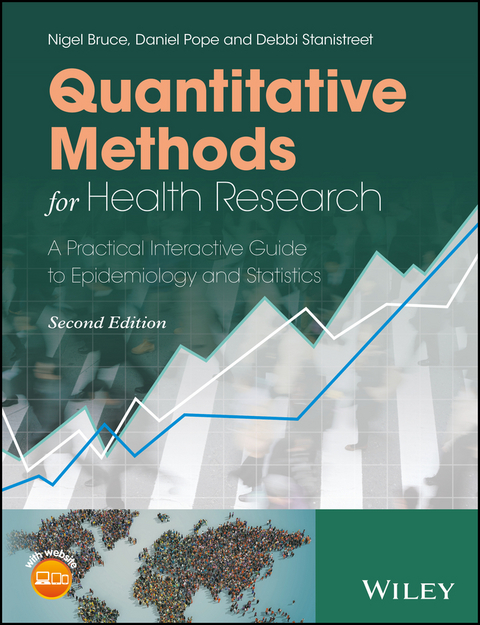
Quantitative Methods for Health Research (eBook)
John Wiley & Sons (Verlag)
978-1-118-66540-4 (ISBN)
A practical introduction to epidemiology, biostatistics, and research methodology for the whole health care community
This comprehensive text, which has been extensively revised with new material and additional topics, utilizes a practical slant to introduce health professionals and students to epidemiology, biostatistics, and research methodology. It draws examples from a wide range of topics, covering all of the main contemporary health research methods, including survival analysis, Cox regression, and systematic reviews and meta-analysis-the explanation of which go beyond introductory concepts. This second edition of Quantitative Methods for Health Research: A Practical Interactive Guide to Epidemiology and Statistics also helps develop critical skills that will prepare students to move on to more advanced and specialized methods.
A clear distinction is made between knowledge and concepts that all students should ensure they understand, and those that can be pursued further by those who wish to do so. Self-assessment exercises throughout the text help students explore and reflect on their understanding. A program of practical exercises in SPSS (using a prepared data set) helps to consolidate the theory and develop skills and confidence in data handling, analysis, and interpretation. Highlights of the book include:
- Combining epidemiology and bio-statistics to demonstrate the relevance and strength of statistical methods
- Emphasis on the interpretation of statistics using examples from a variety of public health and health care situations to stress relevance and application
- Use of concepts related to examples of published research to show the application of methods and balance between ideals and the realities of research in practice
- Integration of practical data analysis exercises to develop skills and confidence
- Supplementation by a student companion website which provides guidance on data handling in SPSS and study data sets as referred to in the text
Quantitative Methods for Health Research, Second Edition is a practical learning resource for students, practitioners and researchers in public health, health care and related disciplines, providing both a course book and a useful introductory reference.
Nigel Bruce, PhD is Emeritus Professor of Public Health at the Department of Public Health and Policy, University of Liverpool, UK.
Daniel Pope, PhD is Senior Lecturer in Epidemiology and Public Health at the Department of Public Health and Policy, University of Liverpool, UK.
Debbi Stanistreet, PhD is Senior Lecturer and Faculty Director of Widening Participation at the Department of Public Health and Policy, University of Liverpool, UK.
A practical introduction to epidemiology, biostatistics, and research methodology for the whole health care community This comprehensive text, which has been extensively revised with new material and additional topics, utilizes a practical slant to introduce health professionals and students to epidemiology, biostatistics, and research methodology. It draws examples from a wide range of topics, covering all of the main contemporary health research methods, including survival analysis, Cox regression, and systematic reviews and meta-analysis the explanation of which go beyond introductory concepts. This second edition of Quantitative Methods for Health Research: A Practical Interactive Guide to Epidemiology and Statistics also helps develop critical skills that will prepare students to move on to more advanced and specialized methods. A clear distinction is made between knowledge and concepts that all students should ensure they understand, and those that can be pursued further by those who wish to do so. Self-assessment exercises throughout the text help students explore and reflect on their understanding. A program of practical exercises in SPSS (using a prepared data set) helps to consolidate the theory and develop skills and confidence in data handling, analysis, and interpretation. Highlights of the book include: Combining epidemiology and bio-statistics to demonstrate the relevance and strength of statistical methods Emphasis on the interpretation of statistics using examples from a variety of public health and health care situations to stress relevance and application Use of concepts related to examples of published research to show the application of methods and balance between ideals and the realities of research in practice Integration of practical data analysis exercises to develop skills and confidence Supplementation by a student companion website which provides guidance on data handling in SPSS and study data sets as referred to in the text Quantitative Methods for Health Research, Second Edition is a practical learning resource for students, practitioners and researchers in public health, health care and related disciplines, providing both a course book and a useful introductory reference.
Nigel Bruce, PhD is Emeritus Professor of Public Health at the Department of Public Health and Policy, University of Liverpool, UK. Daniel Pope, PhD is Senior Lecturer in Epidemiology and Public Health at the Department of Public Health and Policy, University of Liverpool, UK. Debbi Stanistreet, PhD is Senior Lecturer and Faculty Director of Widening Participation at the Department of Public Health and Policy, University of Liverpool, UK.
Preface
Introduction
Welcome to Quantitative Methods for Health Research, a study programme designed to introduce you to the knowledge and skills required to make sense of published health research, and to begin designing and carrying out studies of your own.
The book is based closely on materials developed and tested over more than 15 years with the campus-based and online Master of Public Health (MPH) programmes at the University of Liverpool, UK. A key theme of our approach to teaching and learning is to ensure a reasonable level of theoretical knowledge (as this helps to provide a solid basis to understanding), while placing at least as much emphasis on the application of theory to practice (to demonstrate what actually happens when theoretical ‘ideals’ come up against reality). For these reasons, the learning materials have been designed around a number of published research studies and information sources that address a variety of topics from around the world, including both developed and developing countries. The many aspects of study design and analysis illustrated by these studies provide examples which are used to help you understand the fundamental principles of good research, and to practise these techniques yourself.
The MPH programme on which this book is based consists of two postgraduate taught epidemiology and statistics modules, one Introductory and the other Advanced, each of which requires 150 hours of study (including assessments), and provides 15 postgraduate credits (1 unit). As students and tutors using the book may find it convenient to follow a similar module-based approach, the content of chapters has been organised to make this as simple as possible. The table summarising the content of each chapter on pages xvii to xix indicates which sections (together with page numbers) relate to the introductory programme, and which to the advanced programme.
The use of computer software for data analysis is a fundamental area of knowledge and skills for the application of epidemiological and statistical methods. A complementary study programme in data analysis using IBM SPSS software has been prepared; this relates closely to the structure and content of the book. Full details of this study programme, including the data sets used for data analysis exercises, are available on the companion website for this book www.wiley.com/go/bruce/quantitative-health-research.
The book also has a number of other features designed to enhance learning effectiveness, summarised in the following sections.
Learning Objectives
Specific, detailed learning objectives are provided at the start of each chapter. These set out the nature and level of knowledge, understanding, and skills required to achieve a good standard at the master's level, and can be used as one point of reference for assessing progress.
Resource Papers and Information Sources
All sections of published studies that are required, in order to follow the text and answer the self-assessment exercises, are reproduced as excerpts in the book. However, we strongly recommend that all resource papers be obtained and read fully, as indicated in the text. This will greatly enhance the understanding of how the methods and ideas discussed in the book are applied in practice, and how research papers are prepared. All papers are fully referenced and available through open-access, in journals that are easily available through higher education establishments.
Key Terms
In order to help identify which concepts and terms are most important, those regarded as core knowledge appear in bold italic font. These can be used as another form of self-assessment, as a good grasp of the material covered in this book will only have been achieved if all these key terms are familiar and understood.
Sample Size Calculations
In several chapters, sample size calculations are explained and used as a basis for self-assessment exercises. We use OpenEpi webtools for this purpose, which can be found at http://www.openepi.com.
SPSS Dataset Used for Illustrating Examples of Statistical Analysis
A reference dataset is used in the book to illustrate analytical output from regression analyses (Chapters 5 and 6) using SPSS. It is also used for other data manipulation and analysis exercises for workbooks located on the companion website for the book (www.wiley.com/go/ bruce/quantitative-health-research). This reference dataset relates to how aspects of work in manual occupational settings are associated with the outcome of low back pain, and has the following features:
- The aim of the study was to see what features of the occupational environment were associated with low back pain.
- The dataset relates to information collected on 775 employees selected randomly from manual occupational settings in the North West of England.
- The dataset includes information on demography (age, sex, height, weight and social class), physical working environment (working postures, manual handling activities and repetitive upper limb movements – the duration of these activities was recorded for 60 minutes of one shift), psychosocial working environment (psychological demands of work) and psychological distress (a score based on responses to a psychological questionnaire – a higher score indicates a higher level of psychological distress).
Self-Assessment Exercises
Each chapter includes self-assessment exercises, which are an integral part of the study programme. These have been designed to assess and consolidate the understanding of theoretical concepts and competency in practical techniques. The exercises have also been designed to be worked through as they are encountered, as many of the answers expand on issues that are introduced in the main text. The answers and discussion for these exercises are provided at the end of each chapter.
Mathematical Aspects of Statistics
It has been our experience that many students interested in health research, while motivated and very capable, nevertheless do find that the mathematical aspects of statistical methods, such as formulae and mathematical notation, are quite daunting. This is an area of study that does require some persistence, as it is valuable to gain at least a basic mathematical understanding of the most commonly used statistical concepts and methods. We recognise, however, that creating the expectation of much more in-depth knowledge for all readers would be very demanding, and arguably unnecessary. For the most part, therefore, this book avoids detailed mathematical explanation and formulae.
Readers with more affinity for and knowledge of mathematics may be interested to know more, and such understanding is very important for more advanced research work and data analysis. In order to meet these objectives, all basic concepts, simple mathematical formulae, etc., the understanding of which can be seen as core knowledge, are included in the main text. More detailed explanations, including some more complex formulae and examples, are included in statistical reference sections [RS], marked with a start and finish as indicated below.
RS – Reference Section on Statistical Methods
Text, formulae, and examples.
We hope that you will enjoy this study programme, and find that it meets your expectations and needs.
Organisation of Subject Matter by Chapter
The following table summarises the subject content for each chapter, indicating which sections are introductory and which are advanced.
| Chapter content and level |
| Chapter | Level | Pages | Topics covered |
| Introductory | 1–24 |
|
| Introductory | 25–100 |
|
| Introductory | 101–122 |
|
| Introductory | 123–184 |
|
|
| Erscheint lt. Verlag | 6.12.2017 |
|---|---|
| Sprache | englisch |
| Themenwelt | Medizin / Pharmazie ► Allgemeines / Lexika |
| Medizin / Pharmazie ► Medizinische Fachgebiete ► Pharmakologie / Pharmakotherapie | |
| Studium ► Querschnittsbereiche ► Epidemiologie / Med. Biometrie | |
| Schlagworte | and meta-analysis • Biostatistics • Biostatistik • clinical research • Cox Regression • data handling for health research • epidemiology • evidence based healthcare • Healthcare • health clinic research • health research data analysis • health research data interpretation • health research methodology • Health Science • Health Studies • Medical Research • Medical Science • Medical Statistics • Medical Statistics & Epidemiology • Medizin • Medizinische Statistik u. Epidemiologie • nursing: physiotherapy • Pharmacology & Pharmaceutical Medicine • Pharmakologie u. Pharmazeutische Medizin • public health studies • quantitative research in health care • SPSS • Statistics • Statistik • Survival Analysis |
| ISBN-10 | 1-118-66540-6 / 1118665406 |
| ISBN-13 | 978-1-118-66540-4 / 9781118665404 |
| Informationen gemäß Produktsicherheitsverordnung (GPSR) | |
| Haben Sie eine Frage zum Produkt? |
 EPUB (Adobe DRM)
Kopierschutz: Adobe-DRM
Adobe-DRM ist ein Kopierschutz, der das eBook vor Mißbrauch schützen soll. Dabei wird das eBook bereits beim Download auf Ihre persönliche Adobe-ID autorisiert. Lesen können Sie das eBook dann nur auf den Geräten, welche ebenfalls auf Ihre Adobe-ID registriert sind.
Details zum Adobe-DRM
Dateiformat: EPUB (Electronic Publication)
EPUB ist ein offener Standard für eBooks und eignet sich besonders zur Darstellung von Belletristik und Sachbüchern. Der Fließtext wird dynamisch an die Display- und Schriftgröße angepasst. Auch für mobile Lesegeräte ist EPUB daher gut geeignet.
Systemvoraussetzungen:
PC/Mac: Mit einem PC oder Mac können Sie dieses eBook lesen. Sie benötigen eine
eReader: Dieses eBook kann mit (fast) allen eBook-Readern gelesen werden. Mit dem amazon-Kindle ist es aber nicht kompatibel.
Smartphone/Tablet: Egal ob Apple oder Android, dieses eBook können Sie lesen. Sie benötigen eine
Geräteliste und zusätzliche Hinweise
Buying eBooks from abroad
For tax law reasons we can sell eBooks just within Germany and Switzerland. Regrettably we cannot fulfill eBook-orders from other countries.


