


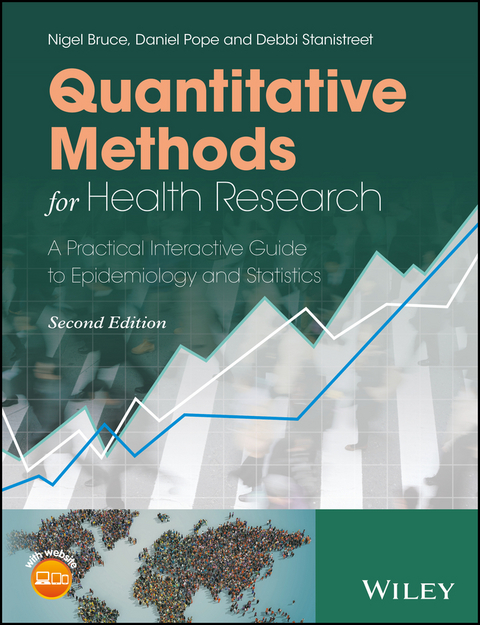
Quantitative Methods for Health Research (eBook)
John Wiley & Sons (Verlag)
978-1-118-66526-8 (ISBN)
A practical introduction to epidemiology, biostatistics, and research methodology for the whole health care community
This comprehensive text, which has been extensively revised with new material and additional topics, utilizes a practical slant to introduce health professionals and students to epidemiology, biostatistics, and research methodology. It draws examples from a wide range of topics, covering all of the main contemporary health research methods, including survival analysis, Cox regression, and systematic reviews and meta-analysis-the explanation of which go beyond introductory concepts. This second edition of Quantitative Methods for Health Research: A Practical Interactive Guide to Epidemiology and Statistics also helps develop critical skills that will prepare students to move on to more advanced and specialized methods.
A clear distinction is made between knowledge and concepts that all students should ensure they understand, and those that can be pursued further by those who wish to do so. Self-assessment exercises throughout the text help students explore and reflect on their understanding. A program of practical exercises in SPSS (using a prepared data set) helps to consolidate the theory and develop skills and confidence in data handling, analysis, and interpretation. Highlights of the book include:
- Combining epidemiology and bio-statistics to demonstrate the relevance and strength of statistical methods
- Emphasis on the interpretation of statistics using examples from a variety of public health and health care situations to stress relevance and application
- Use of concepts related to examples of published research to show the application of methods and balance between ideals and the realities of research in practice
- Integration of practical data analysis exercises to develop skills and confidence
- Supplementation by a student companion website which provides guidance on data handling in SPSS and study data sets as referred to in the text
Quantitative Methods for Health Research, Second Edition is a practical learning resource for students, practitioners and researchers in public health, health care and related disciplines, providing both a course book and a useful introductory reference.
Nigel Bruce, PhD is Emeritus Professor of Public Health at the Department of Public Health and Policy, University of Liverpool, UK.
Daniel Pope, PhD is Senior Lecturer in Epidemiology and Public Health at the Department of Public Health and Policy, University of Liverpool, UK.
Debbi Stanistreet, PhD is Senior Lecturer and Faculty Director of Widening Participation at the Department of Public Health and Policy, University of Liverpool, UK.
A practical introduction to epidemiology, biostatistics, and research methodology for the whole health care community This comprehensive text, which has been extensively revised with new material and additional topics, utilizes a practical slant to introduce health professionals and students to epidemiology, biostatistics, and research methodology. It draws examples from a wide range of topics, covering all of the main contemporary health research methods, including survival analysis, Cox regression, and systematic reviews and meta-analysis the explanation of which go beyond introductory concepts. This second edition of Quantitative Methods for Health Research: A Practical Interactive Guide to Epidemiology and Statistics also helps develop critical skills that will prepare students to move on to more advanced and specialized methods. A clear distinction is made between knowledge and concepts that all students should ensure they understand, and those that can be pursued further by those who wish to do so. Self-assessment exercises throughout the text help students explore and reflect on their understanding. A program of practical exercises in SPSS (using a prepared data set) helps to consolidate the theory and develop skills and confidence in data handling, analysis, and interpretation. Highlights of the book include: Combining epidemiology and bio-statistics to demonstrate the relevance and strength of statistical methods Emphasis on the interpretation of statistics using examples from a variety of public health and health care situations to stress relevance and application Use of concepts related to examples of published research to show the application of methods and balance between ideals and the realities of research in practice Integration of practical data analysis exercises to develop skills and confidence Supplementation by a student companion website which provides guidance on data handling in SPSS and study data sets as referred to in the text Quantitative Methods for Health Research, Second Edition is a practical learning resource for students, practitioners and researchers in public health, health care and related disciplines, providing both a course book and a useful introductory reference.
Nigel Bruce, PhD is Emeritus Professor of Public Health at the Department of Public Health and Policy, University of Liverpool, UK. Daniel Pope, PhD is Senior Lecturer in Epidemiology and Public Health at the Department of Public Health and Policy, University of Liverpool, UK. Debbi Stanistreet, PhD is Senior Lecturer and Faculty Director of Widening Participation at the Department of Public Health and Policy, University of Liverpool, UK.
Quantitative Methods for Health Research 3
Contents 7
Preface 17
Introduction 17
Learning Objectives 18
Resource Papers and Information Sources 18
Key Terms 18
Sample Size Calculations 18
SPSS Dataset Used for Illustrating Examples of Statistical Analysis 18
Self-Assessment Exercises 19
Mathematical Aspects of Statistics 19
Organisation of Subject Matter by Chapter 19
Acknowledgements 22
About the Companion Website 23
1 Philosophy of Science and Introduction to Epidemiology 25
Introduction and Learning Objectives 25
1.1 Approaches to Scientific Research 26
1.1.1 History and Nature of Scientific Research 26
1.1.2 What is Epidemiology? 30
1.1.3 What are Statistics? 31
1.1.4 Approach to Learning 32
1.2 Formulating a Research Question 32
1.2.1 Importance of a Well-Defined Research Question 32
1.2.2 Development of Research Ideas 34
1.3 Rates: Incidence and Prevalence 35
1.3.1 Why Do We Need Rates? 35
1.3.2 Measures of Disease Frequency 36
1.3.3 Prevalence Rate 36
1.3.4 Incidence Rate 36
1.3.5 Relationship Between Incidence, Duration, and Prevalence 39
1.4 Concepts of Prevention 40
1.4.1 Introduction 40
1.4.2 Primary, Secondary, and Tertiary Prevention 41
1.5 Answers to Self-Assessment Exercises 42
2 Routine Data Sources and Descriptive Epidemiology 49
Introduction and Learning Objectives 49
2.1 Routine Collection of Health Information 50
2.1.1 Deaths (Mortality) 50
2.1.2 Compiling Mortality Statistics: The Example of England and Wales 52
2.1.3 Suicide Among Men 53
2.1.4 Suicide Among Young Women 55
2.1.5 Variations in Deaths of Very Young Children 55
2.2 Descriptive Epidemiology 57
2.2.1 What is Descriptive Epidemiology? 57
2.2.2 International Variations in Rates of Lung Cancer 57
2.2.3 Illness (Morbidity) 58
2.2.4 Sources of Information on Morbidity 59
2.2.5 Notification of Infectious Disease 59
2.2.6 Illness Seen in General Practice 62
2.3 Information on the Environment 63
2.3.1 Air Pollution and Health 63
2.3.2 Routinely Available Data on Air Pollution 63
2.4 Displaying, Describing, and Presenting Data 65
2.4.1 Displaying the Data 65
2.4.2 Calculating the Frequency Distribution 66
2.4.3 Describing the Frequency Distribution 68
2.4.4 The Relative Frequency Distribution 81
2.4.5 Scatterplots, Linear Relationships and Correlation 84
2.5 Routinely Available Health Data 93
2.5.1 Introduction 93
2.5.2 Classification of Routine Health Information Sources 93
2.5.3 Demographic Data 94
2.5.4 Health Event Data 97
2.5.5 Population-Based Health Information 102
2.5.6 Deprivation Indices 103
2.5.7 Routine Data Sources for Countries Other Than the UK 104
2.6 Descriptive Epidemiology in Action 104
2.6.1 The London Smogs of the 1950s 104
2.6.2 Ecological Studies 106
2.7 Overview of Epidemiological Study Designs 108
2.8 Answers to Self-Assessment Exercises 110
3 Standardisation 125
Introduction and Learning Objectives 125
3.1 Health Inequalities in Merseyside 125
3.1.1 Socio-Economic Conditions and Health 125
3.1.2 Comparison of Crude Death Rates 126
3.1.3 Usefulness of a Summary Measure 128
3.2 Indirect Standardisation: Calculation of the Standardised Mortality Ratio (SMR) 129
3.2.1 Mortality in Liverpool 129
3.2.2 Interpretation of the SMR 131
3.2.3 Dealing With Random Variation: The 95 per cent Confidence Interval 131
3.2.4 Increasing Precision of the SMR Estimate 132
3.2.5 Mortality in Sefton 132
3.2.6 Comparison of SMRs 134
3.2.7 Indirectly Standardised Mortality Rates 134
3.3 Direct Standardisation 134
3.3.1 Introduction 134
3.3.2 An Example: Changes in Deaths From Stroke Over Time 135
3.3.3 Using the European Standard Population 136
3.3.4 Direct or Indirect: Which Method is Best? 137
3.4 Standardisation for Factors Other Than Age 138
3.5 Answers to Self-Assessment Exercises 139
4 Surveys 147
Introduction and Learning Objectives 147
Resource Papers 148
4.1 Purpose and Context 148
4.1.1 Defining the Research Question 148
4.1.2 Political Context of Research 150
4.2 Sampling Methods 151
4.2.1 Introduction 151
4.2.2 Sampling 151
4.2.3 Probability 153
4.2.4 Simple Random Sampling 154
4.2.5 Stratified Sampling 155
4.2.6 Cluster Random Sampling 156
4.2.7 Multistage Random Sampling 157
4.2.8 Systematic Sampling 157
4.2.9 Convenience Sampling 157
4.2.10 Sampling People Who are Difficult to Contact 157
4.2.11 Quota Sampling 158
4.2.12 Sampling in Natsal-3 159
4.3 The Sampling Frame 161
4.3.1 Why Do We Need a Sampling Frame? 161
4.3.2 Losses in Sampling 161
4.4 Sampling Error, Confidence Intervals, and Sample Size 163
4.4.1 Sampling Distributions and the Standard Error 163
4.4.2 The Standard Error 164
4.4.3 Key Properties of the Normal Distribution 169
4.4.4 Confidence Interval (CI) for the Sample Mean 170
4.4.5 Estimating Sample Size 173
4.4.6 Sample Size for Estimating a Population Mean 173
4.4.7 Standard Error and 95 per cent CI for a Population Proportion 174
4.4.8 Sample Size to Estimate a Population Proportion 175
4.5 Response 177
4.5.1 Determining the Response Rate 177
4.5.2 Assessing Whether the Sample is Representative 178
4.5.3 Maximising the Response Rate 178
4.6 Measurement 181
4.6.1 Introduction: The Importance of Good Measurement 181
4.6.2 Interview or Self-Completed Questionnaire? 181
4.6.3 Principles of Good Questionnaire Design 182
4.6.4 Development of a Questionnaire 185
4.6.5 Checking How Well the Interviews and Questionnaires Have Worked 185
4.6.6 Assessing Measurement Quality 189
4.6.7 Overview of Sources of Error 193
4.7 Data Types and Presentation 195
4.7.1 Introduction 195
4.7.2 Types of Data 196
4.7.3 Displaying and Summarising the Data 197
4.8 Answers to Self-Assessment Exercises 200
5 Cohort Studies 209
Introduction and Learning Objectives 209
Resource Papers 210
5.1 Why Do a Cohort Study? 210
5.1.1 Objectives of the Study 210
5.1.2 Study Structure 212
5.2 Obtaining the Sample 212
5.2.1 Introduction 212
5.2.2 Sample Size 214
5.3 Measurement 214
5.3.1 Importance of Good Measurement 214
5.3.2 Identifying and Avoiding Measurement Error 214
5.3.3 The Measurement of Blood Pressure 215
5.3.4 Case Definition 216
5.4 Follow-Up 217
5.4.1 Nature of the Task 217
5.4.2 Deaths (Mortality) 217
5.4.3 Non-Fatal Cases (Morbidity) 218
5.4.4 Challenges Faced with Follow-Up of a Cohort in a Different Setting 218
5.4.5 Assessment of Changes During Follow-Up Period 220
5.5 Basic Presentation and Analysis of Results 222
5.5.1 Initial Presentation of Findings 222
5.5.2 Relative Risk 223
5.5.3 Hypothesis Test for Categorical Data: The Chi-Squared Test 225
5.5.4 Hypothesis Tests for Continuous Data: The z-Test and the t-Test 233
5.6 How Large Should a Cohort Study Be? 238
5.6.1 Perils of Inadequate Sample Size 238
5.6.2 Sample Size for a Cohort Study 239
5.6.3 Example of Output from Sample Size Calculation 240
5.7 Assessing Whether an Association is Causal 242
5.7.1 The Hill Viewpoints 242
5.7.2 Confounding: What Is It and How Can It Be Addressed? 244
5.7.3 Does Smoking Cause Heart Disease? 246
5.7.4 Confounding in the Physical Activity and Cancer Study 246
5.7.5 Methods for Dealing with Confounding 248
5.8 Simple Linear Regression 248
5.8.1 Approaches to Describing Associations 248
5.8.2 Finding the Best Fit for a Straight Line 250
5.8.3 Interpreting the Regression Line 251
5.8.4 Using the Regression Line 252
5.8.5 Hypothesis Test of the Association Between the Explanatory and Outcome Variables 252
5.8.6 How Good is the Regression Model? 253
5.8.7 Interpreting SPSS Output for Simple Linear Regression Analysis 255
5.8.8 First Table: Variables Entered/Removed 256
5.9 Introduction to Multiple Linear Regression 259
5.9.1 Principles of Multiple Regression 259
5.9.2 Using Multivariable Linear Regression to Study Independent Associations 259
5.9.3 Investigation of the Effect of Work Stress on Bodyweight 259
5.9.4 Multiple Regression in the Cancer Study 263
5.9.5 Overview of Regression Methods for Different Types of Outcome 264
5.10 Answers to Self-Assessment Exercises 266
6 Case–Control Studies 275
Introduction and Learning Objectives 275
Resource Papers 276
6.1 Why do a Case–Control Study? 277
6.1.1 Study Objectives 277
6.1.2 Study Structure 278
6.1.3 Approach to Analysis 279
6.1.4 Retrospective Data Collection 281
6.1.5 Applications of the Case–Control Design 282
6.2 Key Elements of Study Design 283
6.2.1 Selecting the Cases 283
6.2.2 The Controls 284
6.2.3 Exposure Assessment 286
6.2.4 Bias in Exposure Assessment 287
6.3 Basic Unmatched and Matched Analysis 289
6.3.1 The Odds Ratio (OR) 289
6.3.2 Calculation of the OR–Simple Matched Analysis 293
6.3.3 Hypothesis Tests for Case–Control Studies 295
6.4 Sample Size for a Case–Control Study 297
6.4.1 Introduction 297
6.4.2 What Information is Required? 297
6.4.3 An Example of Sample Size Calculation Using OpenEpi 298
6.5 Confounding and Logistic Regression 300
6.5.1 Introduction 300
6.5.2 Stratification 301
6.5.3 Logistic Regression 302
6.5.4 Example: Multivariable Logistic Regression 305
6.5.5 Matched Studies – Conditional Logistic Regression 311
6.5.6 Interpretation of Adjusted Results from the New Zealand Study 311
6.6 Answers to Self-Assessment Exercises 313
7 Intervention Studies 321
Introduction and Learning Objectives 321
Typology of Intervention Study Designs Described in This Chapter 321
Terminology 322
Resource Papers 323
Principal References 323
Supplementary References 323
7.1 Why Do an Intervention Study? 323
7.1.1 Study Objectives 323
7.1.2 Structure of a Randomised, Controlled Intervention Study 324
7.2 Key Elements of Intervention Study Design 327
7.2.1 Defining Who Should be Included and Excluded 327
7.2.2 Intervention and Control 328
7.2.3 Randomisation 330
7.2.4 Outcome Assessment 331
7.2.5 Blinding 332
7.2.6 Ethical Issues for Intervention Studies 332
7.3 The Analysis of Intervention Studies 333
7.3.1 Review of Variables at Baseline 334
7.3.2 Loss to Follow-Up 335
7.3.3 Compliance with the Treatment Allocation 335
7.3.4 Analysis by Intention-to-Treat 336
7.3.5 Analysis per Protocol 337
7.3.6 What is the Effect of the Intervention? 337
7.3.7 Drawing Conclusions 339
7.3.8 Adjustment for Variables Known to Influence the Outcome 339
7.3.9 Paired Comparisons 339
7.3.10 The Crossover Trial 341
7.4 Testing More-Complex Interventions 342
7.4.1 Introduction 342
7.4.2 Randomised Trial of Individuals for a Complex Intervention 343
7.4.3 Factorial Design 346
7.4.4 Analysis and Interpretation 347
7.4.5 Departure from the Ideal Blinded RCT Design 351
7.4.6 The Cluster Randomised Trial 352
7.4.7 The Community (Cluster) Randomised Trial 354
7.4.8 Non-Randomised Intervention Designs 356
7.4.9 The Natural Experiment 357
7.5 Analysis of Intervention Studies Using a Cluster Design 358
7.5.1 Why Does the Use of Clusters Make a Difference? 358
7.5.2 Summarising Clustering Effects: The Intra-Class Correlation Coefficient 358
7.5.3 Multi-Level Modelling 359
7.5.4 Analysis of the Cluster RCT of Physical Activity 359
7.6 How Big Should the Intervention Study Be? 361
7.6.1 Introduction 361
7.6.2 Sample Size for a Trial with Categorical Data Outcomes 361
7.6.3 One-Sided and Two-Sided Tests 363
7.6.4 Sample Size for a Trial with Continuous Data Outcomes 363
7.6.5 Sample Size for an Intervention Study Using Cluster Design 364
7.6.6 Estimation of Sample Size is not a Precise Science 365
7.7 Intervention Study Registration, Management, and Reporting 365
7.7.1 Introduction 365
7.7.2 Registration 366
7.7.3 Trial Management 366
7.7.4 Reporting Standards (CONSORT) 367
7.8 Answers to Self-Assessment Exercises 368
8 Life Tables, Survival Analysis, and Cox Regression 379
Introduction and Learning Objectives 379
Resource Papers 380
8.1 Survival Analysis 380
8.1.1 Introduction 380
8.1.2 Why Do We Need Survival Analysis? 380
8.1.3 Censoring 381
8.1.4 Kaplan–Meier Survival Curves 383
8.1.5 Kaplan–Meier Survival Curves 385
8.1.6 The Log-Rank Test 386
8.1.7 Interpretation of the Kaplan–Meier Survival Curve 389
8.2 Cox Regression 395
8.2.1 Introduction 395
8.2.2 The Hazard Function 395
8.2.3 Assumption of Proportional Hazards 396
8.2.4 The Cox Regression Model 396
8.2.5 Checking the Assumption of Proportional Hazards 396
8.2.6 Interpreting the Cox Regression Model 397
8.2.7 Prediction 398
8.2.8 Application of Cox Regression 399
8.3 Current Life Tables 401
8.3.1 Introduction 401
8.3.2 Current Life Tables and Life Expectancy at Birth 401
8.3.3 Life Expectancy at Other Ages 403
8.3.4 Healthy or Disability-Free Life Expectancy 403
8.3.5 Abridged Life Tables 404
8.3.6 Summary 405
8.4 Answers to Self-Assessment Exercises 405
9 Systematic Reviews and Meta-Analysis 409
Introduction and Learning Objectives 409
Increasing Power by Combining Studies 410
Resource Papers 411
9.1 The Why and How of Systematic Reviews 411
9.1.1 Why is it Important that Reviews be Systematic? 411
9.1.2 Method of Systematic Review – Overview and Developing a Protocol 412
9.1.3 Deciding on the Research Question and Objectives for the Review 413
9.1.4 Defining Criteria for Inclusion and Exclusion of Studies 414
9.1.5 Identifying Relevant Studies 415
9.1.6 Assessment of Methodological Quality 420
9.1.7 Extracting Data 423
9.1.8 Describing the Results 423
9.2 The Methodology of Meta-Analysis 426
9.2.1 Method of Meta-Analysis – Overview 426
9.2.2 Assessment of Publication Bias – the Funnel Plot 427
9.2.3 Heterogeneity 429
9.2.4 Calculating the Pooled Estimate 431
9.2.5 Presentation of Results: Forest Plot 432
9.2.6 Sensitivity Analysis 433
9.2.7 Statistical Software for the Conduct of Meta-Analysis 434
9.2.8 Another Example of the Value of Meta-Analysis – Identifying a Dangerous Treatment 435
9.3 Systematic Reviews and Meta-Analyses of Observational Studies 438
9.3.1 Introduction 438
9.3.2 Why Conduct a Systematic Review of Observational Studies? 438
9.3.3 Approach to Meta-Analysis of Observational Studies 439
9.3.4 Method of Systematic Review of Observational Studies 440
9.3.5 Method of Meta-Analysis of Observational Studies 440
9.4 Reporting and Publishing Systematic Reviews and Meta-Analyses 442
9.5 The Cochrane Collaboration 443
9.5.1 Introduction 443
9.5.2 Cochrane Collaboration Logo 446
9.5.3 Collaborative Review Groups 446
9.5.4 Cochrane Library 446
9.6 Answers to Self-Assessment Exercises 447
10 Prevention Strategies and Evaluation of Screening 453
Introduction and Learning Objectives 453
Resource Papers 454
10.1 Concepts of Risk 454
10.1.1 Relative and Attributable Risk 454
10.1.2 Calculation of AR 455
10.1.3 Attributable Fraction (AF) for a Dichotomous Exposure 456
10.1.4 Attributable Fraction for Continuous and Multiple Category Exposures 458
10.1.5 Years of Life Lost (YLL) and Years Lived with Disability (YLD) 458
10.1.6 Disability-Adjusted Life Years (DALYs) 460
10.1.7 Burden Attributable to Specific Risk Factors 462
10.2 Strategies of Prevention 464
10.2.1 The Distribution of Risk in Populations 464
10.2.2 High-Risk and Population Approaches to Prevention 467
10.2.3 Safety and the Population Strategy 470
10.2.4 The High-Risk and Population Strategies Revisited 471
10.2.5 Implications of Genomic Research for Disease Prevention 472
10.3 Evaluation of Screening Programmes 474
10.3.1 Purpose of Screening 475
10.3.2 Criteria for Programme Evaluation 475
10.3.3 Assessing Validity of a Screening Test 476
10.3.4 Methodological Issues in Studies of Screening Programme Effectiveness 484
10.3.5 Are the Wilson–Jungner Criteria Relevant Today? 485
10.4 Cohort and Period Effects 487
10.4.1 Analysis of Change in Risk Over Time 487
10.4.2 Example: Suicide Trends in UK Men and Women 488
10.5 Answers to Self-Assessment Exercises 492
11 Probability Distributions, Hypothesis Testing, and Bayesian Methods 501
Introduction and Learning Objectives 501
Resource Papers 502
11.1 Probability Distributions 502
11.1.1 Probability – A Brief Review 502
11.1.2 Introduction to Probability Distributions 503
11.1.3 Types of Probability Distribution 505
11.1.4 Probability Distributions: Implications for Statistical Methods 511
11.2 Data That Do Not Fit a Probability Distribution 512
11.2.1 Robustness of an Hypothesis Test 512
11.2.2 Transforming the Data 512
11.2.3 Principles of Non-Parametric Hypothesis Testing 516
11.3 Hypothesis Testing: Summary of Common Parametric and Non-Parametric Methods 517
11.3.1 Introduction 517
11.3.2 Review of Hypothesis Tests 518
11.3.3 Fundamentals of Hypothesis Testing 518
11.3.4 Summary: Stages of Hypothesis Testing 519
11.3.5 Comparing Two Independent Groups 520
11.3.6 Comparing Two Paired (or Matched) Groups 524
11.3.7 Testing for Association Between Two Groups 530
11.3.8 Comparing More Than Two Groups 532
11.3.9 Association Between Categorical Variables 537
11.4 Choosing an Appropriate Hypothesis Test 541
11.4.1 Introduction 541
11.4.2 Using a Guide Table for Selecting a Hypothesis Test 541
11.4.3 The Problem of Multiple Significance Testing 544
11.5 Bayesian Methods 544
11.5.1 Introduction: A Different Approach to Inference 544
11.5.2 Bayes’ Theorem and Formula 545
11.5.3 Application and Relevance 546
11.6 Answers to Self-Assessment Exercises 549
Bibliography 553
Index 557
EULA 570
| Erscheint lt. Verlag | 29.11.2017 |
|---|---|
| Sprache | englisch |
| Themenwelt | Medizin / Pharmazie ► Allgemeines / Lexika |
| Medizin / Pharmazie ► Medizinische Fachgebiete ► Pharmakologie / Pharmakotherapie | |
| Studium ► Querschnittsbereiche ► Epidemiologie / Med. Biometrie | |
| Schlagworte | and meta-analysis • Biostatistics • Biostatistik • clinical research • Cox Regression • data handling for health research • epidemiology • evidence based healthcare • Healthcare • health clinic research • health research data analysis • health research data interpretation • health research methodology • Health Science • Health Studies • Medical Research • Medical Science • Medical Statistics • Medical Statistics & Epidemiology • Medizin • Medizinische Statistik u. Epidemiologie • nursing: physiotherapy • Pharmacology & Pharmaceutical Medicine • Pharmakologie u. Pharmazeutische Medizin • public health studies • quantitative research in health care • SPSS • Statistics • Statistik • Survival Analysis |
| ISBN-10 | 1-118-66526-0 / 1118665260 |
| ISBN-13 | 978-1-118-66526-8 / 9781118665268 |
| Informationen gemäß Produktsicherheitsverordnung (GPSR) | |
| Haben Sie eine Frage zum Produkt? |
 PDF (Adobe DRM)
Kopierschutz: Adobe-DRM
Adobe-DRM ist ein Kopierschutz, der das eBook vor Mißbrauch schützen soll. Dabei wird das eBook bereits beim Download auf Ihre persönliche Adobe-ID autorisiert. Lesen können Sie das eBook dann nur auf den Geräten, welche ebenfalls auf Ihre Adobe-ID registriert sind.
Details zum Adobe-DRM
Dateiformat: PDF (Portable Document Format)
Mit einem festen Seitenlayout eignet sich die PDF besonders für Fachbücher mit Spalten, Tabellen und Abbildungen. Eine PDF kann auf fast allen Geräten angezeigt werden, ist aber für kleine Displays (Smartphone, eReader) nur eingeschränkt geeignet.
Systemvoraussetzungen:
PC/Mac: Mit einem PC oder Mac können Sie dieses eBook lesen. Sie benötigen eine
eReader: Dieses eBook kann mit (fast) allen eBook-Readern gelesen werden. Mit dem amazon-Kindle ist es aber nicht kompatibel.
Smartphone/Tablet: Egal ob Apple oder Android, dieses eBook können Sie lesen. Sie benötigen eine
Geräteliste und zusätzliche Hinweise
Buying eBooks from abroad
For tax law reasons we can sell eBooks just within Germany and Switzerland. Regrettably we cannot fulfill eBook-orders from other countries.


