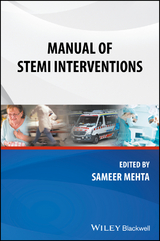
Manual of STEMI Interventions (eBook)
John Wiley & Sons (Verlag)
978-1-119-09542-2 (ISBN)
- Understand the varied pharmacological options available in managing STEMI patients, including newer anti-coagulants
- Improve your STEMI procedure technique through expert guidance, including stent choice, and other techniques such as trans radial procedures
- Provides an overview of STEMI networks internationally and how to set up a STEMI program
- Reviews future perspectives for STEMI and the role of telemedicine for STEMI procedures
Sameer Mehta, MD, FACC, MBA
Voluntary Associate Clinical Professor of Medicine, University of Miami - Miller School of Medicine; Chairman, Lumen Foundation,
Miami, FL, USA
Benefit from this concise yet comprehensive manual, designed to improve the practice and process of STEMI interventions Understand the varied pharmacological options available in managing STEMI patients, including newer anti-coagulants Improve your STEMI procedure technique through expert guidance, including stent choice, and other techniques such as trans radial procedures Provides an overview of STEMI networks internationally and how to set up a STEMI program Reviews future perspectives for STEMI and the role of telemedicine for STEMI procedures
Sameer Mehta, MD, FACC, MBA Voluntary Associate Clinical Professor of Medicine, University of Miami Miller School of Medicine; Chairman, Lumen Foundation, Miami, FL, USA
1
Compendium of STEMI Clinical Trials
Juanita Gonzalez Arango MD, Miguel Vega Arango MD, Estefania Calle Botero MD, Isaac Yepes Moreno MD, Maria Botero Urrea MD, Alicia Henao Velasquez MD, Daniel Rodriguez MD, Daniela Parra Dunoyer MD, Maria Teresa Bedoya Reina MD, Sameer Mehta MD
Introduction
As we constructed our fourth textbook of interventions for ST‐elevation myocardial infarction (STEMI), the need for including a chapter on clinical trials was paramount. To provide a complete compendium of relevant STEMI guidelines and clinical trials, two distinct chapters have been created. We recognize that this information is easily obtained from searching the internet; however, we deemed it important to present in this book the most up‐to‐date guidelines and clinical trials. In this chapter, we have divided the trials into stents (Table 1.1), no‐reflow (Table 1.2), thrombectomy (Table 1.3), percutaneous coronary interventions for non‐culprit lesions (Table 1.4), and the role of left ventricular support devices (Table 1.5). In Chapter 2, we have separated out those guidelines from the American College of Cardiology and the European Society of Cardiology. These topics are discussed further in various chapters of the textbook. However, we firmly believe that a compendium of guidelines and clinical trials will provide a useful summary of these STEMI‐related studies.
Table 1.1 Which stent is most desirable for STEMI interventions?
| Study Title | Hypothesis | Cohort | Principal Findings | Conclusion |
| COBALT: long‐term clinical outcome of thin‐strut CoCr stents in the DES era [1]. | To assess characteristics and outcomes of patients treated with 2 different new‐generation CoCr BMS, the MULTI‐LINK VISION® and PRO‐Kinetic Energy® stents. | 1176 patients: MLV (n = 438); PRO‐Kinetic (n = 738). | TLR and TVR were lower in the MLV group. Death, MI, ARC and definite stent thrombosis were similar. | The use of last‐generation thin‐strut BMS in selected patients is associated with acceptable clinical outcome, with similar clinical results for both the MLV and PRO‐Kinetic stents. |
| Comparison of newer‐generation DES with BMS in patients with acute STEMI [2]. | Efficacy and safety of newer‐generation DES compared with BMS in patients with STEMI. | 2665 STEMI patients: 1326 received a newer‐generation DES (EES or biolimus A9 eluting stent) and 1329 received BMS. | Newer‐generation DES substantially reduced the risk of repeat TVR, target‐vessel infarction, definite stent thrombosis compared with BMS at 1 year. | Newer‐generation DES improves safety and efficacy compared with BMS throughout 1st year. |
| Meta‐analysis of long‐term outcomes for DES compared with BMS in PCI for STEMI [3]. | Available literature examining the outcomes of DES and BMS in PPCI after > 3 years of follow‐up. | 8 RCTs and 5 observational studies. 5797 patients in whom 1st‐generation DES (SES or PES) were compared with BMS control arms. | Patients with DES had lower risk of TLR, TVR, and MACE. Incidence of stent thrombosis equal between groups. No difference in mortality or recurrent MI. Those receiving DES had lower mortality. | DES use resulted in decreased repeat revascularization with no increase in stent thrombosis, mortality, or recurrent MI. |
| Outcomes with various DES or BMS in patients with STEMI [4]. | Efficacy (TVR) and safety (death, MI, and stent thrombosis) outcomes at the longest reported follow‐up times with DES compared with BMS. | 28 randomized clinical trials; 34,068 patients comparing any DES against each other or BMS. | No increase in the risk of death, MI, or stent thrombosis with any DES compared with BMS. EES was associated with a statistically significant reduction in the rate of stent thrombosis when compared with SES, PES, and even BMS. | DES versus BMS was associated with substantial decrease in the risk of TVR. EES had substantial reduction in the risk of stent thrombosis with no increase in very late stent thrombosis. |
| Benefits of DES compared with BMS in STEMI: 4‐year results of PES or SES vs. BMS in primary angioplasty (PASEO) randomized trial [5]. | To evaluate the short and long‐term benefits of SES and PES vs. BMS in patients undergoing primary angioplasty. | 270 patients with STEMI were randomized to BMS (n = 90), PES (n = 90), or SES (n = 90). | PES and SES were associated with significant reduction in TLR at 1year. No difference was observed in terms of death and reinfarction. | SES and PES are safe and associated with significant benefits in terms of TLR up to 4 years of follow‐up, compared with BMS. |
| PPCI for AMI: long‐term outcome after BMS and DES Implantation [6]. | To investigate the long‐term outcomes of unselected patients undergoing PPCI with BMS and DES. | 1738 patients undergoing PPCI for a new lesion. 3 cohorts of BMS (n = 531), SES (n = 185) or PES (n = 1022). | No differences in all‐cause mortality or repeat revascularization between DES and BMS. SES was associated with lower rates of all‐cause death, nonfatal MI, or TVR compared with PES. Very late stent thrombosis only occurred in the DES groups. | DES are not associated with an increase in adverse events compared with BMS when used for PPCI, neither DES reduced repeat revascularizations. |
| Safety and efficacy outcomes of first‐ and second‐generation durable polymer DES and biodegradable polymer BES in clinical practice: comprehensive network meta‐analysis [7]. | To investigate the safety and efficacy of durable polymer DES and biodegradable polymer BES. | 60 randomized controlled trials were compared, which involved 63,242 patients treated with DES. | At 1year, there were no differences in mortality. Resolute and EZES, EES and SES were associated with reduced odds of MI compared with PES. Compared with EES, BP‐BES were associated with increased odds of MI, while EZES and PES were associated with increased odds of ST. EES and EZES offering the highest safety profiles. | The newer durable polymer EES and EZES and the BP‐BES maintain the efficacy of SES. EES and EZES are the safest stents to date. |
| EXAMINATION trial (EES Versus BMS in STEMI): 2‐year results from a multicenter randomized controlled trial [8]. | To evaluate the outcomes of the population included in the EXAMINATION trial. | 1498 patients were randomized to receive EES (n = 751) or BMS (n = 747). | Rate of TLR, definite or probable stent thrombosis was significantly lower in EES group than in BMS group. | Both rates of TLR and stent thrombosis were reduced in recipients of EES. |
| 2‐year outcomes after first‐ or second‐generation DES or BMS implantation in patients undergoing PCI. A pre‐specified analysis from the PRODIGY study [9]. | To assess device‐specific outcomes with respect to the occurrence of MACE, after implantation of BMS, ZESS, PES, or EES in patients undergoing PCI. | 2013 randomized patients undergoing CA in a 1:1:1:1 fashion to BMS, ZESS, PES, or EES implantation. | MACE rate was lowest in EES, highest in BMS, and intermediate in PES and ZESS. The 2‐year incidence of stent thrombosis in the EES group was similar to that in ZESS group, but lower compared with PES and BMS groups. | MACE rate was lowest for EES, highest for BMS, and intermediate for PES and ZESS groups. EES outperformed BMS with safety endpoints and stent thrombosis. |
| New DES for STEMI: A new paradigm for safety [10]. | To compare the long‐term safety of new‐generation DES with early‐generation DES and BMS for STEMI. | 3464 STEMI patients were treated with BMS (n = 1187), early‐generation DES (n = 1,525), or new‐generation DES (n = 752). | At 2 years, new‐generation DES had lower mortality, similar reinfarction, and fewer stent thromboses compared with BMS; and similar mortality, similar reinfarction, and trends for fewer stent thromboses compared with early‐generation DES. | New‐generation DES in STEMI patients have fewer stent thromboses compared with BMS and trends for fewer stent thromboses compared with early‐generation DES. |
| Safety and effectiveness of DES in patients with STEMI undergoing primary angioplasty [11]. | To confirm the safety and effectiveness of DES in patients with STEMI. | 370 patients (120 in DES group and 250 in BMS group) with STEMI treated with primary PCI. Patients were retrospectively followed for the occurrence of MACE. | There was no difference in rate of stent thrombosis in the BMS group. Incidence of MACE was lower... |
| Erscheint lt. Verlag | 19.7.2017 |
|---|---|
| Sprache | englisch |
| Themenwelt | Medizin / Pharmazie ► Allgemeines / Lexika |
| Medizinische Fachgebiete ► Innere Medizin ► Kardiologie / Angiologie | |
| Schlagworte | Acute Coronary Syndrome • Acute myocardial infarction • acute stent thrombosis • anti-coagulant drugs • Bleeding • Cardiovascular Disease • coronary artery disease • hemodynamics • Interventional cardiology • Invasive Kardiologie • Kardiovaskuläre Erkrankungen • Kardiovaskuläre Erkrankungen • Manual of STEMI Interventions • Mechanical Circulatory Support • Medical Science • Medizin • Myocardial Infarction • Primary PCI • primary percutaneous coronary intervention • revascularization • Sameer Mehta • ST-elevation myocardial infarction • STEMI |
| ISBN-10 | 1-119-09542-5 / 1119095425 |
| ISBN-13 | 978-1-119-09542-2 / 9781119095422 |
| Informationen gemäß Produktsicherheitsverordnung (GPSR) | |
| Haben Sie eine Frage zum Produkt? |
 EPUB (Adobe DRM)
Kopierschutz: Adobe-DRM
Adobe-DRM ist ein Kopierschutz, der das eBook vor Mißbrauch schützen soll. Dabei wird das eBook bereits beim Download auf Ihre persönliche Adobe-ID autorisiert. Lesen können Sie das eBook dann nur auf den Geräten, welche ebenfalls auf Ihre Adobe-ID registriert sind.
Details zum Adobe-DRM
Dateiformat: EPUB (Electronic Publication)
EPUB ist ein offener Standard für eBooks und eignet sich besonders zur Darstellung von Belletristik und Sachbüchern. Der Fließtext wird dynamisch an die Display- und Schriftgröße angepasst. Auch für mobile Lesegeräte ist EPUB daher gut geeignet.
Systemvoraussetzungen:
PC/Mac: Mit einem PC oder Mac können Sie dieses eBook lesen. Sie benötigen eine
eReader: Dieses eBook kann mit (fast) allen eBook-Readern gelesen werden. Mit dem amazon-Kindle ist es aber nicht kompatibel.
Smartphone/Tablet: Egal ob Apple oder Android, dieses eBook können Sie lesen. Sie benötigen eine
Geräteliste und zusätzliche Hinweise
Buying eBooks from abroad
For tax law reasons we can sell eBooks just within Germany and Switzerland. Regrettably we cannot fulfill eBook-orders from other countries.
aus dem Bereich