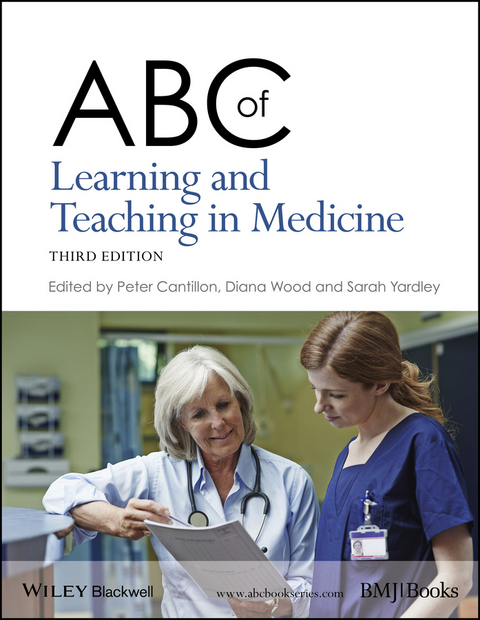
ABC of Learning and Teaching in Medicine (eBook)
John Wiley & Sons (Verlag)
978-1-118-89216-9 (ISBN)
ABC of Learning and Teaching in Medicine is an invaluable resource for both novice and experienced medical teachers, It emphasises the teacher's role as a facilitator of learning rather than a transmitter of knowledge, and is designed to be practical and accessible not only to those new to the profession, but also to those who wish to keep abreast of developments in medical education,
Fully updated and revised, this new edition continues to provide an accessible account of the most important domains of medical education including educational design, assessment, feedback and evaluation, The succinct chapters contained in this ABC are designed to help new teachers learn to teach and for experienced teachers to become even better than they are, Four new chapters have been added covering topics such as social media; quality assurance of assessments; mindfulness and learner supervision,
Written by an expert editorial team with an international selection of authoritative contributors, this edition of ABC of Learning and Teaching in Medicine is an excellent introductory text for doctors and other health professionals starting out in their careers, as well as being an important reference for experienced educators,
Peter Cantillon, Professor of Primary Care, Discipline of General Practice, School of Medicine, National University of Ireland, Galway, Ireland
Diana Wood, Director of Medical Education and Clinical Dean, School of Clinical Medicine, University of Cambridge, Cambridge, UK
Sarah Yardley, Consultant in Palliative Medicine, Central & North West London NHS Foundation Trust and Honorary Lecturer, Marie Curie Palliative Care Research Department, University College London, London, UK
ABC of Learning and Teaching in Medicine is an invaluable resource for both novice and experienced medical teachers. It emphasises the teacher s role as a facilitator of learning rather than a transmitter of knowledge, and is designed to be practical and accessible not only to those new to the profession, but also to those who wish to keep abreast of developments in medical education. Fully updated and revised, this new edition continues to provide an accessible account of the most important domains of medical education including educational design, assessment, feedback and evaluation. The succinct chapters contained in this ABC are designed to help new teachers learn to teach and for experienced teachers to become even better than they are. Four new chapters have been added covering topics such as social media; quality assurance of assessments; mindfulness and learner supervision. Written by an expert editorial team with an international selection of authoritative contributors, this edition of ABC of Learning and Teaching in Medicine is an excellent introductory text for doctors and other health professionals starting out in their careers, as well as being an important reference for experienced educators.
Peter Cantillon, Professor of Primary Care, Discipline of General Practice, School of Medicine, National University of Ireland, Galway, Ireland Diana Wood, Director of Medical Education and Clinical Dean, School of Clinical Medicine, University of Cambridge, Cambridge, UK Sarah Yardley, Consultant in Palliative Medicine, Central & North West London NHS Foundation Trust and Honorary Lecturer, Marie Curie Palliative Care Research Department, University College London, London, UK
List of Contributors vii
Preface ix
Acknowledgements xi
1 Becoming a Better Teacher 1
Peter Cantillon
2 Educational Theory: An Overview 7
Tim Dornan, Gerard J. Gormley, and Sarah Yardley
3 Inquiry-based Learning 11
Inam Haq
4 Course Design 15
Deborah Gill
5 Creating Educational Materials 19
Vimmi Passi and Alan Dellow
6 Creating a Safe and Effective Learning Environment 23
Jeremy Webb
7 Feedback in Medical Education: Skills for Improving Learner Performance 29
Joan Sargeant and Karen Mann
8 Small-Group Learning 33
Gary D. Rogers and Peter M. Hamilton
9 Lectures Lecturing and Learning 39
Peter Cantillon
10 Simulation in Healthcare Education 43
Jean Ker and Ben Shippey
11 Workplace Learning: Promoting Strengths Addressing Weaknesses 49
Pim W. Teunissen and Walter Eppich
12 Learner Supervision 53
Ed Peile
13 Formative Assessment 59
Diana Wood
14 Written Assessment 65
Lambert W.T. Schuwirth and Cees P.M. van der Vleuten
15 Skill-based Assessment 71
Val Wass
16 Work-based Assessment 77
John Norcini and Eric Holmboe
17 Quality Assurance of Assessments 81
Celia Taylor
18 Students in Difficulty 85
Dason Evans and Jo Brown
19 Teaching and Learning Professionalism 91
Rachel Morris and Hilary Neve
20 Social Media and Learning 97
Natalie T. Lafferty and Annalisa Manca
21 The Mindful Clinician-Teacher 105
Stephen Liben
22 Evaluation 109
Jill Morrison
Index 115
CHAPTER 1
Becoming a Better Teacher
Peter Cantillon
Discipline of General Practice, School of Medicine, National University of Ireland, Galway, Ireland,
OVERVIEW
- This chapter outlines teacher development strategies for teachers who find it difficult to attend formal faculty development
- Teaching scripts (i.e. teachers’ knowledge of the subject matter, the learners, the context and teaching techniques) provide excellent organisational frameworks for thinking about teaching
- Developing a critical self‐awareness of teaching beliefs and practices is essential if teachers are to develop themselves. Critical self‐awareness can be developed by:
- developing a habit of teaching evaluation
- arranging peer observation of teaching
- completing a teaching orientation inventory
- learning how to get the most out of teaching and learning experiences through reflective practice
Becoming a better teacher
For centuries medicine has been learned through an apprenticeship of observation and participation. Medical teachers acted as apprentice masters who provided their apprentices with access to patients and shared their expertise. It was unusual for clinicians to undergo any form of teacher training, because the only qualification required for teaching was clinical proficiency. The expert clinician/amateur teacher model persists to this day, but it has come under increasing pressure with the advent of limited hours working time directives, competency‐based curricular designs, enhanced supervisory roles, external accreditation of medical education and increasingly complex assessment strategies. As a result, it is becoming ever more difficult for medical educators to rely solely on their subject matter knowledge as being sufficient for their teaching roles. In many countries there is now an expectation that doctors who have formal educational roles should undertake some form of faculty development in order to fulfil those roles. It is important to bear in mind, however, that many medical teachers are full‐time clinicians or may have significant research responsibilities, thus making it difficult for them to engage with faculty development opportunities. Given the very real pressures of service delivery and research productivity, how can we support clinicians in their endeavours to become better informed educators? This chapter will set out to address this question.
What every medical educator needs to know
If you are thinking about developing yourself as a medical educator, it is important to have a sense of direction. You need to have some idea about what aspects of your teaching role you might want to enhance. Since the early 1990s, several reviews have been published exploring the attributes of excellent medical teachers and the key findings from these reviews are summarised in Box 1.1. When structuring the attributes of excellent teachers in Box 1.1. I used features of the so‐called teaching script model described by David Irby (1992). Irby interviewed medical teachers who had been identified as excellent educators by other teachers. He found that expert teachers use mental shortcuts, which he called teaching scripts, to structure their teaching. When asked to teach about something familiar, expert teachers call on particular forms of knowledge, including:
- knowledge about the subject matter;
- knowledge about the learners;
- knowledge about the patient;
- knowledge about teaching.
Box 1.1 Attributes of excellent medical educators
Understand learners
- Knows what learners should be able to do, say or perform at a particular stage of development
- Knows how to use observation and questioning techniques to diagnose the state of learners’ knowledge and competence
- Is aware that learners differ in terms of prior knowledge and ability even within groups at the same chronological stage of development
- Is aware that he/she cannot re‐inhabit themselves at an earlier stage of development and must therefore endeavour to look at problems and challenges through the learner's eyes.
Understand learning
- Is aware of behaviourist, cognitive and constructivist perspectives on learning
- Is aware of the benefits of active learning techniques
- Understands what motivates learners and how to capture attention
- Understands how his/her own enthusiasm and role model behaviour influence learning
Understand self
- Aware of personal teaching values, beliefs and biases
- Critically reflects on teaching experiences
- Routinely seeks evaluation of teaching from learners and peers
- Uses evaluation findings to develop as a teacher
Understands how to use effective teaching strategies
- Uses questions to explore thinking and direct learning
- Knows how to structure explanations around core concepts
- Provides focused and timely feedback for learners and seeks feedback on his/her own clinical teaching activity
- Is self‐aware as a role model
- Knows how to use time effectively for maximum educational benefit
- Knows how to ensure learner safety in busy educational and clinical learning environments
Teaching scripts represent automated ways of thinking and teaching (see Figure 1.1). Whilst it is unlikely that you will consciously construct teaching scripts (they tend to come into being implicitly), the teaching script model does provide a useful way of thinking about what you need to know when you teach, (e.g. ‘knowledge of the learners’ implies that you need to know who these learners are, their names, where they are in the course, what they are likely to know – you can use this knowledge to pitch your teaching appropriately).
Figure 1.1 Various domains of knowledge contribute to the idiosyncratic teaching strategies (‘teaching scripts’) that tutors use in clinical settings.
Using the teaching script model we can conceptualise that becoming a teacher is essentially about understanding yourself, your learners and learning. This chapter will, for the most part, focus on understanding yourself as a vital part of developing yourself as a teacher. The chapter will also offer some suggestions about how we might come to understand learners. Understanding learning is core business for faculty development and we offer a table that summarises many of the formal faculty development opportunities available.
Understanding yourself
Most descriptions of teacher development talk about what teachers should be able to do, what they should know, etc. However, it is important to bear in mind that medical teachers become the teachers that they are as a result of their experiences as learners and practitioners as they transit a multitude of clinical, professional and educational contexts. Over time, doctors develop strong implicit beliefs and assumptions about learning and teaching that inform their teaching practices. We know from cognitive descriptions of teacher development that educators’ ‘prior knowledge’ about teaching, (i.e. their beliefs, their rules of thumb, their teaching habits) exert a strong influence over what they are capable of subsequently learning about teaching. Prior knowledge is very powerful in shaping what people pay attention to: the sense that they make and what they learn. In practice this means that teachers are likely to tacitly reject new ideas that do not fit with their strongly held beliefs or that threaten to disrupt well‐established teaching habits. Thus, developing and encouraging self‐knowledge and critical self‐awareness (curiosity about your own thinking and practices) are essential attributes to nourish if you want to become a better teacher.
How to develop self‐knowledge as a teacher
Perhaps the simplest way to become aware of yourself as a teacher is to develop a strong and consistent habit of evaluating your teaching. Evaluation in this context means placing a value or worth on your teaching. You can look for evaluation information from two common sources – your learners and your professional peers:
- Learners can tell you about what it was like to listen to you or to be observed by you, etc. They can tell you about things like clarity, speed, diction and how safe they felt in your company. Learner safety, like patient safety, is an essential consideration for the excellent teacher. Learner safety means that learners feel secure to share their doubts, their misconceptions and their scepticism with you, without fear of ridicule or disrespect. This is a lot easier if you begin to regard yourself as a coach who is trying support students in achieving something rather than as a demonstrator.
- Professional peers can tell you about the currency and comprehensiveness of the content that you might wish to explain. They can also tell you about whether you are carrying out important teaching functions, such as exploring learners’ thinking, giving them opportunities to perform and providing feedback.
There are many forms of evaluation and, indeed, there are many...
| Erscheint lt. Verlag | 10.7.2017 |
|---|---|
| Reihe/Serie | ABC Series |
| ABC Series | ABC Series |
| Sprache | englisch |
| Themenwelt | Medizin / Pharmazie ► Allgemeines / Lexika |
| Medizin / Pharmazie ► Medizinische Fachgebiete ► Innere Medizin | |
| Medizin / Pharmazie ► Medizinische Fachgebiete ► Medizinethik | |
| Medizin / Pharmazie ► Studium | |
| Schlagworte | Allgemeine u. Innere Medizin • General & Internal Medicine • medical education • medical educational design • medical education assessment • medical education feedback and evaluation methods • medical education teaching guide • medical educator reference • Medical Professional Development • medical professional reference guide • Medical Science • Medizin • Medizinstudium • Perspektiven in medizinischen Berufen • resource for experienced medical teachers • resource novice medical teachers • study aids for doctors in training • teaching medicine guide • teaching medicine resource |
| ISBN-10 | 1-118-89216-X / 111889216X |
| ISBN-13 | 978-1-118-89216-9 / 9781118892169 |
| Informationen gemäß Produktsicherheitsverordnung (GPSR) | |
| Haben Sie eine Frage zum Produkt? |
 EPUB (Adobe DRM)
Kopierschutz: Adobe-DRM
Adobe-DRM ist ein Kopierschutz, der das eBook vor Mißbrauch schützen soll. Dabei wird das eBook bereits beim Download auf Ihre persönliche Adobe-ID autorisiert. Lesen können Sie das eBook dann nur auf den Geräten, welche ebenfalls auf Ihre Adobe-ID registriert sind.
Details zum Adobe-DRM
Dateiformat: EPUB (Electronic Publication)
EPUB ist ein offener Standard für eBooks und eignet sich besonders zur Darstellung von Belletristik und Sachbüchern. Der Fließtext wird dynamisch an die Display- und Schriftgröße angepasst. Auch für mobile Lesegeräte ist EPUB daher gut geeignet.
Systemvoraussetzungen:
PC/Mac: Mit einem PC oder Mac können Sie dieses eBook lesen. Sie benötigen eine
eReader: Dieses eBook kann mit (fast) allen eBook-Readern gelesen werden. Mit dem amazon-Kindle ist es aber nicht kompatibel.
Smartphone/Tablet: Egal ob Apple oder Android, dieses eBook können Sie lesen. Sie benötigen eine
Geräteliste und zusätzliche Hinweise
Buying eBooks from abroad
For tax law reasons we can sell eBooks just within Germany and Switzerland. Regrettably we cannot fulfill eBook-orders from other countries.
aus dem Bereich