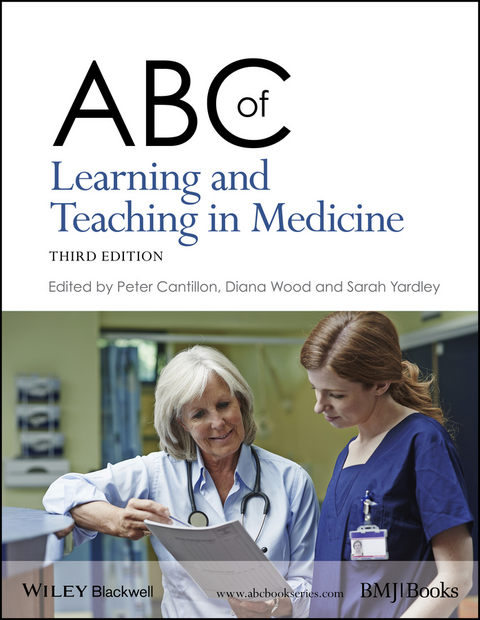
ABC of Learning and Teaching in Medicine (eBook)
John Wiley & Sons (Verlag)
978-1-118-89215-2 (ISBN)
ABC of Learning and Teaching in Medicine is an invaluable resource for both novice and experienced medical teachers. It emphasises the teacher's role as a facilitator of learning rather than a transmitter of knowledge, and is designed to be practical and accessible not only to those new to the profession, but also to those who wish to keep abreast of developments in medical education.
Fully updated and revised, this new edition continues to provide an accessible account of the most important domains of medical education including educational design, assessment, feedback and evaluation. The succinct chapters contained in this ABC are designed to help new teachers learn to teach and for experienced teachers to become even better than they are. Four new chapters have been added covering topics such as social media; quality assurance of assessments; mindfulness and learner supervision.
Written by an expert editorial team with an international selection of authoritative contributors, this edition of ABC of Learning and Teaching in Medicine is an excellent introductory text for doctors and other health professionals starting out in their careers, as well as being an important reference for experienced educators.
Peter Cantillon, Professor of Primary Care, Discipline of General Practice, School of Medicine, National University of Ireland, Galway, Ireland
Diana Wood, Director of Medical Education and Clinical Dean, School of Clinical Medicine, University of Cambridge, Cambridge, UK
Sarah Yardley, Consultant in Palliative Medicine, Central & North West London NHS Foundation Trust and Honorary Lecturer, Marie Curie Palliative Care Research Department, University College London, London, UK
ABC of Learning and Teaching in Medicine is an invaluable resource for both novice and experienced medical teachers. It emphasises the teacher s role as a facilitator of learning rather than a transmitter of knowledge, and is designed to be practical and accessible not only to those new to the profession, but also to those who wish to keep abreast of developments in medical education. Fully updated and revised, this new edition continues to provide an accessible account of the most important domains of medical education including educational design, assessment, feedback and evaluation. The succinct chapters contained in this ABC are designed to help new teachers learn to teach and for experienced teachers to become even better than they are. Four new chapters have been added covering topics such as social media; quality assurance of assessments; mindfulness and learner supervision. Written by an expert editorial team with an international selection of authoritative contributors, this edition of ABC of Learning and Teaching in Medicine is an excellent introductory text for doctors and other health professionals starting out in their careers, as well as being an important reference for experienced educators.
Peter Cantillon, Professor of Primary Care, Discipline of General Practice, School of Medicine, National University of Ireland, Galway, Ireland Diana Wood, Director of Medical Education and Clinical Dean, School of Clinical Medicine, University of Cambridge, Cambridge, UK Sarah Yardley, Consultant in Palliative Medicine, Central & North West London NHS Foundation Trust and Honorary Lecturer, Marie Curie Palliative Care Research Department, University College London, London, UK
Title Page 3
Copyright Page 6
Contents 7
List of Contributors 9
Preface 11
Acknowledgements 13
Chapter 1 Becoming a Better Teacher 15
Becoming a better teacher 15
What every medical educator needs to know 15
Understanding yourself 16
How to develop self?knowledge as a teacher 16
Peer evaluation 17
Knowing your teaching orientation 17
Learning from experience: becoming a reflective teacher 17
Understanding learning and learning environments 18
Understanding learners 19
Conclusion 19
References 19
Further reading 19
Chapter 2 Educational Theory: An Overview 21
Introduction 21
What is a theory? 21
What types of theory exist? 22
Grand theories 22
Personal theories 22
Mid-range theories 22
Why do I need theories? 22
Conclusion 24
Further reading 24
Chapter 3 Inquiry-based Learning 25
Making IBL work: using small groups 25
Methods of inquiry-based learning 27
Team-based learning 27
Problem-based learning 27
Case-based learning 27
Project-based learning 27
Information technology and IBL 28
Conclusion 28
Further reading 28
Chapter 4 Course Design 29
What is a course? 29
No course is an island: courses in context 29
Three key issues to consider when designing a course 30
Product – what is the purpose of this course? 30
What should be the content of this course? 30
How should the learning activities be structured and delivered? 30
Approaches to course design 31
Assessment, course evaluation and course review 31
The dynamic curriculum 31
Further reading 32
Chapter 5 Creating Educational Materials 33
Introduction 33
Aims – Be specific about your learning objectives 33
Appropriateness – Ensure that your teaching materials are appropriate and varied 34
Analysis – Break complex tasks into manageable steps 34
Application – Encourage the application of new skills and knowledge 34
Approach – Encourage a deep approach to learning 34
Atmosphere – Ensure a supportive, motivating educational environment 35
Summary 35
References 35
Chapter 6 Creating a Safe and Effective Learning Environment 37
Introduction 37
Maslow’s hierarchy of needs 37
Learning environments in healthcare settings 39
Learning in clinical environments 39
Learning away from the clinical environment 40
Virtual learning environments (VLEs) 41
Conclusion 41
Summary 41
References 42
Further reading 42
Chapter 7 Feedback in Medical Education: Skills for Improving Learner Performance 43
Introduction 43
Challenges in feedback: the gap between giving and receiving 43
Why does this happen? 43
Rationale: Why make the effort to engage the learner and provide constructive feedback? 44
What to do about it? 44
A shared definition of feedback can help 44
Tips to improve feedback effectiveness: bridging the gaps between giving, receiving and using feedback 45
Context and culture within which feedback is provided 45
The feedback provider 45
The feedback receiver and learner engagement 46
Summary 46
References 46
Further reading 46
Chapter 8 Small-Group Learning 47
Introduction 47
Principles for small-group learning 47
Domains of learning 48
Areas of focus for facilitating small groups 48
Learning outcomes 48
Facilitator skills 48
Group composition 49
Group culture 49
Feedback, assessment and evaluation 49
Small-group learning in classroom based activities 49
Small-group learning in skills workshops 50
Small-group learning in clinical settings 51
Conclusion 51
Further reading 51
Chapter 9 Lectures, Lecturing and Learning 53
How students learn in lectures 53
Preparing to lecture 54
Performing a lecture 54
Context 54
Media 54
Storytelling 55
Active learning 55
Evaluation 56
What have the students learned? 56
What worked, what didn’t? 56
Conclusion 56
Reference 56
Further reading 56
Chapter 10 Simulation in Healthcare Education 57
Introduction 57
What is simulation? 57
Why use simulation? 57
What is simulation used for? 58
What are the advantages of simulation? 59
How do you use simulation effectively? 59
How do you run a simulation learning event? 60
The brief 60
Immersion 60
Conclusion 61
References 61
Further reading 61
Chapter 11 Workplace Learning: Promoting Strengths, Addressing Weaknesses 63
Workplaces: context, trigger and variability 63
Workplace learning in perspective 64
Practice-based learning 64
Understanding development at the workplace – three intertwined levels 65
Situations lead to experiences 65
Strings of experiences lead to trajectories 65
Recurrent activities result in social and cultural reifications 65
Supporting development at the workplace – a continuous challenge 65
Efficiency 66
Safety 66
Transparency 66
Conclusion 66
References 66
Further reading 66
Chapter 12 Learner Supervision 67
Introduction 67
Why do learners need supervision? 67
The tasks of supervision 67
Support and challenge helping learners grow 68
Who are the learners and who are the supervisors? 68
What is involved in the supervision of learners? 69
Patient-centred supervision 69
Learner-focused supervision 69
Process-directed supervision 70
Entrustable professional activities 70
Problem avoidance and problem management 71
Boundary recognition 71
Conflicted responsibilities 71
Conclusions 71
Final thought 71
References 71
Further reading 71
Chapter 13 Formative Assessment 73
What is formative assessment? 74
Feedback in formative assessment 74
The student perspective 74
The teacher perspective 75
Formative assessment in curriculum design 75
Formative assessment for institutional transformation 75
Formative assessment in medical education 76
Summary 76
References 76
Further reading 77
Chapter 14 Written Assessment 79
Different question formats 80
Avoid unnecessary complexity 80
True/false questions 80
‘Single, best option’ multiple choice questions 80
Multiple true/false questions 81
‘Short answer’ open-ended questions 81
Essays 81
‘Key feature’ questions 82
Extended matching questions 82
Script concordance test 82
Conclusion 83
Further reading 83
Chapter 15 Skill-based Assessment 85
Background 85
Applying basic assessment principles to SBA 85
Summative versus formative assessment 85
Blueprinting 85
Context specificity 86
Reliability 87
Validity 87
Standard-setting 87
Agreeing the content 88
Designing the circuit 88
Station content 89
Marking schemes 89
Evaluation 89
Advantages and disadvantages of SBAs 90
Further reading 90
Chapter 16 Work-based Assessment 91
Methods for work-based assessment 91
Basis for judgement 91
Outcomes 91
Process of care 92
Volume 92
Method of data collection 93
Clinical practice records and registries 93
Administrative databases 93
Diaries 93
Observation 93
Portfolios 93
Summary 94
Further reading 94
Chapter 17 Quality Assurance of Assessments 95
What is QA and why is it necessary? 95
Designing a process of QA 95
The three levels of QA 95
The three stages of QA 95
QA activities 96
QA standards 96
Reporting and acting on the results of QA 96
Pulling all of the decisions together and undertaking QA 96
Summary 98
Acknowledgment 98
Further reading 98
Chapter 18 Students in Difficulty 99
Introduction 99
How do students in difficulty present? 99
Why do students struggle? 100
Educational assessment interview – making an ‘educational diagnosis’ 100
Interventions 102
Outcomes 103
Prevention and early intervention 103
Issues 104
References 104
Further reading 104
Chapter 19 Teaching and Learning Professionalism 105
Introduction 105
What is professionalism? 105
Professionalism curricula: what should be included? 106
Learning professionalism in clinical practice 106
Reflective practice 106
Reflective small-group learning 106
Reflective writing 108
Workshops 108
Encourage connection with emotions and patient perspectives 108
Challenges for professionalism curricula 108
Encourage wider faculty buy-in 108
Encourage students to raise concerns and give them support and feedback when they do 108
Recognise the power of role?modelling and the hidden curriculum 109
Assessing professionalism 109
Conclusion 110
References 110
Further reading 110
Chapter 20 Social Media and Learning 111
The practice 111
Digital professionalism 112
SoMe and the open learning culture 113
How SoMe can support personal learning 114
The tools 115
Thinking about your learners 115
Conclusion 115
Reference 118
Further reading 118
Chapter 21 The Mindful Clinician-Teacher 119
What is mindfulness? 119
Where might mindfulness be helpful in clinical practice? 120
Attention and awareness 120
Mindful responding versus mindless reacting 120
Responding to suffering 121
Cultivating clinician resilience 121
What learning to be mindful means: progressing from not knowing??? knowing???realising???actualising 122
Further reading 122
Chapter 22 Evaluation 123
Evaluation 123
Planning an evaluation 123
What are the goals of the evaluation? 124
Who are the stakeholders in the evaluation? 124
What should be evaluated and what information should be collected? 124
What methods will be used to collect the information? 124
Interviews 125
Surveys 125
Information from student assessment 125
From whom will the information be collected? 125
Competence 125
Ownership 125
Sampling 125
Anonymity or not 125
Who will collect and analyse the information? 125
How will information be fed back to the stakeholders? 125
What decisions can be made as a result of the evaluation? 126
When will the evaluation be repeated? 126
Completing the evaluation cycle 126
References 126
Further reading 127
Index 129
EULA 132
| Erscheint lt. Verlag | 10.7.2017 |
|---|---|
| Reihe/Serie | ABC Series | ABC Series |
| Sprache | englisch |
| Themenwelt | Medizin / Pharmazie ► Allgemeines / Lexika |
| Medizin / Pharmazie ► Medizinische Fachgebiete ► Innere Medizin | |
| Medizin / Pharmazie ► Medizinische Fachgebiete ► Medizinethik | |
| Medizin / Pharmazie ► Studium | |
| Schlagworte | Allgemeine u. Innere Medizin • General & Internal Medicine • medical education • medical educational design • medical education assessment • medical education feedback and evaluation methods • medical education teaching guide • medical educator reference • Medical Professional Development • medical professional reference guide • Medical Science • Medizin • Medizinstudium • Perspektiven in medizinischen Berufen • resource for experienced medical teachers • resource novice medical teachers • study aids for doctors in training • teaching medicine guide • teaching medicine resource |
| ISBN-10 | 1-118-89215-1 / 1118892151 |
| ISBN-13 | 978-1-118-89215-2 / 9781118892152 |
| Informationen gemäß Produktsicherheitsverordnung (GPSR) | |
| Haben Sie eine Frage zum Produkt? |
 PDF (Adobe DRM)
Kopierschutz: Adobe-DRM
Adobe-DRM ist ein Kopierschutz, der das eBook vor Mißbrauch schützen soll. Dabei wird das eBook bereits beim Download auf Ihre persönliche Adobe-ID autorisiert. Lesen können Sie das eBook dann nur auf den Geräten, welche ebenfalls auf Ihre Adobe-ID registriert sind.
Details zum Adobe-DRM
Dateiformat: PDF (Portable Document Format)
Mit einem festen Seitenlayout eignet sich die PDF besonders für Fachbücher mit Spalten, Tabellen und Abbildungen. Eine PDF kann auf fast allen Geräten angezeigt werden, ist aber für kleine Displays (Smartphone, eReader) nur eingeschränkt geeignet.
Systemvoraussetzungen:
PC/Mac: Mit einem PC oder Mac können Sie dieses eBook lesen. Sie benötigen eine
eReader: Dieses eBook kann mit (fast) allen eBook-Readern gelesen werden. Mit dem amazon-Kindle ist es aber nicht kompatibel.
Smartphone/Tablet: Egal ob Apple oder Android, dieses eBook können Sie lesen. Sie benötigen eine
Geräteliste und zusätzliche Hinweise
Buying eBooks from abroad
For tax law reasons we can sell eBooks just within Germany and Switzerland. Regrettably we cannot fulfill eBook-orders from other countries.
aus dem Bereich