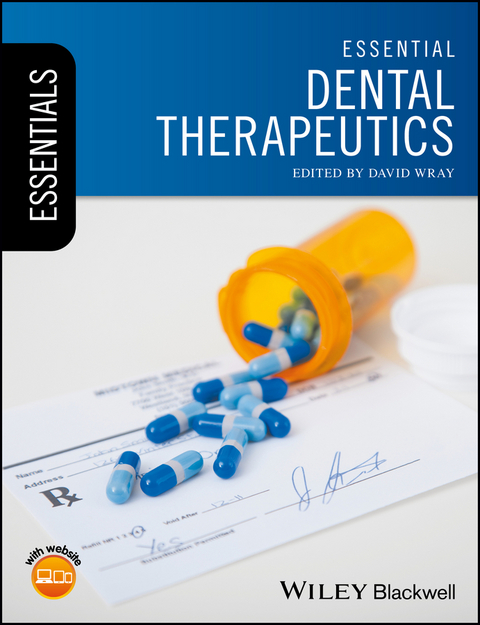
Essential Dental Therapeutics (eBook)
John Wiley & Sons (Verlag)
978-1-119-05742-0 (ISBN)
Essential Dental Therapeutics is a practical guide to drugs and their effects on dental care. Covering both medical and dental prescribing, all major categories of prescription drugs, their possible side effects, and potential drug interactions are discussed. The medical section is succinct and easily understandable, providing busy dentists with the information they need about medical conditions and the drugs used to treat them. The dental section offers practical, straightforward information that is relevant to everyday dental prescribing.
All clinical contributing authors are medically and dentally trained, and both strands are fully integrated throughout the text. Readers can test their knowledge by using the key topics and learning objectives at the start of each chapter, and by accessing the companion website featuring self-assessment questions. Essential Dental Therapeutics is a practical reference for dental students and practitioners, ensuring they are safe and informed in everyday practice.
About the Editor
David Wray is Emeritus Professor at the University of Glasgow, and previously Dean of the Glasgow Dental School, UK and the Hamdan bin Mohammed College of Dental Medicine in Dubai, United Arab Emirates. He is a former chair of the Dental Advisory Group of the British National Formulary, and his research interests include oral ulceration, candidal infections, mucosal immunology and facial pain.
Essential Dental Therapeutics is a practical guide to drugs and their effects on dental care. Covering both medical and dental prescribing, all major categories of prescription drugs, their possible side effects, and potential drug interactions are discussed. The medical section is succinct and easily understandable, providing busy dentists with the information they need about medical conditions and the drugs used to treat them. The dental section offers practical, straightforward information that is relevant to everyday dental prescribing. All clinical contributing authors are medically and dentally trained, and both strands are fully integrated throughout the text. Readers can test their knowledge by using the key topics and learning objectives at the start of each chapter, and by accessing the companion website featuring self-assessment questions. Essential Dental Therapeutics is a practical reference for dental students and practitioners, ensuring they are safe and informed in everyday practice.
About the Editor David Wray is Emeritus Professor at the University of Glasgow, and previously Dean of the Glasgow Dental School, UK and the Hamdan bin Mohammed College of Dental Medicine in Dubai, United Arab Emirates. He is a former chair of the Dental Advisory Group of the British National Formulary, and his research interests include oral ulceration, candidal infections, mucosal immunology and facial pain.
List of contributors vii
Preface ix
About the companion website xi
1 Introduction to pharmacology and therapeutics - pharmacodynamics 1
Alan Nimmo
2 Introduction to pharmacology and therapeutics - pharmacokinetics 7
Alan Nimmo
3 Introduction to pharmacology and therapeutics - drug safety 15
Alan Nimmo
4 Antimicrobials - antiseptics and disinfectants 23
Martina Shepard
5 Antimicrobials - antibiotics 31
Esther Hullah
6 Antimicrobials - antifungals 41
John Steele and Jenny Taylor
7 Antimicrobials - antivirals 47
John Steele and Jenny Taylor
8 Therapeutics of pain management 53
Roddy McMillan
9 Corticosteroids 65
Jenny Taylor and John Steele
10 Fluoride and toothpaste 69
Sabine Jurge
11 Treatments for dry mouth 73
Roddy McMillan
12 Therapeutics for medical emergencies in dental practice 77
Roddy McMillan
13 Central nervous system 1 - mood disorders 85
Alan Nimmo
14 Central nervous system 2 - neurodegenerative and acquired disorders 93
Alan Nimmo
15 Central nervous system 3 - genetic and developmental disorders 101
Alan Nimmo
16 Endocrine disorders 1 109
Alan Nimmo
17 Endocrine disorders 2 - diabetes mellitus 117
Alan Nimmo
18 Cardiovascular therapeutics 125
Roddy McMillan
19 The respiratory system 137
Martyn Ormond
20 Coagulation 145
Martina Shepard
21 Gastrointestinal pharmacology 153
Esther Hullah
22 Antineoplastic therapeutics 159
Jenny Taylor and John Steele
23 Vitamins and minerals 167
Sabine Jurge
24 Musculoskeletal therapeutics 175
Martyn Ormond
Index 181
Chapter 1
Introduction to pharmacology and therapeutics – pharmacodynamics
Alan Nimmo
Key Topics
- • Introduction to therapeutics – pharmacodynamics and the basis for drug action
- • Molecular targets for drug action – receptors, enzymes, ion channels and carrier proteins
- • Selective toxicity – the basis of antibacterial, antiviral and antifungal drug action, and cancer chemotherapy
Learning Objectives
- • Be familiar with the main types of functional protein that serve as the molecular targets for drug action
- • Be aware that in most cases, altering the activity of these proteins alters chemical signaling in the body, and hence control of body function
- • Be familiar with how drugs, such as antibiotics, are able to exert a selectively toxic effect
- • Be aware of the challenges posed in developing antiviral drugs and drugs for the treatment of cancer
Introduction
Therapeutics has its roots in the historical use of herbal remedies and natural potions. However, the modern practice of therapeutics really began in the twentieth century. The herald for this new era was the German physician, Paul Ehrlich. Ehrlich sowed the seeds for transforming therapeutics into a science by insisting that drug action could be explained in terms of chemical and physical reactions. The understanding of how drugs produce their effects represents the area of therapeutics known as pharmacodynamics.
During the twentieth century, the advent of many effective therapeutic agents began to deliver immeasurable benefits to society. Perhaps the biggest single advance in medicine was the development of antibiotic therapies, exemplified by the work of Florey, Chain and Fleming on penicillin. The introduction of these novel treatments transformed what had previously been fatal or life-devastating diseases into manageable conditions.
However, we cannot be complacent. There are still many areas of practice where our current therapies have limited efficacy, or are associated with unwanted, or side, effects. For example, many cancer therapies come with significant side effects. In dental practice you'll see some of the most severe side effects associated with cancer treatment, such as stomatitis. It will only be through making cancer treatments more specific in the way they target cancerous cells, that we will be able to overcome many of these issues. Another challenge we face is the ability of bacteria to develop resistance to antibiotic therapy. In developed countries, antibiotic-resistant bacteria are now responsible for more deaths than HIV/AIDS. If we do not respond appropriately to these issues, we could return to an era where bacterial infections are no longer treatable. Hence therapeutics is, and needs to be, a constantly evolving science.
In dentistry, therapeutics may not be such a major component of daily practice as compared to general medical practice. However, an understanding of therapeutics is one of the cornerstones of good clinical dental practice. Pain-free dentistry would not be possible without the use of local anaesthetics, while analgesics are used to manage peri- and post-operative pain. In dental practice, the primary approach to managing microbial infection is surgical, however antibiotics do provide an important adjunct therapy, particularly in the case of a spreading infection. Dental practitioners also rely on drugs to manage fungal and viral infections, and inflammation. Other common uses of drugs in the dental clinic are to manage patient anxiety and to provide sedation for patients. However, this is only one side of the coin. Being aware of patients' general medical conditions, and their associated medications, is central to providing safe and effective treatment. Patients' medications may impact directly upon their oral health, for example many common medications cause the problem of xerostomia. In addition, medications may impact upon how a dentist manages a patient within the dental clinic. A significant number of patients may be receiving anticoagulant therapy in order to reduce their risk of a thrombotic event, such as a heart attack. However, a direct consequence of this is these patients will have a tendency to increased bleeding with surgical procedures, and this must be controlled with effective, local measures. Hence, good dental practice relies on a good understanding of therapeutics.
History of therapeutics
The practice of therapeutics is as old as history, and was well documented in ancient Greek and Egyptian civilizations. Throughout history there have been two opposing approaches to therapeutics, a magico-religious approach and an empirico-rational approach. The magico-religious approach is based upon the belief that disease is a supernatural event, and therefore should be managed by such forces, while the empirico-rational approach assumes that disease is a natural process that is best managed by a scientific approach, and evolving treatments in response to careful observation and evaluation of patient outcomes. It is this latter approach that forms the basis of current evidence-based practice.
In itself, the empirico-rational approach is not new. The father of modern medicine was the Ancient Greek physician, Hippocrates (circa 460–370 bce). Hippocrates is accredited with insisting that disease is a natural process, and should be managed in a judicious manner. Some of the most basic principles of clinical practice, such as the importance of hygiene, can be traced back to the Hippocratic Works. Hippocrates even suggested that sometimes, ‘to do nothing was the best remedy’, recognition of the capacity of the human body to fight disease and initiate repair. However, for most of the intervening period between Hippocrates and the twentieth century, the practice of therapeutics was not based upon a scientific rationale. Common practices have included treatments such as bleeding patients, not only through the use of leeches, but also by severing blood vessels. Needless to say, many of these treatments did more harm than good. In fairness, though, a key underlying issue was that the function of the human body, and the basis of disease, was so poorly understood that it impeded a more scientific approach to medicine. It was the Russian physician, Virchow, who indicated that a scientific approach to therapeutics would come through its combination with physiology, and with it an improved understanding of normal body function.
As mentioned earlier, the historical basis of therapeutics lay in the use of natural potions, normally of plant origin. Some of these natural agents were actually very potent and effective. Indeed, there are a number of agents in current, clinical use, which have been used, in crude form, for hundreds, and even thousands of years. Some notable examples include the analgesic, morphine, which comes from the opium poppy, and the muscarinic antagonist, atropine, which comes from the plant, deadly nightshade. Indeed, the first local anaesthetic was cocaine, which comes from the leaves of the cocoa plant. One might assume that the existence of such effective medicinal agents would facilitate a scientific approach to therapeutics but, if anything, they tended to work against it. The issue was that those agents that were effective, produced their effects in such a specific and potent manner, that it was believed their actions could not be explained in terms of physical or chemical reactions. Instead, it was assumed that they must be imbued with some kind of magical, or vital forces. It was Paul Ehrlich, at the beginning of the twentieth century, who insisted that drug action should be understood in terms of normal chemical and physical reactions. In particular, he suggested that drugs are able to produce their specific and selective effects because they bind to specific targets within the body. It is an understanding of these targets, and how drugs interact with them, that underpins modern pharmacology.
Targets for drug actions
Although there are hundreds of different drugs in clinical use, the way in which these drugs are able to produce their effects within the body is limited to a few basic mechanisms. Ehrlich suggested that drugs bind to specific target molecules, and we now recognize that these molecules are primarily key functional proteins, particularly proteins associated with communication within the body. The normal function of the body is under the control of the nervous, endocrine and paracrine systems. These systems use chemical mediators, such as neurotransmitters and hormones, to affect their control. In the same way, many drugs produce their effect by modulating this natural chemical signalling through targeting the functional proteins associated with chemical communication. The other, major way in which drugs act is by being selectively toxic, in other words they are toxic to particular cells or organisms, but are relatively innocuous to healthy human cells.
Receptors
As indicated, the key communication and control systems in the body exert their effects through the release of chemical mediators, such as neurotransmitters and hormones. These mediators are able to produce their effects on their target cells because those cells have receptors, that are not only capable of detecting chemical messages, but are also able to transduce and amplifying that signal to bring about a meaningful response within that cell. In terms of the way in which natural mediators act on...
| Erscheint lt. Verlag | 3.7.2017 |
|---|---|
| Reihe/Serie | Essentials (Dentistry) |
| Essentials (Dentistry) | Essentials (Dentistry) |
| Sprache | englisch |
| Themenwelt | Medizin / Pharmazie ► Allgemeines / Lexika |
| Medizin / Pharmazie ► Gesundheitsfachberufe | |
| Medizin / Pharmazie ► Zahnmedizin | |
| Schlagworte | antifungals in dental practice • antigout drugs in dental practice • anti-inflammatory drugs in dental practice • antimicrobial drugs in dental practice • antirheumatic drugs in dental practice • antivirals in dental practice • concise guide to prescription drugs in dental practice • corticosteroids in dental practice • dental antiseptics • dental applications of pharmacology • dental disinfectants • dental prescribing • dental therapeutics</p> • dentistry • drug interactions for dentists • drug interactions in clinical dentistry • drugs and their effects on dental practice • Einführung i. d. Zahnmedizin • guide to prescription drugs for dentists • Introductions to Dentistry • <p>dental pharmacology • Mundheilkunde / Pharmakologie • non-opioid analgesics in dental practice • nonsteroidal anti-inflammatory drugs in dental practice • Oral Pharmacology • pharmacology and dental therapeutics • pharmacology basics for dentists • prescription drugs for dentistry • Zahnmedizin |
| ISBN-10 | 1-119-05742-6 / 1119057426 |
| ISBN-13 | 978-1-119-05742-0 / 9781119057420 |
| Informationen gemäß Produktsicherheitsverordnung (GPSR) | |
| Haben Sie eine Frage zum Produkt? |
 EPUB (Adobe DRM)
Kopierschutz: Adobe-DRM
Adobe-DRM ist ein Kopierschutz, der das eBook vor Mißbrauch schützen soll. Dabei wird das eBook bereits beim Download auf Ihre persönliche Adobe-ID autorisiert. Lesen können Sie das eBook dann nur auf den Geräten, welche ebenfalls auf Ihre Adobe-ID registriert sind.
Details zum Adobe-DRM
Dateiformat: EPUB (Electronic Publication)
EPUB ist ein offener Standard für eBooks und eignet sich besonders zur Darstellung von Belletristik und Sachbüchern. Der Fließtext wird dynamisch an die Display- und Schriftgröße angepasst. Auch für mobile Lesegeräte ist EPUB daher gut geeignet.
Systemvoraussetzungen:
PC/Mac: Mit einem PC oder Mac können Sie dieses eBook lesen. Sie benötigen eine
eReader: Dieses eBook kann mit (fast) allen eBook-Readern gelesen werden. Mit dem amazon-Kindle ist es aber nicht kompatibel.
Smartphone/Tablet: Egal ob Apple oder Android, dieses eBook können Sie lesen. Sie benötigen eine
Geräteliste und zusätzliche Hinweise
Buying eBooks from abroad
For tax law reasons we can sell eBooks just within Germany and Switzerland. Regrettably we cannot fulfill eBook-orders from other countries.
aus dem Bereich