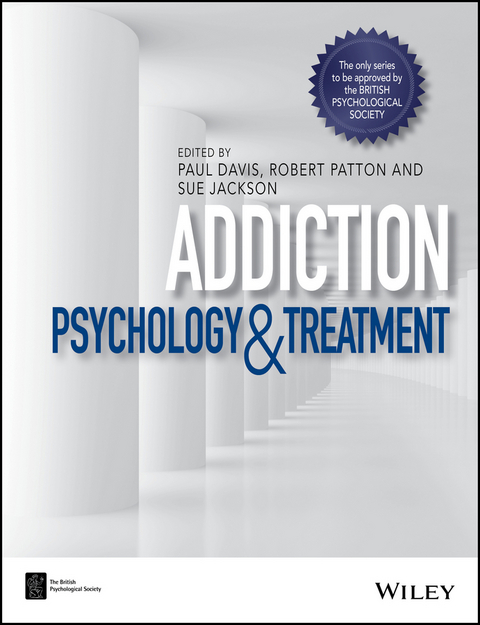
Addiction (eBook)
John Wiley & Sons (Verlag)
978-1-118-48973-4 (ISBN)
- Emphasises the use of several approaches including CBT, psychodynamic and systemic and family treatments, and consideration of the wider picture of addictions
- As well as the theories, gives a clear overview of the application of these models
- Reflects the very latest developments in the role played by psychological perspectives and interventions in the recovery agenda for problem drug and alcohol users
Paul Davis is a Consultant Clinical Psychologist in Addiction, and Teaching Fellow in Clinical Psychology at the University of Surrey, UK. He has contributed at a national level on substance misuse treatment guidelines, policies and service developments and has published widely in the field of psychosocial interventions for substance misuse.
Bob Patton is a lecturer in Psychology at the University of Surrey, UK, Director of Short Term Solutions Ltd and Director of AdApped Ltd. He has previously worked as a consultant for the Home Office Drugs Prevention Initiative and as a Research Fellow in Addiction at Imperial College, King's College London and the Maudsley Hospital Hospital.
Sue Jackson is a chartered psychologist specialising in the psychosocial impact and treatment of chronic health conditions. In addition to managing an extensive research portfolio, she is a teaching fellow on the Clinical Psychology Doctorate Programme at the University of Surrey and is the first psychologist to serve on the Medical Advisory Committee for the Pituitary Foundation.
Paul Davis is a Consultant Clinical Psychologist in Addiction, and Teaching Fellow in Clinical Psychology at the University of Surrey, UK. He has contributed at a national level on substance misuse treatment guidelines, policies and service developments and has published widely in the field of psychosocial interventions for substance misuse. Bob Patton is a lecturer in Psychology at the University of Surrey, UK, Director of Short Term Solutions Ltd and Director of AdApped Ltd. He has previously worked as a consultant for the Home Office Drugs Prevention Initiative and as a Research Fellow in Addiction at Imperial College, King's College London and the Maudsley Hospital Hospital. Sue Jackson is a chartered psychologist specialising in the psychosocial impact and treatment of chronic health conditions. In addition to managing an extensive research portfolio, she is a teaching fellow on the Clinical Psychology Doctorate Programme at the University of Surrey and is the first psychologist to serve on the Medical Advisory Committee for the Pituitary Foundation.
Foreword
Addiction is highly prevalent. The World Health Organization (WHO) estimates that the number of people globally who suffer from an alcohol or drug use disorder annually is in the region of 100 million. Harmful and hazardous alcohol use, like tobacco, is considered by WHO to be a major preventable contributor to the global burden of disease and disability. There is no estimate, to my knowledge, of the worldwide prevalence of gambling disorder, but in Britain alone the adult annual prevalence is in the region of a third to a half million, which is very similar to the prevalence of disorders associated with illicit drug use. So prevalent is addiction that it can reasonably be thought of, along with anxiety and/or depression, as one of the two most common forms of psychological disorder. Yet in most relevant professions and disciplines, including psychology, it remains strangely marginalized. In Chapter 14 in this volume, on AA and 12 Step programmes, Martin Weegmann admits that when he first worked in the area of the addictions he had had virtually no experience of this client group, and minimal training in the area during his clinical psychology course. My experience was even worse. I led two clinical psychology training courses, in Exeter for 17 years in the 1970s and 1980s, and then in Birmingham for five years in the 1990s. Despite my passionate interest in the addictions, the British Psychological Society requirements for a training course, plus the lack of availability of supervised practice, plus I suspect a lot of prejudice about the topic, meant that my success in giving trainees a better grounding in the subject than Martin and I had had was only minimally successful. Perhaps everything has changed. I hope so, but suspect not. That is one of the main reasons why this book is so important.
Judging by the enthusiasm shown by all the authors of the chapters of this book, it seems their experience of finding themselves working in the addiction field – like me, often by accident, I suspect – was of entering a field that is endlessly rewarding and fascinating. Large numbers of people overcome their addictions, often with our help and sometimes even without it, and when they do, their recoveries are frequently impressive, given the depths to which their lives have been harmed. Addiction has more than its share of sadness and despair, but it is also replete with hope and inspiration.
For all that we have learned about addiction and its treatment – including so much that is included in these chapters – there remains a great deal that is mysterious about it, and about recovery from it. The scope for researching and theorizing about addiction, for developing and evaluating forms of treatment, for applying knowledge and methods for understanding and treating such complications of addiction as brain damage or Hepatitis C – both topics accorded chapters here – is endless. In fact, no one book can explore anything like all the intriguing issues that surround addiction. How do gender roles influence the prevalence of the different forms of addiction? What insights does psychology offer about how we might prevent addiction? What has psychology to say about what our relationships should be, if any, with the suppliers of the products to which people can become addicted – the commercial suppliers of alcohol, tobacco and gambling products and the legal and illegal suppliers of other substances? These are among the questions that must wait for a second edition.
This book treads dangerous ground in a number of ways, departing often from dominant thinking in the field. The latter is under the sway of a bio-psychological model of addiction which privileges diagnosis (very little mention of DSM can be found in this book), a rather limited approach to evidence-based treatment, and a greater emphasis on aggregated statistics than on a detailed understanding of the experiences of people who suffer from addiction and those others who are affected by it. Certain vital issues are neglected because of that dominant model of addiction, but they get proper attention here. One, which is repeatedly mentioned, is the importance for addiction of emotions and emotional regulation. This receives some attention in the dominant paradigm – the idea of self-medication, for example – but is rarely explored in any detail. Cognition tends to rule and emotion sits in second place. Emotions and emotional regulation have the great strength of being something that unites sub-topic areas such as attachment, psychodynamic and systemic approaches, and relapse prevention and mindfulness, albeit dealt with differently under those various headings.
There are chapters in this book which reach other parts of the mystery and despair of addiction which the dominant paradigm does not reach. One feature of addiction, rarely addressed elsewhere, is its effect on a person's ability to relate to others, variously described in different chapters as the replacement of affectional bonds by ‘addictional bonds', empathic blunting, and the way addiction can interfere with sensitivities and capacities (see Nussbaum, 2000, a favourite book of mine, for an explication of the capabilities approach). Family members affected by their relatives' addictions, who are equally as numerous as those who experience addiction at first hand, and probably more so, often talk of how their relatives have ceased to be the people they knew and loved and how addiction seems to have robbed their relatives of the capacity to care for the family. For family members, addiction is truly a mystery –
how can this person they knew be investing so much in something that seems so pointless and so damaging, and relatively less in what really matters? It is good, therefore, to see families highlighted early on in the book, and in more than one token chapter, as is often the case.
Another central feature, infrequently given the attention it deserves but properly addressed here, is the ambivalence and fragmentation that come with addiction (Adams, 2008). This can be seen as a surface phenomenon, as in the instability of motivation to change (an idea that West derives from PRIME theory), or the ambivalence which is central to motivational interviewing theory, or the conflict which is central to my Excessive Appetites model (Orford, 2001). But it can also be seen, as it is in a number of chapters, as a deeper fragmentation of the self. Rarely dealt with in psychology, one otherwise needs to go to the philosopher Levy (2011) for an appreciation of fragmentation of self as being close to the essence of addiction. His key idea was that an addicted person's preferences are inconsistent: the ability to make judgements about action is not impaired, but judgements shift from time to time. What characterizes addiction, therefore, is the fragmentation of agency, an inability to consistently exert will across time, and the loss of full capacity to effectively make plans and put in place long-term projects. I see this as a form of disempowerment, and I found it extremely helpful in developing my attempt to use the concept of power to integrate otherwise disparate areas of addiction studies (Orford, 2013).
Yet another topic which it is good to see given attention is the importance for change and recovery of the relationship with helpers or therapists. As I put it in my article, ‘Asking the right questions in the right way' (Orford, 2008):
The prevailing model of psychological treatment for addiction can be described, aptly, as a technology model. It is likened to a technique which, supported by a manual and good training and supervision, can be delivered to a high standard so that ‘therapist differences' cease to be important. The therapist is the medium through which a standard technique is applied at a high level of fidelity. Some have referred to this as the ‘drug metaphor', implying that treatment is seen, like a medication, as a piece of technology that requires only therapist skill and efficiency and patient compliance in order to be delivered effectively.
Like the authors of some of the chapters in this book I have always been suspicious of that model, and our experiences in the UK Alcohol Treatment Trial (UKATT) confirmed my suspicions. When clients were asked at follow-up to what factors they attributed any positive changes they had made, the most popular attributions were characteristics of the therapist and of the client's relationship with the therapist, more so than social-type attributions for Social Behaviour and Network Therapy clients or motivational-type attributions for Motivational Enhancement Therapy clients (Orford et al., 2009).
I could go on listing the aspects of addiction which the conventional wisdom downplays or dismisses but which are not avoided in this highly thoughtful volume. The importance of narratives and story-telling, of personal and social identity, of one's life values, of the very meaning of life are among them. The experience of trauma and the high frequency of addiction problems combined with other mental health problems are recurring themes in the book.
However, clinical psychology faces a number of problems – although they are by no means confined to clinical psychology. One is the question of evidence. Like all professions, it is required to demonstrate that its treatments ‘work'. That can be problematic, not just because showing that something works can be costly, time-consuming and fraught with methodological and interpretive difficulties – research evidence is often so...
| Erscheint lt. Verlag | 18.5.2017 |
|---|---|
| Reihe/Serie | BPS Textbooks in Psychology |
| BPS Textbooks in Psychology | BPS Textbooks in Psychology |
| Sprache | englisch |
| Themenwelt | Geisteswissenschaften ► Psychologie ► Klinische Psychologie |
| Medizin / Pharmazie ► Gesundheitsfachberufe | |
| Medizin / Pharmazie ► Medizinische Fachgebiete ► Suchtkrankheiten | |
| Schlagworte | Abhängigkeit (Medizin) • Addiction, psychosocial interventions, substance misuse, psychology, psychologists, psychology of addiction, attachment theory, cognitive and behavioural approaches, psychodynamic aspects of addictions, biological aspects of addictions, clinical addiction, psychology of addiction, psychological interventions, evidence based practice, CBT, psychodynamic, systemic, family treatments, IAPT, alcohol addiction, drug addiction • Clinical psychology • Klinische Psychologie • Psychologie • Psychology |
| ISBN-10 | 1-118-48973-X / 111848973X |
| ISBN-13 | 978-1-118-48973-4 / 9781118489734 |
| Informationen gemäß Produktsicherheitsverordnung (GPSR) | |
| Haben Sie eine Frage zum Produkt? |
 EPUB (Adobe DRM)
Kopierschutz: Adobe-DRM
Adobe-DRM ist ein Kopierschutz, der das eBook vor Mißbrauch schützen soll. Dabei wird das eBook bereits beim Download auf Ihre persönliche Adobe-ID autorisiert. Lesen können Sie das eBook dann nur auf den Geräten, welche ebenfalls auf Ihre Adobe-ID registriert sind.
Details zum Adobe-DRM
Dateiformat: EPUB (Electronic Publication)
EPUB ist ein offener Standard für eBooks und eignet sich besonders zur Darstellung von Belletristik und Sachbüchern. Der Fließtext wird dynamisch an die Display- und Schriftgröße angepasst. Auch für mobile Lesegeräte ist EPUB daher gut geeignet.
Systemvoraussetzungen:
PC/Mac: Mit einem PC oder Mac können Sie dieses eBook lesen. Sie benötigen eine
eReader: Dieses eBook kann mit (fast) allen eBook-Readern gelesen werden. Mit dem amazon-Kindle ist es aber nicht kompatibel.
Smartphone/Tablet: Egal ob Apple oder Android, dieses eBook können Sie lesen. Sie benötigen eine
Geräteliste und zusätzliche Hinweise
Buying eBooks from abroad
For tax law reasons we can sell eBooks just within Germany and Switzerland. Regrettably we cannot fulfill eBook-orders from other countries.
aus dem Bereich