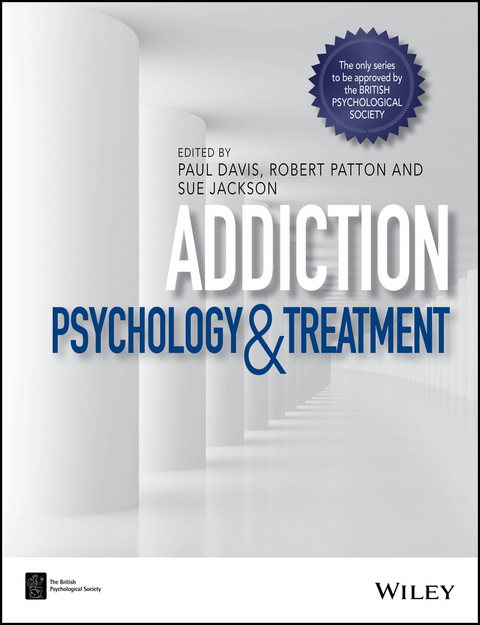
Addiction (eBook)
John Wiley & Sons (Verlag)
978-1-118-48976-5 (ISBN)
- Emphasises the use of several approaches including CBT, psychodynamic and systemic and family treatments, and consideration of the wider picture of addictions
- As well as the theories, gives a clear overview of the application of these models
- Reflects the very latest developments in the role played by psychological perspectives and interventions in the recovery agenda for problem drug and alcohol users
Paul Davis is a Consultant Clinical Psychologist in Addiction, and Teaching Fellow in Clinical Psychology at the University of Surrey, UK. He has contributed at a national level on substance misuse treatment guidelines, policies and service developments and has published widely in the field of psychosocial interventions for substance misuse.
Bob Patton is a lecturer in Psychology at the University of Surrey, UK, Director of Short Term Solutions Ltd and Director of AdApped Ltd. He has previously worked as a consultant for the Home Office Drugs Prevention Initiative and as a Research Fellow in Addiction at Imperial College, King's College London and the Maudsley Hospital Hospital.
Sue Jackson is a chartered psychologist specialising in the psychosocial impact and treatment of chronic health conditions. In addition to managing an extensive research portfolio, she is a teaching fellow on the Clinical Psychology Doctorate Programme at the University of Surrey and is the first psychologist to serve on the Medical Advisory Committee for the Pituitary Foundation.
Addiction: Psychology and Treatment brings together leading psychologists to provide a comprehensive overview of the psychology of addictions and their treatment across specialities and types of services. Emphasises the use of several approaches including CBT, psychodynamic and systemic and family treatments, and consideration of the wider picture of addictions As well as the theories, gives a clear overview of the application of these models Reflects the very latest developments in the role played by psychological perspectives and interventions in the recovery agenda for problem drug and alcohol users
Paul Davis is a Consultant Clinical Psychologist in Addiction, and Teaching Fellow in Clinical Psychology at the University of Surrey, UK. He has contributed at a national level on substance misuse treatment guidelines, policies and service developments and has published widely in the field of psychosocial interventions for substance misuse. Bob Patton is a lecturer in Psychology at the University of Surrey, UK, Director of Short Term Solutions Ltd and Director of AdApped Ltd. He has previously worked as a consultant for the Home Office Drugs Prevention Initiative and as a Research Fellow in Addiction at Imperial College, King's College London and the Maudsley Hospital Hospital. Sue Jackson is a chartered psychologist specialising in the psychosocial impact and treatment of chronic health conditions. In addition to managing an extensive research portfolio, she is a teaching fellow on the Clinical Psychology Doctorate Programme at the University of Surrey and is the first psychologist to serve on the Medical Advisory Committee for the Pituitary Foundation.
Addiction 3
Table of Contents 7
List of Contributors 13
Foreword 15
Preface 19
Notes on Contributors 21
PART 1 Understanding the Psychology and Treatment of Addictions 27
CHAPTER 1 Addiction: A Comprehensive Approach 29
1.1 Introduction 30
1.2 Existing theories 31
1.2.1 Choice Theories 31
1.2.2 Compulsion and Self-Control Theories 32
1.2.3 Theories Focusing on the Neural Basis of Reward and Punishment 32
1.2.4 Integrated Theories 33
1.2.5 The Need for a Synthetic Theory 34
1.3 The human motivational system 34
1.3.1 Structure of the Motivational System 35
1.4 Internal and external sources of influence 37
1.4.1 Drives, Emotional States and Arousal 37
1.4.2 Self-Control and Identity 38
1.5 The dynamics of the system 38
1.5.1 The Moment-to-Moment Control of Behaviour 38
1.5.2 The Unstable Mind and Chreods 39
1.6 Changing dispositions 40
1.7 Testing the theory 41
Suggestions for further reading 42
References 42
CHAPTER 2 An Attachment-Informed Approach to Working with Addiction 46
2.1 Introduction to attachment 47
2.2 Attachment and psychopathology 49
2.2.1 Parenting 50
2.2.2 Trauma 51
2.3 Attachment and addiction 51
2.3.1 Emotion Regulation 52
2.3.2 Alexithymia 53
2.3.3 Interpersonal Difficulties 53
2.3.4 Co-Morbid Mental Health Problems 54
2.4 Attachment styles in clinical samples 54
2.5 Assessment and formulation through an attachment lens 55
2.5.1 The Clinical Interview 56
2.5.2 Psychometric Approaches 57
2.5.3 Transference and Counter-Transference 57
2.6 Treatment implications 58
2.6.1 Therapeutic Alliance 58
2.6.2 Enhancing Skills 59
2.6.3 Addressing Issues of Loss 61
2.7 Conclusion 61
Suggestions for further reading 61
References 62
CHAPTER 3 Families, Friends and Addiction: Impacts, Psychological Models and Interventions 68
3.1 Introduction 69
3.2 The composition of alcohol and drug users’ social networks 69
3.3 Impacts of addictions on others 70
3.4 Theoretical models of addiction and the family: stress-strain-coping-support 73
3.5 From models to interventions 74
3.5.1 Supporting Family Members in Their Own Right: The 5-Step Method 75
3.5.2 Involving Families and Wider Social Networks in Treatment to Support Alcohol- and Drug-Users 77
3.6 Conclusion 78
Suggestions for further reading 79
References 80
CHAPTER 4 Working Systemically with Alcohol Misuse 83
4.1 Introduction 84
4.2 Family life 85
4.3 Family systems approaches 86
4.3.1 Patterns in Communication 87
4.3.2 Patterns in Relationships 87
4.3.3 Patterns over Time and Life Cycle Issues 88
4.4 Working therapeutically with violence and abuse 90
4.5 Engagement and the therapeutic relationship 91
4.6 Conclusion 92
Suggestions for further reading 92
References 93
CHAPTER 5 ‘Dangerous Desires and Inanimate Attachments’: Modern Psychodynamic Approaches to Substance Misuse 94
5.1 Introduction 95
5.2 Primitive emotional states: Kleinian views 96
5.3 Comforting self-objects: Kohutian views 98
5.4 Inanimate attachments: Bowlbian views 100
5.5 Bringing it together: addiction as a disorder of self-regulation 102
5.6 Reflective practice 104
5.7 Internal recovery 105
5.8 Conclusion 107
Suggestions for further reading 108
References 108
CHAPTER 6 Mindfulness, Acceptance and Values in Substance Misuse Services 110
6.1 Introduction: what are the principles and methods of mindfulness, acceptance and values? 111
6.1.1 Mindfulness 111
6.1.2 Acceptance 112
6.1.3 Values 113
6.2 How does ACT integrate with other approaches? 113
6.3 How does the service use these principles and methods of ACT? 116
6.4 How do mindfulness, acceptance and values support the resilience of staff in the face of seemingly relentless relapse and other behaviours? 118
6.4.1 Mindfulness, Acceptance, Values and the Therapeutic Alliance 118
6.4.2 Increasing Openness and Flexibility 119
6.4.3 Building and Maintaining Personal Strengths and Resources 119
6.5 What are the experiences of staff working with ACT? 120
6.5.1 Mindfulness, Acceptance and Values 120
6.5.2 Impact on Client Work 121
6.5.3 Team Impact 121
6.5.4 Concerns 122
6.6 What are the experiences of clients working this way? 122
6.7 Our experience of ACT 123
Suggestions for further reading 124
References 124
PART 2 Clinical Applications of Addiction Psychology 129
CHAPTER 7 The Role of Clinical Psychology within Alcohol Related Brain Damage 131
7.1 Introduction 132
7.2 Clinical definition of alcohol-related brain damage and related syndromes 132
7.3 Epidemiology of ARBD and related syndromes 133
7.4 Cognitive function in ARBD 134
7.4.1 Cognitive Deficits in ARBD 134
7.4.2 Neuropsychological Assessment in ARBD 135
7.4.3 Recovery of Cognitive Function in ARBD 136
7.5 Psychosocial and cognitive rehabilitation 137
7.5.1 Impact of Cognitive Deficits in ARBD and Rationale for Treatment 137
7.5.2 Adaptations to Alcohol Treatment Programmes 139
7.5.3 Cognitive Rehabilitation from Both ARBD and Brain Injury Settings 140
7.5.4 Holistic Rehabilitation for ARBD 142
7.5.5 Conclusion 142
7.6 Legal framework: mental capacity 143
7.6.1 Assessment of Capacity 144
7.7 Recovery 144
Suggestions for further reading 145
References 145
CHAPTER 8 Trauma and Addiction 150
8.1 Psychological trauma and PTSD 151
8.2 The relationship between addiction and psychological trauma 153
8.3 Assessment 155
8.3.1 The Clinical Interview 156
8.3.2 Self-Report Measures 156
8.4 Treatment of co-existing trauma and substance use disorders 157
8.4.1 Sequential Versus Parallel Treatment 159
8.4.2 Trauma-Focused Versus Non-Trauma-Focused Interventions 159
8.5 Clinical implications 161
8.5.1 Attending to the Therapeutic Relationship 161
8.5.2 Identifying Treatment Goals 161
8.5.3 Treatment Retention 162
8.5.4 Exploring Trauma 163
8.5.5 Emotional Reactivity 163
8.5.6 Training 164
8.6 Conclusion 165
Suggestions for further reading 165
References 165
CHAPTER 9 Narrative Identity and Change: Addiction and Recovery 170
9.1 Narrative theory 171
9.2 Narrative therapy 171
9.3 Narrative theory and addiction 172
9.4 Client talk 173
9.5 Generating narrative 175
9.5.1 Letters 176
9.5.2 Chapters 176
9.5.3 Evocative Questions 177
9.5.4 Poems, Books, Stories 177
9.6 Narratives of recovery 178
9.7 Varieties of recovery story 178
9.8 Conclusion 180
Acknowledgements 181
Notes 181
Suggestions for further reading 181
References 182
CHAPTER 10 Addiction and Mental Health 184
10.1 Introduction 185
10.2 Association between substance misuse and psychosis 186
10.3 Prevalence and epidemiology 188
10.4 Outcomes associated with co-occurring disorders 189
10.5 Treatment approach and effectiveness 189
10.6 Evidence for effectiveness 190
10.7 Conclusion 192
Suggestions for further reading 193
References 193
CHAPTER 11 Substance Misuse in Older Adults 198
11.1 Introduction 199
11.2 Definition of older adult 199
11.3 Alcohol 199
11.3.1 Extent and Nature of Alcohol Use and Misuse 199
11.3.2 Onset of Alcohol Misuse 201
11.3.3 Circumstances that Can Lead to Increased Alcohol Use and Misuse 201
11.4 Illicit drug use 202
11.4.1 Extent and Nature of Illicit Drug Use 202
11.4.2 Onset of Illicit Drug Use 203
11.4.3 Circumstances that Can Lead to Late-Onset Drug Use 203
11.5 Medication misuse 204
11.5.1 Extent and Nature of Medication Misuse 204
11.5.2 Onset of Medication Misuse 205
11.5.3 Risk Factors for Medication Misuse in Older Adults 205
11.6 Assessment of older people with substance misuse 205
11.6.1 Principles of Assessment 205
11.6.2 Systematic Assessment 206
11.6.3 Identifying Substance Misuse 206
11.6.4 Screening and Identification 208
11.6.5 Mental State Examination 208
11.6.6 Physical Examination 209
11.6.7 Referral to Other Services 209
11.7 Psychosocial interventions 210
11.7.1 Brief Advice 210
11.7.2 Motivational Interviewing 210
11.7.3 Supporting Families and Carers 211
11.8 Legal and ethical considerations 211
11.8.1 Mental Capacity 211
11.8.2 Elder Abuse 212
11.8.3 Mental Health Act 212
11.9 Using and evaluating health and social outcomes 212
11.10 Conclusion 213
Suggestions for further reading 214
References 214
CHAPTER 12 Issues Arising in Hepatitis C Work: The Role of the Clinical Psychologist 219
12.1 Introduction 220
12.2 Hepatitis C background: the virus and treatment 220
12.3 Social and clinical characteristics of the HCV patient population 221
12.4 HCV treatment challenges 222
12.5 Pegylated Interferon-related adverse psychiatric side-effects 223
12.6 HCV-infected mental health populations 224
12.7 So what is the role of the psychologist? 226
12.7.1 Promoting Treatment Access for People with ‘Severe Psychiatric Condition’ 228
12.7.2 Systematic Identification of Mental Health Problems 229
12.7.3 Intensive Case Management Approach 230
12.7.4 Promoting Resilience 231
12.8 Psychological stepped-care model in HCV treatment 232
12.9 Future challenge 234
12.10 Conclusion 234
Suggestions for further reading 235
References 235
CHAPTER 13 The Psychology and Treatment of Gambling Disorders 239
13.1 Introduction 240
13.2 Definition 240
13.3 Prevalence 241
13.4 Demographic risk factors 242
13.4.1 The Pathways Model of Problem Gambling 242
13.4.2 The ‘Behavioural Conditioned’ Group 242
13.4.3 The ‘Emotionally Vulnerable’ Group 245
13.4.4 The ‘Antisocial Impulsivist’ Group 246
13.4.5 Conclusion 248
13.5 Treatment of gambling disorders 248
13.5.1 Cognitive-Behavioural Interventions 248
13.5.2 Brief Interventions 249
13.5.3 Fellowship and Self-Help 249
13.5.4 Family Therapy and Concerned Significant Others 249
13.5.5 Pharmacological Interventions 249
13.6 Personal comment and reflections 250
13.7 Conclusion 250
Suggestions for further reading 251
References 251
CHAPTER 14 Alcoholics Anonymous and 12 Step Therapy: A Psychologist’s View 256
14.1 Introduction: personal context 257
14.2 History 258
14.3 Philosophy 259
14.4 How does it work? 261
14.4.1 AA: Group Therapy 261
14.4.2 AA: Psychosocial Change 262
14.4.3 AA: Narrative Change 263
14.4.4 AA: Structure of Care and Regulation 265
14.5 What can psychologist and helping professionals do? 265
14.6 Criticisms of AA 266
14.7 Postscript 267
Notes 267
Suggestions for further reading 268
References 268
CHAPTER 15 Relapse Prevention: Underlying Assumptions and Current Thinking 271
15.1 Introduction 272
15.2 What is relapse prevention? 272
15.2.1 Relapse Prevention Is the Sufficient Effect 273
15.2.2 Reoccurrence of the Original Behaviour: A Philosophical Conundrum 273
15.3 Models of relapse prevention 276
15.3.1 The Original Model of Relapse Prevention (Marlatt & Gordon, 1985)
15.3.2 The Dynamic Model of Relapse (Witkiewitz & Marlatt, 2004)
15.3.3 Mindfulness-Based Relapse Prevention (MBRP Marlatt, Bowen, Chawla &
15.4 Addressing co-existing mental health 280
15.5 Neuropsychological and associated difficulties when undertaking RP 281
15.6 Conclusion 283
Suggestions for further reading 284
References 285
CHAPTER 16 Working with Ambivalence about Change: Motivational Interviewing 288
16.1 Introduction 289
16.2 Definition 289
16.3 Historical perspective 290
16.4 Theoretical influences 291
16.5 The spirit of MI 292
16.6 Change talk, sustain talk and discord 292
16.7 The four MI processes 293
16.7.1 Engaging 294
16.7.2 Focusing 294
16.7.3 Evoking 294
16.7.4 Planning 294
16.8 Core MI skills 295
16.8.1 OARS: Open-Ended Questioning 295
16.8.2 OARS: Affirming 295
16.8.3 OARS: Reflections 296
16.8.4 OARS: Summarizing 296
16.8.5 Providing Advice and Information with Permission 297
16.8.6 Exploring Values and Goals 297
16.9 MI strategies more specific to particular processes 297
16.10 Evidence for the efficacy of MI 298
16.11 Integrating MI with other approaches 300
16.12 Using MI in groups 301
16.12.1 Clinical Example of an MI Group 301
16.13 Learning MI 303
16.14 Conclusion 304
Suggestions for further reading 305
References 305
CHAPTER 17 ‘Beyond Workshops’: Turning Evidence for Psychosocial Interventions into Embedded Practice 310
17.1 Introduction 311
17.2 What is implementation? 311
17.2.1 Implementation as a Process 312
17.2.2 Implementation in a Context 312
17.3 Implementation science 313
17.4 Consolidated Framework for Implementation Research (CFIR Damschroder et al., 2009)
17.4.1 Intervention Characteristics 314
17.4.2 Outer Setting 314
17.4.3 Inner Setting 314
17.4.4 Individuals Involved 315
17.4.5 The Implementation Process 316
17.5 Implement what? Evidence-based interventions versus evidence-based practices 318
17.6 Case studies in Motivational Interviewing and treatment effectiveness (Mapping) 320
17.6.1 Motivational Interviewing 320
17.6.2 Beyond Workshops 321
17.6.3 International Treatment Effectiveness (Mapping) 322
17.7 Conclusion 324
Notes 326
Suggestions for further reading 326
References 326
Index 329
EULA 338
| Erscheint lt. Verlag | 18.5.2017 |
|---|---|
| Reihe/Serie | BPS Textbooks in Psychology |
| BPS Textbooks in Psychology | BPS Textbooks in Psychology |
| Sprache | englisch |
| Themenwelt | Geisteswissenschaften ► Psychologie ► Klinische Psychologie |
| Medizin / Pharmazie ► Gesundheitsfachberufe | |
| Medizin / Pharmazie ► Medizinische Fachgebiete ► Suchtkrankheiten | |
| Schlagworte | Abhängigkeit (Medizin) • Addiction, psychosocial interventions, substance misuse, psychology, psychologists, psychology of addiction, attachment theory, cognitive and behavioural approaches, psychodynamic aspects of addictions, biological aspects of addictions, clinical addiction, psychology of addiction, psychological interventions, evidence based practice, CBT, psychodynamic, systemic, family treatments, IAPT, alcohol addiction, drug addiction • Clinical psychology • Klinische Psychologie • Psychologie • Psychology |
| ISBN-10 | 1-118-48976-4 / 1118489764 |
| ISBN-13 | 978-1-118-48976-5 / 9781118489765 |
| Informationen gemäß Produktsicherheitsverordnung (GPSR) | |
| Haben Sie eine Frage zum Produkt? |
 PDF (Adobe DRM)
Kopierschutz: Adobe-DRM
Adobe-DRM ist ein Kopierschutz, der das eBook vor Mißbrauch schützen soll. Dabei wird das eBook bereits beim Download auf Ihre persönliche Adobe-ID autorisiert. Lesen können Sie das eBook dann nur auf den Geräten, welche ebenfalls auf Ihre Adobe-ID registriert sind.
Details zum Adobe-DRM
Dateiformat: PDF (Portable Document Format)
Mit einem festen Seitenlayout eignet sich die PDF besonders für Fachbücher mit Spalten, Tabellen und Abbildungen. Eine PDF kann auf fast allen Geräten angezeigt werden, ist aber für kleine Displays (Smartphone, eReader) nur eingeschränkt geeignet.
Systemvoraussetzungen:
PC/Mac: Mit einem PC oder Mac können Sie dieses eBook lesen. Sie benötigen eine
eReader: Dieses eBook kann mit (fast) allen eBook-Readern gelesen werden. Mit dem amazon-Kindle ist es aber nicht kompatibel.
Smartphone/Tablet: Egal ob Apple oder Android, dieses eBook können Sie lesen. Sie benötigen eine
Geräteliste und zusätzliche Hinweise
Buying eBooks from abroad
For tax law reasons we can sell eBooks just within Germany and Switzerland. Regrettably we cannot fulfill eBook-orders from other countries.
aus dem Bereich