


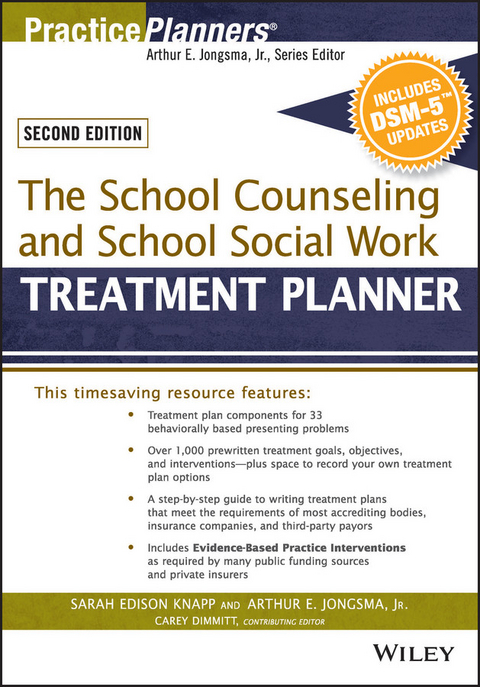
School Counseling and School Social Work Treatment Planner, with DSM-5 Updates, 2nd Edition (eBook)
432 Seiten
Wiley (Verlag)
978-1-119-06388-9 (ISBN)
This timesaving resource features:
- Treatment plan components for 33 behaviorally based presenting problems
- Over 1,000 prewritten treatment goals, objectives, and interventions-plus space to record your own treatment plan options
- A step-by-step guide to writing treatment plans that meet the requirements of most accrediting bodies, insurance companies, and third-party payors
- Includes Evidence-Based Practice Interventions as required by many public funding sources and private insurers
PracticePlanners® THE BESTSELLING TREATMENT PLANNING SYSTEM FOR MENTAL HEALTH PROFESSIONALS
The School Counseling and School Social Work Treatment Planner, Second Edition provides all the elements necessary to quickly and easily develop formal treatment plans that satisfy the demands of HMOs, managed care companies, third-party payors, and state and federal agencies.
New edition features empirically supported, evidence-based treatment interventions including coverage of disruptive classroom behaviors, reinforcing student success, bullying, peer conflict, and school violence
Organized around 33 behaviorally based presenting problems in treating students who experience social and emotional difficulties, including social maladjustment, learning difficulties, depression, substance abuse, family instability, and others
Over 1,000 prewritten treatment goals, objectives, and interventions-plus space to record your own treatment plan options
Easy-to-use reference format helps locate treatment plan components by behavioral problem
Includes a sample treatment plan that conforms to the requirements of most third-party payors and accrediting agencies including CARF, The Joint Commission (TJC), COA, and the NCQA
Additional resources in the PracticePlanners® series:
Documentation Sourcebooks provide the forms and records that mental health??professionals need to??efficiently run their practice.
Homework Planners feature behaviorally based, ready-to-use assignments to speed treatment and keep clients engaged between sessions.
For more information on our PracticePlanners®, including our full line of Treatment Planners, visit us on the Web at: www.wiley.com/practiceplanners
ARTHUR E. JONGSMA, JR., PHD, is the Series Editor for the bestselling PracticePlanners®. Since 1971, he has provided professional mental health services to both inpatient and outpatient clients. He was the founder and director of Psychological Consultants, a group private practice in Grand Rapids, Michigan, for 25 years. He is the author or coauthor of over 50 books and conducts training workshops for mental health professionals around the world.
SARAH EDISON KNAPP, MSW, CSW, is a former school social worker who now devotes her time and expertise to helping educators and parents relate to children in positive and highly effective ways. She is the author of several books including the School Counseling and School Social Work Homework Planner??and the Parenting Skills Homework Planner, both published by Wiley.
CAREY DIMMITT, PHD, is an Associate Professor and the Coordinator of School Counselor Education, University of Massachusetts Amherst. She is the Associate Director of the Center for School Counseling Outcome Research and Evaluation. Her research interests include school counseling curriculum outcome research, counseling skill development, metacognition, and linking research to effective practice. She is coauthor of Evidence-Based School Counseling: Making a Difference with Data-Driven Practices.
This timesaving resource features: Treatment plan components for 33 behaviorally based presenting problems Over 1,000 prewritten treatment goals, objectives, and interventions plus space to record your own treatment plan options A step-by-step guide to writing treatment plans that meet the requirements of most accrediting bodies, insurance companies, and third-party payors Includes Evidence-Based Practice Interventions as required by many public funding sources and private insurers PracticePlanners THE BESTSELLING TREATMENT PLANNING SYSTEM FOR MENTAL HEALTH PROFESSIONALS The School Counseling and School Social Work Treatment Planner, Second Edition provides all the elements necessary to quickly and easily develop formal treatment plans that satisfy the demands of HMOs, managed care companies, third-party payors, and state and federal agencies. New edition features empirically supported, evidence-based treatment interventions including coverage of disruptive classroom behaviors, reinforcing student success, bullying, peer conflict, and school violence Organized around 33 behaviorally based presenting problems in treating students who experience social and emotional difficulties, including social maladjustment, learning difficulties, depression, substance abuse, family instability, and others Over 1,000 prewritten treatment goals, objectives, and interventions plus space to record your own treatment plan options Easy-to-use reference format helps locate treatment plan components by behavioral problem Includes a sample treatment plan that conforms to the requirements of most third-party payors and accrediting agencies including CARF, The Joint Commission (TJC), COA, and the NCQA Additional resources in the PracticePlanners series: Documentation Sourcebooks provide the forms and records that mental health??professionals need to??efficiently run their practice. Homework Planners feature behaviorally based, ready-to-use assignments to speed treatment and keep clients engaged between sessions. For more information on our PracticePlanners , including our full line of Treatment Planners, visit us on the Web at: www.wiley.com/practiceplanners
INTRODUCTION
ABOUT PRACTICEPLANNERS® TREATMENT PLANNERS
Pressure from third‐party payors, accrediting agencies, and other outside parties has increased the need for clinicians to quickly produce effective, high‐quality treatment plans. Treatment Planners provide all the elements necessary to quickly and easily develop formal treatment plans that satisfy the needs of most third‐party payors and state and federal review agencies.
Each Treatment Planner:
- Saves you hours of time‐consuming paperwork.
- Offers the freedom to develop customized treatment plans.
- Includes over 1,000 clear statements describing the behavioral manifestations of each relational problem, and includes long‐term goals, short‐term object‐ives, and clinically tested treatment options.
- Has an easy‐to‐use reference format that helps locate treatment plan compo‐nents by behavioral problem or DSM‐IV‐TR® diagnosis.
As with the rest of the books in the PracticePlanners® series, our aim is to clarify, simplify, and accelerate the treatment planning process, so you spend less time on paperwork, and more time with your clients.
ABOUT THE SCHOOL COUNSELING AND SCHOOL SOCIAL WORK TREATMENT PLANNER
In the decade since the first School Counseling and School Social Work Treatment Planner was published, the United States has moved toward an increasingly standards‐based and accountability‐focused education model. All school professionals are under pressure to demonstrate that what they are doing has evidence of effectiveness. At the same time, the mental health profession has experienced growing demands for use of evidence‐based practices. Regardless of how one feels about these changes, they are the current reality in schools, and resources such as this School Counseling and School Social Work Treatment Planner are invaluable for successful professional practice. Because school‐based mental health services may be the first and only place where children and adolescents receive this care, it is imperative that those services be effective.
In this revised Treatment Planner, all chapters and the bibliotherapy resources have been updated and information about evidence‐based practices has been integrated into existing chapter content. The range of interventions for student difficulties that were a hallmark of the original book has been maintained, providing practitioners with a choice of options that can be personalized for students and contexts. Three new chapters about key school challenges—Bullying, Disruptive Classroom Behaviors, and School Violence—have been added. There is a new professional appendix with extensive general references regarding evidence‐based practices (EBP), as well as domain‐specific EBP print and web resources.
There are references throughout this book to the School Counseling and School Social Work Homework Planner (Knapp, 2003), which is a related resource. Additionally, because a number of evidence‐based treatments are consistent across context, some of the interventions in this Treatment Planner are related to those in the Child Psychotherapy Treatment Planner (Jongsma, Peterson, McInnis, and Bruce, 2006b) and the Adolescent Psychotherapy Treatment Planner (Jongsma, Peterson, McInnis, and Bruce, 2006a). There are also, of course, many school‐based interventions and programs that are unique to also this text.
INCORPORATING EVIDENCE‐BASED TREATMENT INTO THIS TREATMENT PLANNER
Effective mental health practice, whether in school or community settings, requires the knowledge and use of evidence‐based treatments (Carr, 2009; Weisz, Sandler, Durlak, and Anton, 2005) where they are identified and available. The imperative to use such practices has come from family and client advocacy groups (e.g., National Alliance on Mental Illness, 2007), professional organizations (American Psychological Association Task Force on Evidence‐Based Practice With Children and Adolescents, 2008), and the federal government (President's New Freedom Commission on Mental Health, 2003; Substance Abuse and Mental Health Services Administration, 2005). It's helpful to distinguish between evidence‐based treatments (EBT)—specific treatment interventions with research evidence—and evidence‐based practice (EBP)—using clinical expertise as well as research about assessment, treatments, interventions, outcome studies, and so on—to inform broader practice (Kazdin, 2008; Roberts and James, 2008). Using EBT information allows school mental health providers to make informed, consistent decisions about treatment options that address specific student difficulties (Sexton, Schofield, and Whiston, 1997; Steele, Elkin, and Roberts, 2008). The use of EBP more directly correlates the vital work of school counselors and school social workers with improvement in student outcomes, and provides clear practitioner accountability (Dimmitt, Carey, and Hatch, 2007; Gibbs, 2003; Kelly, 2008).
One school‐based model of EBP (Dimmitt, Carey, and Hatch, 2007), which is based on the Schlonsky and Gibbs (2004) model, identifies three interrelated aspects of using an evidence‐based approach. First, it's helpful to identify and assess what needs to be changed, in order to determine which treatment or intervention options to consider. Determining whether to intervene at the individual, family, classroom, and/or school level is a key decision at this time. For individuals, using a brief screening and assessment instrument with demonstrated reliability and validity such as the Children's Global Assessment Scale (Shaffer et al., 1983), the Achenbach System of Empirically Based Assessment (Achenbach and Rescorla, 2007) or the Behavior Assessment System for Children (BASC‐2; Tan, 2007) is preferable (see Meyer et al., 2001 for a summary of assessment instruments). If the problem is more systemic, such as bullying or classroom disruption, using school data about discipline incidences and any prior intervention efforts is warranted. Measures of school climate such as the School Success Profile (Bowen, Richman, and Bowen, 1997) can provide crucial systemic information.
Once the problem that needs to be addressed has been assessed and can be clearly articulated, gathering information about what effective intervention options exist is the next step in an integrated EBP process. This Treatment Planner identifies many EBP treatments and interventions where they currently exist, and there are numerous additional ways to stay knowledgeable about research‐based practices. The What Works Clearinghouse (http://ies.ed.gov/ncee/wwc/) maintained by the U. S. Department of Education posts educational research summaries identifying best practices. The Social Work Policy Institute (http://www.socialworkpolicy.org/) posts research and information about social work practice. The Campbell Collaboration (http://www.campbellcollaboration.org/) organizes multiple resources about a wide variety of interventions and practices in education, justice, and social welfare. Google Scholar (http://scholar.google.com/) provides access to articles and resources from academic sources. There are now several books that summarize child and adolescent clinical treatment research (Barrett and Ollendick, 2004; Carr, 2009; Grinnell and Unrau, 2008; Kazdin and Weisz, 2003; Macgowan, 2008; Norcross, 2011; Steele, Elkin, and Roberts; Weisz and Kazdin, 2010) and professional journals in school counseling, school social work, child and school psychology, and mental health all provide relevant up‐to‐date research about treatment outcomes. General knowledge of what constitutes good research is crucial, as is being an informed consumer. In this second edition of the School Counseling and School Social Work Treatment Planner, where there are clear and reliable empirical research findings about an effective treatment choice, the related Short‐Term Objects and Therapeutic Interventions have been highlighted with an icon indicating an EBT intervention [].
After possible evidence‐based treatment interventions have been identified, there has to be a decision about which one is most likely to work in your specific context. Are there the resources, commitment, and capability to implement the intervention or treatment with fidelity? Which EBP is the best match with this particular student, family, and/or school? Will it fit the school schedule and activities? Using your own experience along with the collective wisdom of colleagues and the client and his/her family is imperative at this stage in the process. Using a school data team to make these decisions is optimal (Poynton and Carey, 2006). Choosing an evidence‐based treatment or program and then not implementing it as it was designed may not provide students with the desired outcomes.
The third component of this model (Dimmitt, Carey, and Hatch, 2007) involves evaluating whether the intervention or treatment that has been used is effective. A treatment that is supported by sound outcome research still may not have the desired impact in all contexts, and evaluation will help to determine whether the intervention should be continued or modified. Evaluations can be accomplished through outcome surveys, post‐treatment assessments, learning assessment, school climate measures, and so on (see Dimmitt,...
| Erscheint lt. Verlag | 22.3.2017 |
|---|---|
| Sprache | englisch |
| Themenwelt | Geisteswissenschaften ► Psychologie ► Entwicklungspsychologie |
| Medizin / Pharmazie ► Medizinische Fachgebiete ► Psychiatrie / Psychotherapie | |
| Sozialwissenschaften ► Pädagogik ► Didaktik | |
| ISBN-10 | 1-119-06388-4 / 1119063884 |
| ISBN-13 | 978-1-119-06388-9 / 9781119063889 |
| Informationen gemäß Produktsicherheitsverordnung (GPSR) | |
| Haben Sie eine Frage zum Produkt? |
 EPUB (Adobe DRM)
Größe: 2,0 MB
Kopierschutz: Adobe-DRM
Adobe-DRM ist ein Kopierschutz, der das eBook vor Mißbrauch schützen soll. Dabei wird das eBook bereits beim Download auf Ihre persönliche Adobe-ID autorisiert. Lesen können Sie das eBook dann nur auf den Geräten, welche ebenfalls auf Ihre Adobe-ID registriert sind.
Details zum Adobe-DRM
Dateiformat: EPUB (Electronic Publication)
EPUB ist ein offener Standard für eBooks und eignet sich besonders zur Darstellung von Belletristik und Sachbüchern. Der Fließtext wird dynamisch an die Display- und Schriftgröße angepasst. Auch für mobile Lesegeräte ist EPUB daher gut geeignet.
Systemvoraussetzungen:
PC/Mac: Mit einem PC oder Mac können Sie dieses eBook lesen. Sie benötigen eine
eReader: Dieses eBook kann mit (fast) allen eBook-Readern gelesen werden. Mit dem amazon-Kindle ist es aber nicht kompatibel.
Smartphone/Tablet: Egal ob Apple oder Android, dieses eBook können Sie lesen. Sie benötigen eine
Geräteliste und zusätzliche Hinweise
Buying eBooks from abroad
For tax law reasons we can sell eBooks just within Germany and Switzerland. Regrettably we cannot fulfill eBook-orders from other countries.
aus dem Bereich


