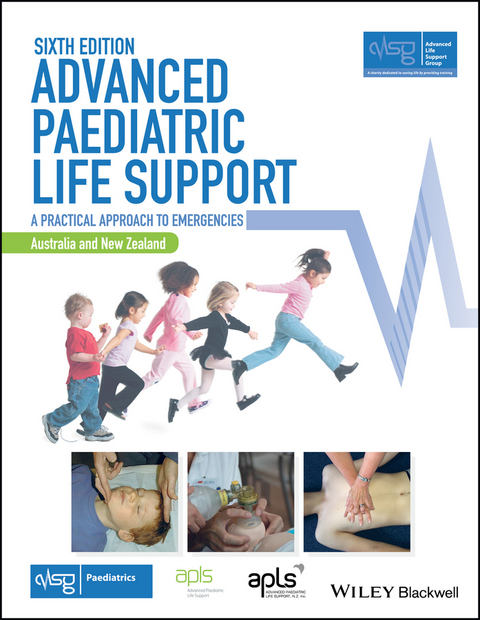
Advanced Paediatric Life Support, Australia and New Zealand (eBook)
John Wiley & Sons (Verlag)
978-1-119-38547-9 (ISBN)
Advanced Paediatric Life Support is the internationally renowned manual on emergency paediatric care, written to support the course run by the Advanced Life Support Group. This edition has been adapted specifically for use in Australia and New Zealand, with the latest procedures, medications and clinical best practice to match the guidelines of the Australia and New Zealand Resuscitation Councils. Using their structured approach, a tried and tested practical method of treating children during the crucial first few hours of a life threatening illness or injury, Advanced Paediatric Life Support is used by doctors, nurses and allied health professionals dealing with emergencies in children. Its clear layout and straightforward style make it a highly practical tool both for training and in the event of an emergency.
The sixth edition includes major new features bringing it right up to date, including:
- Fully adapted for use in Australia and New Zealand, with updates to chapters on shock, the choking child, basic life support and cardiac arrest
- The latest International Liaison Committee on Resuscitation (ILCOR) 2015 Guidelines
- The latest consensus guidelines on paediatric trauma
- Enhanced discussions on the importance of human factors
- A new and improved design including full colour photographs and diagrams
- Free access to the Wiley E-Text
With this book at hand, all those providing care during paediatric emergencies can be confident in having comprehensive and authoritative guidance on the recognition and management of life threatening conditions necessary to save a child's life.
The Advanced Life Support Group (ALSG), Manchester UK, began life in 1990 and became a registered medical education charity in 1993. The organisation exists to 'preserve life by providing training and education to the general public and in particular but not exclusively to doctors, nurses and other members of the medical profession, in life saving techniques'.
The book is written and edited by Emergency Medicine specialists who are Advanced Life Support Group (ALSG) trainers.
The Advanced Life Support Group (ALSG), Manchester UK, began life in 1990 and became a registered medical education charity in 1993. The organisation exists to "preserve life by providing training and education to the general public and in particular but not exclusively to doctors, nurses and other members of the medical profession, in life saving techniques". The book is written and edited by Emergency Medicine specialists who are Advanced Life Support Group (ALSG) trainers.
Clinical conditions list vii
Working group x
Contributors xii
Preface to the first edition xvii
Preface to the sixth edition xviii
Preface to the modified Australia and New Zealand sixth edition xix
Acknowledgements xx
Contact details and further information xxi
How to use your textbook xxii
PART 1: Introduction 1
1 Introduction 3
2 Structured approach to paediatric emergencies 13
3 Human factors 23
PART 2: The seriously ill child 33
4 Structured approach to the seriously ill child 35
5 The child with breathing difficulties 49
6 The child in shock 67
7 The child with an abnormal pulse rate or rhythm 81
8 The child with a decreased conscious level 89
9 The convulsing child 99
PART 3: The seriously injured child 107
10 Introduction to the seriously injured child 109
11 Structured approach to the seriously injured child 115
12 The child with chest injury 127
13 The child with abdominal injury 135
14 The child with traumatic brain injury 139
15 The child with injuries to the extremities or the spine 147
16 The burned or scalded child 155
17 The child with an electrical injury or drowning 161
PART 4: Life support 167
18 Basic life support 169
19 Support of the airway and ventilation 185
20 Management of cardiac arrest 199
PART 5: Practical application of APLS 209
21 Practical procedures: airway and breathing 211
22 Practical procedures: circulation 225
23 Practical procedures: trauma 239
24 Imaging in trauma 249
25 Structured approach to stabilisation and transfer 255
PART 6: Appendices 267
Appendix A Acid-base balance 269
Appendix B Fluid and electrolyte management 281
Appendix C Child abuse and neglect 291
Appendix D When a child dies 299
Appendix E General approach to poisoning and envenomation 303
Appendix F Resuscitation of the baby at birth 317
Appendix G Formulary 333
Index 351
CHAPTER 1
Introduction
Learning outcomes
After reading this chapter, you will be able to:
- Describe the focus of the APLS course
- Identify the important differences in children and their impact on the management of emergencies
1.1 Introduction
Over the last two decades there has been a substantial reduction in childhood mortality across the world. This has been related to improvements in many areas such as maternal education, access to clean water, access to food, immunisation against an increasing number of infectious conditions, and improved access to healthcare services. Even conditions such as human immunodeficiency virus infections have potentially come under control with the development of highly effective antiretroviral therapeutic regimes. However, children across the world continue to suffer potentially life‐threatening acute illness (sometimes on a background of chronic illness) and injury. The Advanced Paediatric Life Support (APLS) course is directed at training healthcare workers to recognise life‐threatening illness or injury in children; provide effective emergency intervention; and ensure that children receive the appropriate definitive management of the condition as soon as possible. This approach is potentially applicable in many different settings across the world.
1.2 Principles
There are a number of principles that underpin this approach.
Physiological differences
Most clinical medicine is taught with the underlying assumption that adults best exemplify ‘normal’ in health. This is perhaps justified by the reality that in most parts of the world the majority of the population is made up of adults, but in poorer countries up to 40% of the population may be made up of children (depending on how children are defined). Thus it is important to highlight where children are different to adults in terms of physiology, pathophysiology and responses to various interventions (see Section 1.3). Among the most important differences are the substantially lower physiological reserves in children, particularly young children. A consequence of this is that in the face of injury or severe illness their condition may deteriorate more rapidly than would be expected for adult patients. Thus particular attention has to be paid to timeliness and effective support of the respiratory and cardiovascular systems.
Children come in a range of sizes, and a consequence of this is the constant requirement to adjust all therapy, interventions and selection of equipment or consumable to the size of the particular patient (see Table 1.1 in Section 1.3).
Table 1.1 Normal ranges: respiratory rate (RR), heart rate (HR) and blood pressure (BP)
| Age | Guide weight (kg) | RR At rest Breaths per minute 5th–95th centile | HR Beats per minute 5th–95th centile | BP Systolic |
| Boys | Girls | 5th centile | 50th centile | 95th centile |
| Birth | 3.5 | 3.5 | 25–50 | 120–170 | 65–75 | 80–90 | 105 |
| 1 month | 4.5 | 4.5 |
| 3 months | 6.5 | 6 | 25–45 | 115–160 |
| 6 months | 8 | 7 | 20–40 | 110–160 |
| 12 months | 9.5 | 9 | 70–75 | 85–95 |
| 18 months | 11 | 10 | 20–35 | 100–155 |
| 2 years | 12 | 12 | 20–30 | 100–150 | 70–80 | 85–100 | 110 |
| 3 years | 14 | 14 | 90–140 |
| 4 years | 16 | 16 | 80–135 |
| 5 years | 18 | 18 | 80–90 | 90–110 | 111–120 |
| 6 years | 21 | 20 | 80–130 |
| 7 years | 23 | 22 |
| 8 years | 25 | 25 | 15–25 | 70–120 |
| 9 years | 28 | 28 |
| 10 years | 31 | 32 |
| 11 years | 35 | 35 |
| 12 years | 43 | 43 | 12–24 | 65–115 | 90–105 | 100–120 | 125–140 |
| 14 years | 50 | 50 | 60–110 |
| Adult | 70 | 70 |
Relationship between disease progression and outcomes
The further a disease process is allowed to progress, the worse the outcome is likely to be. The outcomes for children who have a cardiac arrest out of hospital are generally poor (this may be related to the fact that in children cardiac arrest is rarely related to cardiac arrhythmia, but more commonly is a sequel of hypoxaemia and/or shock with associated organ damage and dysfunction). By the time that cardiac arrest occurs, there has already been substantial damage to various organs. This is in contrast to situations (more common in adults) where the cardiac arrest was the consequence of cardiac arrhythmia – with preceding normal perfusion and oxygenation. Thus the focus of the course is on early recognition and effective management of potentially life‐threatening problems before there is progression to respiratory and/or cardiac arrest (Figure 1.1).
Figure 1.1 Pathways leading to cardiac arrest in childhood (with examples of underlying causes). [ICP, intracranial pressure]
Standardised structure for assessment and stabilisation
The use of a standardised structure for resuscitation provides benefits in many areas. Firstly it provides a structured approach to a critically ill child who may have multiple problems. The standardised approach enables the provision of a standard working environment, ensuring that all the necessary equipment is available as required. By focusing attention on life‐threatening issues and dealing with those in a logical sequence it is possible to stabilise the child’s condition as quickly as possible. The use of the standardised structure enables the entire team to know what is likely to be expected of them and in what sequence.
There may well be discussion around the optimum sequence of resuscitation, but in this course a particular approach has been accepted as being reasonable, and most in keeping with the available research information. It is likely that aspects of this approach will change over time, and in fact it may be appropriate to modify the approach in particular working environments and contexts.
Once basic stabilisation has been achieved, it is then appropriate to investigate the underlying diagnoses and proceed to definitive therapy. Occasionally, definitive therapy (such as surgical intervention) may be a component of the resuscitation.
Resource management
There is increasing realisation that provision of effective emergency treatment depends on the development of teams of healthcare providers who are able to work together in a coordinated and appropriately directed way (Figure 1.2). Thus part of training in paediatric life support must focus on understanding how the human resources available for a particular resuscitation episode can be utilised most effectively.
Figure 1.2 Advanced paediatric life support (APLS) in action
Early referral to appropriate teams for definitive management
It is clear that emergency areas are unlikely to be able to provide definitive management for all paediatric emergencies, and a component of stabilisation of critically ill or injured children is the capacity to call for help as soon as possible, and where necessary transfer the child to the appropriate site safely.
Ongoing care until admission to appropriate care
In most parts of the world it is impossible to transfer critically ill children into intensive care units or other specialised units within a short time of their arrival in the emergency area. Thus it is important to provide training in the ongoing therapy that is required for a range of relatively common conditions once initial stabilisation has been completed.
1.3 Important differences in children
Children are a diverse group, varying enormously in weight, size, shape, intellectual ability and emotional responses. At birth a child is, on average, a 3.5 kg, 50 cm long individual with small respiratory and cardiovascular reserves and an immature immune system. They are capable of limited movement, have immature emotional responses though still perceive pain and...
| Erscheint lt. Verlag | 9.5.2017 |
|---|---|
| Reihe/Serie | Advanced Life Support Group |
| Advanced Life Support Group | Advanced Life Support Group |
| Sprache | englisch |
| Themenwelt | Medizin / Pharmazie ► Allgemeines / Lexika |
| Medizin / Pharmazie ► Medizinische Fachgebiete ► Notfallmedizin | |
| Medizin / Pharmazie ► Medizinische Fachgebiete ► Pädiatrie | |
| Medizin / Pharmazie ► Studium | |
| Schlagworte | Advanced Life Support Group course manual • advanced paediatric life support • Australia and New Zealand Resuscitation Councils guidelines • basic life support for children • emergency care for children • emergency healthcare for children • Emergency Medicine & Trauma • emergency paediatric care manual • how to treat a child in cardiac arrest • how to treat a child in shock • how to treat the choking child • International Liaison Committee on Resuscitation (ILCOR) Guidelines • internationally renowned emergency paediatric care manual • latest paediatric life support procedures, medications and clinical best practices • medical education • Medical Science • Medizin • Medizinstudium • Notfallmedizin u. Traumatologie • paediatric trauma guidelines • practical emergency treatment methods for children's illness or injury |
| ISBN-10 | 1-119-38547-4 / 1119385474 |
| ISBN-13 | 978-1-119-38547-9 / 9781119385479 |
| Informationen gemäß Produktsicherheitsverordnung (GPSR) | |
| Haben Sie eine Frage zum Produkt? |
 EPUB (Adobe DRM)
Kopierschutz: Adobe-DRM
Adobe-DRM ist ein Kopierschutz, der das eBook vor Mißbrauch schützen soll. Dabei wird das eBook bereits beim Download auf Ihre persönliche Adobe-ID autorisiert. Lesen können Sie das eBook dann nur auf den Geräten, welche ebenfalls auf Ihre Adobe-ID registriert sind.
Details zum Adobe-DRM
Dateiformat: EPUB (Electronic Publication)
EPUB ist ein offener Standard für eBooks und eignet sich besonders zur Darstellung von Belletristik und Sachbüchern. Der Fließtext wird dynamisch an die Display- und Schriftgröße angepasst. Auch für mobile Lesegeräte ist EPUB daher gut geeignet.
Systemvoraussetzungen:
PC/Mac: Mit einem PC oder Mac können Sie dieses eBook lesen. Sie benötigen eine
eReader: Dieses eBook kann mit (fast) allen eBook-Readern gelesen werden. Mit dem amazon-Kindle ist es aber nicht kompatibel.
Smartphone/Tablet: Egal ob Apple oder Android, dieses eBook können Sie lesen. Sie benötigen eine
Geräteliste und zusätzliche Hinweise
Buying eBooks from abroad
For tax law reasons we can sell eBooks just within Germany and Switzerland. Regrettably we cannot fulfill eBook-orders from other countries.
aus dem Bereich