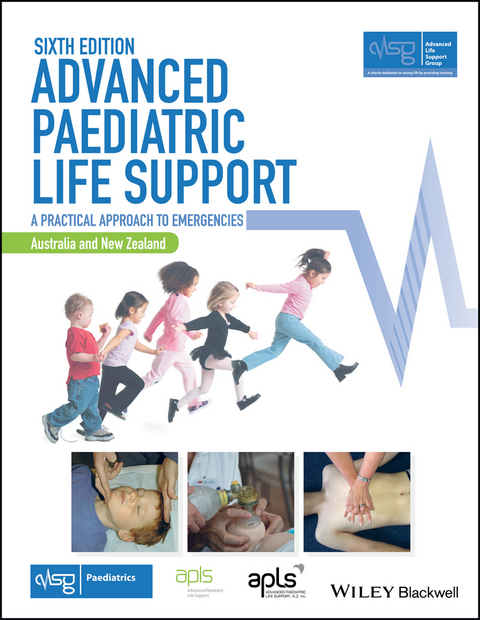
Advanced Paediatric Life Support, Australia and New Zealand (eBook)
John Wiley & Sons (Verlag)
978-1-119-38545-5 (ISBN)
Advanced Paediatric Life Support is the internationally renowned manual on emergency paediatric care, written to support the course run by the Advanced Life Support Group. This edition has been adapted specifically for use in Australia and New Zealand, with the latest procedures, medications and clinical best practice to match the guidelines of the Australia and New Zealand Resuscitation Councils. Using their structured approach, a tried and tested practical method of treating children during the crucial first few hours of a life threatening illness or injury, Advanced Paediatric Life Support is used by doctors, nurses and allied health professionals dealing with emergencies in children. Its clear layout and straightforward style make it a highly practical tool both for training and in the event of an emergency.
The sixth edition includes major new features bringing it right up to date, including:
- Fully adapted for use in Australia and New Zealand, with updates to chapters on shock, the choking child, basic life support and cardiac arrest
- The latest International Liaison Committee on Resuscitation (ILCOR) 2015 Guidelines
- The latest consensus guidelines on paediatric trauma
- Enhanced discussions on the importance of human factors
- A new and improved design including full colour photographs and diagrams
- Free access to the Wiley E-Text
With this book at hand, all those providing care during paediatric emergencies can be confident in having comprehensive and authoritative guidance on the recognition and management of life threatening conditions necessary to save a child's life.
The Advanced Life Support Group (ALSG), Manchester UK, began life in 1990 and became a registered medical education charity in 1993. The organisation exists to 'preserve life by providing training and education to the general public and in particular but not exclusively to doctors, nurses and other members of the medical profession, in life saving techniques'.
The book is written and edited by Emergency Medicine specialists who are Advanced Life Support Group (ALSG) trainers.
Advanced Paediatric Life Support is the internationally renowned manual on emergency paediatric care, written to support the course run by the Advanced Life Support Group. This edition has been adapted specifically for use in Australia and New Zealand, with the latest procedures, medications and clinical best practice to match the guidelines of the Australia and New Zealand Resuscitation Councils. Using their structured approach, a tried and tested practical method of treating children during the crucial first few hours of a life threatening illness or injury, Advanced Paediatric Life Support is used by doctors, nurses and allied health professionals dealing with emergencies in children. Its clear layout and straightforward style make it a highly practical tool both for training and in the event of an emergency. The sixth edition includes major new features bringing it right up to date, including: Fully adapted for use in Australia and New Zealand, with updates to chapters on shock, the choking child, basic life support and cardiac arrest The latest International Liaison Committee on Resuscitation (ILCOR) 2015 Guidelines The latest consensus guidelines on paediatric trauma Enhanced discussions on the importance of human factors A new and improved design including full colour photographs and diagrams Free access to the Wiley E-Text With this book at hand, all those providing care during paediatric emergencies can be confident in having comprehensive and authoritative guidance on the recognition and management of life threatening conditions necessary to save a child's life.
The Advanced Life Support Group (ALSG), Manchester UK, began life in 1990 and became a registered medical education charity in 1993. The organisation exists to "preserve life by providing training and education to the general public and in particular but not exclusively to doctors, nurses and other members of the medical profession, in life saving techniques". The book is written and edited by Emergency Medicine specialists who are Advanced Life Support Group (ALSG) trainers.
Title Page 5
Copyright Page 6
Contents 7
Clinical conditions list 9
Working group 12
Contributors 14
Preface to the first edition 19
Preface to the sixth edition 20
Preface to the modified Australia and New Zealand sixth edition 21
Acknowledgements 22
Contact details and further information 23
How to use your textbook 24
Part 1 Introduction 25
Chapter 1 Introduction 27
1.1 Introduction 27
1.2 Principles 27
1.3 Important differences in children 29
1.4 Summary 35
Chapter 2 Structured approach to paediatric emergencies 37
2.1 Introduction 37
2.2 Preparation 37
2.3 Teamwork 38
2.4 Communication 39
2.5 Triage 39
2.6 Managing pain 41
2.7 Summary 45
Explanatory notes of the Alder Hey Triage Pain Score 46
Chapter 3 Human factors 47
3.1 Introduction 47
3.2 Extent of healthcare error 47
3.3 Causes of healthcare error 48
3.4 Human error 48
3.5 Learning from error 49
3.6 Communication 50
3.7 Team working, leadership and followership 51
3.8 Situation awareness 52
3.9 Improving team and individual performance 54
3.10 Summary 55
Part 2 The seriously ill child 57
Chapter 4 Structured approach to the seriously ill child 59
4.1 Introduction 59
4.2 Primary assessment of airway and breathing 59
4.3 Primary assessment of the circulation 62
4.4 Primary assessment of disability 64
4.5 Primary assessment of exposure 66
4.6 Structured approach to the seriously ill child 67
4.7 Primary assessment and resuscitation 67
4.8 Secondary assessment and emergency treatment 68
4.9 Summary 72
Chapter 5 The child with breathing difficulties 73
5.1 introduction 73
5.2 Susceptibility to respiratory failure 73
5.3 Clinical presentations of the child with breathing difficulty 74
5.4 Primary assessment and resuscitation 75
5.5 Secondary assessment and looking for key features 76
5.6 Approach to the child with stridor 76
5.7 Approach to the child with wheeze 81
5.8 Approach to the child with fever 87
5.9 Approach to the child with heart failure 89
5.10 Approach to the child with anaphylaxis 90
5.11 Approach to the child with metabolic and poisoning problems 90
5.12 Summary 90
Chapter 6 The child in shock 91
6.1 Introduction 91
6.2 Pathophysiology of shock 91
6.3 Classification of the causes of shock 92
6.4 Approach to the child in shock 92
6.5 Primary assessment and resuscitation 93
6.6 Key features of the child in shock 95
6.7 Approach to the child with non?haemorrhagic fluid loss 95
6.8 Approach to the child with septic shock 96
6.9 Approach to the child with anaphylaxis 98
6.10 Approach to the infant with a duct?dependent congenital heart disease 100
6.11 Approach to the child with shock due to cardiomyopathy 101
6.12 Approach to the child with profound anaemia 102
6.13 Approach to the child with sickle cell crisis 102
6.14 After resuscitation and emergency treatment of shock 102
6.15 Use of fluids in resuscitation 102
6.16 Summary 103
Chapter 7 The child with an abnormal pulse rate or rhythm 105
7.1 Introduction 105
7.2 Primary assessment and resuscitation 106
7.3 Approach to the child with bradycardia 107
7.4 Approach to the child with supraventricular tachycardia 108
7.5 Approach to the child with ventricular tachycardia 110
7.6 Summary 111
Chapter 8 The child with a decreased conscious level 113
8.1 Introduction 113
8.2 Pathophysiology of raised intracranial pressure 114
8.3 Primary assessment and resuscitation 115
8.4 Secondary assessment and looking for key features 118
8.5 Further general treatment of coma 120
8.6 Approach to the child with meningitis/encephalitis 120
8.7 Approach to the child poisoned with opiates 121
8.8 Approach to the child with metabolic coma 121
8.9 Approach to the child with malaria 121
8.10 Approach to the child with systemic hypertensive crisis 122
8.11 Stabilisation and transfer to definitive care 122
8.12 Summary 122
Chapter 9 The convulsing child 123
9.1 Introduction 123
9.2 Pathophysiology of prolonged convulsions 123
9.3 Primary assessment and resuscitation 124
9.4 Secondary assessment and looking for key features 125
9.5 Emergency treatment of the convulsion 125
9.6 Approach to the child with systemic hypertensive crisis 129
9.7 Hypertension emergency treatment 129
9.8 Summary 130
Part 3 The seriously injured child 131
Chapter 10 Introduction to the seriously injured child 133
10.1 Introduction 133
10.2 Injury prevention 133
10.3 Epidemiology 133
10.4 Levels of injury prevention 134
10.5 Trauma systems 136
10.6 Trauma teams 137
10.7 Summary 137
Chapter 11 Structured approach to the seriously injured child 139
11.1 Introduction 139
11.2 Primary survey and resuscitation 140
11.3 Secondary survey and looking for key features 146
11.4 Emergency treatment 147
11.5 Continuing stabilisation 148
11.6 Summary 150
Chapter 12 The child with chest injury 151
12.1 Introduction 151
12.2 Injuries posing an immediate threat to life 151
12.3 Serious injuries discovered later 154
12.4 Other injuries 156
12.5 Practical procedures 156
12.6 Referral 156
12.7 Continuing stabilisation 156
12.8 Summary 157
Chapter 13 The child with abdominal injury 159
13.1 Introduction 159
13.2 History 159
13.3 Assessment of the injured abdomen 159
13.4 Definitive care 160
13.5 Summary 161
Chapter 14 The child with traumatic brain injury 163
14.1 Introduction 163
14.2 Triage 164
14.3 Primary survey and resuscitation 165
14.4 Secondary survey and looking for key features 166
14.5 Emergency treatment 167
14.6 Detailed review and continuing stabilisation 169
14.7 Transfer to definitive care 170
14.8 Summary 170
Chapter 15 The child with injuries to the extremities or the spine 171
15.1 Extremity trauma: introduction 171
15.2 Assessment of extremity trauma 171
15.3 Primary survey and resuscitation of extremity trauma 171
15.4 Secondary survey and looking for key features of extremity trauma 173
15.5 Emergency treatment of extremity trauma 174
15.6 Extremity trauma: summary 174
15.7 Spinal trauma: introduction 174
15.8 Injuries of the cervical spine 176
15.9 Injuries of the thoracic and lumbar spine 177
15.10 Spinal cord injury without radiographic abnormality 177
15.11 Spinal trauma: summary 177
Chapter 16 The burned or scalded child 179
16.1 Introduction 179
16.2 Primary survey and resuscitation 180
16.3 Secondary survey and looking for key features 181
16.4 Emergency treatment 182
16.5 Continuing stabilisation and transfer to definitive care 183
16.6 Toxic shock syndrome 183
16.7 Summary 184
Chapter 17 The child with an electrical injury or drowning 185
17.1 Electrical injuries: introduction 185
17.2 Initial treatment of electrical injuries 186
17.3 Primary survey of electrical injuries and resuscitation 186
17.4 Secondary survey and looking for key features of electrical injuries 186
17.5 Stabilisation of electrical injuries and transfer to definitive care 186
17.6 Electrical injuries: summary 186
17.7 Drowning: introduction 186
17.8 Primary survey of drowning and resuscitation 187
17.9 Secondary survey and looking for key features in drowning 188
17.10 Emergency treatment and stabilisation in drowning 189
17.11 Prognostic indicators in drowning 189
17.12 Outcome of drowning 190
17.13 Drowning: summary 190
Part 4 Life support 191
Chapter 18 Basic life support 193
18.1 Introduction 193
18.2 Primary assessment and resuscitation 193
18.3 Basic life support and infection risk 203
18.4 The choking child 204
18.5 Summary 207
Chapter 19 Support of the airway and ventilation 209
19.1 Introduction? 209
19.2 Airway and breathing management: principles 209
19.3 Primary assessment and resuscitation 209
19.4 Secondary assessment 210
19.5 Emergency treatment 210
19.6 Team aspects of airway management 210
19.7 Equipment for providing oxygen and ventilation 212
19.8 Equipment for managing the airway 213
19.9 Monitoring an intubated patient 219
19.10 Management of a blocked tracheostomy (Figure 19.5) 220
19.11 Summary 222
Chapter 20 Management of cardiac arrest 223
20.1 Introduction 223
20.2 Non-shockable rhythms 223
20.3 Shockable rhythms 227
20.4 When to stop resuscitation 231
20.5 Parental presence 231
20.6 Summary 231
Part 5 Practical application of APLS 233
Chapter 21 Practical procedures: airway and breathing 235
21.1 Ventilation without intubation 235
21.2 Oropharyngeal airway (Guedel) insertion 237
21.3 Nasopharyngeal airway insertion 238
21.4 Tracheal intubation and rapid sequence induction 238
21.5 Drugs 241
21.6 Intubation algorithm 241
21.7 Laryngeal mask airway 243
21.8 Surgical airway 244
21.9 Management of a blocked tracheostomy 247
Chapter 22 Practical procedures: circulation 249
22.1 Vascular access 249
22.2 Defibrillation 259
Chapter 23 Practical procedures: trauma 263
23.1 Needle thoracocentesis 263
23.2 Chest drain placement 264
23.3 Clamshell thoracotomy 265
23.4 Pericardiocentesis 265
23.5 Femoral nerve block 266
23.6 Cervical spine immobilisation 268
Chapter 24 Imaging in trauma 273
24.1 Introduction 273
24.2 Cervical spine imaging 275
24.3 Chest radiograph 276
24.4 The role of further imaging 278
24.5 Summary 278
Chapter 25 Structured approach to stabilisation and transfer 279
25.1 Stabilisation of the child 279
25.2 Assessment after stabilisation 283
25.3 Principles of safe transfer and retrieval 283
25.4 Summary 290
Part 6 Appendices 291
Appendix A Acid–base balance 293
A.1 Introduction 293
A.2 Hydrogen ion concentration, acidity and pH 293
A.3 Carbonic acid reaction 295
A.4 Standard bicarbonate 296
A.5 Stewart’s strong ion theory 296
A.6 Applying this in practice 299
A.7 Summary 303
Appendix B Fluid and electrolyte management 305
B.1 Introduction 305
B.2 Fluid balance 305
B.3 Diabetic ketoacidosis 313
B.4 Summary 314
Appendix C Child abuse and neglect 315
C.1 Introduction 315
C.2 Recognition of child abuse and neglect 317
C.3 Assessment 318
C.4 Initial management 320
C.5 Referral 320
C.6 Medicolegal aspects 321
C.7 Summary 322
Appendix D When a child dies 323
D.1 Introduction 323
D.2 Dealing with the family 324
D.3 Post-death procedures 324
D.4 Take care of the staff 325
D.5 Summary 325
Appendix E General approach to poisoning and envenomation 327
E.1 Poisoning: introduction 327
E.2 Primary assessment and resuscitation in poisoning 328
E.3 Emergency treatment in poisoning 331
E.4 Emergency treatment of specific poisons 331
E.5 Envenoming (envenomation): introduction 334
E.6 Resuscitation and support in envenoming (envenomation) 335
E.7 Specific envenoming issues 336
E.8 Button battery ingestion 340
E.9 Summary 340
Appendix F Resuscitation of the baby at birth 341
F.1 Introduction 341
F.2 Normal physiology 341
F.3 Pathophysiology 342
F.4 Equipment 344
F.5 Strategy for assessing and resuscitating a baby at birth 345
F.6 Response to resuscitation 352
F.7 Tracheal intubation 352
F.8 Laryngeal mask airway 353
F.9 Preterm babies 353
F.10 Summary 356
Appendix G Formulary 357
G.1 General guidance on the use of the formulary 357
Index 375
EULA 387
| Erscheint lt. Verlag | 3.5.2017 |
|---|---|
| Reihe/Serie | Advanced Life Support Group | Advanced Life Support Group |
| Sprache | englisch |
| Themenwelt | Medizin / Pharmazie ► Allgemeines / Lexika |
| Medizin / Pharmazie ► Medizinische Fachgebiete ► Notfallmedizin | |
| Medizin / Pharmazie ► Medizinische Fachgebiete ► Pädiatrie | |
| Medizin / Pharmazie ► Studium | |
| Schlagworte | Advanced Life Support Group course manual • advanced paediatric life support • Australia and New Zealand Resuscitation Councils guidelines • basic life support for children • emergency care for children • emergency healthcare for children • Emergency Medicine & Trauma • emergency paediatric care manual • how to treat a child in cardiac arrest • how to treat a child in shock • how to treat the choking child • International Liaison Committee on Resuscitation (ILCOR) Guidelines • internationally renowned emergency paediatric care manual • latest paediatric life support procedures, medications and clinical best practices • medical education • Medical Science • Medizin • Medizinstudium • Notfallmedizin u. Traumatologie • paediatric trauma guidelines • practical emergency treatment methods for children's illness or injury |
| ISBN-10 | 1-119-38545-8 / 1119385458 |
| ISBN-13 | 978-1-119-38545-5 / 9781119385455 |
| Informationen gemäß Produktsicherheitsverordnung (GPSR) | |
| Haben Sie eine Frage zum Produkt? |
 PDF (Adobe DRM)
Kopierschutz: Adobe-DRM
Adobe-DRM ist ein Kopierschutz, der das eBook vor Mißbrauch schützen soll. Dabei wird das eBook bereits beim Download auf Ihre persönliche Adobe-ID autorisiert. Lesen können Sie das eBook dann nur auf den Geräten, welche ebenfalls auf Ihre Adobe-ID registriert sind.
Details zum Adobe-DRM
Dateiformat: PDF (Portable Document Format)
Mit einem festen Seitenlayout eignet sich die PDF besonders für Fachbücher mit Spalten, Tabellen und Abbildungen. Eine PDF kann auf fast allen Geräten angezeigt werden, ist aber für kleine Displays (Smartphone, eReader) nur eingeschränkt geeignet.
Systemvoraussetzungen:
PC/Mac: Mit einem PC oder Mac können Sie dieses eBook lesen. Sie benötigen eine
eReader: Dieses eBook kann mit (fast) allen eBook-Readern gelesen werden. Mit dem amazon-Kindle ist es aber nicht kompatibel.
Smartphone/Tablet: Egal ob Apple oder Android, dieses eBook können Sie lesen. Sie benötigen eine
Geräteliste und zusätzliche Hinweise
Buying eBooks from abroad
For tax law reasons we can sell eBooks just within Germany and Switzerland. Regrettably we cannot fulfill eBook-orders from other countries.
aus dem Bereich