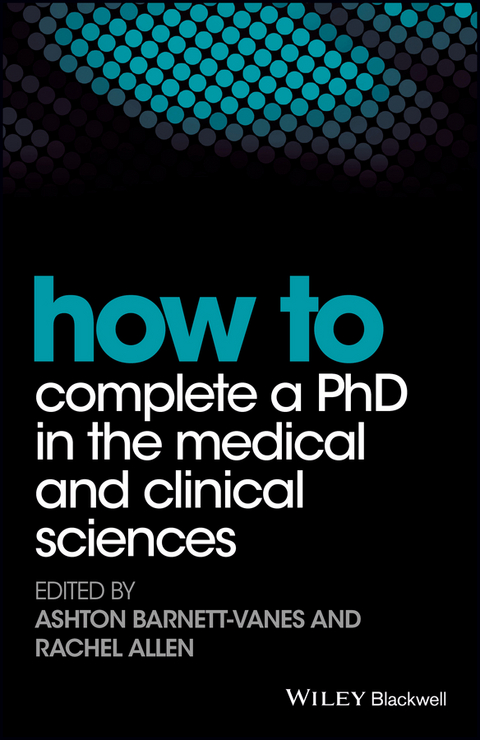
How to Complete a PhD in the Medical and Clinical Sciences (eBook)
John Wiley & Sons (Verlag)
978-1-119-18962-6 (ISBN)
How to Complete a PhD in the Medical and Clinical Sciences provides fresh insight into the PhD process and a concise framework to aid current and prospective students undertaking research in the medical and clinical sciences.
Filled with useful hints, tips, and practical guidance, the book covers key topics relevant to a PhD researcher such as publishing and presenting, core principles and techniques in medical science, dealing with common pitfalls, and how to write up and move on.
Featuring contributions from authors with experience across the PhD research career spectrum, How to Complete a PhD in the Medical and Clinical Sciences is an invaluable resource for those undertaking their doctoral studies.
Dr Ashton Barnett-Vanes, MB-PhD Candidate, St George's, University of London and Imperial College London, UK.
Dr Rachel Allen, Reader in Immunology of Infection and Head of Graduate School, St George's, University of London, UK.
How to Complete a PhD in the Medical and Clinical Sciences provides fresh insight into the PhD process and a concise framework to aid current and prospective students undertaking research in the medical and clinical sciences. Filled with useful hints, tips, and practical guidance, the book covers key topics relevant to a PhD researcher such as publishing and presenting, core principles and techniques in medical science, dealing with common pitfalls, and how to write up and move on. Featuring contributions from authors with experience across the PhD research career spectrum, How to Complete a PhD in the Medical and Clinical Sciences is an invaluable resource for those undertaking their doctoral studies.
Dr Ashton Barnett-Vanes, MB-PhD Candidate, St George's, University of London and Imperial College London, UK. Dr Rachel Allen, Reader in Immunology of Infection and Head of Graduate School, St George's, University of London, UK.
'Intended as a step-by-step guide, the book is a good summary of the major steps, pitfalls along the way, and advice on how to be successful as a student ... There are not many books that attempt to do what this one does, and there is not much written about this topic in general, so students should find this a useful resource. Doing a PhD is often fraught with uncertainty, and a written guide to the steps would be helpful for most students, especially as they begin the program.' Doody's, November 2017
'How to Complete a PhD in the Medical and Clinical Sciences aims (and succeeds) in remaining concise, it examines every aspect of the PhD journey in a comprehensive and precise manner. I would strongly recommend the book to anyone doing or planning to do a PhD in Medical, Clinical, Biomedical or Life Sciences. As well as, frankly, any other subject.' Kristine Bagdassarian, FindAPhD.com
Chapter 2
Deciding on and finding a PhD
Jonathan C.H. Lau1 and Ming He2
1 MB‐PhD Candidate, University of Cambridge and University College London, UK
2 Surgical Research Fellow, Imperial College London and King’s College Hospital, UK
Background
Applying for a PhD project is one of the first and most crucial steps of your academic journey. It sets you on a PhD path that, if chosen wisely, should be not only be secure, feasible and motivating; but above all, worthwhile and productive. A good project, one that fosters such attributes, will help to offset the difficulties and challenges that you may come to face, while also granting maximal opportunity to reap several important benefits – be it getting a first author publication, travelling abroad to attend conferences, striking lifelong friendships and future collaborations, or indeed, simply succeeding in taking the work from conception through to completion (a noble endeavour in itself).
Quite unsurprisingly, therefore, the task of choosing a project to embark on, with all that it entails – the supervisor(s), research theme, affiliated university/institution, mode of funding, timeliness and so on – may seem daunting. Moreover, there is also likely to be fierce competition for any doctoral position. Nevertheless, efforts to overcome these hurdles should be channelled accordingly to help reach a firm decision, one that reflects your own preferences for what an ‘ideal’ project should be or consist of. While there is no such thing as a perfect project, it is well within your means to find a project that ultimately suits you; however, this requires your proactive participation.
Medical and clinical science projects vary in their nature, with some already having funded proposals in place. Such projects, which are ‘ready to go’, tend to have a more structured feel to the application process. However, these projects are often less flexible in what they may offer you in scope, compared to a project that you co‐develop with a prospective supervisor. Consequently, it is common for medical science PhD applicants to prepare multiple applications for a range of suitable projects, or alternatively, for institutions to offer a choice on potential projects once a place has been awarded. This contrasts with higher degrees in the arts and humanities, where project proposals may frequently be written and thus tailored from scratch.
The aim of this chapter is to detail the process of applying for a PhD and provide a sensible strategy for selecting a project and securing it.
Routes of entry
Deciding when in your career to apply for a PhD is largely dictated by your career track: scientific or clinical.
The scientific route typically progresses from an undergraduate Bachelor’s degree (e.g. BSc), on to a Master’s degree or directly to a PhD. A Bachelor’s degree in any aspect of medical or clinical science is likely to contain a research project; serving as the first opportunity to develop an understanding of research methods and build a relationship with researchers in a specific field. It’s important you achieve strongly in this Bachelor’s, with ideally at least a 2:1 honours degree. Master’s projects may take the form of taught courses with a research component (MSc) or a research‐focused degree often with several research rotations (MRes). Alternatively, an MSc degree will provide you with a ~4‐year rounded education in science, gaining a Masters qualification on an undergraduate funding system. Either way, achieving a merit or distinction in your Master’s degree is necessary if you are to make a strong PhD application.
Again, alongside developing scientific research skills, these degrees and research programmes provide a platform to engage with researchers and senior academics to raise your profile above the competition as a prospective PhD candidate. Presenting or publishing during your time as a Bachelor’s or Master’s student (see Chapter 8) is likely to strengthen your perceived suitability for a position; it will also garner support (such as references or letters of support) from colleagues, improving your competitiveness in applying elsewhere. Finally, if you’re lacking a Master’s, an alternative way to boost your CV is to demonstrate a track record of research experience, for example as a research assistant in a laboratory (see Chapter 3) – but along this route, you risk being ‘outgunned’ by those with stronger academic qualifications, irrespective of research assistant time.
Clinical track
Over the last decade, the implementation of the National Institute of Health Research integrated academic training programme has enabled would be academic trainees to incorporate both clinical and academic training simultaneously (see Figure 2.1). Beginning at medical school and continuing after qualification, this flexible framework has become the mainstay for clinical academic training in the UK, providing multiple possible entry points for acquiring a PhD, while also enabling resumption of clinical training or ongoing career progression. Although all routes of entry culminate in the award of a doctorate, not all necessarily share the same structure or composition in terms of duration, entry requirements, pay bands, ongoing professional development, and protected time allocation for research. Consequently, with each one having its own merits and drawbacks, certain routes may appeal more to some than to others and thus require careful consideration.
Figure 2.1 Career routes in academic medicine.
Courtesy of Dr Garth Funston/BMJ Careers
Along the clinical academic career path, one may embark on their PhD at two broadly different possible time points or routes:
- Pre‐qualification PhD (‘MB‐PhD’) route
- Post‐qualification PhD route
Pre‐qualification route
Of all possible entry points for those on a clinical track, the pre‐qualification PhD (‘MB‐PhD’) route represents the earliest opportunity to obtain a PhD while also attaining a primary medical qualification (MBBS or equivalent). It is the UK equivalent of the ‘MD‐PhD’ programme, which was first established in the USA more than 40 years ago. Presently, few UK medical schools offer formal MB/PhD programmes including the University of Cambridge and University College London.
The key requirement to undertake an MB‐PhD is having (or committing to attain) an intercalated BSc (iBSc), often with upper second class or first honours. Applications for MB‐PhD programmes typically occur in the year prior to starting clinical training; for 5‐year MBBS courses, this corresponds to the year leading up to the award of an iBSc; while for 4‐year graduate entry programmes, this corresponds to the second year of pre‐clinical training. In general, most students on their MB‐PhD programme start by following their school’s clinical curriculum for the first 24 or so months, before diverting into a period of full‐time research that paves the way to the PhD itself. Alongside formal programmes, it is also possible as a medical student to self‐organise a PhD, through an ‘interruption of studies’ organised with your university, and apply directly for PhD studentships alongside other science track students.
The difference between formal and self‐intercalated projects can be significant. Formal programmes are likely to have a more fixed timeline with introductions and PhD projects offered directly to students, with typically a few hours each week devoted to ongoing clinical education and bedside teaching. Self‐intercalated PhDs may not have these benefits, however, the greater autonomy over your project and schedule may still appeal. Once students have successfully completed their PhD, they return to where they left off by re‐joining their clinical course at the start of the appropriate year. Doing a PhD during medical school is slightly more flexible than embarking on one after (see later). Here, you won’t have clinical rotas/responsibilities you’re contractually obliged to return to – should your PhD run into difficulties that may necessitate an additional 6–12 months of research time.
Post‐qualification PhD route
Qualified medics who are fully registered with the GMC have the option of integrating a PhD into the middle of their training, usually with the intention of embarking on a career as a clinical academic. Those wishing to do so are strongly encouraged to follow the academic career path and apply for positions within the academic foundation programme (AFP) and/or academic clinical fellowship (ACF), which feature as distinct run‐through training posts for the Foundation Programme and early stages of speciality training (i.e. ST1 core medical training), respectively. These schemes provide ring‐fenced research time, conferring additional academic training opportunities that can aid in preparing and applying for a PhD, while also enabling trainees to continue practising and maintaining their clinical skills. While the importance of clinical academic training posts in helping to secure a place on a PhD programme – which includes funding – are significant; having one is not a prerequisite to making a PhD application. Indeed, several doctors have successfully applied for PhDs...
| Erscheint lt. Verlag | 2.5.2017 |
|---|---|
| Reihe/Serie | HOW - How To |
| HOW - How To | How To |
| Sprache | englisch |
| Themenwelt | Medizin / Pharmazie ► Allgemeines / Lexika |
| Medizin / Pharmazie ► Medizinische Fachgebiete | |
| Schlagworte | Clinical & Experimental Medical Research • clinical science • clinical science student • core techniques • Guide • Klinische u. experimentelle medizinische Forschung • Life Science • Medical literature • Medical Professional Development • Medical Science • medical student • Medical Writing • Medicine • Medizin • Perspektiven in medizinischen Berufen • PhD • Presenting • Principles • Promotion • Research • Statistics • Verfassen medizinischer Texte • Veterinary Medicine • Veterinary Science • Writing |
| ISBN-10 | 1-119-18962-4 / 1119189624 |
| ISBN-13 | 978-1-119-18962-6 / 9781119189626 |
| Informationen gemäß Produktsicherheitsverordnung (GPSR) | |
| Haben Sie eine Frage zum Produkt? |
 EPUB (Adobe DRM)
Kopierschutz: Adobe-DRM
Adobe-DRM ist ein Kopierschutz, der das eBook vor Mißbrauch schützen soll. Dabei wird das eBook bereits beim Download auf Ihre persönliche Adobe-ID autorisiert. Lesen können Sie das eBook dann nur auf den Geräten, welche ebenfalls auf Ihre Adobe-ID registriert sind.
Details zum Adobe-DRM
Dateiformat: EPUB (Electronic Publication)
EPUB ist ein offener Standard für eBooks und eignet sich besonders zur Darstellung von Belletristik und Sachbüchern. Der Fließtext wird dynamisch an die Display- und Schriftgröße angepasst. Auch für mobile Lesegeräte ist EPUB daher gut geeignet.
Systemvoraussetzungen:
PC/Mac: Mit einem PC oder Mac können Sie dieses eBook lesen. Sie benötigen eine
eReader: Dieses eBook kann mit (fast) allen eBook-Readern gelesen werden. Mit dem amazon-Kindle ist es aber nicht kompatibel.
Smartphone/Tablet: Egal ob Apple oder Android, dieses eBook können Sie lesen. Sie benötigen eine
Geräteliste und zusätzliche Hinweise
Buying eBooks from abroad
For tax law reasons we can sell eBooks just within Germany and Switzerland. Regrettably we cannot fulfill eBook-orders from other countries.
aus dem Bereich