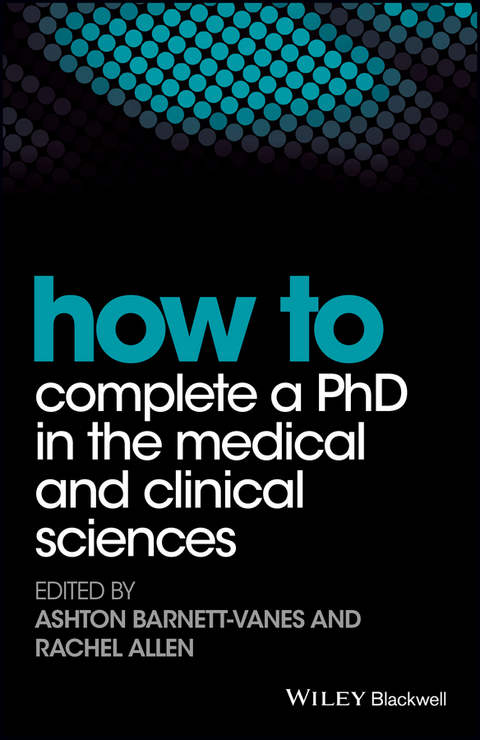
How to Complete a PhD in the Medical and Clinical Sciences (eBook)
John Wiley & Sons (Verlag)
978-1-119-18961-9 (ISBN)
How to Complete a PhD in the Medical and Clinical Sciences provides fresh insight into the PhD process and a concise framework to aid current and prospective students undertaking research in the medical and clinical sciences.
Filled with useful hints, tips, and practical guidance, the book covers key topics relevant to a PhD researcher such as publishing and presenting, core principles and techniques in medical science, dealing with common pitfalls, and how to write up and move on.
Featuring contributions from authors with experience across the PhD research career spectrum, How to Complete a PhD in the Medical and Clinical Sciences is an invaluable resource for those undertaking their doctoral studies.
Dr Ashton Barnett-Vanes, MB-PhD Candidate, St George's, University of London and Imperial College London, UK.
Dr Rachel Allen, Reader in Immunology of Infection and Head of Graduate School, St George's, University of London, UK.
How to Complete a PhD in the Medical and Clinical Sciences provides fresh insight into the PhD process and a concise framework to aid current and prospective students undertaking research in the medical and clinical sciences. Filled with useful hints, tips, and practical guidance, the book covers key topics relevant to a PhD researcher such as publishing and presenting, core principles and techniques in medical science, dealing with common pitfalls, and how to write up and move on. Featuring contributions from authors with experience across the PhD research career spectrum, How to Complete a PhD in the Medical and Clinical Sciences is an invaluable resource for those undertaking their doctoral studies.
Dr Ashton Barnett-Vanes, MB-PhD Candidate, St George's, University of London and Imperial College London, UK. Dr Rachel Allen, Reader in Immunology of Infection and Head of Graduate School, St George's, University of London, UK.
Title Page 5
Copyright Page 6
Contents 7
List of contributors 13
About the editors 17
Foreword 19
Preface 21
Acknowledgements 23
Chapter 1 Introduction 25
A PhD 25
Perspective 26
Why a book? How to use it 29
References 30
Chapter 2 Deciding on and finding a PhD 31
Background 31
Routes of entry 32
Clinical track 32
Pre-qualification route 33
Post-qualification PhD route 34
How to find one 35
Choosing a project 37
Checklist I: Shortlisting potential PhD projects 37
Checklist II: Finalising your decision on a PhD project 38
Making an application 40
Interviews 41
How to fund one 42
Reference 46
Further reading 46
Chapter 3 Anatomy of a PhD: Where you fit in the academic world 47
Background: Welcome to the new you 47
You are here: PhD research versus undergraduate studies 48
Lab types: A field guide 49
The student (you) 49
Technicians 49
Support staff 50
Post-docs 50
PIs (principle investigators) 50
A note on advanced academic-ology 51
It’s tricky: The student?supervisor interaction 51
Check out my massive organogram 52
Other dull, but important stuff 53
Graduate school 53
Part-time and full-time 55
Conclusion 55
Reference 56
Chapter 4 Core techniques, principles and statistics 57
Genomics 57
Nucleic acids 57
Proteins 60
Conclusion 61
Metabolomics 62
Metabolomics in a PhD project 62
Combination technologies 63
Common pitfalls 63
Flow cytometry 64
How does flow cytometry work? 64
Applications 65
Important considerations 67
Statistics 69
Speak to a friendly statistician – early! 69
Calculating your sample size 70
Analysing your data 70
Improving your statistical skills 72
References 73
Further reading 73
Chapter 5 Take off: Year 1 75
Background 75
Understanding your team and project 76
The literature 77
The research proposal 79
Starting experiments 80
Data management and record keeping 81
The ‘transfer’ 82
Conclusion 83
Common pitfalls 83
Chapter 6 Dealing with problems 87
Background 87
General problems 88
Work-life balance 88
Personal difficulties 89
Financial difficulties 89
Loneliness 90
Academic problems 90
Assessing your progress against peers 90
Lack of structure 91
Procrastination 91
Fear of criticism 92
Building resilience 93
Common PhD problems 93
Project title 93
Project direction 94
Supervisors 94
Colleagues 96
Conclusions 96
References 97
Further reading 97
Chapter 7 Breaking ground: Year 2 99
Background 99
Taking ownership of your project 99
Shaping the research direction 100
From preliminary to publishable data 101
Supervising junior students 103
The end of Year 2 review/assessment 104
Conclusion 106
Common pitfalls 106
Chapter 8 Presenting and publishing as a PhD student 109
Background 109
Presentations 109
Why should you present? 109
Common presentation scenarios 110
How to present 111
Abstract submission 111
Oral presentations 111
Poster presentations 112
General considerations for presentations 113
Publications 113
Why? 114
What? 114
Where 114
Writing an original research article 114
Overview 114
Title 115
Abstract 115
Introduction 115
Methods (and materials) 115
Results 116
Discussion 116
Conclusion 117
Bibliography 117
Writing a review article 117
Overview 117
Systematic reviews: The basics 117
Introduction 118
Methods 118
Results 119
Discussion and conclusion 119
Narrative reviews 119
Final steps 119
Covering letter 119
Acknowledgements 120
Writing style 120
Managing the process 120
Authors 120
Drafts 121
Open access and your thesis 121
Journal amendments and response to reviewer comments 121
Other considerations 122
Conclusion 122
References 122
Further reading 122
Chapter 9 Landing and writing up: Year 3 123
Background 123
An exit strategy 123
The X Factor results 124
Before you start writing 125
Writing your thesis: Part 1 126
Declaration 127
Abbreviations 127
Acknowledgements 127
Table of Contents, figures and tables 128
Bibliography 129
Writing your thesis: Part 2 129
Introduction 129
Aims and Hypothesis 130
Materials and Methods 130
Results 131
Discussion 133
Conclusion/Future work 134
Selection of examiners 134
Conclusion 135
Common pitfalls 135
Further reading 136
Chapter 10 The viva and moving on 137
Background 137
An examiner’s perspective (Rachel) 137
The viva 139
Preparation 139
On the day 139
What to expect 140
Corrections 141
Minor 142
Major 142
Fail 143
Career routes 143
Academia 144
Research-related careers: Industry 145
Research-related careers: Publishing 145
Non-scientific careers 146
Further study 146
Returning to clinical training 146
Conclusion 147
Further reading 147
Chapter 11 PhDs in veterinary science and medicine 149
Background 149
Is it for me? 150
Your project 152
Impact 152
Knowledge base 152
Reagents 153
Animal genomes 153
Funding 154
Presenting and publishing your findings 154
Post-PhD, what’s next for me? 155
Conclusion 157
Possible concerns 157
Acknowledgements 158
Reference 158
Chapter 12 International perspectives on medical and clinical science PhDs 159
Background 159
Choosing a country 159
Duration and content 160
Language 160
Work ethos 160
Finding a department 160
‘Full’ PhDs versus ‘dual-PhDs’ 161
Full PhD 161
Dual PhD 163
Going abroad on a ‘home’ PhD 163
Interviewing in a lab abroad 163
Funding 164
Administrative issues 164
Status 164
Health care and assessments 166
The local office for international affairs 166
Maintaining clinical contact 166
Conclusion 167
Common pitfalls 167
Further reading 168
Chapter 13 What I’m really thinking: The post-doc 169
Background 169
It is great to be a post?doc! 169
Is it really that great? 170
A post-doc’s advice 170
Choose the position carefully 171
Publications, publications, publications 171
Grant writing 172
Visibility and networking 172
Teaching and mentoring 172
Conclusion 173
Further reading 173
Chapter 14 What I’m really thinking: The Professor 175
Index 177
EULA 179
'Intended as a step-by-step guide, the book is a good summary of the major steps, pitfalls along the way, and advice on how to be successful as a student ... There are not many books that attempt to do what this one does, and there is not much written about this topic in general, so students should find this a useful resource. Doing a PhD is often fraught with uncertainty, and a written guide to the steps would be helpful for most students, especially as they begin the program.' Doody's, November 2017
'How to Complete a PhD in the Medical and Clinical Sciences aims (and succeeds) in remaining concise, it examines every aspect of the PhD journey in a comprehensive and precise manner. I would strongly recommend the book to anyone doing or planning to do a PhD in Medical, Clinical, Biomedical or Life Sciences. As well as, frankly, any other subject.' Kristine Bagdassarian, FindAPhD.com
| Erscheint lt. Verlag | 2.5.2017 |
|---|---|
| Reihe/Serie | HOW - How To |
| HOW - How To | How To |
| Sprache | englisch |
| Themenwelt | Medizin / Pharmazie ► Allgemeines / Lexika |
| Medizin / Pharmazie ► Medizinische Fachgebiete | |
| Schlagworte | Clinical & Experimental Medical Research • clinical science • clinical science student • core techniques • Guide • Klinische u. experimentelle medizinische Forschung • Life Science • Medical literature • Medical Professional Development • Medical Science • medical student • Medical Writing • Medicine • Medizin • Perspektiven in medizinischen Berufen • PhD • Presenting • Principles • Promotion • Research • Statistics • Verfassen medizinischer Texte • Veterinary Medicine • Veterinary Science • Writing |
| ISBN-10 | 1-119-18961-6 / 1119189616 |
| ISBN-13 | 978-1-119-18961-9 / 9781119189619 |
| Informationen gemäß Produktsicherheitsverordnung (GPSR) | |
| Haben Sie eine Frage zum Produkt? |
 PDF (Adobe DRM)
Kopierschutz: Adobe-DRM
Adobe-DRM ist ein Kopierschutz, der das eBook vor Mißbrauch schützen soll. Dabei wird das eBook bereits beim Download auf Ihre persönliche Adobe-ID autorisiert. Lesen können Sie das eBook dann nur auf den Geräten, welche ebenfalls auf Ihre Adobe-ID registriert sind.
Details zum Adobe-DRM
Dateiformat: PDF (Portable Document Format)
Mit einem festen Seitenlayout eignet sich die PDF besonders für Fachbücher mit Spalten, Tabellen und Abbildungen. Eine PDF kann auf fast allen Geräten angezeigt werden, ist aber für kleine Displays (Smartphone, eReader) nur eingeschränkt geeignet.
Systemvoraussetzungen:
PC/Mac: Mit einem PC oder Mac können Sie dieses eBook lesen. Sie benötigen eine
eReader: Dieses eBook kann mit (fast) allen eBook-Readern gelesen werden. Mit dem amazon-Kindle ist es aber nicht kompatibel.
Smartphone/Tablet: Egal ob Apple oder Android, dieses eBook können Sie lesen. Sie benötigen eine
Geräteliste und zusätzliche Hinweise
Buying eBooks from abroad
For tax law reasons we can sell eBooks just within Germany and Switzerland. Regrettably we cannot fulfill eBook-orders from other countries.
aus dem Bereich