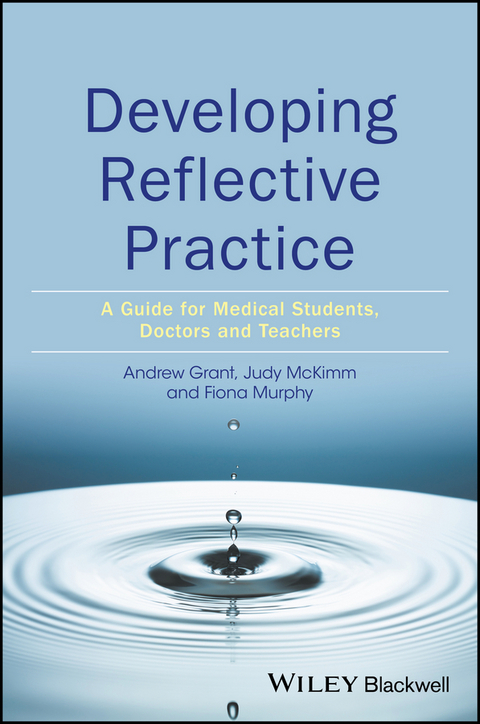
Developing Reflective Practice (eBook)
John Wiley & Sons (Verlag)
978-1-119-06475-6 (ISBN)
The ability to reflect on practice is a fundamental component of effective medical practice. In a sector increasingly focused on professionalism and patient-centred care, Developing Reflective Practice is a timely publication providing practical guidance on how to acquire the reflective skills necessary to become a successful clinician.
This new title draws from a wide range of theoretical and practical multidisciplinary perspectives to assist students, practitioners and educators in embedding reflection in everyday activities. It also offers structures and ideas for more purposeful and meaningful formal reflections and professional development.
Developing Reflective Practice:
- Focuses on the developing practitioner and their lifelong learning and the development of professional identity through reflection
- Provides practical how-to information for students, practitioners and educators, including realistic case examples and practice-based hints and tips
- Examines and explains the theoretical and conceptual approaches to reflective practice, including its models and frameworks.
Professor Andrew Grant is Dean of Medical Education at Swansea University Medical School, UK.
Professor Judy McKimm is Professor of Medical Education and Director of Strategic Educational Development at Swansea University Medical School, UK.
Professor Fiona Murphy is Professor of Clinical Nursing at the University of Limerick, Ireland.
The ability to reflect on practice is a fundamental component of effective medical practice. In a sector increasingly focused on professionalism and patient-centred care, Developing Reflective Practice is a timely publication providing practical guidance on how to acquire the reflective skills necessary to become a successful clinician. This new title draws from a wide range of theoretical and practical multidisciplinary perspectives to assist students, practitioners and educators in embedding reflection in everyday activities. It also offers structures and ideas for more purposeful and meaningful formal reflections and professional development. Developing Reflective Practice: Focuses on the developing practitioner and their lifelong learning and the development of professional identity through reflection Provides practical how-to information for students, practitioners and educators, including realistic case examples and practice-based hints and tips Examines and explains the theoretical and conceptual approaches to reflective practice, including its models and frameworks.
Professor Andrew Grant is Dean of Medical Education at Swansea University Medical School, UK. Professor Judy McKimm is Professor of Medical Education and Director of Strategic Educational Development at Swansea University Medical School, UK. Professor Fiona Murphy is Professor of Clinical Nursing at the University of Limerick, Ireland.
Cover 1
Title Page 5
Copyright 6
Contents 7
Acknowledgements 13
About the Authors 15
Part I What is Reflection? 17
Chapter 1 Perspectives on Reflection 19
Reflective Learning: Making a Difference – Andrew Grant 19
Start Early, Make it Routine – Judy McKimm 21
Some Challenges for Reflective Practice – Fiona Murphy 23
About the Book: Structure and Content Overview 24
Chapter 2 What is Reflection and Why Do We Do It? 27
Why are Learners Required to Reflect? 27
The Place of Reflection in Professional Development 29
John Dewey’s Contribution 31
What can be Achieved by Reflection? 31
Getting the Most Out of Reflection 32
Summary 34
Chapter 3 Theoretical Underpinnings of Reflection 35
Kolb 36
Freire 36
Applying and Integrating Learning Through Reflection 37
Knowledge – a Constantly-Changing Network 37
Deep and Surface Approaches to Learning 38
Reflection In Action, Reflection On Action – Donald Schön 39
The Uncertain World of Practice 40
Emotional Content of Learning 40
Summary 41
Chapter 4 Frameworks for Reflection 43
Introduction 43
Frameworks for Reflection 44
Summary 51
Part II Learning Reflection 53
Chapter 5 Reflecting in Practice 55
Capturing and Describing the Experience 55
‘Less than a Minute’ Techniques 56
One to Five Minute Techniques 57
Analysing the Experience 59
Summary 65
Chapter 6 Writing Reflectively 67
What is Reflective Writing? 67
Different Types of Reflective Writing 67
Creative Writing 68
Analytical–Academic Reflective Writing 71
Some Issues with Reflective Writing 77
Summary 78
Chapter 7 Reflective Activities 79
Types of Reflective Learning Activity 79
Supporting Reflective Learning 81
Summary 86
Chapter 8 Reflection, Critical Thinking and Action Research 87
Connecting Reflection and Knowledge Generation 87
Connecting Reflection, Knowledge and Research through Critical Thinking 88
1. Identifying and Challenging Assumptions 90
2. Recognizing the Importance of Context 92
3. Exploring and Imagining Alternatives 93
4. Reflective Scepticism 94
Action Research: Connecting Reflection, Knowledge and Critical Thinking 94
Summary 98
Part III Facilitating Reflection 99
Chapter 9 Teaching and Supporting Reflection 101
Aims, Goals and Purpose 102
Supporting Learners to Get Started as Reflective Learners 103
Selecting the Right Method of Reflective Learning 104
Using Learning Technologies to Enable Reflection 109
Peer Learning 110
Reflection as Part of Developing Professional Identity 111
Evaluating Reflective Learning and Teaching 113
Summary 114
Chapter 10 Assessing Reflection 115
What Are You Looking For in Reflective Assessment? 116
Marking Reflective Work – a Cause of Potential Conflict 116
Effects of Making Reflective Learning Compulsory 117
Strategies to Discourage Students from Writing What They Think the Tutor Wants to Read or Will Gain Them Good Marks 118
Creating a Robust, Defensible Assessment for Your Students’ Reflective Work 120
Ensuring Robust, Valid, Reliable Assessment 121
Summary 123
Part IV Developing as a Reflective Practitioner 125
Chapter 11 The Role of Reflection in Developing Professional Identity 127
How Does Reflective Practice Form Professional Identity? 128
How Can Reflection Be Challenging to Professional Identity? 129
Self Theories, PIF and Reflective Practice 130
How Can Guided Reflection Be Challenging Without Being Threatening? 132
Summary 133
Chapter 12 Reflection, Revalidation and Appraisal 135
Adult Learning – Andragogy 135
1. The Need to Know 136
2. The Learners’ Self-Concept 136
3. The Role of the Learners’ Experiences 137
4. Readiness to Learn 137
5. Orientations to Learning 137
6. Motivation 137
Maximizing Learning Return on Effort 138
A Curriculum Based on Your Experience 139
Learning that is Intrinsically Rewarding 141
Keeping a Record for CPD, Appraisal and Revalidation 142
Demonstrating Learning and Development over Time 143
Summary 144
References and Resources 145
Index 153
EULA 0
| Erscheint lt. Verlag | 12.4.2017 |
|---|---|
| Sprache | englisch |
| Themenwelt | Medizin / Pharmazie ► Allgemeines / Lexika |
| Medizin / Pharmazie ► Medizinische Fachgebiete ► Medizinethik | |
| Medizin / Pharmazie ► Studium | |
| Schlagworte | medical education • Medical Professional Development • Medical Science • Medizin • Medizinstudium • Patient-Centred Care • Perspektiven in medizinischen Berufen • professional development • Professionalism • Reflect • Reflections • reflective practice |
| ISBN-10 | 1-119-06475-9 / 1119064759 |
| ISBN-13 | 978-1-119-06475-6 / 9781119064756 |
| Informationen gemäß Produktsicherheitsverordnung (GPSR) | |
| Haben Sie eine Frage zum Produkt? |
 PDF (Adobe DRM)
Kopierschutz: Adobe-DRM
Adobe-DRM ist ein Kopierschutz, der das eBook vor Mißbrauch schützen soll. Dabei wird das eBook bereits beim Download auf Ihre persönliche Adobe-ID autorisiert. Lesen können Sie das eBook dann nur auf den Geräten, welche ebenfalls auf Ihre Adobe-ID registriert sind.
Details zum Adobe-DRM
Dateiformat: PDF (Portable Document Format)
Mit einem festen Seitenlayout eignet sich die PDF besonders für Fachbücher mit Spalten, Tabellen und Abbildungen. Eine PDF kann auf fast allen Geräten angezeigt werden, ist aber für kleine Displays (Smartphone, eReader) nur eingeschränkt geeignet.
Systemvoraussetzungen:
PC/Mac: Mit einem PC oder Mac können Sie dieses eBook lesen. Sie benötigen eine
eReader: Dieses eBook kann mit (fast) allen eBook-Readern gelesen werden. Mit dem amazon-Kindle ist es aber nicht kompatibel.
Smartphone/Tablet: Egal ob Apple oder Android, dieses eBook können Sie lesen. Sie benötigen eine
Geräteliste und zusätzliche Hinweise
Buying eBooks from abroad
For tax law reasons we can sell eBooks just within Germany and Switzerland. Regrettably we cannot fulfill eBook-orders from other countries.
aus dem Bereich