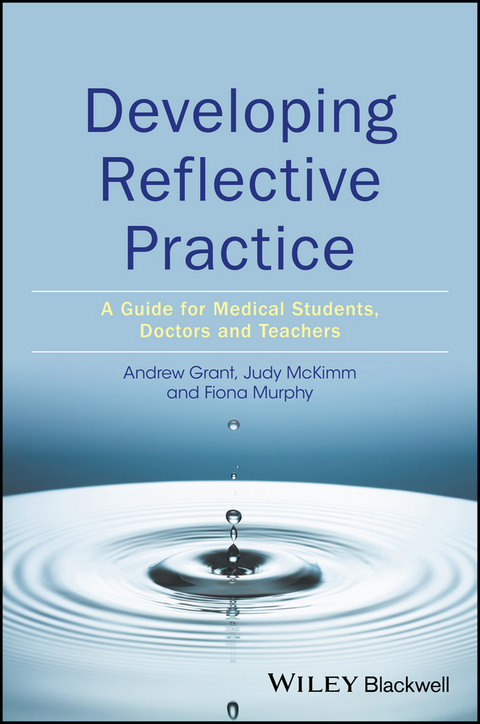
Developing Reflective Practice (eBook)
John Wiley & Sons (Verlag)
978-1-119-06476-3 (ISBN)
The ability to reflect on practice is a fundamental component of effective medical practice. In a sector increasingly focused on professionalism and patient-centred care, Developing Reflective Practice is a timely publication providing practical guidance on how to acquire the reflective skills necessary to become a successful clinician.
This new title draws from a wide range of theoretical and practical multidisciplinary perspectives to assist students, practitioners and educators in embedding reflection in everyday activities. It also offers structures and ideas for more purposeful and meaningful formal reflections and professional development.
Developing Reflective Practice:
- Focuses on the developing practitioner and their lifelong learning and the development of professional identity through reflection
- Provides practical how-to information for students, practitioners and educators, including realistic case examples and practice-based hints and tips
- Examines and explains the theoretical and conceptual approaches to reflective practice, including its models and frameworks.
Professor Andrew Grant is Dean of Medical Education at Swansea University Medical School, UK.
Professor Judy McKimm is Professor of Medical Education and Director of Strategic Educational Development at Swansea University Medical School, UK.
Professor Fiona Murphy is Professor of Clinical Nursing at the University of Limerick, Ireland.
The ability to reflect on practice is a fundamental component of effective medical practice. In a sector increasingly focused on professionalism and patient-centred care, Developing Reflective Practice is a timely publication providing practical guidance on how to acquire the reflective skills necessary to become a successful clinician. This new title draws from a wide range of theoretical and practical multidisciplinary perspectives to assist students, practitioners and educators in embedding reflection in everyday activities. It also offers structures and ideas for more purposeful and meaningful formal reflections and professional development. Developing Reflective Practice: Focuses on the developing practitioner and their lifelong learning and the development of professional identity through reflection Provides practical how-to information for students, practitioners and educators, including realistic case examples and practice-based hints and tips Examines and explains the theoretical and conceptual approaches to reflective practice, including its models and frameworks.
Professor Andrew Grant is Dean of Medical Education at Swansea University Medical School, UK. Professor Judy McKimm is Professor of Medical Education and Director of Strategic Educational Development at Swansea University Medical School, UK. Professor Fiona Murphy is Professor of Clinical Nursing at the University of Limerick, Ireland.
Chapter 2
What is Reflection and Why Do We Do It?
In this chapter we look at the reasons why learners are asked to reflect and what they might expect to gain from reflective learning. We will also explore the difference between the kind of reflection that forms part of everyday life, such as thinking over the day's work while driving home, and the more structured reflective learning activities that are often asked for as part of a required syllabus or training programme. We will also describe in some detail what can be achieved by reflection and look at some techniques that will help you find ways of learning reflectively that are beneficial in helping you improve your practice.
Why are Learners Required to Reflect?
Many learners, when they are first faced with having to incorporate reflective activities in their learning, are very uncertain what they have to do. Where they actually have to submit reflective learning work they are unclear what it should look like and, if it is to be assessed, what would gain them good marks. So what is it that causes teachers and educators to decide whether or not to include reflection among learning activities?
There are a number of reasons for encouraging (even requiring) doctors and other health professionals to reflect on their practice throughout their lives. Reflection, if well structured and supported, helps to put more responsibility for learning onto the learner. More than anything else, reflective learning activities should encourage learners to be constructively critical of their learning and their developing practice as professionals. In this context, ‘critical’ is not about being a theatre critic or finding fault, but it is about an unwillingness to accept, unquestioningly, what one is told as right or correct, a readiness to ask ‘why’ questions and an approach to developing practice that embeds learning from experience. Reflective learners should be willing to question the assumptions underlying their existing understanding and be prepared to probe their knowledge for inconsistencies and lack of congruity. The learner in a classroom can easily be seen as a recipient of information and the teacher as the deliverer of it. However, we know that knowledge is constructed by the learner through social interaction with teachers and peers; therefore, to merely deliver information to a learner does not guarantee construction of any knowledge at all. Reflective learners on the other hand are being challenged to examine their current level of understanding and knowledge, and to see whether their current experience is compatible with this and, if not, what further activity is needed to bring them to the required level of understanding.
When someone is learning reflectively he or she is using a completely different sort of mental activity from that of sitting in a classroom listening to a teacher and (in theory anyway) absorbing factual information. Reflective learners, as well as exploring their own understanding and questioning things they are being told, are more likely to bring together current understanding with new information, and the active constructing of new or deeper knowledge is more likely to be the outcome from this kind of learning process (Ausubel, 2000). For example, if using a written journal as a method of reflecting, by writing down events and thoughts, learners are engaging in a different mental activity from just thinking them over or describing them to someone in conversation (Moon, 1999) (see Chapter 6).
Reflective learners need to think about how they learn as well as what they know. This kind of activity is often referred to as metacognition (see Box 2.1): in other words, thinking about, or managing, thinking.
Box 2.1 Metacognition
What might sound like yet another piece of jargon, metacognition describes the activities that take place when a learner goes beyond trying to assimilate information and takes a more active role in his or her learning. Literally ‘thinking about thinking’, metacognitive activity may include
- • recognizing how you learn,
- • identifying for yourself what it is that you need to learn,
- • recognizing gaps in your knowledge and skills,
- • identifying why you need to know or to learn something for yourself and
- • being aware of the reasons for learning something and its importance to you.
Through metacognitive activity, reflective learners become aware of what they know, what they don't know and the importance of things that they need to know. They should also have a sense of how they best go about learning in a particular situation. This is likely to make their learning more purposeful and intrinsically motivated, for reasons from within themselves. Intrinsically motivated learning is more likely to be carried out with a deep approach, is more likely to be retained and is associated with a better affective quality for the learner. This refers to the learner feeling more positive about the learning that has taken place. He or she may feel that the learning was more enjoyable or feel a sense of personal achievement. An increased management of learning, with the associated intrinsic motivation, results in a learner with a greater sense of self-efficacy. In other words the learner knows what he or she has learned and why he or she has learned it and has a good judgement of the level of his or her understanding and competence (see Box 2.2).
Box 2.2 Motivation and self-efficacy
The reasons why we are learning something might affect how well we learn it and how useful the learning is to us subsequently (Bruning, Schraw and Norby, 2011)
Extrinsically motivated learning takes place because the learner has been told he or she needs to learn something or is geared towards achieving something that will be seen by others as important. This might be on the instruction of a teacher or in preparation for an examination. Extrinsically motivated learning typically involves a surface approach and poorly integrated learning.
Intrinsically motivated learning is carried out because the learner realizes for themselves that the subject matter is necessary or important or that the subject stimulates interest or curiosity in them. Intrinsically motivated learning is more likely to involve a deep approach to learning and integration of the subject matter.
Self-efficacy is the sense each person has of his or her own ability to function in the world (Bandura, 1997). According to Dewey (1910), when learners realize that their understanding is flawed or incomplete it is their sense of self-efficacy that motivates them to put right the knowledge or understanding gap that they, themselves, have identified.
The Place of Reflection in Professional Development
As a medical student or qualified doctor you might find yourself asking the question ‘Why am I being asked to provide evidence of reflective learning?’. When doctors were first required to participate in continuing professional development they were mainly required to attend a fixed number of hours of didactic teaching each year. However, research failed to demonstrate that this approach results in much change, less still improvement, in patient care (Mathers, Mitchell and Hunn, 2012). Over recent years, there has been a shift in the requirements for qualified, practising doctors and subsequently for medical students. For example, in the United Kingdom, as part of the annual appraisal cycle and the five-yearly revalidation programme required by the General Medical Council, every registered doctor is required to provide evidence of reflective learning activity in relation to all aspects of their work (see Chapters 11 and 12). By participating in reflective learning, practitioners are encouraged to think about incidents relating to their practice that have, in some way, been out of the ordinary and stimulated them to revisit their knowledge, skills or professional behaviours in this area. By replacing the ‘hours of lectures’ or conference attendance (which can easily become a tick box activity) approach with a reflective one, doctors are being asked to take a far bigger part in the ongoing management of the knowledge and skills they need to continue to practise competently and safely. Each individual practitioner will have a unique collection of knowledge and skills in relation to his or her clinical practice. Therefore, by encouraging practitioners to identify the strengths and weaknesses of their knowledge and skills base, they are more likely to undertake specific, intrinsically motivated learning activities chosen to meet their individual learning needs. When doctors attend didactic sessions or conferences, they should reflect on how they have applied what they learned in their practice.
Everything said so far applies to medical students' and doctors in training's learning as much as it does to the continuing professional development of qualified doctors. Additionally, by making reflection a part of everyday practice early in their education and training, a skill is being acquired that will help them continue to learn, grow and monitor their readiness for practice throughout their careers. However, the spirit in which doctors and medical students undertake reflection makes a massive difference to how much they benefit from it. A doctor who reluctantly completes the required elements of their portfolio for appraisal the night before the closing...
| Erscheint lt. Verlag | 11.4.2017 |
|---|---|
| Sprache | englisch |
| Themenwelt | Medizin / Pharmazie ► Allgemeines / Lexika |
| Medizin / Pharmazie ► Medizinische Fachgebiete ► Medizinethik | |
| Medizin / Pharmazie ► Studium | |
| Schlagworte | medical education • Medical Professional Development • Medical Science • Medizin • Medizinstudium • Patient-Centred Care • Perspektiven in medizinischen Berufen • professional development • Professionalism • Reflect • Reflections • reflective practice |
| ISBN-10 | 1-119-06476-7 / 1119064767 |
| ISBN-13 | 978-1-119-06476-3 / 9781119064763 |
| Informationen gemäß Produktsicherheitsverordnung (GPSR) | |
| Haben Sie eine Frage zum Produkt? |
 EPUB (Adobe DRM)
Kopierschutz: Adobe-DRM
Adobe-DRM ist ein Kopierschutz, der das eBook vor Mißbrauch schützen soll. Dabei wird das eBook bereits beim Download auf Ihre persönliche Adobe-ID autorisiert. Lesen können Sie das eBook dann nur auf den Geräten, welche ebenfalls auf Ihre Adobe-ID registriert sind.
Details zum Adobe-DRM
Dateiformat: EPUB (Electronic Publication)
EPUB ist ein offener Standard für eBooks und eignet sich besonders zur Darstellung von Belletristik und Sachbüchern. Der Fließtext wird dynamisch an die Display- und Schriftgröße angepasst. Auch für mobile Lesegeräte ist EPUB daher gut geeignet.
Systemvoraussetzungen:
PC/Mac: Mit einem PC oder Mac können Sie dieses eBook lesen. Sie benötigen eine
eReader: Dieses eBook kann mit (fast) allen eBook-Readern gelesen werden. Mit dem amazon-Kindle ist es aber nicht kompatibel.
Smartphone/Tablet: Egal ob Apple oder Android, dieses eBook können Sie lesen. Sie benötigen eine
Geräteliste und zusätzliche Hinweise
Buying eBooks from abroad
For tax law reasons we can sell eBooks just within Germany and Switzerland. Regrettably we cannot fulfill eBook-orders from other countries.
aus dem Bereich