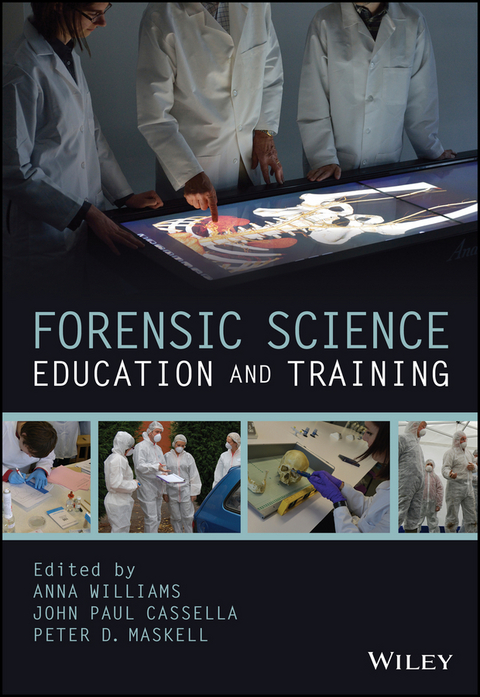
Forensic Science Education and Training (eBook)
John Wiley & Sons (Verlag)
978-1-118-68915-8 (ISBN)
A comprehensive and innovative guide to teaching, learning and assessment in forensic science education and practitioner training
- Includes student exercises for mock crime scene and disaster scenarios
- Addresses innovative teaching methods including apps and e-gaming
- Discusses existing and proposed teaching methods
Edited by
Anna Williams School of Applied Sciences, University of Huddersfield, UK
John Paul Cassella Department of Forensic Science and Crime Science, Staffordshire University, UK
Peter D. Maskell School of Science, Engineering and Technology, Abertay University, UK
A comprehensive and innovative guide to teaching, learning and assessment in forensic science education and practitioner training Includes student exercises for mock crime scene and disaster scenarios Addresses innovative teaching methods including apps and e-gaming Discusses existing and proposed teaching methods
Anna Williams School of Applied Sciences, University of Huddersfield, UK John Paul Cassella Department of Forensic Science and Crime Science, Staffordshire University, UK Peter D. Maskell School of Science, Engineering and Technology, Abertay University, UK
"Overall this book is successful in its aims; it is relevant and places emphasis on the importance of quality and standards within forensic science education"....."This book would be of benefit to forensic educators and trainers providing some beneficial opportunities to enhance teaching material and develop curriculums" Ruth Buckley MCSFS on behalf of The Chartered Society of Forensic Sciences
1
Forensic Science Education – The Past and the Present In and Out of the Classroom
John P. Cassella,1 Peter D. Maskell,2 and Anna Williams3
1Staffordshire University, Department of Forensic Science and Crime Science, Faculty of Computing, Engineering and Science, Science Centre, Stoke on Trent, UK
2Abertay University, School of Science, Engineering and Technology, Dundee, UK
3University of Huddersfield, School of Applied Sciences, Queensgate, Huddersfield, UK
Introduction
This chapter aims to reflect upon and to consider the ‘where are we now’ aspect of forensic science education and training. Despite the rhythms and reflective cycle that academia requires, it is surprising how little time the on-the-ground academics and practitioners involved in education and training get to truly reflect upon the curriculum and assessment of what they deliver. Of course what is specifically taught depends upon many variables; the interests, skills and experiences of those academics delivering the material coupled with the requirement of the industry to teach it. Whilst such criteria are of importance to say ‘art’ colleagues in their curriculum design, they are not as crucial as they are to a subject such as forensic science. This offers limited latitude for what is taught and requires industry professionals and accreditation boards to drive the expectations of the curricula to a greater degree. What is apparent over the coming pages is the change and the rate of change that has taken place in the forensic science profession at all levels, technical, practical and academic and its use within the Courtroom is now greater than ever, demanding higher and higher levels of skill, competence and understanding of what is useful in a police investigation and criminal trial.
Forensic science is a ‘critical and integral part’ of any judicial system in the 21st Century because forensic science is one of the primary means through which ‘democratic governments fulfill one of the most fundamental obligations to their citizens: public safety insurance in a just manner’.
Houck, 2006
Well over a decade ago, in 2000, in the United Kingdom (UK), the educational landscape for forensic science was very different to today's current situation.
The changes that have occurred in the past decade not only in the forensic science area but also within policing (Neuroyd, 2011) are the greatest since either forensic science or indeed policing came into being. A number of key national and international events have occurred and documents have been published that have aimed to examine the status quo and to offer direction for future developments within forensic science and hence its delivery and education. Some of these early key events and the documentation resulting from them include:
- The report by the UK House of Commons Science and Technology Committee – Forensic Science on Trial, published in 2005.
- The UK SEMTA Report (Science, Engineering, Manufacturing Technologies Alliance (SEMTA) Sector Skills Council, Forensic Science: Implications for Higher Education 2004, UK) of 2004 on the forensic science implications for Higher Education institutions.
- The UK Skills for Justice Report in 2009 for the Forensic Science Occupational Committee in 2009 into the provision of forensic science degree programmes in UK Higher Education institutions (HEIs).
- The National Academy of Sciences (USA) report (2009) into strengthening forensic science in the United States.
- The publication of the Silverman report on UK Forensic Science Research published in 2011.
- The ‘paradigm shift for UK Forensic Science’ (Royal Society Meeting) in 2015 … and the list could go on.
As a result of the field's prominence and popularity (Mennell, 2006), the number of education providers offering forensic science courses and the number of students enrolling in these courses increased exponentially (Engber, 2005; NIFS, 2006) but the subjective observation is that there is now a downward trend in recruitment in forensic science courses in favour of policing based education.
The expansion in forensic science education worldwide driven by university consumer forces and popular demand, in addition to the inconsistency and lack of clarity in the huge range of forensic science courses on offer, have led to inconsistencies in skills and competencies acquired by the graduates seeking employment in the field. Whilst this has clearly been addressed through accreditation by the laudable attempts of learned societies in their host countries (such as the UK Chartered Society of Forensic Sciences) to harmonise the content of delivery, this has worked within countries to some extent, but less so across countries, which reflects the relationship of forensic science with the law and the wider Criminal Justice System within that particular country.
In 2004 that may have been the case, but the situation is now somewhat improved. The question concerning the variety and the value of the many publications and reports on this topic into forensic science provision and education and the legacies and the recommendations that they have offered will be considered further within this chapter and indeed as a paradigm throughout this book. There is, however, much still to be done as forensic science education enters the second decade in the UK HEIs. As Samarji (2012) observed, forensic science academic programmes are still characterised by a great deal of randomness and uncertainty.
Burnett et al. (2001) had argued that little research has been undertaken and published on forensic science education; it is reasonable to surmise that this issue of a paucity of literature at the turn of the twenty-first century has long since been redressed with a myriad of documents, investigations and recommendations at national and international level into all levels and aspects of forensic science. Four years later, Lewis et al. (2005) concluded that the random expansion in forensic science education worldwide, in addition to an inconsistency and lack of clarity in the wide range of forensic science courses on offer, led to variations in the skills and the competencies acquired by trainees and graduates seeking employment in the forensic field. Moreover, forensic science education departments still lack formal arrangements with practitioners and employers to discuss course content, delivery and assessment. Currently in the HEI sector, at best there is a ‘Memorandum of Understanding’ but more often there is a reliance upon the good will of management level staff from both the academic and practitioner organisations involved. Instead ‘what exists is a series of ad hoc arrangements’ (with a couple of notable exceptions), which occur on an individual basis between employers or individuals and UK universities through which ‘employers liaise with universities about particular courses’ (SEMTA, 2004) and how they should or could develop their courses.
Forensic science suffers a non-consensus within the academic community on whether it is a stand-alone and distinct applied field of knowledge, an associate field of study, or merely a technical derivative of existing arenas. Moreover, some scholars and practitioners argue in the public domain in the extreme as to whether or not forensic science education is a necessity at all within Higher Education.
Despite this dialogue, criticisms by potential employers (Lewis et al., 2005) abound more than a decade after the first courses were introduced. Forensic science (education) departments still lack formal arrangement or requirements with employers and national level organisations, for example, the College of Policing (CoP), Chartered Society of Forensic Sciences (CSFS) and Skills for Justice (SfJ), offering endorsement programmes to discuss course content in a meaningful fashion and certainly not at a national, European-wide or international level.
These inconsistencies have resulted, particularly in forensic science education courses because of the lack of dialogue between the various contexts, cultures and mind-set, in a field of shifting but unconfirmed reigning paradigms. This lack of dialogue, compounded by the lack of Quality Assurance Agency (QAA) guidance (until 2012), had resulted in a set of competencies determined to a large degree by the skill set of the academics from the university at the time that the course was first designed. This has been offset in part by up-skilling of HEI academics in the realisation, from advice given by forensic practitioners from industry when attending university forensic science course ‘validation events,’ that the course must be more than `forensic' in name. Whilst this has been achieved to varying levels across the HEI sector, most, if not all institutions involved, are guilty (in part) of not fully entering into dialogue with legal or policing colleagues. The closure of the UK Forensic Science Service (FSS) in 2012 had one positive effect upon HEIs as an industry, in that it offered a willing pool of highly qualified individuals who could join the academic teams. Previously, such individuals had only entered this pool at retirement on a visiting lecturer basis.
Despite the prominence and high stature that forensic science has gained within the general public consciousness and the consequent expansion it has achieved within...
| Erscheint lt. Verlag | 12.4.2017 |
|---|---|
| Sprache | englisch |
| Themenwelt | Studium ► 2. Studienabschnitt (Klinik) ► Rechtsmedizin |
| Naturwissenschaften ► Chemie | |
| Recht / Steuern ► Strafrecht ► Kriminologie | |
| Sozialwissenschaften ► Pädagogik ► Berufspädagogik | |
| Sozialwissenschaften ► Pädagogik ► Erwachsenenbildung | |
| Technik | |
| Schlagworte | Analytische Chemie / Forensik • Biowissenschaften • Chemie • Chemistry • crime scene houses • Criminal Law • forensic concepts • forensic practitioners • Forensics • Forensic Science • forensic science educators • forensic science learning providers • Forensic Science professional trainers • forensic science students • forensic science teaching • forensic science training course providers • Forensik • Law • Law Enforcement Agencies • Life Sciences • mock crime scenes • Police Forces • professional scientists • Rechtswissenschaft • researchers in forensic science • Strafrecht • taphonomy facilities • Virtopsy • virtual anatomy |
| ISBN-10 | 1-118-68915-1 / 1118689151 |
| ISBN-13 | 978-1-118-68915-8 / 9781118689158 |
| Informationen gemäß Produktsicherheitsverordnung (GPSR) | |
| Haben Sie eine Frage zum Produkt? |
 EPUB (Adobe DRM)
Kopierschutz: Adobe-DRM
Adobe-DRM ist ein Kopierschutz, der das eBook vor Mißbrauch schützen soll. Dabei wird das eBook bereits beim Download auf Ihre persönliche Adobe-ID autorisiert. Lesen können Sie das eBook dann nur auf den Geräten, welche ebenfalls auf Ihre Adobe-ID registriert sind.
Details zum Adobe-DRM
Dateiformat: EPUB (Electronic Publication)
EPUB ist ein offener Standard für eBooks und eignet sich besonders zur Darstellung von Belletristik und Sachbüchern. Der Fließtext wird dynamisch an die Display- und Schriftgröße angepasst. Auch für mobile Lesegeräte ist EPUB daher gut geeignet.
Systemvoraussetzungen:
PC/Mac: Mit einem PC oder Mac können Sie dieses eBook lesen. Sie benötigen eine
eReader: Dieses eBook kann mit (fast) allen eBook-Readern gelesen werden. Mit dem amazon-Kindle ist es aber nicht kompatibel.
Smartphone/Tablet: Egal ob Apple oder Android, dieses eBook können Sie lesen. Sie benötigen eine
Geräteliste und zusätzliche Hinweise
Buying eBooks from abroad
For tax law reasons we can sell eBooks just within Germany and Switzerland. Regrettably we cannot fulfill eBook-orders from other countries.
aus dem Bereich