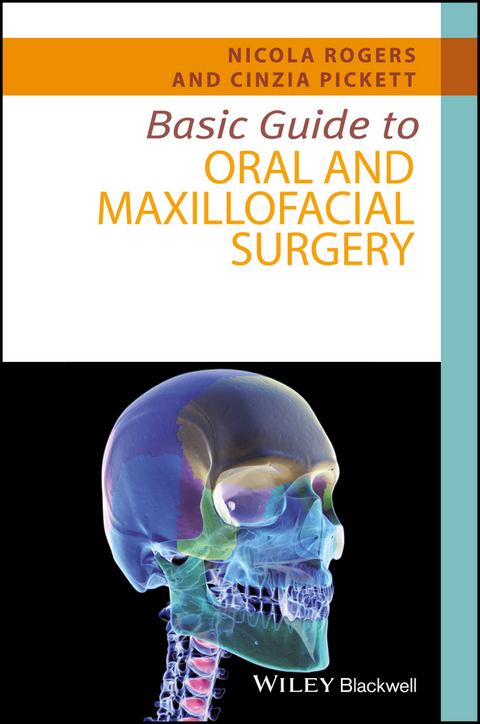
Basic Guide to Oral and Maxillofacial Surgery (eBook)
John Wiley & Sons (Verlag)
978-1-118-92505-8 (ISBN)
An illustrated guide to oral and maxillofacial surgery, written by dental nurses for dental nurses
Basic Guide to Oral and Maxillofacial Surgery will help you understand the role of the dental nurse in oral and maxillofacial surgical procedures. Written in a highly accessible style, comprehensive coverage includes anatomy of the head and neck, pain and anxiety control, assessment clinics, equipment selection, extractions, soft tissue lesions, and trauma and more complex procedures.
Key features include:
- Learning outcomes at the start of each chapter, and full-colour photographs and line drawings throughout
- An overview of the maxillofacial team, the referral process and the legal aspects of maxillofacial procedures
- Clear explanations of the various duties performed by dental nurses during oral and maxillofacial surgery
Basic Guide to Oral and Maxillofacial Surgery is suitable for dental nurses working in practice or specialist maxillofacial units, and is also ideal for student dental nurses working towards the NEBDN National Diploma in Dental Nursing.
About the Authors
Nicola Rogers is a Dental Nurse Tutor and NEBDN National Diploma in Dental Nursing Examiner, based at the Bristol Dental Hospital, Bristol, UK. She was the winner of the 2010 Tutor of the Year at the DDU Educational Awards. Nicola is the author of Basic Guide to Dental Sedation Nursing (Wiley-Blackwell, 2011) and co-author of Post Registration Qualifications for Dental Care Professionals: Questions and Answers (Wiley-Blackwell, 2015).
Cinzia Pickett is a dental nurse and NEBDN National Diploma in Dental Nursing Examiner. She was the winner of the 2011 NEBDN Oral Health Education - Most Outstanding Candidate Award.
An illustrated guide to oral and maxillofacial surgery, written by dental nurses for dental nurses Basic Guide to Oral and Maxillofacial Surgery will help you understand the role of the dental nurse in oral and maxillofacial surgical procedures. Written in a highly accessible style, comprehensive coverage includes anatomy of the head and neck, pain and anxiety control, assessment clinics, equipment selection, extractions, soft tissue lesions, and trauma and more complex procedures. Key features include: Learning outcomes at the start of each chapter, and full-colour photographs and line drawings throughout An overview of the maxillofacial team, the referral process and the legal aspects of maxillofacial procedures Clear explanations of the various duties performed by dental nurses during oral and maxillofacial surgery Basic Guide to Oral and Maxillofacial Surgery is suitable for dental nurses working in practice or specialist maxillofacial units, and is also ideal for student dental nurses working towards the NEBDN National Diploma in Dental Nursing.
About the Authors Nicola Rogers is a Dental Nurse Tutor and NEBDN National Diploma in Dental Nursing Examiner, based at the Bristol Dental Hospital, Bristol, UK. She was the winner of the 2010 Tutor of the Year at the DDU Educational Awards. Nicola is the author of Basic Guide to Dental Sedation Nursing (Wiley-Blackwell, 2011) and co-author of Post Registration Qualifications for Dental Care Professionals: Questions and Answers (Wiley-Blackwell, 2015). Cinzia Pickett is a dental nurse and NEBDN National Diploma in Dental Nursing Examiner. She was the winner of the 2011 NEBDN Oral Health Education - Most Outstanding Candidate Award.
How to use this book vii
Acknowledgements ix
1 Introduction 1
2 Anatomy of the head, neck and skull 9
3 Pain and anxiety control 25
4 Assessment clinics, equipment and medicaments used during complex procedures 47
5 Extractions 59
6 Soft tissue lesions and conditions of the mouth, and methods of their investigation 89
7 Trauma and complex procedures 105
Index 141
Chapter 1
Introduction
Learning Outcomes
At the end of this chapter you should have an understanding of:
- 1. Where maxillofacial surgery is carried out and by whom.
- 2. The procedures that are included under the umbrella of maxillofacial surgery.
- 3. Why maxillofacial surgery is undertaken.
- 4. The members of the dental team that make up the maxillofacial team.
- 5. The referral system.
- 6. The legal aspects associated with the provision of maxillofacial procedures.
Introduction
Maxillofacial surgery forms an appreciable part of daily practice for the non-specialist dentist. Some restrict their practice to straightforward extractions while others undertake a wide range of surgical procedures associated with the jaws, teeth and soft tissues. Many refer to this practice as minor oral surgery. There are specialist centres and departments within local dental and general hospitals where clinicians are committed to procedures that come under the umbrella of maxillofacial surgery. These include:
- • Straightforward extractions.
- • Surgical removal of impacted and broken-down teeth.
- • Surgical removal of retained roots.
- • Biopsies, which involve a sample of tissue being removed and sent for diagnosis to confirm or eliminate a diagnosis.
- • Exposure of impacted canines for patients undergoing orthodontic treatment.
- • Frenectomy, which is where either the labial or lingual frenulum is released.
- • The removal of cysts.
- • Alveolectomies, undertaken prior to dentures being supplied to a patient. This involves the smoothing off of the alveolar ridge.
- • Performing apicectomies where other root treatments have failed or it is impossible for them to be carried out. In dentistry an apicectomy comes under the auspices of endodontic treatments; however, as they involve raising a flap, it is classed as a surgical procedure.
- • Removal of tumours.
- • Reconstruction of the face following trauma or removal of facial tissues and structures.
- • Cosmetic treatments such as a face lift, rhinoplasty (the correction and reconstruction of the nose) or otoplasty (ears that stick out), commonly known as bat ears.
- • Orthognathic surgery, which is where surgical intervention is undertaken to correct jaw discrepancies.
For a clinician to undertake the last four procedures he/she must be dually qualified in dentistry and medicine.
The reason these procedures may be undertaken can be attributed to disease, accidental injury, congenital malformation, periodontal problems and caries. These treatments can be carried out with the use of local anaesthetic, either on its own or in combination with a form of conscious sedation, or a general anaesthetic, thereby involving many team members.
The maxillofacial team comprises the following members:
- • Consultant.
- • Registrar.
- • Oral surgeons.
- • Senior house officers.
- • Dental nurses.
- • Anaesthetists.
- • Recovery nurses who are state registered, with anaesthetic training.
When patients are being treated for cancerous lesions, a multi-disciplinary team approach involves additional team members. These are:
- • Oncologists (a specialist who treats cancerous lesions).
- • Radiologists (a specialist in interpreting images of the body).
- • Microbiologists and pathologists (who study micro-organisms and how they affect the human body).
- • Specialist head and neck nurses (registered general nurses).
- • Macmillan nurses (registered general nurses who specialise in the care of oncology patients).
- • Speech and language therapists (specialists who are trained to aid patients with their speech).
- • Dieticians (a specialist in nutrition or dietetics).
Patient Referral
Patients are referred to specialist units and departments within local dental and general hospitals where maxillofacial surgery is undertaken. Reasons for referring patients can include the following:
- • It is thought that the patient will be managed more appropriately due to the complexity of the treatment required, or their medical history.
- • The patient's general dental practitioner requires a specialist opinion.
- • The patient's general dental practitioner does not offer the treatment the patient requires.
- • The general dental practitioner offers the treatment the patient requires, but does not offer the method of pain and anxiety control the patient requests.
When a general dental practitioner refers a patient for maxillofacial treatment they must provide a referral letter which will, as a minimum, contain the following information:
- • Patient personal details: name, address, telephone number and date of birth.
- • Patient medical history.
- • The presenting dental problem.
- • The reason for the referral.
- • The name and contact details of the referring general dental practitioner.
- • Any radiographs taken.
Many specialist units and departments within local dental and general hospitals have forms that can be completed to make the referral process easier. If the general dental practitioner or the patient's general practitioner suspects a cancerous lesion, they can use a fast track referral form. Some forms request additional information to that listed above in order to allow the member of the maxillofacial surgery team assessing the referral form/letter to assign a suitable time frame for the patient to be seen. Once this has been undertaken, an appointment will be sent to the patient for a consultation. Once the patient has been seen by the specialist unit or departments within local dental and general hospitals, an outcome letter is sent to the referring practitioner. This will contain a diagnosis and whether the patient has been or will be treated by a member of the maxillofacial team, or are being returned into the care of a general dental practitioner or general practitioner for ongoing treatment and care. Any dental radiographs furbished by the general dental practitioner will be returned.
Legal Aspects Associated with Maxillofacial Surgery
The legal aspects associated with maxillofacial surgery are no different from any other specialist field within medicine and dentistry. On a daily basis, the maxillofacial surgeon must consider the following legal and ethical issues:
- • Negligence.
- • Confidentiality.
- • Consent.
- • Accusations of assault.
Negligence
For a member of the maxillofacial team to be negligent, they will have acted outside the law and/or will have undertaken treatment that is not satisfactory. All members of the maxillofacial team have a duty of care to ensure that every patient is treated safely, with a high standard of care being provided. Good communication with patients and the rest of the maxillofacial team is therefore paramount to avoid any misunderstandings. The taking of consent is mandatory, as this will provide documentation of which treatments were agreed and those that were not. Well-kept dental notes will provide a history of the patient's past, present and future treatment. All members of the maxillofacial team must be trained for their area of responsibility and must not work outside that remit and scope of practice. A safe clinical environment should be provided for all, with any equipment being serviced at recommended intervals to avoid any accidents or incidents.
Confidentiality
When a patient provides the maxillofacial team with any information about themselves, they expect it to be kept confidential. This means that all members of the maxillofacial team must not divulge any information relating to patients. They must also ensure that all precautions are taken to prevent any information being divulged unintentionally. All patient information must be kept secure as patients discuss delicate issues with the maxillofacial team/clinician pertinent to their treatment. Patient information cannot be released without the consent of the patient. However, there are exceptional situations where patient information can be disclosed without requesting the patient's consent. These include:
- • Where it would benefit them (e.g. their health was at risk).
- • Where it was considered that a serious crime was imminent.
- • In the interests of the general public.
If any of these situations occur the patient's consent should ideally still be sought and, if not given, only minimal information should be released. Patients should always be aware that their information...
| Erscheint lt. Verlag | 5.4.2017 |
|---|---|
| Reihe/Serie | Basic Guide Dentistry Series |
| Basic Guide Dentistry Series | Basic Guide Dentistry Series |
| Sprache | englisch |
| Themenwelt | Medizin / Pharmazie ► Allgemeines / Lexika |
| Medizin / Pharmazie ► Gesundheitsfachberufe | |
| Medizin / Pharmazie ► Zahnmedizin ► Chirurgie | |
| Schlagworte | assisting in dentoalveolar surgical procedures • assisting in oral soft tissue surgery • assisting in orthognathic surgery • basic guide to dental nursing • Berufspraxis i. d. Zahnmedizin • Dental Nursing • dental nursing handbook • Dental Professional Practice • dentistry • guide to dental nursing • <p>dental surgery nurse • maxillofacial surgery nursing • Mund-, Kiefer- u. Gesichtschirurgie • Oral & Maxillofacial Surgery • oral and maxillofacial dental nurse duties • oral and maxillofacial dental nursing handbook • oral and maxillofacial nursing guide • oral and maxillofacial surgery for dental nurses • oral and maxillofacial surgery illustrations</p> • oral and maxillofacial surgery photographs • oral surgery nursing • Praxis der Zahnarzthelferin • what dental nurses do • Zahnmedizin |
| ISBN-10 | 1-118-92505-X / 111892505X |
| ISBN-13 | 978-1-118-92505-8 / 9781118925058 |
| Informationen gemäß Produktsicherheitsverordnung (GPSR) | |
| Haben Sie eine Frage zum Produkt? |
 EPUB (Adobe DRM)
Kopierschutz: Adobe-DRM
Adobe-DRM ist ein Kopierschutz, der das eBook vor Mißbrauch schützen soll. Dabei wird das eBook bereits beim Download auf Ihre persönliche Adobe-ID autorisiert. Lesen können Sie das eBook dann nur auf den Geräten, welche ebenfalls auf Ihre Adobe-ID registriert sind.
Details zum Adobe-DRM
Dateiformat: EPUB (Electronic Publication)
EPUB ist ein offener Standard für eBooks und eignet sich besonders zur Darstellung von Belletristik und Sachbüchern. Der Fließtext wird dynamisch an die Display- und Schriftgröße angepasst. Auch für mobile Lesegeräte ist EPUB daher gut geeignet.
Systemvoraussetzungen:
PC/Mac: Mit einem PC oder Mac können Sie dieses eBook lesen. Sie benötigen eine
eReader: Dieses eBook kann mit (fast) allen eBook-Readern gelesen werden. Mit dem amazon-Kindle ist es aber nicht kompatibel.
Smartphone/Tablet: Egal ob Apple oder Android, dieses eBook können Sie lesen. Sie benötigen eine
Geräteliste und zusätzliche Hinweise
Buying eBooks from abroad
For tax law reasons we can sell eBooks just within Germany and Switzerland. Regrettably we cannot fulfill eBook-orders from other countries.
aus dem Bereich