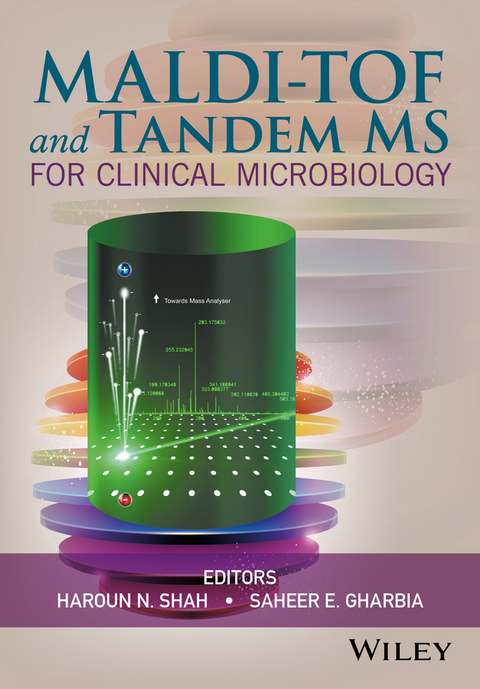
MALDI-TOF and Tandem MS for Clinical Microbiology (eBook)
John Wiley & Sons (Verlag)
978-1-118-96024-0 (ISBN)

This book highlights the triumph of MALDI-TOF mass spectrometry over the past decade and provides insight into new and expanding technologies through a comprehensive range of short chapters that enable the reader to gauge their current status and how they may progress over the next decade. This book serves as a platform to consolidate current strengths of the technology and highlight new frontiers in tandem MS/MS that are likely to eventually supersede MALDI-TOF MS. Chapters discuss:
Challenges of Identifying Mycobacterium to the Species level
Identification of Bacteroides and Other Clinically Relevant Anaerobes
Identification of Species in Mixed Microbial Populations
Detection of Resistance Mechanisms
Proteomics as a biomarker discovery and validation platform
Determination of Antimicrobial Resistance using Tandem Mass Spectrometry
EDITORS
Haroun N. Shah, Department of Natural Sciences, Middlesex University, London, UK
Saheer E. Gharbia, Genomic Research, Public Health England, London, UK
This book highlights the triumph of MALDI-TOF mass spectrometry over the past decade and provides insight into new and expanding technologies through a comprehensive range of short chapters that enable the reader to gauge their current status and how they may progress over the next decade. This book serves as a platform to consolidate current strengths of the technology and highlight new frontiers in tandem MS/MS that are likely to eventually supersede MALDI-TOF MS. Chapters discuss:Challenges of Identifying Mycobacterium to the Species level Identification of Bacteroides and Other Clinically Relevant AnaerobesIdentification of Species in Mixed Microbial PopulationsDetection of Resistance MechanismsProteomics as a biomarker discovery and validation platformDetermination of Antimicrobial Resistance using Tandem Mass Spectrometry
EDITORS Haroun N. Shah, Department of Natural Sciences, Middlesex University, London, UK Saheer E. Gharbia, Genomic Research, Public Health England, London, UK
Title Page 5
Copyright Page 6
Contents 9
List of Contributors 23
Preface A Brief Tour of the Technology and New Grounds for Innovation 31
Part I MALDI-TOF Mass Spectrometry 35
1 A Paradigm Shift from Research to Front-Line Microbial Diagnostics in MALDI-TOF and LC-MS/MS: A Laboratory’s Vision and Relentless Resolve to Help Develop and Implement This New Technology amidst Formidable Obstacles 37
1.1 Introduction 37
1.1.1 Personal Experience at the Interface of Systematics and Diagnostics 38
1.1.2 MALDI-TOF MS: The Early Years 38
1.1.3 The Formidable Challenge to Gain the Confidence of the Clinical Microbiologist in MALDI-TOF MS 40
1.2 Overcoming the Variable Parameters of MALDI-TOF MS Analysis: Publication of the First Database in 2004 42
1.3 SELDI-TOF MS: A Powerful but Largely Unrecognized Microbiological MALDI-TOF MS Platform 50
1.4 MALDI-TOF MS as a Platform for DNA Sequencing 52
1.5 Insights into the Proteome of Major Pathogens 2005–2009: Field Testing of MALDI-TOF MS 55
1.6 2010–2011: The Triumph of MALDI-TOF MS and Emerging Interest in Tandem MS for Clinical Microbiology 56
1.7 Preparations for MALDI-TOF MS Analysis on a Grand Scale: The Looming London 2012 Olympics 59
1.8 Investigating the Detection and Pathogenic Potential of E. coli O104:H4 during Outbreak of 2011 60
1.8.1 The Transition from MALDI-TOF MS to High-Resolution LC-MS/MS: Merits of Bottom-Up and Top-Down Proteomics for Microbial Characterization 63
1.9 Conclusions 67
References 68
Chapter 2 Criteria for Development of MALDI-TOF Mass Spectral Database 73
2.1 Introduction 73
2.2 Commercially Available Databases 73
2.3 Establishment of User?Defined Databases 75
2.4 Species Identification/Control of Reference Strains to Be Included into a Database 76
2.5 Sample Preparation 77
2.5.1 Microorganism Cultivation 77
2.5.2 MALDI Sample Preparation 78
2.6 MALDI-TOF MS Measurement 79
2.7 Quality Control during Creation and after Establishment of Reference Libraries 80
2.8 Common Influencing Factors for MALDI-TOF MS 80
2.8.1 Influencing Factors, Specifically Weighted for MALDI Biotyper 80
2.8.2 Selection of Strains 81
2.8.3 Sample Preparation for Measurement 81
2.8.4 Mass Spectrometry Measurement 82
2.8.5 Spectra Analysis/Quality Control 82
2.8.6 MSP Creation and Analysis/Quality Control 84
2.9 User-Created and Shared Databases: Examples and Benefits 84
References 85
Chapter 3 Applications of MALDI-TOF Mass Spectrometry in Clinical Diagnostic Microbiology 89
3.1 Introduction 89
3.2 Principle of Microorganisms Identification using MALDI-TOF MS 90
3.2.1 Soft Ionization and MS Applied to Microorganisms Identification 90
3.2.2 Biomarker Proteins 0
3.2.3 Current Commercial MALDI-TOF MS Instruments 92
3.2.4 Automated Colony Picking 93
3.3 Factors Impacting the Accuracy of MALDI-TOF MS Identifications 93
3.3.1 The Importance of the Database 93
3.3.2 Quality of the Spectrum and Standardization of the Pre?analytic 94
3.3.3 Limit of Detection 94
3.3.4 Errors and Misidentifications 94
3.3.5 Mixed Bacterial Populations 94
3.3.6 Closely Related Species 95
3.4 Identification of Microorganisms from Positive Cultures 95
3.4.1 Identification from Positive Cultures on Solid Media 95
3.4.2 Identification from Positive Blood Cultures 98
3.5 Identification of Microorganisms Directly from Samples 99
3.5.1 Urine 99
3.5.2 Cerebrospinal Fluid 101
3.6 Microorganisms Requiring a Specific Processing for MALDI-TOF MS Identification 102
3.6.1 Nocardia and Actinomycetes 102
3.6.2 Mycobacteria 102
3.6.3 Yeast and Fungi 103
3.7 Detection of Antimicrobial Resistance 104
3.7.1 Carbapenemase Detection 104
3.7.2 Methicillin-Resistant S. aureus 105
3.7.3 Vancomycin-Resistant Enterococci 105
3.8 Detection of Bacterial Virulence Factors 105
3.9 Typing and Clustering 106
3.9.1 MRSA Typing 106
3.9.2 Enterobacteriaceae Typing 107
3.9.3 Typing Mycobacterium spp. 107
3.10 Application of MALDI-TOF MS in Clinical Virology 107
3.11 PCR-Mass Assay 108
3.11.1 Application of PCR-Mass Assay in Clinical Bacteriology 108
3.11.2 Application of PCR-Mass Assay in Clinical Virology 108
3.12 PCR-ESI MS 109
3.13 Impact of MALDI-TOF MS in Clinical Microbiology and Infectious Disease 109
3.13.1 Time to Result 109
3.13.2 Impact on Patient Management 110
3.13.3 Impact on Rare Pathogenic Bacteria and Difficult-to-Identify Organisms 110
3.13.4 Anaerobes 111
3.14 Identification of Protozoan Parasites 111
3.15 Identification of Ticks and Fleas 111
3.16 Costs 112
3.17 Conclusions 112
References 113
Chapter 4 The Challenges of Identifying Mycobacterium to the Species Level using MALDI-TOF MS 127
Part 4A Modifications of Standard Bruker Biotyper Method 127
4A.1 Taxonomic Structure of the Genus Mycobacterium 127
4A.2 Tuberculosis-Causing Mycobacteria 129
4A.3 Non-tuberculosis Mycobacteria 129
4A.4 MALDI-TOF MS Mycobacteria Library and Parameters for Identification 132
4A.5 Methods for Extraction 133
4A.5.1 Method: Bruker’s Protocol 133
4A.5.2 The Methods of Khéchine et al., 2011 133
4A.5.3 Silica/Zirconium Bead Variation 135
4A.5.4 Results and Recommendations 135
4A.6 Protein Profiling of Cell Extracts using SELDI-TOF MS 138
4A.7 Conclusion 138
References 140
Part 4B ASTA’s MicroID System and Its MycoMp Database for Mycobacteria 144
4B.1 Introduction 144
4B.1.1 The Genus Mycobacterium, Disease and MALDI-TOF Mass Spectrometry 144
4B.2 MycoMp Database for Mycobacterium: The ASTA Mycobacterial Database 145
4B.3 MicroID Software 145
4B.4 Database 146
4B.5 MycoMP Database for Mycobacteria 147
4B.6 Conclusion 154
References 154
Chapter 5 Transformation of Anaerobic Microbiology since the Arrival of MALDI-TOF Mass Spectrometry 157
5.1 Introduction 157
5.2 Identification in the Clinical Laboratory 159
5.3 Pre-analytical Requirements Influence Species Identification of Anaerobic Bacteria 160
5.4 Recent Database Developments for Anaerobes 163
5.5 Application of the MALDI-TOF MS Method for Routine Identification of Anaerobes in the Clinical Practice 165
5.6 The European Network for the Rapid Identification of Anaerobes (ENRIA) Project 168
5.7 Subspecies-Level Typing of Anaerobic Bacteria Based on Differences in Mass Spectra 169
5.8 Impact of MALDI-TOF MS on Subspecies Classification of Propionibacterium acnes: Insights into Protein Expression using ESI-MS-MS 170
5.9 Direct Identification of Anaerobic Bacteria from Positive Blood Cultures 174
References 174
Chapter 6 Differentiation of Closely Related Organisms using MALDI-TOF MS 181
6.1 Introduction 181
6.2 Experimental Methods 183
6.2.1 Strains and Traditional Identification 183
6.2.2 PCR Identification 184
6.2.3 MALDI-TOF MS Identification 185
6.3 Results 187
6.3.1 Semiautomated Models 187
6.3.2 Automated Models 187
6.3.3 Hybrid Models 189
6.3.4 MALDI-TOF MS versus Traditional Identification Methods 190
6.4 Discussion and Implications 192
Acknowledgments 196
References 196
Chapter 7 Identification of Species in Mixed Microbial Populations using MALDI?TOF MS 201
7.1 Introduction 201
7.2 A New Algorithm to Identify Mixed Species in a MALDI-TOF Mass Spectrum 202
7.2.1 Mixed Spectrum Model 202
7.2.2 Algorithm Description 204
7.2.3 A Simulation Framework to Optimize the Model Parameters 206
7.3 Toward Direct-Sample Polymicrobial Identification from Positive Blood Cultures 206
7.3.1 Microbial Panel Considered 208
7.3.2 Qualifying the Success of the Identification 208
7.3.3 In Silico Experiments 209
7.4 In Vitro Experiments 212
7.5 Discussion and Perspectives 215
References 218
Chapter 8.1 Microbial DNA Analysis by MALDI-TOF Mass Spectrometry 221
Part 8A DNA Analysis of Viral Genomes using MALDI-TOF Mass Spectrometry 221
8A.1 Introduction 221
8A.2 The Molecular Detection and Identification of Viruses 222
8A.3 Viral Quantification 223
8A.4 The Characterization of Viral Genetic Heterogeneity 224
8A.5 Viral Transmission Monitoring 226
8A.6 Additional Nucleic Acid Applications of MALDI-TOF MS 227
8A.7 Conclusion 227
References 227
Part 8B Mass Spectral Analysis of Proteins of Nonculture and Cultured Viruses 231
8B.1 Introduction 231
8B.2 Norovirus Identification using MS 233
8B.3 Sample Preparation Considerations 234
8B.4 Experimental Workflow 234
8B.5 Detection of Intact VP1 using MALDI-TOF and SELDI-TOF MS 234
8B.6 Peptide Mass Fingerprinting 236
8B.7 Conclusions 237
8B.8 Bacteriophage Identification using MS 240
8B.9 Bacteriophages 240
8B.10 Protein Identification 240
8B.11 Conclusions 242
References 242
Chapter 9 Impact of MALDI-TOF MS in Clinical Mycology Progress and Barriers in Diagnostics
9.1 Introduction 245
9.2 Evolution in Commercial Methodologies of Sample Preparation 247
9.2.1 Fungal Identification 247
9.2.2 MALDI Biotyper 248
9.2.3 VITEK® MS 251
9.2.4 MS LT2-ANDROMAS 252
9.3 Effect of In-House Sample Preparation on Database Reliability 252
9.3.1 Yeast Identification in Pure Culture 252
9.3.2 Filamentous Fungi Identification 256
9.4 Conclusion 259
References 260
Chapter 10 Development and Application of MALDI-TOF for Detection of Resistance Mechanisms 265
10.1 Attempts to Correlate Signature Mass Ions in MALDI-TOF MS Profiles with Antibiotic Resistance 265
10.2 Distribution and Spread of Carbapenems and Mass Spectrometry 267
10.3 Carbapenem-Resistant Enterobacteriaceae 268
10.4 MALDI-TOF MS Detection Based upon Changes in Antibiotic Structure due to Bacterial Degradation Enzymes 268
10.5 Optimization of the Carbapenemase MALDI-TOF MS-Based Assay to Minimize the Time-to-Result 270
10.6 Detection of Other Bacterial Enzymic Modifications to Antibiotic Structures 272
10.7 Isotopic Detection using MALDI-TOF MS 273
10.8 Multi-Resistant Pseudomonas aeruginosa 276
10.9 MALDI Biotyper Antibiotic Susceptibility Test Rapid Assay (MBT-ASTRA™) 276
10.10 The Potential Use of Mass Spectrometry for Antibiotic Testing in Yeast 278
References 279
Chapter 11 Discrimination of Burkholderia Species, Brucella Biovars, Francisella tularensis and Other Taxa at the Subspecies Level by MALDI-TOF Mass Spectrometry 283
11.1 Introduction 283
11.2 Principles of MALDI-TOF MS?Based Identification of Bacteria 283
11.3 Generality versus Specificity 284
11.4 Shigatoxin-Producing and Enterohemorrhagic Escherichia coli (STEC and EHEC) 285
11.5 Francisella tularensis 287
11.6 The Genus Brucella 289
11.7 The Genus Burkholderia 290
11.8 Studying Closely Related Organisms by MALDI-TOF MS 291
11.8.1 Sample Selection 292
11.8.2 Spectrum Processing 292
11.8.3 Choosing Software for Statistical Calculations 292
11.8.4 Search for Taxon-Specific Markers 293
11.8.5 Spectrum-Based Cluster Analysis 293
11.8.6 Statistical Models for Classification 293
11.8.7 External Validation 294
11.9 Conclusion 294
References 295
Chapter 12 MALDI-TOF-MS Based on Ribosomal Protein Coding in S10-spc-alpha Operons for Proteotyping 303
12.1 Introduction 303
12.2 S10-GERMS Method 306
12.2.1 Background of Proteotyping 306
12.2.2 Construction Procedures of the Working Database for MALDI-TOF MS Analysis 307
12.2.3 Application of Standardized S10-GERMS Method to Bacterial Typing 311
12.3 Conclusion: Computer-Aided Proteotyping of Bacteria Based on the S10-GERMS Method 335
References 337
Part II Tandem MS/MS-Based Approaches to Microbial Characterization 345
Chapter 13 Tandem Mass Spectrometry Analysis as an Approach to Delineate Genetically Related Taxa 347
Part A 347
13.1 Introduction 347
13.2 Methods 350
13.3 Results 355
13.3.1 16S rRNA Identification 355
13.3.2 MALDI-TOF MS Identification 355
13.4 Candidate Biomarker Discovery: Shotgun Sampling of Enterobacteriaceae Proteomes by GeLC-MS/MS 359
13.4.1 Database Optimization and Testing 359
13.4.2 Demonstrating Capability to Delineate Pathotypes using E. coli 0104:H4 as an Exemplar 359
13.5 Discussion 365
Part B 367
13.6 Highly Pathogenic Biothreat Agents 367
13.7 Bacillus anthracis 368
13.7.1 Methods: Strain Panel 369
13.7.2 Whole Cell Protein Extraction 369
13.7.3 One-Dimensional SDS-PAGE and In-Gel Digestion of Bacterial Proteins 370
13.7.4 In-Solution Protein Digestion Directly from Protein Extracts 370
13.7.5 1-D Nanoflow LC-MS/MS, Data-Dependent and Targeted MS Analysis 370
13.7.6 Bioinformatic Workflow for Biomarker Detection 371
13.7.7 Protein/Peptide Marker Identification 371
13.7.8 Procedure for DNA Extraction 372
13.7.9 DNA Extraction 372
13.7.10 Genetic Validation of Candidate Peptide Biomarkers 372
13.8 Summary of Results 376
13.9 Yersinia pestis 378
13.10 Method: Strain Panel 378
13.10.1 Procedure for Whole Cell Protein Extraction 378
13.10.2 One-Dimensional SDS-PAGE and In?Gel Digestion of Bacterial Proteins 378
13.10.3 One-Dimensional Nanoflow LC-MS/MS, Data-Dependent and Targeted MS Analysis 378
13.10.4 Bioinformatic Workflow for Biomarker Detection 379
13.10.5 Genetic Validation of Peptide Biomarkers 379
13.11 Summary of Results 379
13.12 Fransicella tularensis 380
13.13 Method 380
13.13.1 Strain Panel 380
13.13.2 Procedure for Whole Cell Protein Extraction 380
13.13.3 One-Dimensional SDS-PAGE and In-Gel Digestion of Bacterial Proteins 381
13.13.4 One-Dimensional Nanoflow LC-MS/MS, Data-Dependent and Targeted MS Analysis 381
13.13.5 Bioinformatic Workflow for Biomarker Detection 381
13.13.6 Genetic Validation of Peptide Biomarkers 381
13.14 Summary of Results 382
13.15 Clostridium botulinum 384
13.16 Method 385
13.16.1 Strain Panel 385
13.16.2 Procedure for Whole Cell Protein Extraction 385
13.16.3 One-Dimensional SDS-PAGE and In-Gel Digestion of Bacterial Proteins 386
13.16.4 1-D Nanoflow LC-MS/MS, Data-Dependent and Targeted MS Analysis 386
13.16.5 Bioinformatic Workflow for Biomarker Detection 386
13.16.6 Procedure for DNA Extraction 387
13.16.7 Genetic Validation of Peptide Biomarkers 387
13.17 Summary of Results 389
13.18 Burkholderia pseudomallei and B. mallei 389
13.19 Method 391
13.19.1 Strain Panel 391
13.19.2 Procedure for Whole Cell Protein Extraction 391
13.19.3 One-Dimensional SDS-PAGE and In-Gel Digestion of Bacterial Proteins 392
13.19.4 One-Dimensional Nanoflow LC-MS/MS, Data-Dependent and Targeted MS Analysis 392
13.19.5 Bioinformatic Workflow for Biomarker Detection 392
13.19.6 Procedure for DNA Extraction 392
13.19.7 Genetic Validation of Peptide Biomarkers 392
13.20 Summary of Results 394
13.21 Biomarker Detection Sensitivity and Quantification 395
13.22 Method 395
13.22.1 Preparation of Stable Isotope?Labelled Peptides 396
13.22.2 Preparation of Samples for Absolute Quantification 396
13.22.3 One-Dimensional Nanoflow LC-MS/MS, Data-Dependent MS Analysis 396
13.22.4 Data Analysis 396
13.23 Summary of Results 397
13.24 Assay Sensitivity in Relation to Bacterial Cell Numbers 399
13.24.1 Method 399
13.24.2 Preparation of Cell Dilutions 399
13.24.3 Cell Lysis Procedure 399
13.24.4 Capture of Cells and Protein Material 401
13.24.5 Trypsin Digestion on Filters 401
13.25 Summary of Results 401
13.26 Spiked Samples 402
13.27 Method 402
13.28 Summary of Results 402
13.29 Spiked Cells 404
13.30 Method 404
13.31 Summary of Results 404
13.32 B. anthracis Spore Analysis 404
13.33 Method 404
13.34 Summary of Results 405
13.35 Assay Sensitivity in Relation to Bacterial Spore Numbers 405
13.36 Method 405
13.37 Summary of Results 406
13.38 Summary of Results for Biomarker Detection Sensitivity 406
References 409
Chapter 14 Mapping of the Proteogenome of Clostridium difficile Isolates of Varying Virulence 413
14.1 Introduction 413
14.2 Virulence of Clostridium difficile 414
14.2.1 Virulence Factors 414
14.2.2 Variation between Strains 414
14.3 Current Genomic and Proteomic Data 415
14.4 Comparison of Strains of Varying Virulence 415
14.5 Genomic Analysis of Clostridium difficile 416
14.5.1 Using Roche’s Flx and Junior 416
14.5.2 PacBio Genomic Analysis 417
14.6 Proteomic Analysis of Clostridium difficile 418
14.6.1 Two-Dimensional Reference Mapping 418
14.6.2 Differential In-Gel Electrophoresis (DIGE) 419
14.6.3 One-Dimensional Gel Electrophoresis Coupled with LC-MS/MS 421
14.7 Mapping the Proteogenome of Clostridium difficile to Phenotypic Profiles 422
14.7.1 Toxin Expression 422
14.7.2 Mucosal Adherence 423
14.7.3 Flagella 424
14.8 Antibiotic Resistance 428
14.9 Conclusion 429
References 429
Chapter 15 Determination of Antimicrobial Resistance using Tandem Mass Spectrometry 433
15.1 Antibiotic Resistance Mechanisms 433
15.2 Detection of ?-lactamase Activity 435
15.3 Other MALDI-TOF MS Methods 437
15.4 Liquid Chromatography Coupled with MS 438
15.5 Proteomics Approaches for Detection of Antibiotic Resistance 444
15.6 Conclusion 448
References 449
Chapter 16 Proteotyping: Tandem Mass Spectrometry Shotgun Proteomic Characterization and Typing of Pathogenic Microorganisms 453
16.1 Introduction 453
16.2 MS and Proteomics 454
16.3 MALDI TOF MS 456
16.4 Tandem MS Shotgun Proteomic Analyses 460
16.5 Top-Down Proteomics 460
16.6 Bottom-Up Proteomics 462
16.7 Proteotyping 464
16.8 Matching MS Spectra to Peptides 468
16.9 Mapping Peptides to Reference Sequences 469
16.10 Taxonomic Assignment of Protein Sequences 470
16.11 Challenges Assigning Fragments to Lower Taxonomic Levels 471
16.12 Proteotyping for Diagnosing Infectious Diseases 473
16.13 Outlook 475
16.14 Conclusion 477
Acknowledgments 478
References 478
Chapter 17 Proteogenomics of Pseudomonas aeruginosa in Cystic Fibrosis Infections 485
17.1 Introduction: Pseudomonas aeruginosa as a Clinically Important Pathogen 485
17.2 CF and Pathophysiology 486
17.3 CF Infections 486
17.4 Biofilm Formation in P. aeruginosa 487
17.5 Virulence of P. aeruginosa 488
17.6 Genomics to Study Bacterial Pathogenesis 489
17.7 Proteomics to Study Bacterial Pathogenesis 490
17.8 Genomics of P. aeruginosa in CF Infections 491
17.9 Interclonal Genome Diversity 492
17.10 Intraclonal Genome Diversity 492
17.11 Clonal Spread of P. aeruginosa in CF Patients 493
17.12 Parallel Evolution 493
17.13 Mutations in Early-Stage CF P. aeruginosa Isolates 494
17.14 Mutations in Late-Stage CF P. aeruginosa Isolates 495
17.15 Transcriptomics of P. aeruginosa in Chronic CF Infections 496
17.16 Proteomics of P. aeruginosa in Chronic CF Infections 498
17.17 Applications of Proteomics to P. aeruginosa Characterization 498
17.18 Comparative Proteomic Investigation of Bis-(3?-5?)-Cyclic-Dimeric-GMP (C-Di-GMP) Regulation in P. aeruginosa 499
17.19 Comparative Proteomics of Mucoid and Non-Mucoid P. aeruginosa Strains 500
17.20 Proteogenomics Reveal Shifting in Iron Uptake of CF P. aeruginosa 500
17.21 Conclusion and Future Perspectives 502
References 504
Chapter 18 Top-Down Proteomics in the Study of Microbial Pathogenicity 527
18.1 Introduction 527
18.2 Top-Down Analysis of Modified Bacterial Proteins in Targeted Mode 530
18.3 Top-Down Analysis of Bacterial Proteins in Discovery Mode 532
18.4 Top-Down Proteomics: The Next Step in Clinical Microbiology? 533
References 535
Chapter 19 Tandem Mass Spectrometry in Resolving Complex Gut Microbiota Functions 539
19.1 Introduction 539
19.1.1 Scope 539
19.1.2 Strategies to Study Intestinal Microbiome 539
19.2 MS in Microbiology 541
19.3 Intestinal Metaproteomics Addressing All Proteins 546
19.3.1 Preprocessing of the Sample 546
19.3.2 Protein Extraction 547
19.3.3 Protein Digestion 547
19.3.4 Peptide Fractionation 547
19.4 LC-MSMS Analysis 547
19.5 Data Analysis 548
19.5.1 Peptide Spectral Matching 548
19.5.2 De Novo Sequencing 548
19.5.3 Protein Quantification 549
19.5.4 Metaproteomic Pipelines 549
19.5.5 Data Storage 549
19.6 Data Output and Interpretation 549
19.7 Development of Surface Metaproteomics for Intestinal Microbiota 550
19.7.1 Isolation of Bacteria from Fecal Samples 551
19.7.2 Enrichment of the Surface Proteome from Fecal Bacterial Extract 551
19.7.3 Detection of Surface Proteins by LC-MSMS 551
19.8 Conclusions 556
References 557
Chapter 20 Proteogenomics of Non-model Microorganisms 563
20.1 Introduction 563
20.2 The “Proteogenomics” Concept 564
20.3 Applications to Non-model Organisms: From Bacteria to Parasites 565
20.4 Embracing Complexity with Metaproteogenomics 568
References 569
Chapter c21.A Analysis of MALDI-TOF MS Spectra using the BioNumerics Software 573
21A.1 Introduction 573
21A.2 Typing with MALDI-TOF MS 574
21A.3 Preprocessing of Raw MALDI-TOF MS Data 574
21A.4 Downsampling 575
21A.5 Baseline Subtraction 576
21A.6 Curve Smoothing 577
21A.7 Peak Detection 580
21A.8 Biological and Technical Replicates 580
21A.9 Averaging of Replicates 583
21A.10 Spectrum Analysis 584
21A.11 Hierarchical Clustering 584
21A.12 Alternatives to Cluster Analysis 588
21A.13 Classifying Algorithms 593
21A.14 Conclusion 595
References 595
Chapter c21.B Subtyping of Staphylococcus spp. Based upon MALDI-TOF MS Data Analysis 597
21B.1 Introduction 597
21B.2 Sample Collection 598
21B.3 MALDI-TOF Mass Spectrometry 598
21B.4 Cluster Analysis of Environmental Staphylococci 599
21B.5 Antibiotic Susceptibility Test 599
21B.6 Cluster Analysis of Staphylococcus spp. Recovered from Different Sites 600
21B.7 Correlation of Staphylococci Recovered from Different Sites 601
21B.8 Cluster Analysis of S. epidermidis Isolated from Different Sites 602
21B.9 Cluster Analysis of S. aureus Isolated from Different Sites 603
21B.10 Cluster Analysis of Staphylococcus spp. Combined with Antibiotic Susceptibility 603
21B.11 Antibiotic Resistance Patterns of Closely Related S. epidermidis 604
21B.12 Antibiotic Resistance Patterns of Closely Related S. aureus 604
21B.13 Variations of Antibiotic Susceptibility of Closely Related S. epidermidis 606
21B.14 Percentage of Multiple-Resistant Staphylococci Recovered from Each Site 606
21B.15 Conclusion 607
References 609
Chapter c21.C Elucidating the Intra-Species Proteotypes of Pseudomonas aeruginosa from Cystic Fibrosis 613
21C.1 The Emergence of Pseudomonas aeruginosa as Key Component of the Cystic Fibrosis Lung Flora 613
21C.2 Diversity and Rational for Proteotyping 614
21C.3 Selecting Representative Strains for Profiling 614
21C.4 Selection of Strains against a Background of Their Variable Number Tandem Repeat (VNTR) Designation 615
21C.5 Potential to Type P. aeruginosa using MALDI-TOF MS 615
21C.6 Data Processing: Analyzing Data using BioNumerics 7 616
21C.7 Discussion and Data Interpretation 617
21C.8 Going Forward – Reproducibility the Salient Determinant 621
References 622
Index 627
EULA 649
| Erscheint lt. Verlag | 30.3.2017 |
|---|---|
| Sprache | englisch |
| Themenwelt | Medizin / Pharmazie ► Gesundheitsfachberufe |
| Medizin / Pharmazie ► Medizinische Fachgebiete ► Mikrobiologie / Infektologie / Reisemedizin | |
| Naturwissenschaften ► Chemie ► Analytische Chemie | |
| Technik | |
| Schlagworte | antibiotic resistance of single isolates • antibiotic resistance testing • Antimicrobial Resistance • antimycotic resistance testing • bacterial identification • Biomarker discovery • biomedical scientists • Biowissenschaften • Chemie • Chemistry • Clinical Diagnostic Microbiology • clinical microbiologists • clinical microbiology • detection of antibiotic resistance • detection of biological warfare agents • Detection of Resistance Mechanisms • diagnostic technologists • epidemiological studies • identification of Bacteroides • identification of microorganisms • Identification of Species in Mixed Microbial Populations • identifying Mycobacterium • identify microbes to the species level • Klinische Mikrobiologie • Life Sciences • MALDI technology • MALDI-TOF • MALDI-TOF mass spectrometry • MALDI-ToF MS • Massenspektrometrie • mass spectral database • Mass Spectrometry • Medical Science • Medizin • Microbial DNA Analysis • Microbial Identification • microbial pathogenicity • Mikrobiologie • pathogen detection • Proteogenomics of Non-Model Microorganisms • Proteomics • single strain typing • strain typing • Tandem Mass Spectrometry • tandem MS/MS • top-down proteomics |
| ISBN-10 | 1-118-96024-6 / 1118960246 |
| ISBN-13 | 978-1-118-96024-0 / 9781118960240 |
| Informationen gemäß Produktsicherheitsverordnung (GPSR) | |
| Haben Sie eine Frage zum Produkt? |
 PDF (Adobe DRM)
Kopierschutz: Adobe-DRM
Adobe-DRM ist ein Kopierschutz, der das eBook vor Mißbrauch schützen soll. Dabei wird das eBook bereits beim Download auf Ihre persönliche Adobe-ID autorisiert. Lesen können Sie das eBook dann nur auf den Geräten, welche ebenfalls auf Ihre Adobe-ID registriert sind.
Details zum Adobe-DRM
Dateiformat: PDF (Portable Document Format)
Mit einem festen Seitenlayout eignet sich die PDF besonders für Fachbücher mit Spalten, Tabellen und Abbildungen. Eine PDF kann auf fast allen Geräten angezeigt werden, ist aber für kleine Displays (Smartphone, eReader) nur eingeschränkt geeignet.
Systemvoraussetzungen:
PC/Mac: Mit einem PC oder Mac können Sie dieses eBook lesen. Sie benötigen eine
eReader: Dieses eBook kann mit (fast) allen eBook-Readern gelesen werden. Mit dem amazon-Kindle ist es aber nicht kompatibel.
Smartphone/Tablet: Egal ob Apple oder Android, dieses eBook können Sie lesen. Sie benötigen eine
Geräteliste und zusätzliche Hinweise
Buying eBooks from abroad
For tax law reasons we can sell eBooks just within Germany and Switzerland. Regrettably we cannot fulfill eBook-orders from other countries.
aus dem Bereich