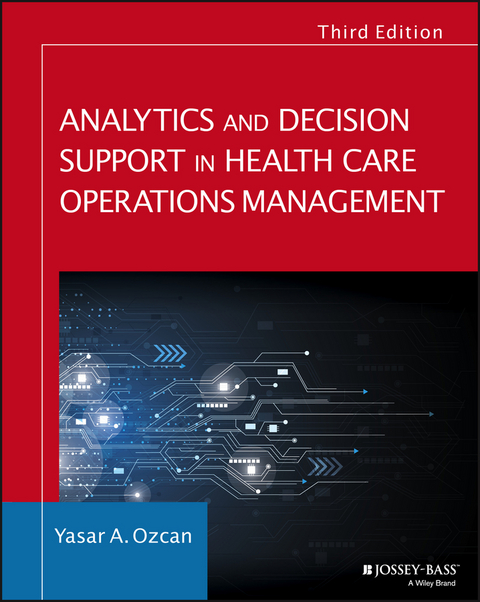
Analytics and Decision Support in Health Care Operations Management (eBook)
John Wiley & Sons (Verlag)
978-1-119-21983-5 (ISBN)
Analytics and Decision Support in Health Care Operations is a comprehensive introductory guide to quantitative techniques, with practical Excel-based solutions for strategic health care management. This new third edition has been extensively updated to reflect the continuously evolving field, with new coverage of predictive analytics, geographical information systems, flow process improvement, lean management, six sigma, health provider productivity and benchmarking, project management, simulation, and more. Each chapter includes additional new exercises to illustrate everyday applications, and provides clear direction on data acquisition under a variety of hospital information systems. Instructor support includes updated Excel templates, PowerPoint slides, web based chapter end supplements, and data banks to facilitate classroom instruction, and working administrators will appreciate the depth and breadth of information with clear applicability to everyday situations.
The ability to use analytics effectively is a critical skill for anyone involved in the study or practice of health services administration. This book provides a comprehensive set of methods spanning tactical, operational, and strategic decision making and analysis for both current and future health care administrators.
- Learn critical analytics and decision support techniques specific to health care administration
- Increase efficiency and effectiveness in problem-solving and decision support
- Locate appropriate data in different commonly-used hospital information systems
- Conduct analyses, simulations, productivity measurements, scheduling, and more
From statistical techniques like multiple regression, decision-tree analysis, queuing and simulation, to field-specific applications including surgical suite scheduling, roster management, quality monitoring, and more, analytics play a central role in health care administration. Analytics and Decision Support in Health Care Operations provides essential guidance on these critical skills that every professional needs.
The Author
YASAR A. OZCAN, PhD, is Charles P. Cardwell, Jr. Professor and vice chair and director of the Master of Science in Health Administration program at Virginia Commonwealth University. Extensively published in health care performance assessment, he is the founding Editor-in-Chief of Health Care Management Science. Dr. Ozcan's massive work has applied data envelopment analysis to health care facilities including hospitals, nursing homes, mental health care organizations, and more. He has taught health analytics and decision support in VCU's MHA and Executive MSHA graduate programs for more than 30 years.
A compendium of health care quantitative techniques based in Excel Analytics and Decision Support in Health Care Operations is a comprehensive introductory guide to quantitative techniques, with practical Excel-based solutions for strategic health care management. This new third edition has been extensively updated to reflect the continuously evolving field, with new coverage of predictive analytics, geographical information systems, flow process improvement, lean management, six sigma, health provider productivity and benchmarking, project management, simulation, and more. Each chapter includes additional new exercises to illustrate everyday applications, and provides clear direction on data acquisition under a variety of hospital information systems. Instructor support includes updated Excel templates, PowerPoint slides, web based chapter end supplements, and data banks to facilitate classroom instruction, and working administrators will appreciate the depth and breadth of information with clear applicability to everyday situations. The ability to use analytics effectively is a critical skill for anyone involved in the study or practice of health services administration. This book provides a comprehensive set of methods spanning tactical, operational, and strategic decision making and analysis for both current and future health care administrators. Learn critical analytics and decision support techniques specific to health care administration Increase efficiency and effectiveness in problem-solving and decision support Locate appropriate data in different commonly-used hospital information systems Conduct analyses, simulations, productivity measurements, scheduling, and more From statistical techniques like multiple regression, decision-tree analysis, queuing and simulation, to field-specific applications including surgical suite scheduling, roster management, quality monitoring, and more, analytics play a central role in health care administration. Analytics and Decision Support in Health Care Operations provides essential guidance on these critical skills that every professional needs.
The Author YASAR A. OZCAN, PhD, is Charles P. Cardwell, Jr. Professor and vice chair and director of the Master of Science in Health Administration program at Virginia Commonwealth University. Extensively published in health care performance assessment, he is the founding Editor-in-Chief of Health Care Management Science. Dr. Ozcan's massive work has applied data envelopment analysis to health care facilities including hospitals, nursing homes, mental health care organizations, and more. He has taught health analytics and decision support in VCU's MHA and Executive MSHA graduate programs for more than 30 years.
Analytics and Decision Support in Health Care Operations Management 1
Contents 7
Tables & Figures
Acknowledgments 23
The Author 25
Introduction 27
Chapter-by-Chapter Revisions for the Third Edition 29
Chapter 1: Introduction to Analytics and Decision Support in Health Care Operations Management 35
Learning Objectives 35
Historical Background and the Development of Decision Techniques 36
The Health Care Manager and Decision Making 37
Importance of Health Analytics: Information Technology (IT) and Decision Support Techniques 37
The Scope of Health Care Services, and Recent Trends 38
Health Care Services Management 39
Distinctive Characteristics of Health Care Services 39
Patient Participation 40
Simultaneous Production and Consumption 40
Perishable Capacity 40
The Intangible Nature of Health Care Outputs 40
The High Levels of Judgment Called Upon, and the Heterogeneous Nature of Health Care 41
Big Data and Data Flow in Health Care Organizations 41
Summary 43
Key Terms 43
Chapter 1 Supplement: Data Analytics in MS Excel: Creating and Manipulating Pivot Tables 44
Exercises 57
Chapter 2: Predictive Analytics 61
Learning Objectives 61
Steps in the Predictive Analytics Process 62
Identify the Goal of the Predictive Analytics 62
Establish a Time Horizon 62
Select a Predictive Analytics Technique 62
Conduct the Prediction 62
Monitor Accuracy 63
Predictive Analytics Techniques 63
Judgmental Predictions 63
Time-Series Technique 64
Techniques for Averaging 65
Techniques for Trend 75
Predictive Techniques for Seasonality 89
Accuracy of Predictive Analytics 95
Prediction Control 96
Summary 99
Key Terms 99
Exercises 100
Chapter 3: Decision Making in Health Care 119
Learning Objectives 119
The Decision Process 119
What Causes Poor Decisions? 121
The Decision Level and Decision Milieu 121
Decision Making under Uncertainty 122
Payoff Table 122
Decision Making under Risk 127
What If Payoffs Are Costs? 131
The Decision Tree Approach 135
Analysis of the Decision Tree: Rollback Procedure 136
Sensitivity Analysis in Decision Making 137
Decision Analysis with Nonmonetary Values and Multiple Attributes 141
Dominance Procedure 142
Minimum Attribute Satisfaction Procedure 143
Most Important Attribute Procedure 143
Clinical Decision Making and Implications for Management 144
Summary 148
Key Terms 148
Exercises 149
Chapter 4: Facility Location 169
Learning Objectives 169
Location Methods 171
Cost-Profit-Volume (CPV) Analysis 171
Factor Rating Methods 174
Multi-Attribute Methods 177
Center of Gravity Method 179
Geographic Information Systems (GIS) in Health Care 183
Summary 188
Key Terms 188
Exercises 189
Chapter 5: Facility Layout 203
Learning Objectives 203
Product Layout 204
Process Layout 205
Process Layout Methods 205
Method of Minimizing Distances and Costs 209
Computer-Based Layout Programs 209
Fixed-Position Layout 211
Summary 214
Key Terms 214
Exercises 215
Chapter 6: Flow Processes Improvement: Reengineering and Lean Management 231
Learning Objectives 231
Reengineering 232
Lean Management 233
Define the Value 234
Map the Process 234
Identify Process Waste 234
Identify Improvements 235
Map the Future State 236
Implement Improvements 236
Repeat the Cycle 237
Work Design in Health Care Organizations 237
Work Design 237
Job Design 238
Work Measurement Using Time Standards 241
Work Measurement Using Work Sampling 248
Work Simplification 257
Worker Compensation 271
Summary 271
Key Terms 272
Exercises 272
Chapter 7: Staffing 287
Learning Objectives 287
Workload Management Overview 288
Establishment Of Workload Standards and Their Influence on Staffing Levels 288
Patient Acuity Systems 290
The Development of Internal Workload Standards 295
Procedurally Based Unit Staffing 297
Acuity-Based Unit Staffing 300
External Work Standards and Their Adjustments 304
Productivity and Workload Management 305
Summary 307
Key Terms 307
Exercises 307
Chapter 8: Scheduling 315
Learning Objectives 315
Staff Scheduling 315
The Eight-, Ten-, and Twelve-Hour Shifts—Studies of Shift Patterns 317
Implementation of a New Work System 322
Surgical Suite Resource Scheduling 324
Operating Room Scheduling Systems 325
Assessment of Scheduling Alternatives 327
Estimation of Procedure Times 328
Summary 328
Key Terms 329
Exercises 329
Chapter 9: Productivity and Performance Benchmarking 331
Learning Objectives 331
Trends in Health Care Productivity: Consequences of Reforms and Policy Decisions 332
Productivity Definitions and Measurements 333
Productivity Benchmarking 334
Multifactor Productivity 334
Commonly Used Productivity Ratios 336
Adjustments for Inputs 338
Adjustments for Outputs 342
Case Mix Adjustments 344
Productivity Measures Using Direct Care Hours 346
The Relationships between Productivity and Qualityin Hospital Settings 348
Summary of Productivity-Related Dilemmasin the Hospital Setting 349
Dealing with the Multiple Dimensions of Productivity: New Methods of Measurement and Benchmarking 350
Technical Efficiency 351
Economic Efficiency 352
Data Envelopment Analysis 352
Overview on Improving Health Care Productivity 355
Summary 357
Key Terms 357
Exercises 357
Chapter 10: Resource Allocation 367
Learning Objectives 367
Linear Programming 367
Maximization Models 369
Minimization Models 379
Integer Linear Programming 380
Summary 389
Key Terms 390
Exercises 390
Chapter 11: Supply Chain and Inventory Management 397
Learning Objectives 397
Health Care Supply Chain 397
Manufacturers/Suppliers 398
Flow of Materials 401
Supply Chain Management Issues for Providers 401
Contemporary Issues in Medical Inventory Management 402
Traditional Inventory Management 404
Requirements for Effective Inventory Management 405
Inventory Accounting Systems 406
Lead Time 407
Cost Information 407
Economic Order Quantity Model 408
Classification System 413
When to Reorder 416
Summary 418
Key Terms 418
Exercises 418
Chapter 12: Quality Control and Improvement 427
Learning Objectives 427
Quality in Health Care 427
Quality Experts 429
Quality Certifications and Awards 430
Total Quality Management (TQM) and Continuous Quality Improvement (CQI) 431
Six Sigma 432
Quality Measurement and Control Techniques 433
Process Variability 433
Monitoring Variation through Control Charts 435
Control Charts for Attributes 437
Control Charts for Continuous Variables 441
Investigation of Control Chart Patterns 446
Process Improvement 449
Methods for Generating New Ideas 449
Tools for Investigating the Presence of Quality Problems and Their Causes 451
Summary 455
Key Terms 455
Exercises 455
Chapter 13: Project Management 465
Learning Objectives 465
The Characteristics of Projects 466
The Project Manager 466
Managing Teams and Relationships on Projects 467
Planning and Scheduling Projects 468
The Network 470
Critical Path Method (CPM) 471
Probabilistic Approach 475
The Case of a Dominant Critical Path 481
Project Compression: Trade-Offs between Reduced Project Time and Cost 482
Project Management Applications in Clinical Settings: Clinical Pathways 495
Summary 498
Key Terms 498
Exercises 498
Chapter 14: Queuing Models and Capacity Planning 511
Learning Objectives 511
Queuing System Characteristics 513
Population Source 514
Number of Servers 514
Arrival Patterns 515
Service Patterns 517
Queue Characteristics 519
Measures of Queuing System Performance 520
Typical Infinite Source Models 520
Model Formulations 521
Capacity Analysis and Costs 528
Summary 530
Key Terms 531
Exercises 531
Chapter 15: Simulation 541
Learning Objectives 541
Simulation Process 541
Monte Carlo Simulation Method 544
Performance Measures and Managerial Decisions 550
Excel-Based Simulation Templates with Performance Measures and Managerial Decisions 551
Multiphase Simulation Model 554
Summary 556
Key Terms 556
Exercises 556
Appendixes 559
Appendix A: Standard Normal Distribution 561
Appendix B: Standard Normal Distribution 563
Appendix C: Cumulative Poisson Probabilities 567
Appendix D: t-Distribution 573
References 575
Index 583
End User License Agreement 603
| Erscheint lt. Verlag | 20.3.2017 |
|---|---|
| Reihe/Serie | Jossey-Bass Public Health |
| Jossey-Bass Public Health/Health Services Text | Jossey-Bass Public Health/Health Services Text |
| Sprache | englisch |
| Themenwelt | Medizin / Pharmazie ► Allgemeines / Lexika |
| Medizin / Pharmazie ► Gesundheitswesen | |
| Studium ► Querschnittsbereiche ► Prävention / Gesundheitsförderung | |
| Schlagworte | Analytics and Decision Support in Health Care Operations Management, Third Edition • analytics case studies • data analytics • Excel-based analytics • Excel decision support • Excel for health care • Excel problem solving • facilities analytics • Gesundheits- u. Sozialwesen • Health & Social Care • Health Care Administration • Health care analytics • Health Care Benchmarking • Health Care Data • health care data analysis • health care management • health care quantitative methods • health services management • Hospital Information Systems • Öffentlicher Gesundheitsdienst u. Gesundheitspolitik • Public Health • Public Health Services & Policy • quantitative techniques • Staffing and scheduling • Verwaltung im Gesundheitswesen • Yasar A. Ozcan |
| ISBN-10 | 1-119-21983-3 / 1119219833 |
| ISBN-13 | 978-1-119-21983-5 / 9781119219835 |
| Informationen gemäß Produktsicherheitsverordnung (GPSR) | |
| Haben Sie eine Frage zum Produkt? |
 PDF (Adobe DRM)
Kopierschutz: Adobe-DRM
Adobe-DRM ist ein Kopierschutz, der das eBook vor Mißbrauch schützen soll. Dabei wird das eBook bereits beim Download auf Ihre persönliche Adobe-ID autorisiert. Lesen können Sie das eBook dann nur auf den Geräten, welche ebenfalls auf Ihre Adobe-ID registriert sind.
Details zum Adobe-DRM
Dateiformat: PDF (Portable Document Format)
Mit einem festen Seitenlayout eignet sich die PDF besonders für Fachbücher mit Spalten, Tabellen und Abbildungen. Eine PDF kann auf fast allen Geräten angezeigt werden, ist aber für kleine Displays (Smartphone, eReader) nur eingeschränkt geeignet.
Systemvoraussetzungen:
PC/Mac: Mit einem PC oder Mac können Sie dieses eBook lesen. Sie benötigen eine
eReader: Dieses eBook kann mit (fast) allen eBook-Readern gelesen werden. Mit dem amazon-Kindle ist es aber nicht kompatibel.
Smartphone/Tablet: Egal ob Apple oder Android, dieses eBook können Sie lesen. Sie benötigen eine
Geräteliste und zusätzliche Hinweise
Buying eBooks from abroad
For tax law reasons we can sell eBooks just within Germany and Switzerland. Regrettably we cannot fulfill eBook-orders from other countries.
aus dem Bereich