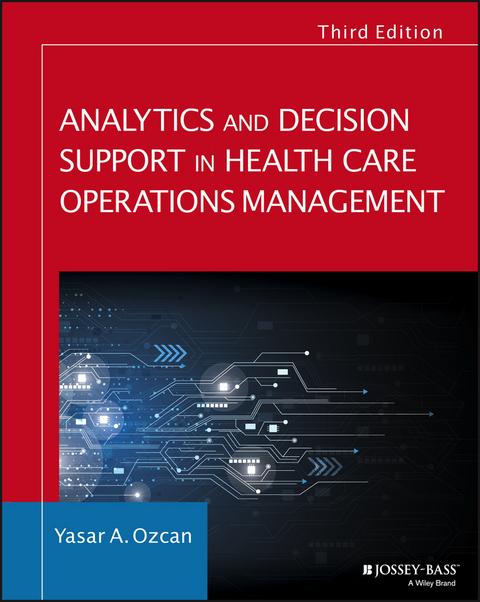
Analytics and Decision Support in Health Care Operations Management (eBook)
John Wiley & Sons (Verlag)
978-1-119-21982-8 (ISBN)
Analytics and Decision Support in Health Care Operations is a comprehensive introductory guide to quantitative techniques, with practical Excel-based solutions for strategic health care management. This new third edition has been extensively updated to reflect the continuously evolving field, with new coverage of predictive analytics, geographical information systems, flow process improvement, lean management, six sigma, health provider productivity and benchmarking, project management, simulation, and more. Each chapter includes additional new exercises to illustrate everyday applications, and provides clear direction on data acquisition under a variety of hospital information systems. Instructor support includes updated Excel templates, PowerPoint slides, web based chapter end supplements, and data banks to facilitate classroom instruction, and working administrators will appreciate the depth and breadth of information with clear applicability to everyday situations.
The ability to use analytics effectively is a critical skill for anyone involved in the study or practice of health services administration. This book provides a comprehensive set of methods spanning tactical, operational, and strategic decision making and analysis for both current and future health care administrators.
- Learn critical analytics and decision support techniques specific to health care administration
- Increase efficiency and effectiveness in problem-solving and decision support
- Locate appropriate data in different commonly-used hospital information systems
- Conduct analyses, simulations, productivity measurements, scheduling, and more
From statistical techniques like multiple regression, decision-tree analysis, queuing and simulation, to field-specific applications including surgical suite scheduling, roster management, quality monitoring, and more, analytics play a central role in health care administration. Analytics and Decision Support in Health Care Operations provides essential guidance on these critical skills that every professional needs.
The Author
YASAR A. OZCAN, PhD, is Charles P. Cardwell, Jr. Professor and vice chair and director of the Master of Science in Health Administration program at Virginia Commonwealth University. Extensively published in health care performance assessment, he is the founding Editor-in-Chief of Health Care Management Science. Dr. Ozcan's massive work has applied data envelopment analysis to health care facilities including hospitals, nursing homes, mental health care organizations, and more. He has taught health analytics and decision support in VCU's MHA and Executive MSHA graduate programs for more than 30 years.
The Author YASAR A. OZCAN, PhD, is Charles P. Cardwell, Jr. Professor and vice chair and director of the Master of Science in Health Administration program at Virginia Commonwealth University. Extensively published in health care performance assessment, he is the founding Editor-in-Chief of Health Care Management Science. Dr. Ozcan's massive work has applied data envelopment analysis to health care facilities including hospitals, nursing homes, mental health care organizations, and more. He has taught health analytics and decision support in VCU's MHA and Executive MSHA graduate programs for more than 30 years.
Tables & Figures
Tables
1.1 Total Expenditures on Health as Percentage GDP for 37 OECD Countries
1.2 Examples of External Data Sources
2.1 Patient Falls, Medication Errors, and Case-Mix Index Data from Medical/Surgical Units of Hospitals.
2.2 Heal-Me Hospital Average Daily Patients for Emergency Department.
2.3 Quarterly Indexes for Heal-Me Hospital.
2.4 Monthly Indexes for Heal-Me Hospital.
2.5 Daily Indexes for Heal-Me Hospital.
2.6 Monthly and Daily Adjusted Predictions for Emergency Department of Heal-Me Hospital.
2.7 Error Calculations
3.1 Payoff Table
3.2 Demand for Additional MRIs
3.3 Maximin Solution
3.4 Maximax Solution
3.5 Sensitivity Analysis Using Hurwitz Optimism Parameters
3.6 Opportunity Losses (Regrets)
3.7 Laplace Strategy
3.8 Payoff Table for EMV
3.9 Expected Opportunity Loss
3.10 Best Outcomes under Certainty
3.11 Total Cost of Alternatives under Various Demand Conditions
3.12 Regret Table Using Costs
3.13 Summary of Supplier Proposals
4.1 Factors to Be Considered in Establishing a Satellite Clinic
4.2 Relative Scores on Factors for a Satellite Clinic
4.3 Relative Factor Scores and Weights
4.4 Composite Scores
4.5 Satellite Clinic Factor Rankings and Minimum Acceptable Levels
4.6 Satellite Clinic Factor Minimum Acceptable Levels
4.7 Satellite Clinic Factor Importance Rankings
4.8 Selected Richmond Metropolitan Area Hospitals with Coordinates
4.9 Selected Richmond Metropolitan Area Hospitals and Their Interaction with the Blood Bank
4.10 Data for Potential Sites
5.1 Distance and Flows among Three Hospital Departments
5.2 Possible Assignment Configurations of Departments to Three Locations
5.3 Ranking Departments According to Highest Flow
5.4 Total Cost of a Layout
6.1 Typical Allowance Percentages for Varying Health Care Delivery Working Conditions
6.2 Observed Times and Performance Ratings for Nursing Unit Activities
6.3 Observed and Normal Time Calculations for Nursing Unit Activities
6.4 Abridged Patient Care Tasks in a Nursing Unit
6.5 Work Sampling Data Collection Form for Nursing Unit
6.6 Partial Work Distribution Chart for Nursing Unit
6.7 Time Study Results
7.1 Examples of Work Standards
7.2 Daily Census, Required Labor Hours, and Acuity Level Statistics for a Medical/Surgical Floor
7.3 Average Census, Required Labor Hours, and Acuity Level Statistics for a Medical/Surgical Floor
7.4 Weighted Average Utilization for a Laboratory Based on Workload Fluctuations by Shift
7.5 Workload Standards for Microscopic Procedures in Laboratory
7.6 Calculation of Staffing Requirements for Microscopic Procedures
7.7 The Effect of Shift Alternatives on Staffing—The Coverage Factor
10.1 Nurse Scheduling with Integer Programming
11.1 A-B-C Classification Analysis
12.1 Factors for Determining Control Limits for Mean and Range Charts
13.1 Activity Precedence Relationships
13.2 Path Lengths for the Radiation Oncology Project
13.3 Probabilistic Time Estimates for Radiation Oncology Project
13.4 Calculation of Expected Time and Standard Deviations on Each Path for the Radiation Oncology Project
13.5 Path Completion Probabilities
13.6 Project Completion Probabilities
14.1 Summary Analysis for M/M/s Queue for Diabetes Information Booth
15.1 Simple Simulation Experiment for Public Health Clinic
15.2 Summary Statistics for Public Health Clinic Experiment
15.3 Patient Arrival Frequencies
15.4 Probability Distribution for Patient Arrivals
15.5 Cumulative Poisson Probabilities for λ=1.7
15.6 Cumulative Poisson Probabilities for Arrivals and Service
15.7 Monte Carlo Simulation Experiment for Public Health Clinic
15.8 Summary Statistics for Public Health Clinic Monte Carlo Simulation Experiment
Figures
1.1 Data Flow in Health Care Organizations
2.1 Seasonal Variation Characteristics
2.2 Cycle Variation
2.3 Random Variation and Trend
2.4 Excel Template Solution: Moving Average (MA3) for OB/GYN Clinic
2.5 Identifying Best Moving Averages with Graph
2.6 Excel Template Solution: Weighted Moving Average (WMA3) for OB/GYN Clinic
2.7 Excel Template Solutions to the OB/GYN Example, Using Single Exponential Smoothing (SES) with α = 0.3 and α = 0.
2.8 Excel Template Solutions to the OB/GYN Example, Using Single Exponential Smoothing (SES) with α = 0.0 and α = 1.
2.9 Linear Regression
2.10 Excel Setup—Linear Regression for the Multihospital System Example
2.11 Excel Solution to the Multihospital System Example
2.12 Linear Regression as a Trend
2.13 Excel Linear Trend Graphic Solution to the OB/GYN Example
2.14 Excel Template Solution to the OB/GYN Example
2.15 Excel Template—SEST Solution to Example 2.
2.16 Excel Setup for Multiple Regression Prediction of Patient Falls
2.17 Excel Solution to Prediction of Patient Falls
2.18 Seasonality-Removed Trend Data for Emergency Department of Heal-Me Hospital Patient Demand
2.19 Alternative Prediction Methods and Accuracy, Measured by MAD and MAPE
2.20 Linear Trend with Tracking Signal for Patient Visit Prediction, Heal-Me Hospital
2.21 Control Chart of Tracking Signal for Patient Visit Prediction, Heal-Me Hospital
3.1 Decision Process Steps
3.2 Decision Tree
3.3 Rollback Method
3.4 Payoff Table Analysis Using Excel Template for Decision Analysis
3.5 Decision Tree and Rollback Procedure Using Excel Template for Decision Analysis
3.6 Clinical Decision
3.7 Best Expected QALY Years
4.1 Total Cost of Alternative Imaging Sites
4.2 Profit Evaluation of Alternative Sites
4.3 Google Maps “What's Here?”
4.4 Google Maps Location Coordinates
4.5 Selected Richmond Metropolitan Area Hospitals
4.6 Richmond Metropolitan Area Blood Bank Locations
4.7 Geographic Information Systems
4.8 Coronary Heart Disease Hospitalization Rate for Harris County, Texas
4.9 Median Household Income Harris County, Texas
4.10 Data Table—Median Household Income, Harris County, Texas
5.1 Available Space for Layout of Long-Term Care Facility
5.2 Closeness Rating Chart for Long-Term Care Facility
5.3 A and X Closeness Representation
5.4 Layout Solution
5.5 From-To Chart for a Small Hospital
5.6 Excel Template Initial Solution
5.7 Excel Template Final Solution
6.1 Work Design—A Systems Perspective
6.2 Socio-Technical School Approach
6.3 Random Observation Schedule
6.4 Stabilized Dates and Times
6.5 Valid Dates and Times
6.6 Final Observation Schedule
6.7 Flow Process Chart for Emergency Room Specimen Processing
6.8 Commonly Used Flow Chart Symbols
6.9 Flow Chart for Emergency Room Specimen Processing
6.10 Value Stream Map for Prescribing and Dispensing Medication
6.11 Front Desk Check-In Spaghetti Diagram
6.12 Value Stream Map—Patient Flow
6.13 Spaghetti Diagram for Primary Care
6.14 Bottlenecks—Value Stream Map
6.15 Bottlenecks—Spaghetti Diagram for Primary Care
6.16 Future State Value Stream Map
7.1 Workload Management
7.2 Distribution of Daily Workload on a Nursing Unit
7.3 Workload Standard Tolerance Ranges
8.1 Comparison of Eight-, Ten-, and Twelve-Hour Shifts
8.2 Pattern of Alternating Eight- and Twelve-Hour Shifts
8.3 Cyclical Staffing Schedules for Four and Five Weeks
8.4 Example of OR Block Schedule
9.1 Productivity and Quality Trade-Off
9.2 Substitution of Physicians and Nurse Practitioners: A Look at Technical Efficiency
9.3 Example of DEA Efficiency Frontier Formulation
10.1 Graphic Solution for Insurance Company Problem
10.2 Excel Setup for the Insurance Company Problem
10.3 Excel Solver
10.4 Identifying Constraints and Solution Cells
10.5 Selection of Solution Reports
10.6 Answer Report
10.7 Sensitivity Report
10.8 Limits Report
10.9 Graphic Explanation of Sensitivity Analysis: Shadow Price and Its Impact on Alternate Optimal Solutions
10.10 Graphic Solution for Minimization Example
10.11 Excel Setup for the...
| Erscheint lt. Verlag | 20.3.2017 |
|---|---|
| Reihe/Serie | Jossey-Bass Public Health |
| Jossey-Bass Public Health/Health Services Text | Jossey-Bass Public Health/Health Services Text |
| Sprache | englisch |
| Themenwelt | Medizin / Pharmazie ► Allgemeines / Lexika |
| Medizin / Pharmazie ► Gesundheitswesen | |
| Studium ► Querschnittsbereiche ► Prävention / Gesundheitsförderung | |
| Schlagworte | Analytics and Decision Support in Health Care Operations Management, Third Edition • analytics case studies • data analytics • Excel-based analytics • Excel decision support • Excel for health care • Excel problem solving • facilities analytics • Gesundheits- u. Sozialwesen • Health & Social Care • Health Care Administration • Health care analytics • Health Care Benchmarking • Health Care Data • health care data analysis • health care management • health care quantitative methods • health services management • Hospital Information Systems • Öffentlicher Gesundheitsdienst u. Gesundheitspolitik • Public Health • Public Health Services & Policy • quantitative techniques • Staffing and scheduling • Verwaltung im Gesundheitswesen • Yasar A. Ozcan |
| ISBN-10 | 1-119-21982-5 / 1119219825 |
| ISBN-13 | 978-1-119-21982-8 / 9781119219828 |
| Informationen gemäß Produktsicherheitsverordnung (GPSR) | |
| Haben Sie eine Frage zum Produkt? |
 EPUB (Adobe DRM)
Kopierschutz: Adobe-DRM
Adobe-DRM ist ein Kopierschutz, der das eBook vor Mißbrauch schützen soll. Dabei wird das eBook bereits beim Download auf Ihre persönliche Adobe-ID autorisiert. Lesen können Sie das eBook dann nur auf den Geräten, welche ebenfalls auf Ihre Adobe-ID registriert sind.
Details zum Adobe-DRM
Dateiformat: EPUB (Electronic Publication)
EPUB ist ein offener Standard für eBooks und eignet sich besonders zur Darstellung von Belletristik und Sachbüchern. Der Fließtext wird dynamisch an die Display- und Schriftgröße angepasst. Auch für mobile Lesegeräte ist EPUB daher gut geeignet.
Systemvoraussetzungen:
PC/Mac: Mit einem PC oder Mac können Sie dieses eBook lesen. Sie benötigen eine
eReader: Dieses eBook kann mit (fast) allen eBook-Readern gelesen werden. Mit dem amazon-Kindle ist es aber nicht kompatibel.
Smartphone/Tablet: Egal ob Apple oder Android, dieses eBook können Sie lesen. Sie benötigen eine
Geräteliste und zusätzliche Hinweise
Buying eBooks from abroad
For tax law reasons we can sell eBooks just within Germany and Switzerland. Regrettably we cannot fulfill eBook-orders from other countries.
aus dem Bereich