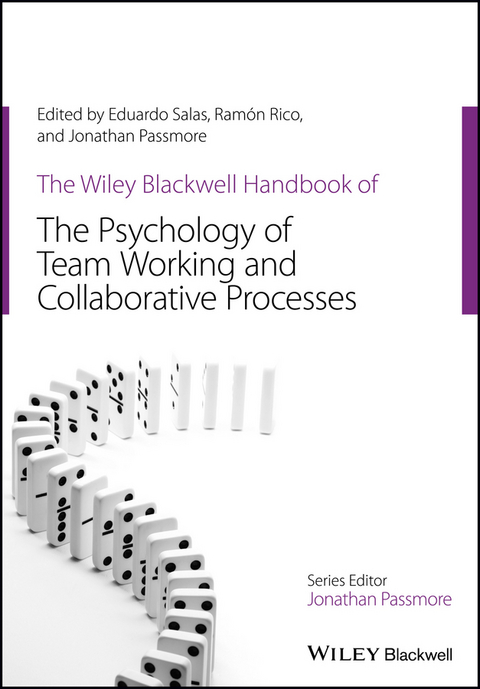
The Wiley Blackwell Handbook of the Psychology of Team Working and Collaborative Processes (eBook)
John Wiley & Sons (Verlag)
978-1-118-90998-0 (ISBN)
A state-of-the-art psychological perspective on team working and collaborative organizational processes...
This handbook makes a unique contribution to organizational psychology and HRM by providing comprehensive international coverage of the contemporary field of team working and collaborative organizational processes. It provides critical reviews of key topics related to teams including design, diversity, leadership, trust processes and performance measurement, drawing on the work of leading thinkers including Linda Argote, Neal Ashkanasy, Robert Kraut, Floor Rink and Daan van Knippenberg.
Eduardo Salas is Trustee Chair and Professor of Psychology at the University of Central Florida, USA. He also holds an appointment as Program Director for Human Systems Integration at the university's Institute for Simulation and Training. He has co-authored over three hundred publications in articles and chapters, has co-edited 15 books and is a Past Editor of the SIOP Professional Practice Series.
Ramon Rico is Professor of Organizational Behavior at the Autonomous University of Madrid, Spain. He is Editor of the European Journal of Work and Organizational Psychology. His research interests include shared cognition, team diversity, and team and multi-team systems processes and effectiveness.
Jonathan Passmore is Managing Director of Embrion, a business psychology consultancy, Professor of Psychology at the University of Évora, Portugal, a Chartered Occupational Psychologist, and Series Editor of the Wiley-Blackwell Handbooks of Organizational Psychology.
Neal Ashkanasy is Professor of Management at the University of Queensland Business School. He was the first Australian to become a Fellow of SIOP, and is a Past President of the Australia and New Zealand Academy of Management. He is Editor-in-Chief of the Journal of Organizational Behavior, Associate Editor for the Academy of Management Review, and Series Editor for Research on Emotion in Organizations.
A state-of-the-art psychological perspective on team working and collaborative organizational processes This handbook makes a unique contribution to organizational psychology and HRM by providing comprehensive international coverage of the contemporary field of team working and collaborative organizational processes. It provides critical reviews of key topics related to teams including design, diversity, leadership, trust processes and performance measurement, drawing on the work of leading thinkers including Linda Argote, Neal Ashkanasy, Robert Kraut, Floor Rink and Daan van Knippenberg.
Jonathan Passmore (Series Editor) is the Professor of Coaching and Behavioural Change at Henley Business School, University of Reading and a professor of psychology at the University of Evora, Portugal. He is a chartered psychologist, holds five degrees, and has an international reputation for his work in coaching and leadership, including being listed by Thinkers50 as one of the top 10 coaches in the world. He has published widely books on the themes of leadership, personal development and change, and served as editor for the Association for Coaching book series. He speaks widely at conferences across the world and has published over 100 journal papers and book chapters. Eduardo Salas is Allyn R. & Gladys M. Cline Professor and Chair of the Department of Psychological Sciences at Rice University. Dr. Salas' research interests are in uncovering what facilitates teamwork and team effectiveness in organizations; how and why does team training work; how to optimize simulation-based training; how to create a culture of safety; how to design, implement and evaluate training & development systems and in generating evidence-based guidance for those in practice. He has co-authored over 450 journal articles and book chapters, has co-edited 35 books an authored a book on team training. Ramón Rico is an associate professor of Management and Organizations at the University of Western Australia (Australia). His expertise interlocks organizational behavior, social psychology and team science. His research currently focuses on the role of team cognition and team coordination processes on both, team and leadership adaptation; team diversity management; and the coordinative and motivational bases of effective multiteam systems.
About the Editors vii
About the Contributors ix
Foreword xvii
Series Preface xix
Supported Charity: Railway Children xxi
Introduction 1
1 The Psychology of Teamwork and Collaborative Processes 3
Eduardo Salas, Ramón Rico, and Jonathan Passmore
Part I Overview of Team Effectiveness 13
2 Factors that Influence Teamwork 15
Julie V. Dinh and Eduardo Salas
3 Team Performance in Knowledge Work 43
Daniel J. Slyngstad, Gia DeMichele, and Maritza R. Salazar
4 Transnational Team Effectiveness 73
Dana Verhoeven, Tiffany Cooper, Michelle Flynn, and Marissa L. Shuffler
Part II Antecedents to Team Effectiveness 103
5 Team Design 105
John L. Cordery and Amy W. Tian
6 Team Composition 129
Mikhail A. Wolfson and John E. Mathieu
7 Team Diversity 151
Bertolt Meyer
8 Change in Organizational Work Teams 177
Floor Rink, Aimée A. Kane, Naomi Ellemers, and Gerben van der Vegt
9 Status Effects on Teams 195
Kun Luan, Qiong-Jing Hu, and Xiao-Yun Xie
10 Cross-Cultural Teams 219
Ningyu Tang and Yumei Wang
Part III Team Effectiveness: Processes, Emerging States and Mediators 243
11 Teamwork Processes and Emergent States 245
Rebecca Grossman, Sarit B. Friedman, and Suman Kalra
12 Team Decision Making 271
Tom W. Reader
13 Teamwork under Stress 297
Aaron S. Dietz, James E. Driskell, Mary Jane Sierra, Sallie J. Weaver, Tripp Driskell, and Eduardo Salas
14 Conflict in Teams 317
Lindred L. Greer and Jennifer E. Dannals
15 Team Leadership 345
Daan van Knippenberg
16 Team Cognition: Team Mental Models and Situation Awareness 369
Susan Mohammed, Katherine Hamilton, Miriam Sánchez-Manzanares, and Ramón Rico
17 Team Trust 393
Ana Cristina Costa, and Neil Anderson
18 Psychological Contracts in Teams 417
Carlos-María Alcover, Ramón Rico, William H. Turnley, and Mark C. Bolino
19 Affect and Creativity in Work Teams 441
March L. To, Neal M. Ashkanasy, and Cynthia D. Fisher
20 Team Reflexivity and Innovation 459
Michaéla C. Schippers, Michael A. West, and Amy C. Edmondson
Part IV Team Effectiveness Tools and Outputs 479
21 Team Performance Measurement 481
Michael A. Rosen and Aaron S. Dietz
22 Developing and Managing Teams 503
Charles P. R. Scott and Jessica L. Wildman
23 Team Performance in Extreme Environments 531
William B. Vessey and Lauren B. Landon
24 Team Development Interventions 555
Deborah DiazGranados, Marissa L. Shuffler, Jesse A. Wingate, and Eduardo Salas
Part V The Future of Teams 587
25 The Future of Teams 589
Michael A. West
Index 597
About the Contributors
Carlos‐María Alcover, Ph.D. Carlos is a Professor of Social and Organizational Psychology at the Universidad Rey Juan Carlos, Madrid, Spain. He received his Ph.D. in social psychology from the Complutense University of Madrid. His research has focused on early retirement and psychological wellbeing, bridge employment, psychological contract and exchange relationships in organizations, and membership and temporal matters in work teams.
Neil Anderson, Ph.D. Neil is Professor of Human Resource Management and Research Director (HRM‐OB Group) at Brunel Business School, Brunel University London, U.K. His major research interests are in the areas of applicant reactions, employee selection, creativity and innovation at work, and science–practice relations.
Neal M. Ashkanasy, Ph.D. Neal is Professor of Management at the University of Queensland, Australia with research interests in ethical behavior, leadership, culture, and emotions. He is a past editor‐in‐chief of the Journal of Organizational Behavior. Professor Ashkanasy is a Fellow of the Society for Industrial and Organizational Psychology.
Mark C. Bolino, Ph.D. Mark is a Professor of Management and the Michael F. Price Chair in International Business in the Price College of Business at the University of Oklahoma. He received his Ph.D. from the University of South Carolina. His research interests include organizational citizenship behavior, impression management, global careers, and psychological contracts.
Tiffany Cooper Tiffany is a Ph.D. student in industrial and organizational psychology at Clemson University. Her current research interests revolve around the automated assistance of team behaviors through the use of physiological measures. Specifically, she is interested in automating the assessment of workload within teams to create more effective mutual monitoring and backup behaviors in working units.
John L. Cordery, Ph.D. John is the Provost and Senior Deputy Vice‐Chancellor at Curtin University. His primary research interests relate to work design and how it affects employee behavior and wellbeing, and the ways in which collaborative structures, such as teams and communities of practice, function in organizations.
Ana Cristina Costa Ana Cristina is Senior Lecturer Human Resource Management and Organizational Behavior at Brunel Business School, Brunel University, London, U.K. Her major research interests include trust in organizations, innovation and psychological wellbeing, applicant reactions, and employee turnover.
Jennifer E. Dannals Jennifer is a doctoral candidate at Stanford University’s Graduate School of Business. Her research is focused on how individuals use distributions of group behavior to infer the social norm. Other current research projects include: the role of uncertainty in influencing cooperative and competitive decisions; examining the market effects of diversity announcements from Google and other tech firms; and the effects of role differentiation on team coordination, perceptions of equality, and team performance in startup teams.
Gia DeMichele Gia is a doctoral candidate at Claremont Graduate University’s (CGU) Division of Behavioral and Organizational Sciences. She received an MA degree in positive organizational psychology from CGU. Her research is oriented around communication on complex teams in high‐risk environments.
Deborah DiazGranados, Ph.D. Deborah is an Assistant Professor at Virginia Commonwealth University, School of Medicine. She earned her Ph.D. in industrial/organizational psychology from the University of Central Florida. Her research is focused on understanding the influence of teamwork and leadership processes on individual and team‐level outcomes. Dr. DiazGranados has developed curriculum that focuses on developing team and leadership competencies and skills within the healthcare context. Dr. DiazGranados’ research also considers the influence of context on how teams function and leaders lead.
Aaron S. Dietz, Ph.D. Aaron is a human factors psychologist and faculty at the Johns Hopkins University School of Medicine with dual appointments in the Armstrong Institute for Patient Safety and Quality and Department of Anesthesiology and Critical Care Medicine.
Julie V. Dinh Julie is a doctoral student in industrial/organizational psychology at Rice University. After graduating with highest honors in psychology at the University of California, Berkeley, she conducted research in health and clinical behavioral sciences. She is a Graduate Research Fellow of the National Science Foundation.
James E. Driskell, Ph.D. James is the president and a senior scientist at Florida Maxima Corporation in Winter Park, Florida. He received his Ph.D. from the University of South Carolina in 1981.
Tripp Driskell, Ph.D. Tripp is a research scientist at Florida Maxima Corporation. He received his Ph.D. in applied experimental and human factors psychology from the University of Central Florida.
Amy C. Edmondson, Ph.D. Amy is Novartis Professor of Leadership and Management at Harvard University. She studies the social psychology of learning in organizations; her book, Teaming: How Organizations Learn, Innovate, and Compete in the Knowledge Economy, explores teamwork as a dynamic flexible process. Edmondson received her Ph.D. in organizational behavior from Harvard.
Naomi Ellemers, Ph.D. Naomi studied at the University of California at Berkeley, and the University of Groningen, the Netherlands, where she obtained her Ph.D. in 1991. She holds a chair as Distinguished University Professor at Utrecht University, the Netherlands. She also is member of the Supervisory Board of the consultancy and accounting firm PWC in the Netherlands.
Cynthia D. Fisher, Ph.D. Cynthia is Professor of Management at Bond Business School, Bond University, Australia. She writes on moods and emotions at work and employee attitudes and work behavior. Professor Fisher is a Fellow of the Society for Industrial and Organizational Psychology.
Michelle Flynn Michelle graduated from Clemson University with a degree in psychology and a minor in business administration. Her main research interests include leadership and team development, cross‐cultural teams, and organizational culture.
Sarit B. Friedman Sarit is a doctoral student in Hofstra University’s Applied Organizational Psychology program. Her research interests include teams, group dynamics, and conflict management. She obtained her M.A. in social organizational psychology at Teachers College, Columbia University, where she was also certified in conflict resolution and mediation at the Morton Deutsch ICCCR.
Lindred L. Greer, Ph.D. Lindred is Assistant Professor of Organizational Behavior at Stanford University. Her work focuses on the impact of team composition on intragroup conflict and team performance. She has a particular interest in how teams, especially early stage startup teams, are composed in terms of power, status, and leadership structures, and when and why particular forms of team composition may fuel power struggles and conflicts. Her research appears in academic journals such as the Journal of Applied Psychology, Organizational Behavior and Human Decision Processes, and Science.
Rebecca Grossman, Ph.D. Rebecca is an Assistant Professor of Industrial/Organizational Psychology at Hofstra University. Her research focuses on teams (team processes and emergent states, team diversity, measurement of team constructs), training (individual and team training, transfer of training, instructional features), and complex settings (multicultural, virtual, and/or distributed teams, extreme and/or high‐risk environments, multiteam systems).
Katherine Hamilton, Ph.D. Katherine is a lecturer in the College of Information Sciences and Technology at Penn State University. She received her Ph.D. in industrial/organizational psychology from Penn State in 2009. Her research focuses on how to improve team effectiveness, particularly as it relates to team cognition, team conflict, and team virtuality.
Qiong‐Jing Hu Qiong‐Jing Hu is a doctoral candidate at Guanghua School of Management, Peking University, China. His research interest is focused on organizational proactive behavior (e.g., voice), status and power, and ethical leadership.
Suman Kalra Suman is a Ph.D. student in the Applied Organizational Psychology program at Hofstra University. Previously, she was a training consultant, specializing in experiential learning workshops and interventions on areas like team building, leadership, and interpersonal skills. Her research interests include role negotiation and power dynamics and their impact on decision making in complex team structures.
Aimée A. Kane Aimée A. Kane is an Associate Professor of Management in at the Palumbo‐Donahue School of Business at Duquesne University, Pittsburgh, PA. She holds a Ph.D. and a M.S. in organizational behavior and theory from the Tepper School of Business at Carnegie Mellon University, Pittsburgh. Her research has been published in leading academic journals such as the Academy of Management Annals, Organization Science, and Organizational Studies. She currently serves on the editorial board of...
| Erscheint lt. Verlag | 14.3.2017 |
|---|---|
| Reihe/Serie | Wiley-Blackwell Handbooks in Organizational Psychology |
| Wiley-Blackwell Handbooks in Organizational Psychology | Wiley-Blackwell Handbooks in Organizational Psychology |
| Sprache | englisch |
| Themenwelt | Geisteswissenschaften ► Psychologie ► Arbeits- und Organisationspsychologie |
| Medizin / Pharmazie ► Medizinische Fachgebiete ► Psychiatrie / Psychotherapie | |
| Wirtschaft ► Betriebswirtschaft / Management ► Unternehmensführung / Management | |
| Schlagworte | Arbeitspsychologie • Business & Management • Management • Management f. Teams • Management / Teams • Organizational & Industrial Psychology • Psychologie • Psychologie i. d. Arbeitswelt • Psychology • Teamwork • Training & Human Resource Development / Teams • Training u. Personalentwicklung / Teamarbeit • Wirtschaft u. Management |
| ISBN-10 | 1-118-90998-4 / 1118909984 |
| ISBN-13 | 978-1-118-90998-0 / 9781118909980 |
| Informationen gemäß Produktsicherheitsverordnung (GPSR) | |
| Haben Sie eine Frage zum Produkt? |
 EPUB (Adobe DRM)
Kopierschutz: Adobe-DRM
Adobe-DRM ist ein Kopierschutz, der das eBook vor Mißbrauch schützen soll. Dabei wird das eBook bereits beim Download auf Ihre persönliche Adobe-ID autorisiert. Lesen können Sie das eBook dann nur auf den Geräten, welche ebenfalls auf Ihre Adobe-ID registriert sind.
Details zum Adobe-DRM
Dateiformat: EPUB (Electronic Publication)
EPUB ist ein offener Standard für eBooks und eignet sich besonders zur Darstellung von Belletristik und Sachbüchern. Der Fließtext wird dynamisch an die Display- und Schriftgröße angepasst. Auch für mobile Lesegeräte ist EPUB daher gut geeignet.
Systemvoraussetzungen:
PC/Mac: Mit einem PC oder Mac können Sie dieses eBook lesen. Sie benötigen eine
eReader: Dieses eBook kann mit (fast) allen eBook-Readern gelesen werden. Mit dem amazon-Kindle ist es aber nicht kompatibel.
Smartphone/Tablet: Egal ob Apple oder Android, dieses eBook können Sie lesen. Sie benötigen eine
Geräteliste und zusätzliche Hinweise
Buying eBooks from abroad
For tax law reasons we can sell eBooks just within Germany and Switzerland. Regrettably we cannot fulfill eBook-orders from other countries.
aus dem Bereich