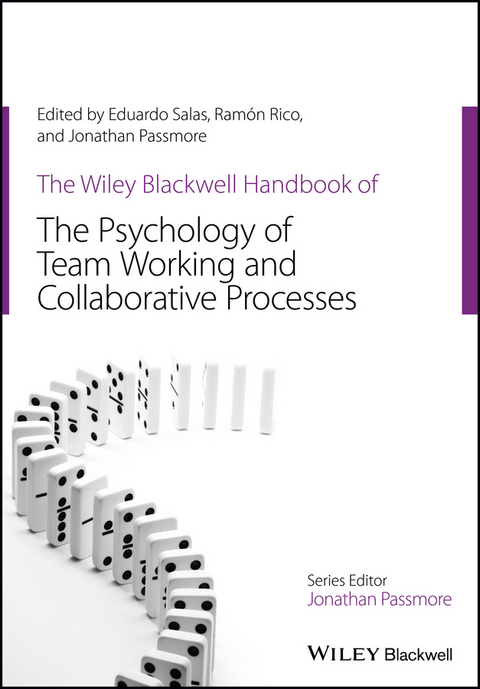
The Wiley Blackwell Handbook of the Psychology of Team Working and Collaborative Processes (eBook)
John Wiley & Sons (Verlag)
978-1-118-90997-3 (ISBN)
A state-of-the-art psychological perspective on team working and collaborative organizational processes This handbook makes a unique contribution to organizational psychology and HRM by providing comprehensive international coverage of the contemporary field of team working and collaborative organizational processes. It provides critical reviews of key topics related to teams including design, diversity, leadership, trust processes and performance measurement, drawing on the work of leading thinkers including Linda Argote, Neal Ashkanasy, Robert Kraut, Floor Rink and Daan van Knippenberg.
Jonathan Passmore (Series Editor) is the Professor of Coaching and Behavioural Change at Henley Business School, University of Reading and a professor of psychology at the University of Evora, Portugal. He is a chartered psychologist, holds five degrees, and has an international reputation for his work in coaching and leadership, including being listed by Thinkers50 as one of the top 10 coaches in the world. He has published widely books on the themes of leadership, personal development and change, and served as editor for the Association for Coaching book series. He speaks widely at conferences across the world and has published over 100 journal papers and book chapters.
Eduardo Salas is Allyn R. & Gladys M. Cline Professor and Chair of the Department of Psychological Sciences at Rice University. Dr. Salas' research interests are in uncovering what facilitates teamwork and team effectiveness in organizations; how and why does team training work; how to optimize simulation-based training; how to create a culture of safety; how to design, implement and evaluate training & development systems and in generating evidence-based guidance for those in practice. He has co-authored over 450 journal articles and book chapters, has co-edited 35 books an authored a book on team training.
Ramón Rico is an associate professor of Management and Organizations at the University of Western Australia (Australia). His expertise interlocks organizational behavior, social psychology and team science. His research currently focuses on the role of team cognition and team coordination processes on both, team and leadership adaptation; team diversity management; and the coordinative and motivational bases of effective multiteam systems.
A state-of-the-art psychological perspective on team working and collaborative organizational processes This handbook makes a unique contribution to organizational psychology and HRM by providing comprehensive international coverage of the contemporary field of team working and collaborative organizational processes. It provides critical reviews of key topics related to teams including design, diversity, leadership, trust processes and performance measurement, drawing on the work of leading thinkers including Linda Argote, Neal Ashkanasy, Robert Kraut, Floor Rink and Daan van Knippenberg.
Jonathan Passmore (Series Editor) is the Professor of Coaching and Behavioural Change at Henley Business School, University of Reading and a professor of psychology at the University of Evora, Portugal. He is a chartered psychologist, holds five degrees, and has an international reputation for his work in coaching and leadership, including being listed by Thinkers50 as one of the top 10 coaches in the world. He has published widely books on the themes of leadership, personal development and change, and served as editor for the Association for Coaching book series. He speaks widely at conferences across the world and has published over 100 journal papers and book chapters. Eduardo Salas is Allyn R. & Gladys M. Cline Professor and Chair of the Department of Psychological Sciences at Rice University. Dr. Salas' research interests are in uncovering what facilitates teamwork and team effectiveness in organizations; how and why does team training work; how to optimize simulation-based training; how to create a culture of safety; how to design, implement and evaluate training & development systems and in generating evidence-based guidance for those in practice. He has co-authored over 450 journal articles and book chapters, has co-edited 35 books an authored a book on team training. Ramón Rico is an associate professor of Management and Organizations at the University of Western Australia (Australia). His expertise interlocks organizational behavior, social psychology and team science. His research currently focuses on the role of team cognition and team coordination processes on both, team and leadership adaptation; team diversity management; and the coordinative and motivational bases of effective multiteam systems.
Title Page 5
Copyright Page 6
Contents 7
About the Editors 9
About the Contributors 11
Foreword 19
Series Preface 21
Supported Charity: Railway Children 23
Introduction 25
Chapter 1 The Psychology of Teamwork and Collaborative Processes 27
Introduction 27
What Are Teams? 27
The Developing Research Agenda for Teamwork 28
Conclusion 34
References 34
Part I Overview of Team Effectiveness 37
Chapter 2 Factors that Influence Teamwork 39
Introduction 39
Defining Teamwork 39
Critical Considerations 40
Evaluation 55
Future Research 56
Conclusion 56
Acknowledgements 56
References 57
Chapter 3 Team Performance in Knowledge Work 67
Introduction 67
Contemporary Teamwork 67
Past and Present Conceptualizations of Performance: A Brief Overview 69
A Flexible Definition: Performance as Functional Utility 71
Higher-Order Dimensions of Team Functional Utility 74
An Integrated Framework for Team Effectiveness in Knowledge Work 81
Future Research 85
Conclusion 86
References 86
Chapter 4 Transnational Team Effectiveness 97
Introduction 97
International Perspective and Cultural Constructs 98
Input–Process–Output vs. Input–Mediator–Output 99
Inputs to Team Effectiveness 105
Mediators/Processes of Team Effectiveness 110
Outputs of Team Effectiveness 114
Comprehensive Models of Team Effectiveness for the Future 116
Future Research 118
Conclusion 119
References 120
Part II Antecedents to Team Effectiveness 127
Chapter 5 Team Design 129
Introduction 129
What is Team Design? 130
Constituting the Team 130
Boundaries 130
Shared Purpose 131
Stability 132
Composition 133
Structuring the Team 133
Activity Structure 134
Authority Structure 136
Creating a Supportive Context 139
Team Micro-Context 139
Organization Macro-Context 141
Environmental Context 142
Future Research 144
Conclusion 145
References 145
Chapter 6 Team Composition 153
Introduction 153
Teams and Team Types 153
Team Composition 154
Networks: A Bridge across Typologies, Roles, Positions, and Team Types 160
Network Measures as Related to Team Composition 163
Networks and Team Composition Moving Forward 167
Future Research 169
Conclusion 170
References 170
Chapter 7 Team Diversity 175
Introduction 175
Consequences of Team Diversity 176
The Bi-theoretical Approach to Team Diversity 177
Attributing Different Effects to Different Types of Diversity 179
Diversity Perceptions 180
The Contingency Approach to Team Diversity: The Categorization–Elaboration Model 182
Faultlines and Subgroups 185
Multilevel and Status?based Approaches to Team Diversity 189
Future Research 192
Conclusion 193
References 194
Chapter 8 Change in Organizational Work Teams 201
Introduction 201
Team Receptivity 202
Future Research 210
Conclusion 213
Acknowledgments 214
References 214
Chapter 9 Status Effects on Teams 219
Introduction 219
Definition of Status 220
Status Effects on Teams 221
Future Research 228
Conclusion 235
Acknowledgement 235
References 235
Chapter 10 Cross-Cultural Teams 243
Introduction 243
Cross-Cultural Teams 244
The IPO Framework and Cross?Cultural Team Effectiveness 245
Team Outputs 245
Team Processes 251
Team Inputs 255
Input–Output and Input–Process Relationships 257
Input–Process–Outcome Relationships 258
Limitations 258
Future Research 259
Conclusion 261
Acknowledgements 261
References 261
Part III Team Effectiveness: Processes, Emerging States and Mediators 267
Chapter 11 Teamwork Processes and Emergent States 269
Introduction 269
Defining the Basics 270
Team Processes and Emergent States: The ABCs 271
Future Research 284
Conclusion 287
References 288
Chapter 12 Team Decision Making 295
Introduction 295
Group Processes and Team Decision Making 296
Teamwork and Team Decision Making 301
Interventions for Improving Team Decision Making 308
Future Research 311
Conclusions 312
References 313
Chapter 13 Teamwork under Stress 321
Introduction 321
Understanding Teamwork under Stress 321
Teams in Extreme Environments 325
Optimizing Teamwork under Stress 327
Measuring Team-Level Stress 332
Future Research 333
Conclusion 334
Acknowledgement 334
References 334
Chapter 14 Conflict in Teams 341
Introduction 341
Intragroup Conflict 342
Task Conflict 343
Relationship Conflict 346
Process Conflict 349
Status Conflict 351
Alternative Perspectives on the Study of Intragroup Conflict 353
Future Research 359
Conclusion 360
References 361
Chapter 15 Team Leadership 369
Introduction 369
Teams and Leadership Effectiveness: Setting the Stage 370
Generic Approaches to Team Leadership 372
Team-Specific Approaches to Team Leadership 380
Future Research 383
Conclusion 384
References 385
Chapter 16 Team Cognition: Team Mental Models and Situation Awareness 393
Introduction 393
The Importance and Maturation of Team Cognition 394
Team Mental Models 394
Team Situation Awareness 399
Integration of Team Mental Models and Situation Awareness 403
Future Research 406
Conclusion 407
References 407
Chapter 17 Team Trust 417
Introduction 417
Conceptual Issues and Clarification 418
Team Trust: Similarities and Distinctions with Interpersonal Trust 419
Team Trust: A Multilevel Perspective 420
Multilevel Antecedents of Team Trust 421
Multi-Level Outcomes of Team Trust 430
Future Research 431
Conclusion 432
Acknowledgments 432
References 433
Chapter 18 Psychological Contracts in Teams 441
Introduction 441
Multiple Foci Social Exchange Relationships and Psychological Contracts 444
LMX and Psychological Contracts 446
Fairness, Peer Justice and Psychological Contracts 450
Social support in teams and psychological contracts 452
Future Research 454
Conclusion 456
References 456
Chapter 19 Affect and Creativity in Work Teams 465
Introduction 465
Affect and Individual Creativity 466
Affect and Creativity in Teams 468
Positive GAT and Team Creativity 468
Applying Individual-Level Effects to Multiple Levels 470
Affect and Creativity in Teams as a Dynamic Process 474
Future Research 475
Conclusions 477
Acknowledgement 477
References 478
Chapter 20 Team Reflexivity and Innovation 483
Introduction 483
Team Reflexivity 484
A Model of Team Reflexivity 487
Moderators 493
Implications for Practice 495
Future Research 496
Conclusion 497
References 497
Part IV Team Effectiveness Tools and Outputs 503
Chapter 21 Team Performance Measurement 505
Introduction 505
The Science of Teams and Performance Measurement 506
Requirements for Team Performance Measurement System Design 509
Emerging Methods of Unobtrusive Team Performance Measurement 516
Strategies for Team Performance Measurement 518
Future Research 521
Conclusion 522
References 522
Chapter 22 Developing and Managing Teams 527
Introduction 527
Developing and Managing Teams 528
Team Outcomes 529
Team Mediators 529
Inputs 537
Future Research 544
Conclusion 544
References 545
Chapter 23 Team Performance in Extreme Environments 555
Introduction 555
Team Composition 556
Cohesion and Conflict 559
Leadership 563
Communication 568
Future Research 571
Conclusion 572
References 573
Chapter 24 Team Development Interventions 579
Introduction 579
The Changing Nature of Teams 580
Team Development Interventions 582
Future Research 596
Conclusion 599
Acknowledgement of Funding Support 599
References 599
Part V The Future of Teams 611
Chapter 25 The Future of Teams 613
Introduction 613
Interconnectedness, Belonging and Compassion 613
Interconnectedness in a Digital World 614
Interconnectedness and Diversity 615
Interconnectedness Within and Across Organizations 615
Languishing or Flourishing Through Interconnection 616
Interconnection Promoting Belonging 617
Compassionate Cultures Sustain Interconnectedness 618
Conclusion 619
References 619
Index 621
EULA 640
| Erscheint lt. Verlag | 13.3.2017 |
|---|---|
| Reihe/Serie | Wiley-Blackwell Handbooks in Organizational Psychology | Wiley-Blackwell Handbooks in Organizational Psychology |
| Sprache | englisch |
| Themenwelt | Geisteswissenschaften ► Psychologie ► Arbeits- und Organisationspsychologie |
| Medizin / Pharmazie ► Medizinische Fachgebiete ► Psychiatrie / Psychotherapie | |
| Wirtschaft ► Betriebswirtschaft / Management ► Unternehmensführung / Management | |
| Schlagworte | Arbeitspsychologie • Business & Management • Management • Management f. Teams • Management / Teams • Organizational & Industrial Psychology • Psychologie • Psychologie i. d. Arbeitswelt • Psychology • Teamwork • Training & Human Resource Development / Teams • Training u. Personalentwicklung / Teamarbeit • Wirtschaft u. Management |
| ISBN-10 | 1-118-90997-6 / 1118909976 |
| ISBN-13 | 978-1-118-90997-3 / 9781118909973 |
| Informationen gemäß Produktsicherheitsverordnung (GPSR) | |
| Haben Sie eine Frage zum Produkt? |
 PDF (Adobe DRM)
Kopierschutz: Adobe-DRM
Adobe-DRM ist ein Kopierschutz, der das eBook vor Mißbrauch schützen soll. Dabei wird das eBook bereits beim Download auf Ihre persönliche Adobe-ID autorisiert. Lesen können Sie das eBook dann nur auf den Geräten, welche ebenfalls auf Ihre Adobe-ID registriert sind.
Details zum Adobe-DRM
Dateiformat: PDF (Portable Document Format)
Mit einem festen Seitenlayout eignet sich die PDF besonders für Fachbücher mit Spalten, Tabellen und Abbildungen. Eine PDF kann auf fast allen Geräten angezeigt werden, ist aber für kleine Displays (Smartphone, eReader) nur eingeschränkt geeignet.
Systemvoraussetzungen:
PC/Mac: Mit einem PC oder Mac können Sie dieses eBook lesen. Sie benötigen eine
eReader: Dieses eBook kann mit (fast) allen eBook-Readern gelesen werden. Mit dem amazon-Kindle ist es aber nicht kompatibel.
Smartphone/Tablet: Egal ob Apple oder Android, dieses eBook können Sie lesen. Sie benötigen eine
Geräteliste und zusätzliche Hinweise
Buying eBooks from abroad
For tax law reasons we can sell eBooks just within Germany and Switzerland. Regrettably we cannot fulfill eBook-orders from other countries.
aus dem Bereich